Japandi Style Guide: Palette, Materials, Furniture, Rooms
AI Flip Room · 10 min read
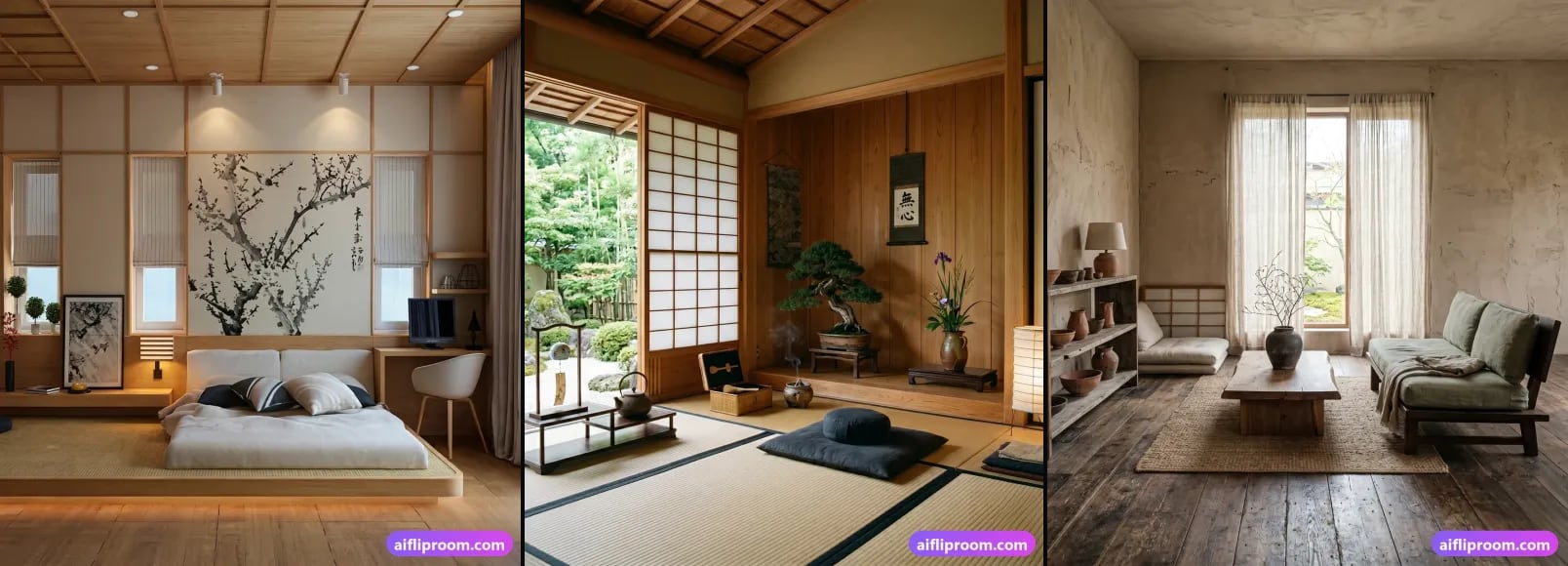
Two design traditions on opposite sides of the planet want the same things: fewer objects, better ones, and rooms that let you breathe. Japandi is what happens when Japanese restraint and Scandinavian comfort are pulled into one quiet room. People keep asking for it for a simple reason: it feels calm without feeling cold, and warm without feeling cluttered.
This guide covers what Japandi actually is, the two ideas underneath it, the palette and materials that make a room read as the real thing rather than as beige minimalism, the furniture that works, how the look changes from the living room to the home office, and the handful of mistakes that break it. Along the way it points to the room-by-room pages in our style library and, near the end, to how to see the style on a photograph of your own room before buying anything. We make that tool, AI Flip Room, so read that part with the interest in mind.
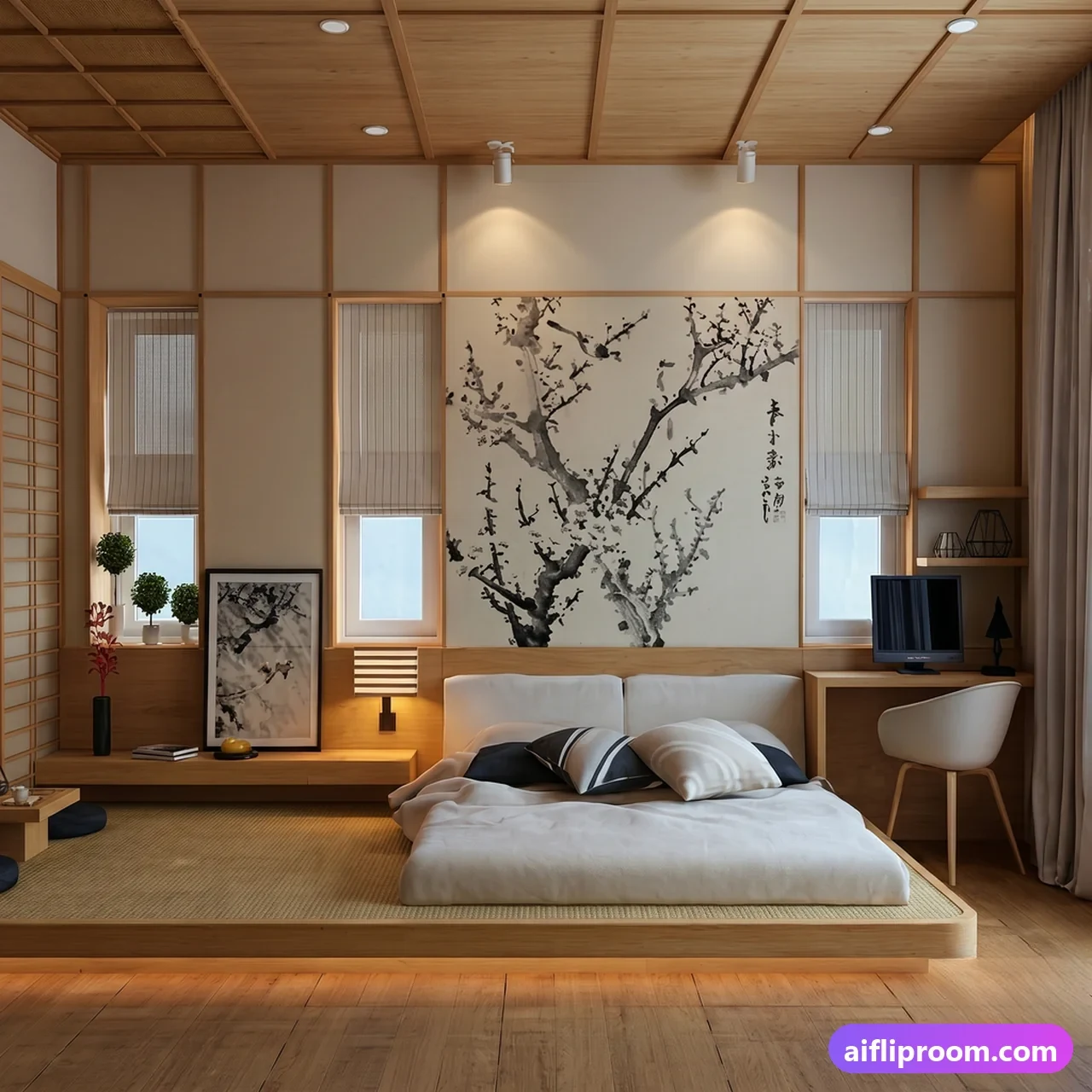
What is Japandi?
Japandi is a blend of Japanese and Scandinavian interior design: low, simply shaped furniture, natural materials left close to their raw state, a warm neutral palette with a few dark notes, and deliberate empty space. Japan supplies the restraint and the respect for imperfection; Scandinavia supplies the light, the softness and the everyday practicality.
The word is a portmanteau of Japan and Scandi, and it is recent — it spread through design writing during the 2010s as shorthand for a pairing people were already making. The affinity behind it is much older. The two traditions grew up far apart and arrived at strikingly similar answers: restraint over ornament, craftsmanship you can see, wood and fibre rather than plastic and gloss, rooms organised around light rather than around furniture. Mid-century Danish designers were openly interested in Japanese proportion and joinery, and the interest ran in both directions.
Where they differ is temperature. Japanese interiors lean darker, more sculptural and a little austere; Scandinavian interiors lean paler, softer and more playful. Japandi lives in the middle, and the balance is the whole point: the discipline of one keeps the other from tipping into cute, and the warmth of one keeps the other from feeling like a gallery.
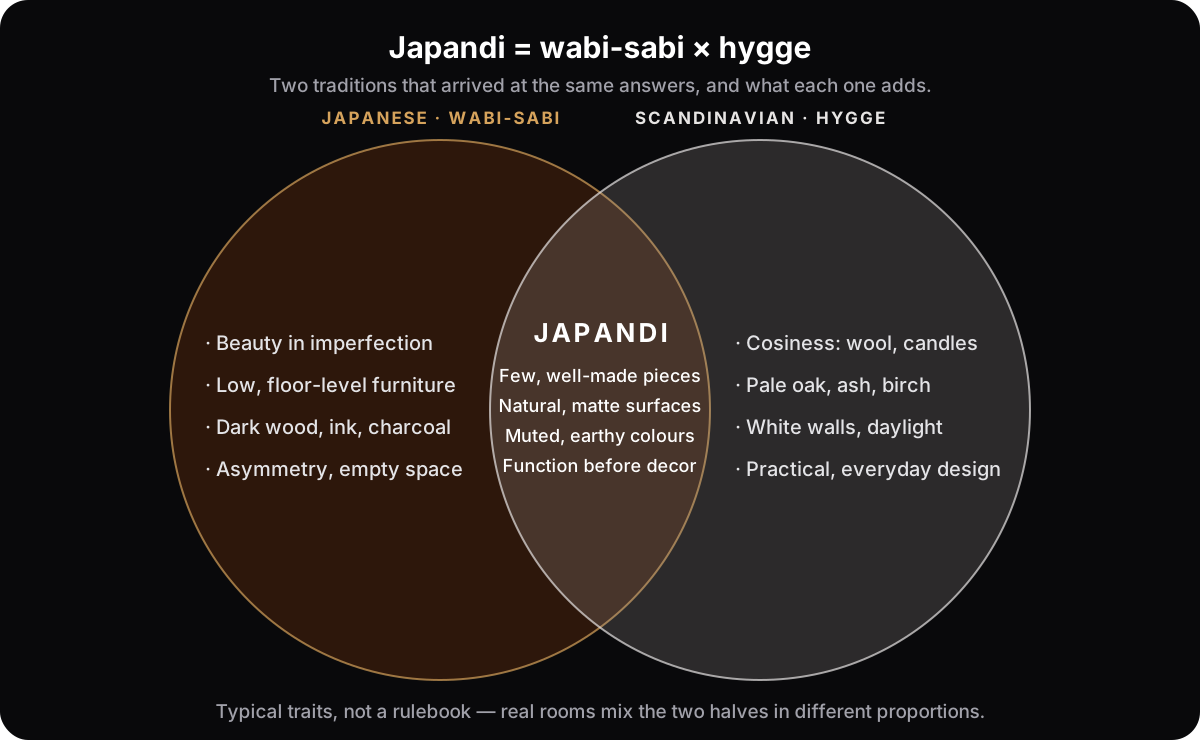
Wabi-sabi, the Japanese half
Wabi-sabi is the acceptance of imperfection and impermanence — beauty in things that are weathered, handmade, asymmetrical or quietly ageing. In a room that means a hand-thrown bowl with a slightly uneven rim, a table that shows its grain and a few honest marks, a linen throw that creases instead of staying crisp. Nothing tries to look factory-perfect. The imperfections are the point.
Hygge, the Scandinavian half
Hygge is the Danish word for cosy contentment — soft light, warm textiles and spaces built for slowing down. It is the reason a strictly pared-back room can still be somewhere you want to sit with a cup of tea. Hygge brings the wool throw, the candle and the reading corner. Put the two together and you get the Japandi promise: a room with very little in it that is nonetheless genuinely warm to be in.
What colours and materials define it?
A warm, low-contrast base — soft white, oatmeal, greige, unbleached linen — with a small amount of something genuinely dark for depth, and at most one earthy accent. Materials matter more than colour: pale oak and ash, walnut and blackened timber, linen, wool, paper, stoneware, rattan. Everything matte. Gloss, chrome and printed pattern sit outside the style.
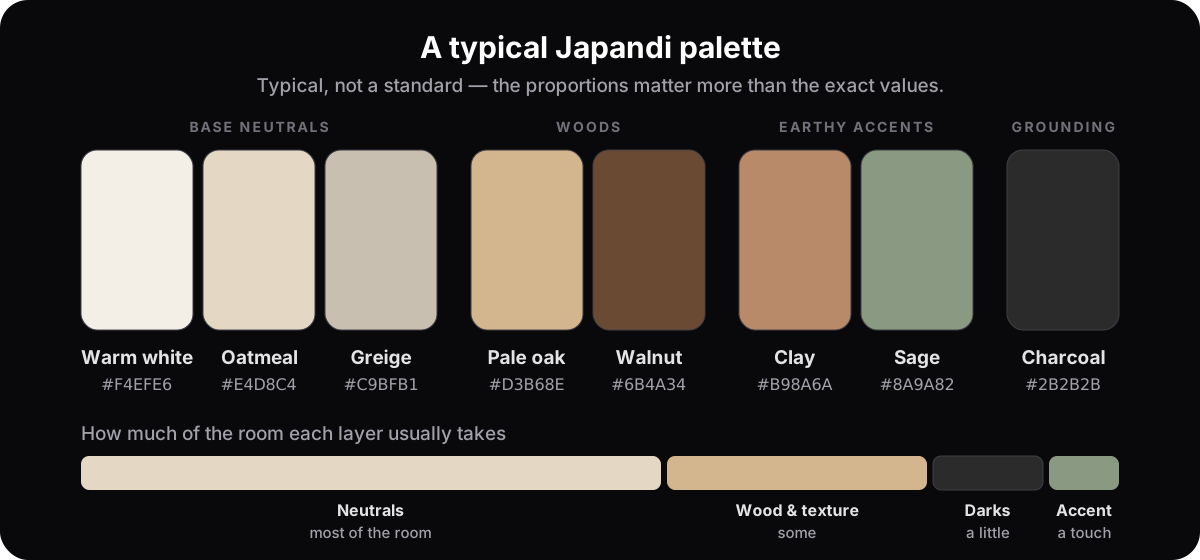
Build the palette in three layers, and keep the proportions roughly in the order shown above.
- Base neutrals — warm white, oatmeal, greige, soft taupe and pale plaster tones for walls, large upholstery and floors. This is most of the room.
- Woods and texture — pale oak, ash or maple for the Nordic half; walnut, charred or blackened timber for the Japanese half. Oiled or matte, never high-gloss.
- Darks and one accent — charcoal, ink, aged brass or blackened steel in a lamp base, a frame, a single chair; then one earthy note, if any — clay, terracotta, sage, moss or a muted indigo — in a cushion or a ceramic.
The Scandinavian half keeps the scheme from going too dark; the Japanese half keeps it from going sweet or pastel. If a colour looks dug out of the ground or steeped like tea, it probably belongs. Skip the dark layer altogether and you get the most common failure: a room that is beige rather than calm.
Because the colour range is so narrow, texture does the heavy lifting. A near-monochrome Japandi room stays interesting because it layers several natural materials against one another:
- Wood — light for lightness, dark for depth, often both in one room, bridged by a third material so they do not fight.
- Linen and cotton — relaxed, breathable, a little creased. Bedding, curtains, loose covers.
- Rattan, cane and bamboo — woven pieces that add craft without adding weight.
- Stone and clay — honed rather than polished stone; stoneware with a glaze that pools unevenly.
- Paper and wool — a paper or linen shade on every lamp; a chunky wool throw or a flat-weave rug.
The rule of thumb: mix warm with cool and smooth with rough, but keep every surface matte and organic. The whole look depends on materials that absorb light rather than bounce it, which is why a single lacquered table or a mirrored cabinet can undo a room.
Which furniture works?
Low, simply shaped pieces in solid wood and natural fibre: a platform bed, a sofa with a lower seat on slim legs, a coffee table with visible joinery, one sculptural chair that does not match the sofa, storage that closes, paper or linen lamps and a single plant. Fewer pieces, chosen with care, rather than a matched set.
A few things turn up again and again. A room does not need all of them, but it usually reads as Japandi thanks to some combination:
- Low-profile furniture. Platform beds, sofas with a seat height nearer 40 cm than 50, short-legged tables. Keeping the eye near the floor makes the ceiling read taller and the room larger.
- Clean silhouettes, softened by material. Straight lines, no carving or trim, with the warmth coming from grain and weave rather than from ornament.
- A deliberate mismatch. One Nordic sofa, one Japanese-inflected side table or chair. The style is a conversation between two traditions; a three-piece suite from one range has nobody to talk to.
- Storage that closes. A low sideboard, built-in cabinets, lidded baskets. Clear surfaces are not a styling choice here; they are the effect.
- Lighting with a shade. Paper lanterns, linen drums, a sculptural pendant — warm bulbs, several sources, ceiling light off in the evening. Lighting is the one place the style allows a little drama.
- A small, curated group of objects. A hand-thrown vessel, a wooden board, a branch in a tall vase. Three considered things beat thirty.
- One plant. An olive, a fiddle-leaf fig, a fern or a bare branch, rather than a jungle.
The mindset is curation, not accumulation. If you are arranging five objects on a shelf, the answer is one object and four empty spaces.
How does Japandi change room by room?
The principles hold everywhere — low, warm, matte, uncluttered — but each room has its own hinge. The living room turns on the visible floor, the bedroom on bed height, the kitchen on flat cabinetry, the bathroom on matte tile and warm metal, the home office on storage that closes. Each has its own page below.
Here is what the living-room version looks like on a real room rather than in a photo studio. The photograph is a genuinely empty living room; everything that arrived is furniture.
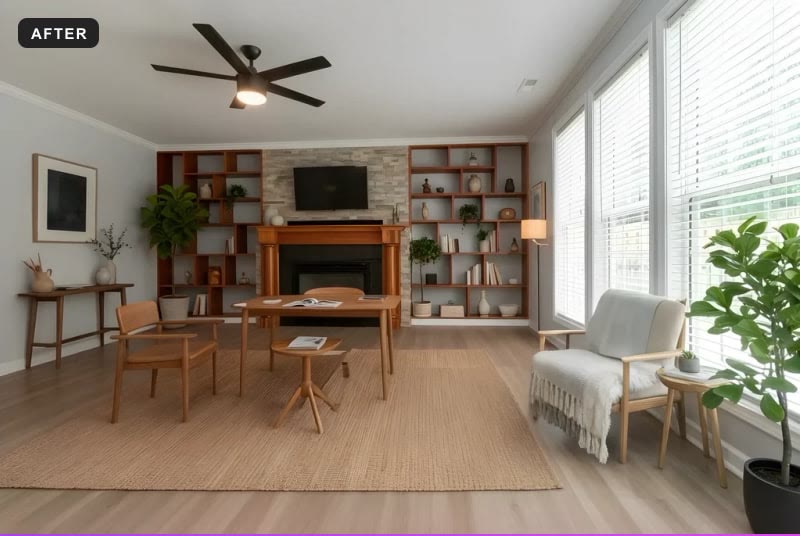
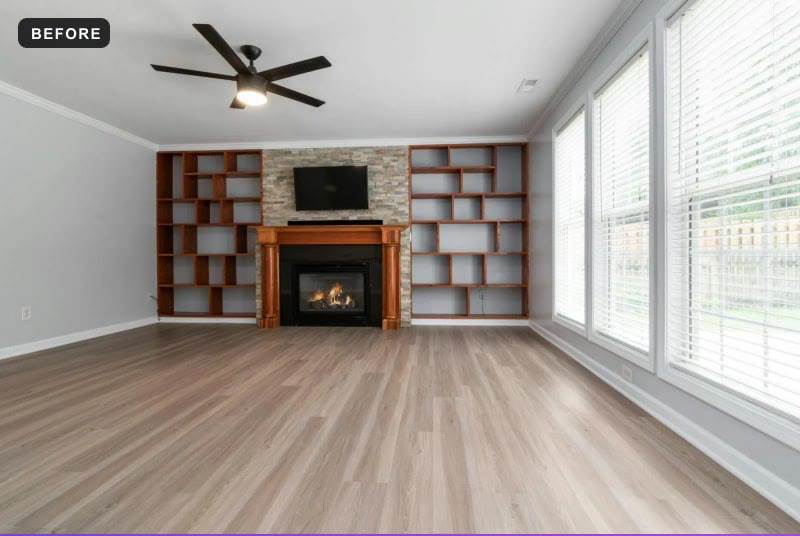
Notice what the render did not do. The fireplace, the built-in shelving, the two tall windows and the ceiling fan are where the photographer left them; the shelves were dressed rather than replaced; even the fire is off, which is a rendering choice rather than a change to the room. What changed is a light-wood table and chairs on a jute rug, a pale armchair with a throw by the window, a console with a few ceramics under one dark artwork, a paper floor lamp and two plants. That restraint is the style, and it is also what keeps a staged image honest if the photo ever goes into a listing.
What are the common mistakes?
Too much stuff; no dark note, so the neutrals go flat; cool clinical grey instead of warm neutrals; glossy or plastic finishes; a perfectly matched set; standard-height furniture in Japandi colours; and cold white bulbs. Most are the same mistake in different clothes: treating Japandi as a colour scheme when it is a discipline about what is left out.
| Do | Don't |
|---|---|
| Keep the floor visible: low seating on slim legs, one wall left bare | Fill every wall and surface — a gallery wall belongs to a different style |
| Warm neutrals plus one genuinely dark note: charcoal, ink, blackened wood | All beige, or cool clinical grey with nothing to push against |
| Matte, natural finishes: oiled wood, linen, stoneware, honed stone | Gloss lacquer, chrome, mirrored surfaces, printed pattern |
| Mix the two halves: a Nordic sofa with a Japanese-inflected side table | Buy one matched collection and call it done |
| Several warm lamps with shades, ceiling light off in the evening | One cool white bulb overhead |
| One plant and one object with no function | A jungle and a shelf of small things |
Two of these deserve a word more. The missing dark note is the one people do not notice they have made: the room is pleasant, and beige, and nobody can say why it does not look like the pictures. And the light is the one they notice least of all — the same room under warm bulbs and under cool ones reads as two different styles, and only one of them is this one.
How is Japandi different from Scandinavian and minimalist?
Scandinavian style is the paler, cosier cousin: white walls, pale wood, more textiles and more warmth, with less of the dark contrast and less of the empty space. Minimalism shares the restraint but not the warmth. Japandi sits between them — the Scandinavian palette pulled darker and quieter, the minimalist discipline made soft, handmade and lived in.
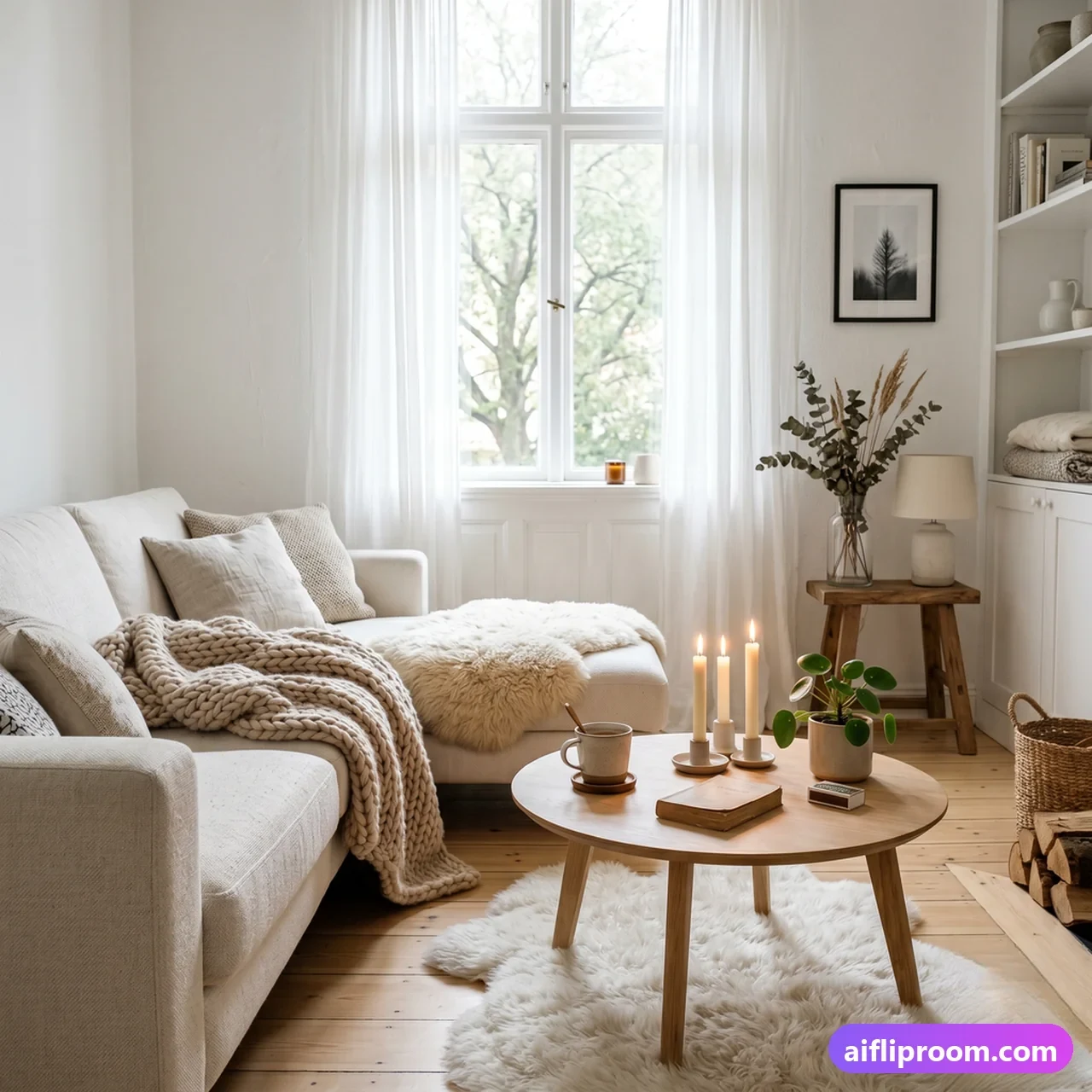
If your instinct is towards more light and more softness — sheepskin, candles, a chunky knit — you are probably a Scandinavian person rather than a Japandi one, and our Scandinavian interior design guide covers that look in the same depth. If your instinct is towards emptier and harder, look at minimalist. And if calm is exactly what you do not want, our cyberpunk room guide takes the same living room as this article in the opposite direction. The quickest way to find out is to try all three on the same photograph; the Scandinavian and Japandi pages each start a render in that style.
How do you try Japandi on your own room?
Photograph the room in daylight, upload it, choose Japandi, and look at the result on your phone while standing where you took the photo. The render keeps the walls, windows, ceiling height and camera angle and changes only the furnishings, so you are judging the style on your own room rather than on a magazine's.
You can build Japandi the slow way — one honest, well-made piece at a time, which is very much in the spirit of the style. But before committing money and weekends, it helps to see the palette and the layout on the room you actually have, because the same scheme reads differently under a north-facing window and a south-facing one.
That is what the generate page does. Upload a photo, pick Japandi, and in 15–60 seconds — depending on how much detail the room has — you get a realistic preview to react to; every account starts with three free renders and no card. Our guide on seeing your room in a new style before you buy anything covers how to get a preview you can actually decide from, and how to photograph a room covers the one photo it all starts from.
A few practical ways people use it:
- Homeowners test Japandi against their existing layout before buying furniture, then run Scandinavian and minimalist on the same photo to settle which of the three they actually want.
- Renters picture a calmer version of a space they cannot renovate.
- Agents and stagers present an empty or dated room as a serene, move-in-ready home; Japandi photographs well and offends nobody.
One note if the image might go into a listing: keep the change to the furnishings, leave the walls, windows and fixtures exactly as photographed, and say the image is virtually staged. The wording differs by market; our guide to virtual staging disclosure rules has the detail.
Japandi endures because it is less a trend than a temperament: buy less, choose better, leave room to breathe. Get those three things right and the style mostly takes care of itself.
Questions people ask about Japandi
Is Japandi the same as minimalism?+
No. Minimalism is about reduction — fewer things, less visual noise, often a hard-edged and quite cool result. Japandi shares the restraint but insists on warmth, texture and handmade imperfection. A minimalist room can be perfect and empty; a Japandi room should feel lived in, with wool, linen, visible wood grain and a glaze that is not quite even. The two are neighbours, not twins.
Does Japandi work in a small apartment?+
It is one of the styles best suited to small rooms. Low furniture keeps sightlines open and makes the ceiling read higher, the pale base reflects whatever daylight there is, and the discipline about clutter is exactly what a small room needs anyway. The one adjustment is scale: choose fewer, slightly smaller pieces rather than shrinking everything, and still leave one wall bare.
Is Japandi expensive to do?+
It does not have to be. The style asks for fewer pieces, and the discipline about what to leave out costs nothing. Solid wood, linen and stoneware are all easy to find second-hand, and a table with a few honest marks is in the spirit of wabi-sabi rather than against it. Where it pays to spend is the one or two pieces you touch every day — the bed, the sofa — and a warm bulb for every lamp.
Is Japandi a good style for a listing photo?+
It photographs unusually well, which is why it turns up so often in listing photos: uncluttered rooms read as spacious, warm neutrals suit almost any buyer, and nothing about it is polarising. If the image is virtually staged, keep the change to the furniture, leave the walls, windows and fixtures exactly as photographed, and say clearly that it is staged. Rules differ by market, so check the ones that apply to you.
See it on your own room
Upload a photo and watch AI restage your space in 15–60 seconds, depending on how much detail it has — free to try, no credit card.
Try AI Flip Room freeGot a question about this?
Something unclear or not covered? Ask here. We read every question and answer the useful ones right in the article. Nothing you write is published.
Related reading
Scandinavian Interior Design Guide: Palette, Wood, Rooms
What defines Scandinavian interior design: the typical palette and woods, how it differs from Japandi and minimalism, room-by-room notes, common mistakes.
See Your Own Room in a New Style Before You Buy Anything
Preview your actual room in a new style before buying furniture or hiring anyone: what a preview settles, what it can't, and five steps to a useful one.
Modern Farmhouse Interior Design: Elements, Rooms, Mistakes
Modern farmhouse explained: six ingredients, a typical palette, its place between rustic and contemporary, room by room, and the mistakes that date it.