Virtual Staging Cost in 2026: What You Will Really Pay
AI Flip Room · 10 min read
If you are getting a space ready to sell or rent, "how much will this cost?" is usually the first question you ask — and the answer depends almost entirely on which of three methods you choose. Physical staging, hand-done virtual staging and AI virtual staging can differ by a factor of a hundred for the exact same room, so the virtual staging cost you end up paying hinges on that decision more than on anything else. In round numbers: a professional physical staging service had a median cost of $1,500 in the National Association of Realtors' 2025 survey, hand-done virtual staging is commonly quoted at $10 to $75 or more per photo, and AI virtual staging is free to start and about 16–18 cents a render on our Pro plan.
This guide breaks down what you will really pay in 2026 and when each approach earns its keep. Every figure below says where it came from: the physical numbers are the National Association of Realtors' 2025 survey medians, the hand-done range is what services commonly quote, and the AI numbers are our own plan prices, shown with the arithmetic. We make an AI staging tool, so read that last set knowing it.
How much does virtual staging cost in 2026?
Hand-done virtual staging is commonly quoted at $10 to $75 or more per photo. AI virtual staging runs from free to a few dollars per image — at AI Flip Room the first three renders are free and a Pro render is about 16–18 cents. Physical staging has a median cost of $1,500 with a professional service (NAR, 2025).
| Physical staging | Hand-done virtual staging | AI virtual staging | |
|---|---|---|---|
| Typical cost | Median $1,500 with a staging service, $500 agent-staged (NAR, 2025); furniture often rented monthly while listed | Commonly $10–75+ per photo | Free to a few dollars per image — 3 free renders, then about 16–18¢ each on Pro |
| Time to result | Days to weeks | Hours to a couple of days | 15–60 seconds per render |
| A second look at the same room | Start over | Usually a second charge | One more render |
| Best for | Luxury or vacant listings where the in-person feel matters most | A done-for-you service on a few key photos | Volume, fast iteration and testing several styles cheaply |
Treat these as directional ranges, not quotes. Physical and hand-done prices vary by market, provider and how much you are staging; the AI numbers are ours and are exact, but they are the rate at full use of a monthly pool, which the AI section below spells out. The gap between the three comes down to one thing: how much human labour and physical furniture sits behind each image.
What does physical staging cost?
The National Association of Realtors' 2025 survey puts the median cost of staging a home at $1,500 with a professional staging service and $500 when the listing agent stages it themselves. Those are medians for the whole home, not ceilings: a large vacant house in an expensive market costs more, and furniture is usually rented while the listing sits.
Physical staging means bringing real furniture, art, rugs and accessories into the property and arranging them by hand. A stager — or a stager plus a moving crew — designs the look, delivers the pieces, styles each room, and later returns to remove everything. Because you are effectively renting furniture and a designer's time, it is the most expensive of the three, and the bill usually has three parts: a consultation or design fee, a monthly furniture rental that runs until the home sells, and delivery, setup and pickup on top.
The two medians come from NAR's 2025 Profile of Home Staging, a February 2025 survey of 1,266 Realtors. The same survey asked whether staging pays for itself; we look at that evidence, and at where it does and does not carry over to virtual staging, in does virtual staging help sell homes.
The payoff is that buyers walk into a space that already feels lived-in and warm. For luxury listings, for vacant homes where an empty echo hurts, or for properties that need to feel premium in person, that tactile experience can be worth every dollar. The trade-off is just as clear: it is slow, it is expensive, and if the home sits on the market for months the monthly fees keep stacking up.
What does hand-done virtual staging cost per photo?
Hand-done virtual staging is commonly quoted at $10 to $75 or more per photo, with a human editor adding the furniture in Photoshop or similar software. The room's complexity, the furniture library, rush turnaround and the number of revision rounds move the price within that range. A ten-photo gallery lands between $100 and $750 before any restyles.
Traditional virtual staging skips the real furniture. You send photos of the empty or dated room to a service, and an editor digitally adds furniture and decor. You get back a realistic image of the room "furnished" — without a single physical object ever moving. Turnaround runs from hours to a couple of days, because a person is doing the work.
Quality can be excellent, and for an agent who just wants a few hero shots handled by someone else it is a reasonable middle ground. But the cost climbs fast across a full listing: a ten-photo gallery at even $25 per image is $250, and every revision, every extra style and every rush order adds more. If you want the same living room in two directions, that is usually two invoices.
What does AI virtual staging cost?
Free to a few dollars per image. At AI Flip Room every account gets 3 renders free, for life. Pro is $46 a month, or $39 billed annually, for 250 renders: $46 ÷ 250 = 18.4 cents each, $39 ÷ 250 = 15.6 cents. Agency is $99, or $89 billed annually, for 1,000 renders — under 10 cents each.
AI virtual staging automates the part a human editor used to do by hand. You upload a room photo, pick a style, and the AI restages the space in 15–60 seconds, depending on how much detail the room has. The detail that makes it trustworthy: a good tool keeps the real architecture intact. Walls, windows, ceiling height and camera angle stay exactly as photographed; only the furnishings change. That is what the what is virtual staging guide calls the same-room principle, and it is the difference between staging and misrepresentation.
That automation is why the price collapses: instead of paying for hours of labour, you are paying for compute. Our plan arithmetic, for the record, all from the pricing page:
- Free: 3 renders, for life — not per month — and no card. Enough to judge the output on your own photo, or to stage the three rooms that matter in a small listing.
- Pro: 250 renders a month for $46, or $39 a month billed annually ($468 a year). Per render: 18.4¢ month to month, 15.6¢ annual.
- Agency: 1,000 renders a month for $99, or $89 billed annually ($1,068 a year). Per render: 9.9¢ month to month, 8.9¢ annual.
- Top-ups if you run out mid-month: 50 renders for $15 on Pro (30¢ each), 250 for $39 on Agency (15.6¢ each). Without a subscription, a one-time Room Pack adds 20 renders for $9 (45¢ each). Purchased renders never expire.
One honest caveat on those per-render figures: they are the rate at full use of the pool. If you stage a single ten-photo listing this month and nothing else, your actual bill is one month of Pro — $46, or $39 on the annual plan — and the other 240 renders are yours to use on the next listing, on a second style, or on the sixty-plus styles in the library.
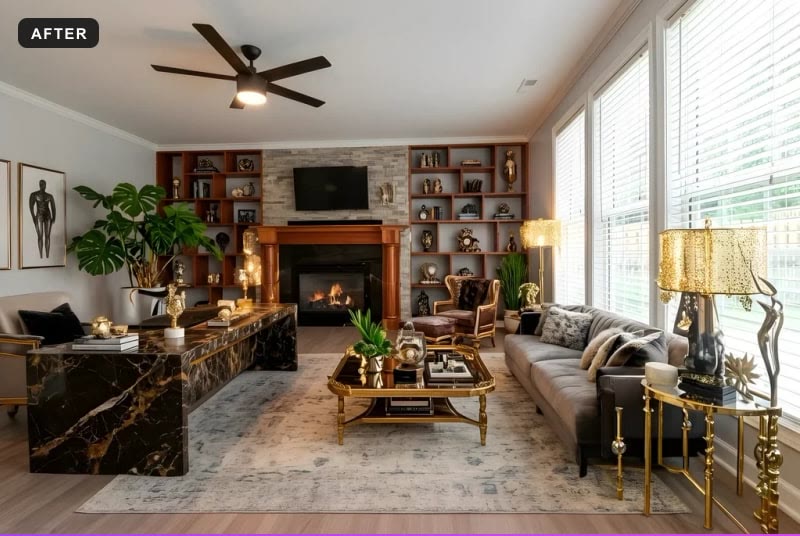
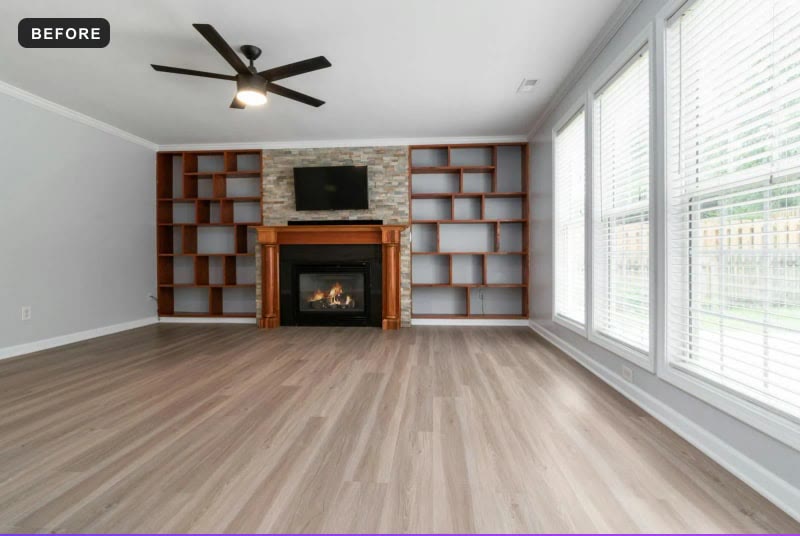
The other advantage is iteration. Because a render costs cents and takes under a minute, you can try the same room in three or four looks and see which one sells. Here is one empty living room taken in a luxury direction; the render cost about 18 cents.
What does a 10-photo gallery cost with each method?
Physical staging: $500 to $1,500 at NAR's 2025 medians, priced for the home rather than the photos. Hand-done: 10 × $10–75 = $100 to $750. AI: the first three renders are free, and ten renders at the Pro rate cost 10 × ($46 ÷ 250) = $1.84, or $1.56 billed annually. Same gallery, three price tags hundreds of times apart.
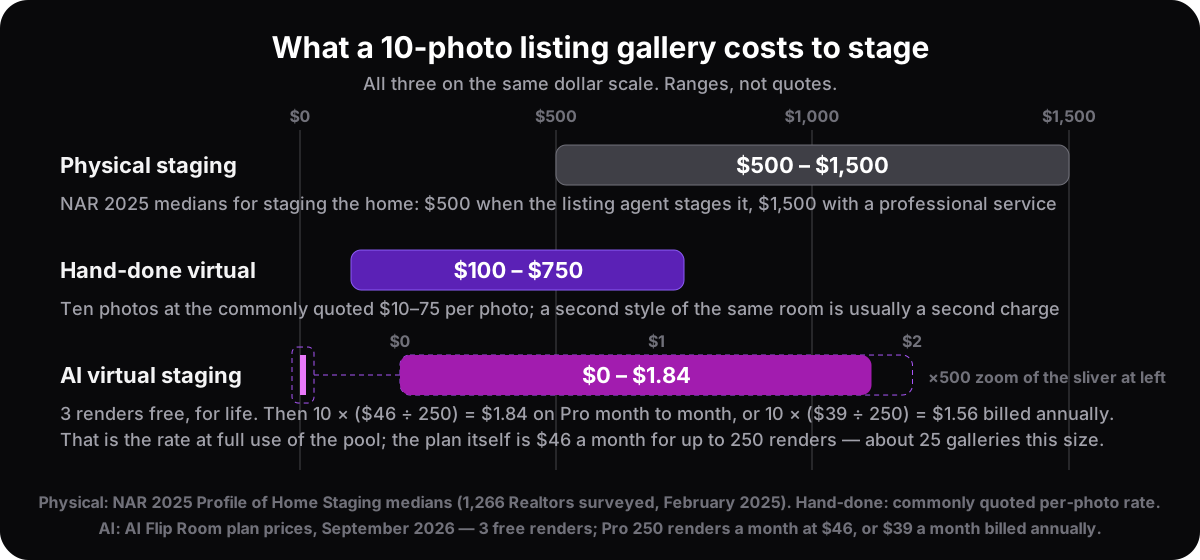
Two notes on the chart. First, the AI figure assumes one render per photo; if you try three styles on every room, thirty renders at the Pro rate are 30 × 18.4¢ = $5.52, still a rounding error next to the other two bars. Second, the plan is the real invoice: $46 buys the month, and the ten renders are what you spent of it. Both facts point the same way — once the gallery is paid for by the month rather than by the photo, staging every room stops being a budget decision.
What drives the price?
Five things: how many rooms and photos you stage, how much human labour sits behind each image, how fast you need it, how many revisions or restyles you want, and what resolution you need. The second dominates — physical furniture and hand editing are expensive, automation is cheap — which is why the gap is structural, not a discount.
Most of these barely move the needle for AI. Ten photos or fifty draw from the same pool, there is no rush fee because there is no queue of editors, and a restyle is a re-run. That is the structural reason AI staging is cheaper, and the reason it will stay cheaper: the cost that dominates the other two methods is the one it removed.
Which option fits your listing?
Physical staging suits a high-end or fully vacant home where the in-person walkthrough decides the sale and the price justifies a four-figure spend. Hand-done virtual staging suits an agent who wants a person to own a few hero shots. AI suits everything that needs volume, speed or several styles — and many agents now blend all three.
Which option fits: four questions, in order
- 1Is the home high-end and completely vacant, with a price that carries a four-figure spend?Choose physical staging. The in-person walkthrough is the make-or-break moment, and buyers will walk through a furnished home. Budget NAR's medians — $500 agent-staged, $1,500 with a service — as a starting point, plus the monthly furniture rental for as long as the listing sits.
- 2Do you want one person to own a handful of hero shots?Choose hand-done virtual staging. You send the photos, an editor returns them in hours to a couple of days, and you pay per image. Sensible for two or three key frames; expensive across a whole gallery, and a second style usually means paying again.
- 3Do you need the whole gallery, several styles, or the result today?Choose AI virtual staging. Ten renders cost under $2 at the Pro rate, a second style is one more render, and each takes 15–60 seconds — which is what makes staging every room, not just the hero shot, affordable. For a vacant property this is the whole playbook: how to sell an empty house faster.
- 4Still unsure? Blend them.Many agents now use AI for the bulk of the gallery and for quick style tests, and reserve physical staging for the one or two rooms that truly need it. Start with the three free renders and make the call with your own photo in hand.
Cost is only half the decision; the other half is what the buyer needs to see. A furnished room at the showing is something only physical staging delivers. A furnished photo that helps a buyer judge scale before they book the showing is what the other two deliver, and for a vacant listing that photo is usually the difference between a click and a scroll. For the wider picture on where staging helps most, start with what virtual staging is and where it earns its keep.
What costs do people forget to budget for?
Four: time on market, because physical rental fees keep running while the home sits; revisions, because per-photo services often charge per round; photography, because staging only looks right on a level, well-lit source photo; and multiple styles, nearly free with AI and expensive with human labour. None appears on the first quote; all favour the faster, cheaper method.
- Time on market. With physical staging, a slow sale means more monthly rental fees. A method that is finished in a minute carries no such risk.
- Revisions. Getting the look right often takes more than one attempt, and per-photo services can charge for each round. With AI a second attempt is one more render.
- Photography. Staging only shines on a good source photo. Daylight, lamps off, camera level at chest height, the whole room in frame — here is how to photograph rooms for virtual staging. A bad photo costs a re-shoot whichever method you choose.
- Multiple styles. Testing several looks is nearly free with AI and adds up quickly with human labour. A family home and a downtown condo want different rooms, and the quickest way to find out is to render both.
Does disclosure cost anything?
No — it costs nothing but honesty, and it is not optional. Virtual staging exists to help a buyer imagine a room, never to mislead them about what is there. Label staged images, keep the unedited original, and never change the property itself. Our disclosure guide covers the wording and compares the rules of the fourteen jurisdictions we have read.
Every jurisdiction we have read draws the same line: furnish what is movable and never alter the property; most also ask you to tell the buyer the photo was staged. That protects you as much as the buyer — a buyer who feels tricked at the showing is a buyer you have lost. Show the empty room alongside the staged version, keep the architecture truthful, and label clearly. The virtual staging disclosure rules guide covers exactly how and where to add those labels, and what each jurisdiction requires.
The bottom line on virtual staging cost in 2026: physical staging buys a real, tactile experience at a real premium; hand-done virtual staging trades furniture for per-photo editing; and AI virtual staging delivers restaged rooms in seconds for cents apiece. For most sellers weighing speed, budget and flexibility, three free renders are the lowest-risk way to see what a space can become before spending a dollar — start with your own photo, no credit card required.
Questions people ask about virtual staging cost
How much does virtual staging cost per photo?+
Hand-done virtual staging is commonly quoted at $10 to $75 or more per photo, depending on the room's complexity, the furniture library, rush turnaround and the revisions included. AI virtual staging is priced by the render rather than the photo: at AI Flip Room the first three renders are free, and a Pro render works out to $46 ÷ 250 = 18.4 cents, or 15.6 cents billed annually. Physical staging is priced per home, not per photo.
Is virtual staging cheaper than physical staging?+
Yes, by a wide margin. NAR's 2025 survey puts the median cost of staging a home at $1,500 with a professional service and $500 when the agent does it, with furniture typically rented for as long as the listing sits. A ten-photo gallery runs $100–750 hand-done and under $2 in AI renders at the Pro rate. What physical staging buys that a photo cannot is the furnished room at the showing.
Can I virtually stage a room for free?+
Yes. Every AI Flip Room account starts with 3 free renders, for life, with no credit card — a one-time allowance rather than a monthly one, enough to judge the quality on your own photo. If your listing needs three key rooms, that is the whole job. Beyond that, Pro is $46 a month, or $39 a month billed annually, for 250 renders; the current numbers are on the pricing page.
Are there hidden costs in virtual staging?+
The two that matter are photography and revisions. Staging only looks right on a level, well-lit photo of the whole room, so a poor source photo costs you a re-shoot whichever method you use. Hand-done services often charge per revision round; with AI a second attempt is one more render. Disclosure costs nothing: label the staged image, keep the unedited original, and never change the property itself.
See it on your own room
Upload a photo and watch AI restage your space in 15–60 seconds, depending on how much detail it has — free to try, no credit card.
Try AI Flip Room freeGot a question about this?
Something unclear or not covered? Ask here. We read every question and answer the useful ones right in the article. Nothing you write is published.
Related reading

What Is Virtual Staging? The Complete Guide: How It Works, Cost, Rules, Examples
Virtual staging explained in plain language: how AI furnishes a photo of a real room, what it costs, what agents think of it (NAR 2025), who it helps, the rules and how to spot bad staging.
Does Virtual Staging Help Sell Homes? An Honest Answer
Virtual staging changes the photo, not the price. Where it helps, where it is wasted, what NAR's 2025 survey actually measured, and what can go wrong.
How to Sell an Empty House Faster With Virtual Staging
Why vacant listings sit longer, which 5 rooms to stage first, how to shoot them, and how to virtually stage an empty house honestly — a 6-step playbook.