Art Nouveau Interior Design
Curved organic lines, Tiffany glass, peacock palette, late-19th-century elegance.
Stage your room in Art Nouveau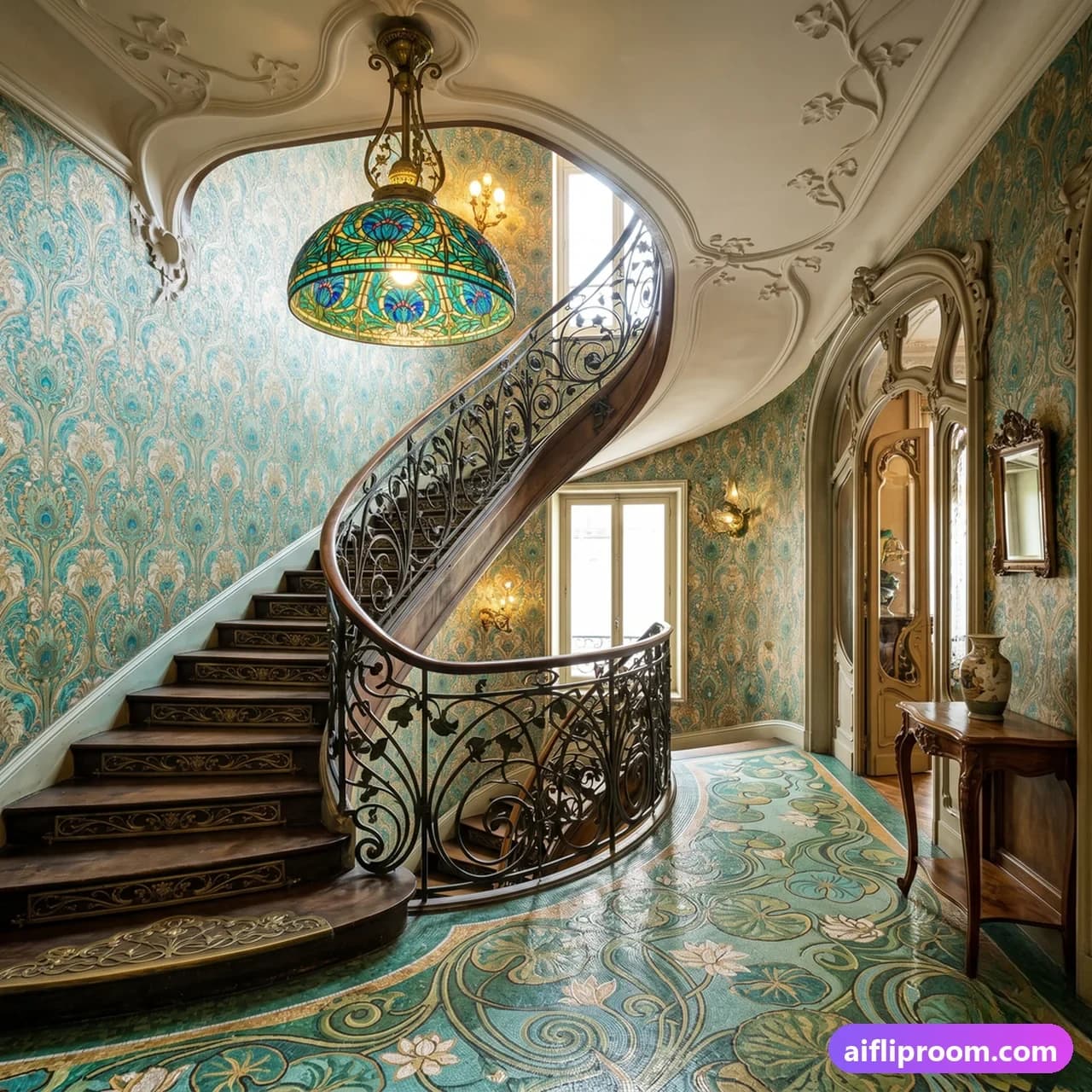
What is Art Nouveau interior design?
Art Nouveau flourished around 1900, and unlike the geometric styles that followed, it took all of its forms from nature. Lines are sinuous and flowing; plant and flower motifs curl across walls, furniture and ironwork; nothing is straight if it could instead be graceful. Stained-glass and Tiffany-style lighting scatter coloured light; flowing floral wallpaper sets the tone; wrought-iron details twist like vines. The palette leans on peacock tones — turquoise, gold, emerald. Every element is decorative and handcrafted, the product of an era that treated the whole interior as a work of art. The result is romantic, artistic and richly detailed. In staging, Art Nouveau is a distinctive choice for living rooms and entry spaces in period properties, and it appeals to buyers who want decorative character and genuine craft.
Where Art Nouveau comes from
Art Nouveau ran from roughly 1890 to 1910 and was the first style in a long time that tried to invent rather than revive. Its designers were tired of borrowing from Greece, Rome and the Middle Ages, and looked instead at plants: the whiplash curve of a stem, the asymmetry of a leaf, the way a vine grows around what it meets. New industrial capability in iron and glass made those shapes buildable, so staircases curled, window frames flowed and a doorway could be a plant form. It went by different names in different places — Jugendstil, Secession, Stile Liberty — and it burned out fast, replaced by the geometric confidence of Art Deco within about two decades. That short life is part of why surviving examples feel so distinctive.
Key elements of Art Nouveau
- Sinuous, flowing lines
- Organic plant and flower motifs
- Stained-glass and Tiffany-style lighting
- Flowing floral wallpaper
- Wrought-iron details
- A peacock palette of turquoise, gold and emerald
When to use Art Nouveau
Living rooms and entry spaces in period properties. A distinctive, artistic look for buyers who want decorative character and craft.
Art Nouveau colours and materials
Muted and slightly smoky rather than bright: sage and olive, mustard and ochre, dusty rose, lilac, peacock blue and teal, against cream and soft brown. Gold appears as a line rather than a surface. Materials are carved and steam-bent wood, wrought and cast iron, leaded and stained glass, ceramic tile with flowing glaze, silk, velvet and embroidered textiles. Pattern is botanical and asymmetric — irises, lilies, wisteria, poppies, dragonflies, peacock feathers — drawn as continuous flowing line. The recognisable move is that structure itself curves: a chair leg, a stair rail, a window mullion.
Art Nouveau room by room
Living room in Art Nouveau
The furniture should carry the curve rather than the accessories. A settee or armchair with a sinuous carved frame, a table with organic legs, and upholstery in a muted botanical print or plain velvet. Papered walls in a flowing pattern — a wisteria or poppy repeat — with plain painted areas to let it breathe. A stained-glass panel in a window or a door, a Tiffany-style lamp casting coloured light, and one large mirror in a curved frame. Keep the layout asymmetric; the style has no interest in matched pairs.
Dining room in Art Nouveau
A table and chairs with carved organic detail, a sideboard with leaded glass doors, and a pendant with coloured glass. Papered or stencilled walls in a botanical repeat above a plain dado. Ceramics with flowing glazes on display. The room should read as though a plant grew through the furniture and everyone agreed to leave it there.
Bedroom in Art Nouveau
A carved wooden bed with a curved headboard, textiles in muted botanical prints, and a dressing table with an organically shaped mirror. Wallpaper in a soft flowing pattern, a lamp with a coloured glass shade, and iron or brass fittings with plant motifs. Keep the palette on the smoky side — sage, dusty rose, ochre — rather than sweet.
Bathroom in Art Nouveau
Tile with flowing glaze or a botanical border, a basin with curved lines, and brass fittings with organic detail. A stained-glass panel in the window is the single most effective addition, since the coloured light does the work no fixture can. A curved-frame mirror and a small ceramic-topped table finish it.
Staircase and hallway in Art Nouveau
Historically where Art Nouveau showed off, because a stair rail is a structural element that can curve freely. A wrought-iron balustrade with plant forms, a stained-glass window on the half landing, patterned tile on the floor, and a lantern with coloured glass. Even in a house with a plain stair, a leaded panel in the front door changes the whole entrance.
Art Nouveau mistakes to avoid
- Confusing it with Art Deco. Nouveau curves, flows and takes its forms from plants; Deco steps, fans and takes its forms from machines. They are consecutive and opposite.
- Applying curves as decoration only. The style works when structure curves — furniture frames, rails, openings — not when flat objects have swirls printed on them.
- Bright colour. The palette is muted and smoky. Saturated versions of the same hues turn the style garish.
- Pattern on every wall. The originals set flowing pattern against large plain areas and a plain dado. Continuous pattern loses the line.
- Mass-produced stained glass in plastic frames. One genuine leaded panel, even small, does more than a whole window of imitation.
Art Nouveau questions, answered
What is Art Nouveau?
An international decorative movement of roughly 1890 to 1910 built on flowing, asymmetric lines drawn from plant forms. It appeared in architecture, furniture, glass, jewellery and graphics, and it deliberately avoided reviving earlier historical styles. It was known as Jugendstil in Germany, Secession in Austria and Stile Liberty in Italy.
What is the difference between Art Nouveau and Art Deco?
They are consecutive and opposite. Art Nouveau, before the First World War, is organic, curving, asymmetric and muted, taking its shapes from plants. Art Deco, in the 1920s and 1930s, is geometric, symmetrical, high-contrast and metallic, taking its shapes from machines and travel. If the line curls like a stem it is Nouveau; if it steps or fans it is Deco.
How do I add Art Nouveau to a normal room?
Three things carry it: one piece of furniture with a genuinely curved frame, one botanical wallpaper or textile in a muted palette, and one piece of coloured glass — a lamp, a leaded panel, a door light. Keep everything else plain and warm. The style is strong enough that a small amount of it registers.
What colours are Art Nouveau?
Sage and olive, mustard and ochre, dusty rose, lilac, peacock blue and teal, over cream and soft brown, with gold used as line rather than as a surface. Everything is slightly muted, as though seen through a faint haze.
Is Art Nouveau practical for a modern home?
As a full scheme it is demanding, because the good pieces are antique and expensive and the style relies on craftsmanship. As an accent it is very practical — a lamp with coloured glass, a botanical paper in a small room, a curved mirror. It also blends surprisingly well with plain modern interiors, where a single flowing object stands out cleanly.
Guides to read next
Longer reads on getting a room photographed and restaged well.
- See Your Own Room in a New Style Before You Buy AnythingPreview your actual room in a new style before buying furniture or hiring anyone: what a preview settles, what it can't, and five steps to a useful one.
- How to Photograph Rooms for Virtual Staging: 7 RulesDaylight, lamps off, a level phone at chest height, the 1x lens not 0.5x, one room per frame, clear surfaces — seven habits that make AI staging look real.
- What Is Virtual Staging? The Complete Guide: How It Works, Cost, Rules, ExamplesVirtual staging explained in plain language: how AI furnishes a photo of a real room, what it costs, what agents think of it (NAR 2025), who it helps, the rules and how to spot bad staging.
See your room in Art Nouveau
Upload a photo and our AI restages it in the Art Nouveau look in 15–60 seconds, depending on how much detail your room has — keeping your walls, windows and layout intact.
Try Art Nouveau on your room