Bauhaus Interior Design
Geometry, primary colors, tubular steel, form follows function.
Stage your room in Bauhaus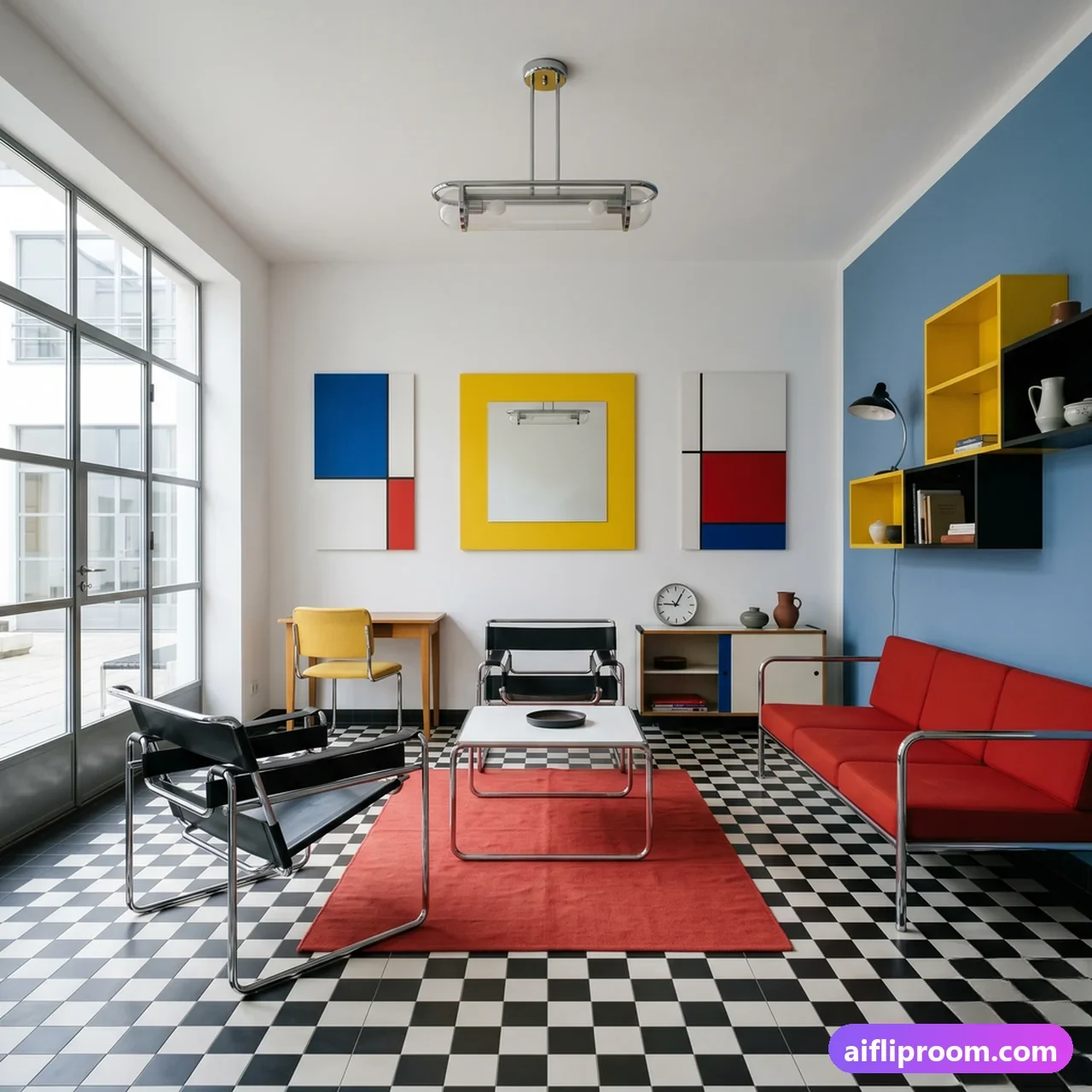
What is Bauhaus interior design?
Bauhaus style comes from the influential German design school of the 1920s, whose ideas still shape modern design a century later. Its core principle is that form follows function: an object's design should be driven by its purpose, with no decoration added for its own sake. In a room this reads as clear geometric forms, honest materials and a deliberate, almost graphic clarity. Primary-colour accents — red, blue, yellow — sit against white walls; tubular steel furniture, pioneered at the school, brings a light, industrial precision; flooring is often bold and graphic. Nothing is fussy, everything is intentional. The result is a room that feels rigorous, modern and quietly radical. In staging, Bauhaus is a bold, intellectual choice for living rooms and studies, and it suits architecturally modern properties and design-aware buyers.
Where Bauhaus comes from
The Bauhaus was a school, not a decorating style — founded in Weimar in 1919, moved to Dessau, closed under political pressure in 1933. Its argument was that art and industrial production should stop being separate: a chair should be designed as rigorously as a painting, and it should be manufacturable. Students worked across metal, textile, cabinetmaking and typography, and the results were stripped to essentials because ornament had no function and function was the whole case. Tubular steel furniture, still in production today, came out of exactly this thinking. When the school closed, its teachers scattered across Europe and America and took the approach with them, which is why so much of what we now simply call modern traces back to fourteen years in two German towns.
Key elements of Bauhaus
- A form-follows-function approach
- Primary-colour accents on white
- Tubular steel furniture
- Clear geometric forms
- Bold, graphic flooring
- Flat, functional textiles
When to use Bauhaus
Living rooms and studies for design-aware buyers. A bold, intellectual look that suits architecturally modern properties.
Bauhaus colours and materials
Primary and unmixed — red, yellow and blue — set against white, black and grey. That is close to the whole palette, and the discipline of it is deliberate: colour is used to mark function or to define a plane, not to decorate. Materials are the machine-age ones the school championed: chrome and tubular steel, plate glass, moulded plywood, leather, canvas and industrial textiles woven in geometric patterns. Surfaces are flat and unornamented. Where wood appears it is usually pale and plain. Anything carved, patterned in a floral way, or decorative for its own sake sits outside the idea entirely.
Bauhaus room by room
Living room in Bauhaus
A tubular steel and leather sofa or a pair of cantilever chairs, a glass or plain timber table with a visible structural base, and a rug in a geometric weave. Walls white, floor plain, and one wall or one object allowed a block of primary colour. Storage in a simple modular system. Lighting should be an early modern fixture — a hemispherical or opal glass shade, a task lamp with visible mechanics. The room should read as composed like a painting: rectangles, one circle, three colours.
Bedroom in Bauhaus
A low platform bed with a plain frame, white bedding, and a single block of colour in a blanket or a wall panel. Storage built in or in a plain modular unit. A wall-mounted task light on an articulated arm rather than a decorative bedside lamp. Nothing on the walls except perhaps one geometric print. Bauhaus bedrooms look sparse because the argument was that a room should contain what it needs and nothing else.
Kitchen in Bauhaus
This is where the school's influence is most invisible and most total: the fitted kitchen, with standardised units, continuous worktops and everything at a designed height, comes directly from this period of thinking. Flat white or primary-coloured fronts, plain handles or none, a stainless or laminate worktop, and open shelving with plain white crockery. No decorative detail anywhere.
Home office in Bauhaus
A plain desk with a steel or trestle base, a cantilever chair, an articulated task lamp, and modular shelving. Cables and structure can stay visible — honest expression of how a thing works is part of the argument, not something to hide. One primary-coloured object. The room should look like a workspace rather than like a study.
Entryway in Bauhaus
A steel and glass or plain timber console, a row of simple hooks, a geometric mat, and a single colour block on the door or the wall. Bauhaus entryways are functional and graphic — the whole style is legible in a very small space, which makes a hallway an easy place to try it.
Bauhaus mistakes to avoid
- Treating primary colour as an obligation. The palette is disciplined, not compulsory — many Bauhaus interiors are almost entirely white, grey and black with one accent.
- Buying reproduction icons and nothing else. Four famous chairs in one room is a furniture showroom; the school's point was ordinary objects designed well.
- Adding ornament back in. Decorative mouldings, patterned wallpaper and carved detail contradict the entire premise.
- Confusing it with mid-century modern. Bauhaus is earlier, cooler, more industrial and more rectilinear; mid-century is warmer, woodier and more organic in its curves.
- Cold lighting on a cold palette. White, grey and chrome under 4000K light is genuinely unpleasant to sit in. Warm bulbs fix it without compromising anything.
Bauhaus questions, answered
What is Bauhaus design?
An approach that came out of the German Bauhaus school, active 1919 to 1933, holding that design should unite art with industrial production and that form should follow function. In interiors it means geometric shapes, no ornament, honest materials, tubular steel and glass, and a restricted palette of primaries against white, black and grey.
What is the difference between Bauhaus and mid-century modern?
Bauhaus is earlier and more industrial: chrome, glass, primary colour, strictly rectilinear, cool in feel. Mid-century modern followed in the 1940s to 1960s and is warmer and more organic — teak and walnut, tapered legs, curved shells, earthy accent colours. Mid-century inherited the thinking; it softened the look considerably.
Is Bauhaus interior design cold?
It can be, and honestly it often is when copied literally. The fixes do not require abandoning it: warm lighting, one wool rug, leather rather than vinyl, and a plain timber surface somewhere in the room. The geometry stays intact and the room becomes liveable.
What furniture is Bauhaus?
Cantilever and tubular steel chairs, leather and steel lounge seating, plain modular storage, glass-topped tables with visible frames, and lighting with simple opal glass or metal shades. Many of the original designs from the 1920s are still manufactured, which is unusual for furniture a century old.
Does Bauhaus work for staging a property?
It suits modern apartments, loft conversions and architect-designed homes, where the building shares the same logic. In a period property or a family home it usually reads as cold and unwelcoming for staging purposes, and a warmer modern or transitional scheme will reach more buyers.
Guides to read next
Longer reads on getting a room photographed and restaged well.
- See Your Own Room in a New Style Before You Buy AnythingPreview your actual room in a new style before buying furniture or hiring anyone: what a preview settles, what it can't, and five steps to a useful one.
- How to Photograph Rooms for Virtual Staging: 7 RulesDaylight, lamps off, a level phone at chest height, the 1x lens not 0.5x, one room per frame, clear surfaces — seven habits that make AI staging look real.
- What Is Virtual Staging? The Complete Guide: How It Works, Cost, Rules, ExamplesVirtual staging explained in plain language: how AI furnishes a photo of a real room, what it costs, what agents think of it (NAR 2025), who it helps, the rules and how to spot bad staging.
See your room in Bauhaus
Upload a photo and our AI restages it in the Bauhaus look in 15–60 seconds, depending on how much detail your room has — keeping your walls, windows and layout intact.
Try Bauhaus on your room