Victorian Interior Design
19th-century opulence — burgundy velvet, William Morris wallpaper, gas-lamp brass.
Stage your room in Victorian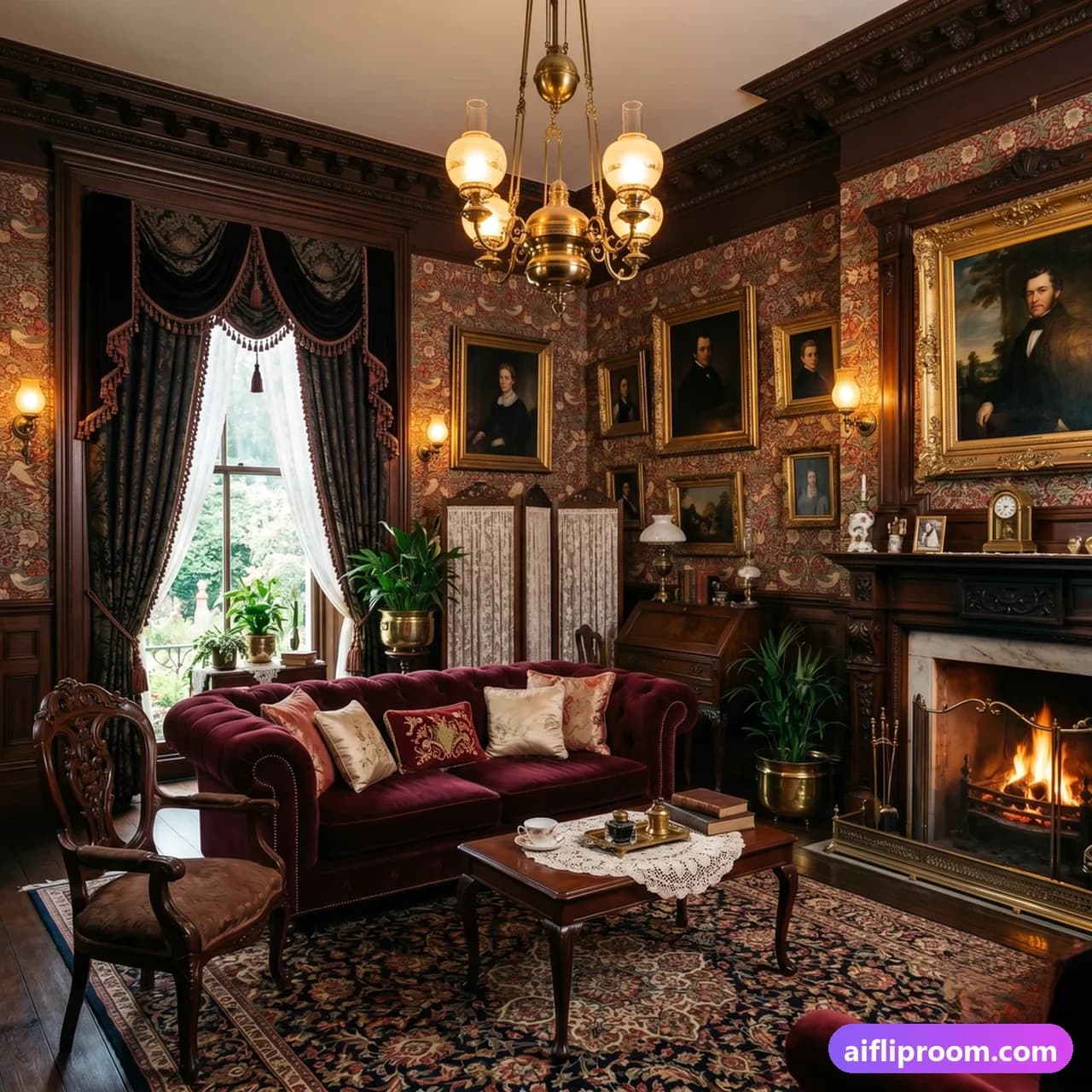
What is Victorian interior design?
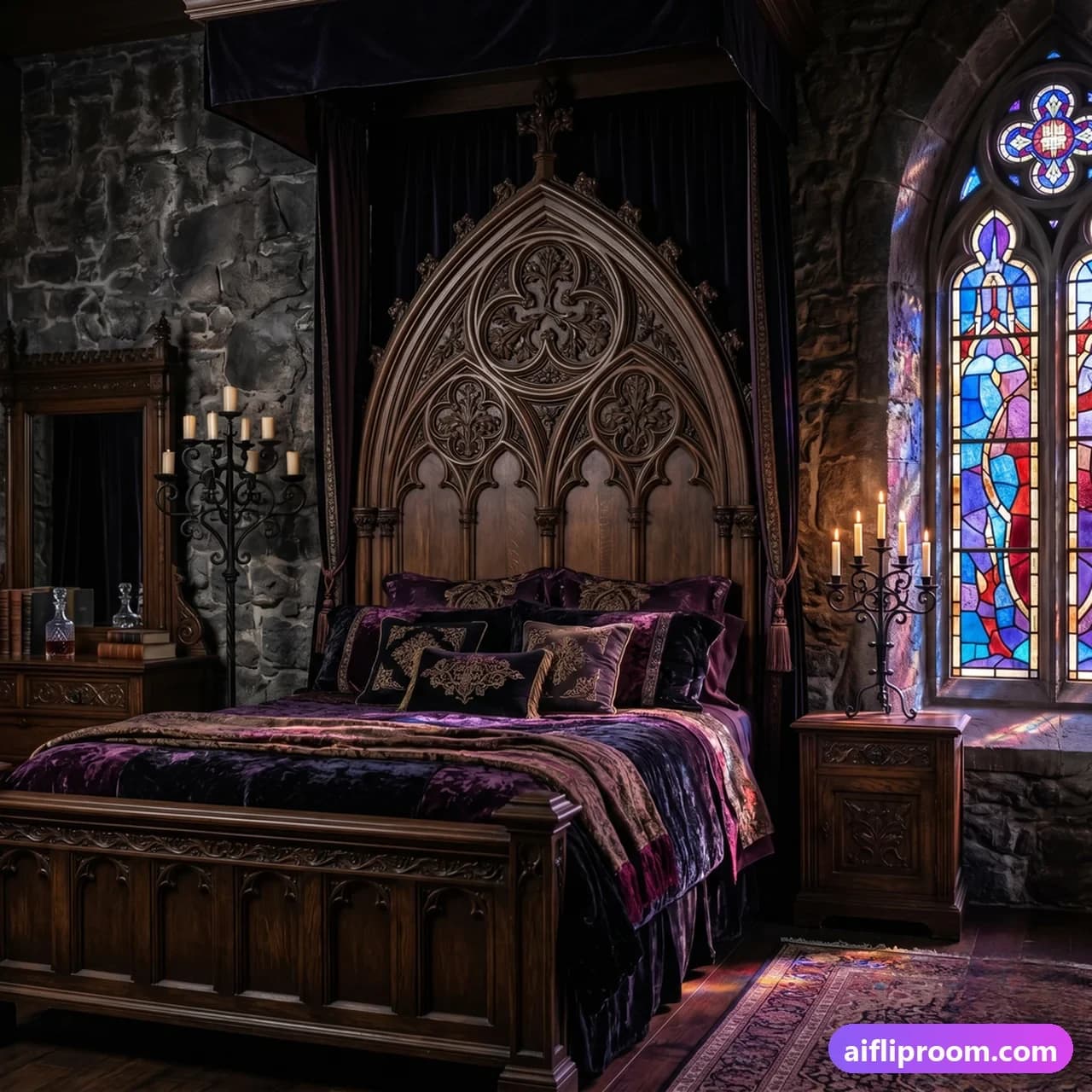
Victorian style recreates the rich, layered interiors of the 19th century, when a well-dressed room signalled status and a love of craft. It is the opposite of minimalism: every surface is an opportunity. Deep, saturated colours — burgundy, forest green — set the mood; ornate carved woodwork and elaborate trim frame the room; patterned wallpaper, often in William Morris–style florals, covers the walls. Velvet tufted upholstery, brass and antique lighting, heavy draped curtains and framed art layer on warmth and detail. It is opulent, formal and unmistakably of its era. In staging, Victorian style is best reserved for genuine period properties, where an ornate treatment works with the architecture and the proportions rather than fighting them — it can make a period room feel authentic and richly characterful.
Where Victorian comes from
The Victorian period runs from 1837 to 1901, and its interiors are the product of industrial manufacturing arriving in the home. For the first time, patterned wallpaper, machine-carved furniture, printed textiles and ornament of every kind became affordable to a large middle class — and that class furnished enthusiastically, because visible abundance signalled that you had arrived. Rooms were densely layered, deeply coloured and full of collected objects. The reaction against all this produced Arts and Crafts and eventually modernism, so the twentieth century tended to describe Victorian interiors as cluttered and oppressive. Seen on their own terms they are the opposite of accidental: highly ordered, formally arranged, and built around detail that was genuinely well made.
Key elements of Victorian
- Deep, saturated colours — burgundy, forest green
- Ornate carved woodwork and trim
- Patterned, floral wallpaper
- Velvet tufted upholstery
- Brass and antique lighting
- Layered, decorated surfaces
When to use Victorian
Living rooms and parlours in genuine period properties, where an ornate Victorian treatment works with the architecture rather than against it.
Victorian colours and materials
Deep and saturated: burgundy, forest and bottle green, navy, plum, mustard and gold, over rich browns of mahogany, walnut and rosewood. Ceilings and cornices are usually lighter than the walls, and the wall itself is often divided into three — dado, field and frieze — with different treatments. Materials are velvet, brocade, damask, chenille, lace, heavy fringing, polished hardwood, brass, marble and stained or etched glass. Pattern is everywhere and deliberately layered: a papered wall behind a patterned carpet under a patterned upholstery. Anything pale, plain or minimal belongs to a different century.
Victorian room by room
Living room in Victorian
Also the parlour, and it was the room used to impress. A carved wooden fireplace with a tiled insert as the focal point, an overmantel mirror above it, and seating arranged formally around it: a buttoned chesterfield or a camelback sofa, a pair of armchairs, a chaise if the room allows. Patterned wallpaper with a picture rail, a large patterned rug, and heavy curtains with a pelmet. Occasional tables, a display cabinet, framed pictures hung densely and high. Deep colours and layered pattern are correct here — restraint is what would look wrong.
Bedroom in Victorian
A cast-iron or carved wooden bed, a washstand or a marble-topped dressing table, and a heavy wardrobe. Bedding in white cotton with a patterned quilt or eiderdown over it. Papered walls, usually in a lighter or more floral pattern than the reception rooms, and a fireplace with a smaller cast-iron surround. Lace at the window under heavier curtains. The Victorian bedroom is more restrained than the parlour because it was private, and that makes it the easier room to do at a modern scale.
Dining room in Victorian
The darkest and most formal room in the house. A large mahogany table with carved legs, upholstered dining chairs, and a sideboard with a mirrored back. Deep green or burgundy walls, often with a dado rail and panelling below it, a brass or crystal chandelier, and a serving of ornament that would look excessive anywhere else. This is the room where the style is most convincing today, because dining rooms are used at night and can carry the depth.
Hallway in Victorian
Encaustic tile on the floor, a dado rail with anaglypta or a strong paper above, a hall stand for coats and umbrellas, and a runner up the stairs held with rods. A pendant lantern and a large mirror. Victorian hallways were narrow and deliberately dramatic, and because you pass through rather than sit in one, it is the safest place in a modern house to commit fully to the style.
Bathroom in Victorian
A roll-top bath with claw feet, a high-level or close-coupled cistern, a pedestal or washstand basin, and brass or nickel fittings with cross-head taps. Black and white geometric floor tile, panelling to dado height, and a framed mirror. Victorian bathrooms are the one part of the period that has never really gone out of production, so the fittings are widely available and mostly excellent.
Victorian mistakes to avoid
- Dark walls plus dark woodwork plus heavy curtains. Authentic, and in a modern house with smaller windows it produces a gloomy room. Keep one element lighter — usually the ceiling and the woodwork above the picture rail.
- Stripping out original detail then adding reproduction detail. Where cornices, ceiling roses, fireplaces or skirtings survive, they are worth more than anything you could buy.
- Thin modern mouldings. Victorian profiles are deep and substantial; a shallow reproduction cornice reads as a sticker.
- One pattern used alone. The style layers pattern deliberately. A single papered wall in an otherwise plain room is a modern feature wall, not a Victorian room.
- Ignoring the light. These rooms were designed for gas and candlelight. Several warm low sources will flatter the colours; a bright ceiling fixture will not.
Victorian questions, answered
What defines Victorian interior design?
Deep saturated colour, layered pattern on walls, floors and upholstery, ornate carved woodwork, formally arranged furniture around a fireplace, and a great many collected objects on display. Walls are usually divided by a dado and picture rail. The overall impression is of deliberate abundance rather than restraint.
How do I make a Victorian room work for modern life?
Keep the architecture and edit the density. Restore or retain the cornices, fireplaces and skirtings, use one strong papered wall rather than all four, choose two or three period pieces rather than a full set, and lighten the ceiling and woodwork. The result reads as a Victorian house that someone lives in now, which is what most people actually want.
What is the difference between Victorian and Edwardian interiors?
Edwardian, from 1901 to around 1910, is a lightening of Victorian. Paler colours, less pattern, simpler mouldings, more daylight, and furniture with cleaner lines under the influence of Arts and Crafts. If a room feels period but airy, it is more likely Edwardian than Victorian.
What colours did the Victorians actually use?
Deeper and bolder than most people expect: burgundy, bottle green, navy, plum, mustard and gold, alongside rich browns. Newly available synthetic dyes made strong colour fashionable, and rooms were often much more saturated than the muted reproductions sold as Victorian today.
Is Victorian styling good for staging a property?
For a genuine Victorian house, a restrained period-sympathetic staging flatters the architecture and attracts the buyers who want that kind of home. A full authentic scheme, dark and densely patterned, tends to reduce the pool — most buyers respond better to period detail with lighter, simpler furnishing.
Guides to read next
Longer reads on getting a room photographed and restaged well.
- See Your Own Room in a New Style Before You Buy AnythingPreview your actual room in a new style before buying furniture or hiring anyone: what a preview settles, what it can't, and five steps to a useful one.
- How to Photograph Rooms for Virtual Staging: 7 RulesDaylight, lamps off, a level phone at chest height, the 1x lens not 0.5x, one room per frame, clear surfaces — seven habits that make AI staging look real.
- What Is Virtual Staging? The Complete Guide: How It Works, Cost, Rules, ExamplesVirtual staging explained in plain language: how AI furnishes a photo of a real room, what it costs, what agents think of it (NAR 2025), who it helps, the rules and how to spot bad staging.
See your room in Victorian
Upload a photo and our AI restages it in the Victorian look in 15–60 seconds, depending on how much detail your room has — keeping your walls, windows and layout intact.
Try Victorian on your room