Gothic Revival Interior Design
Pointed arches, stained glass, dark stone, romantic medieval mystery.
Stage your room in Gothic Revival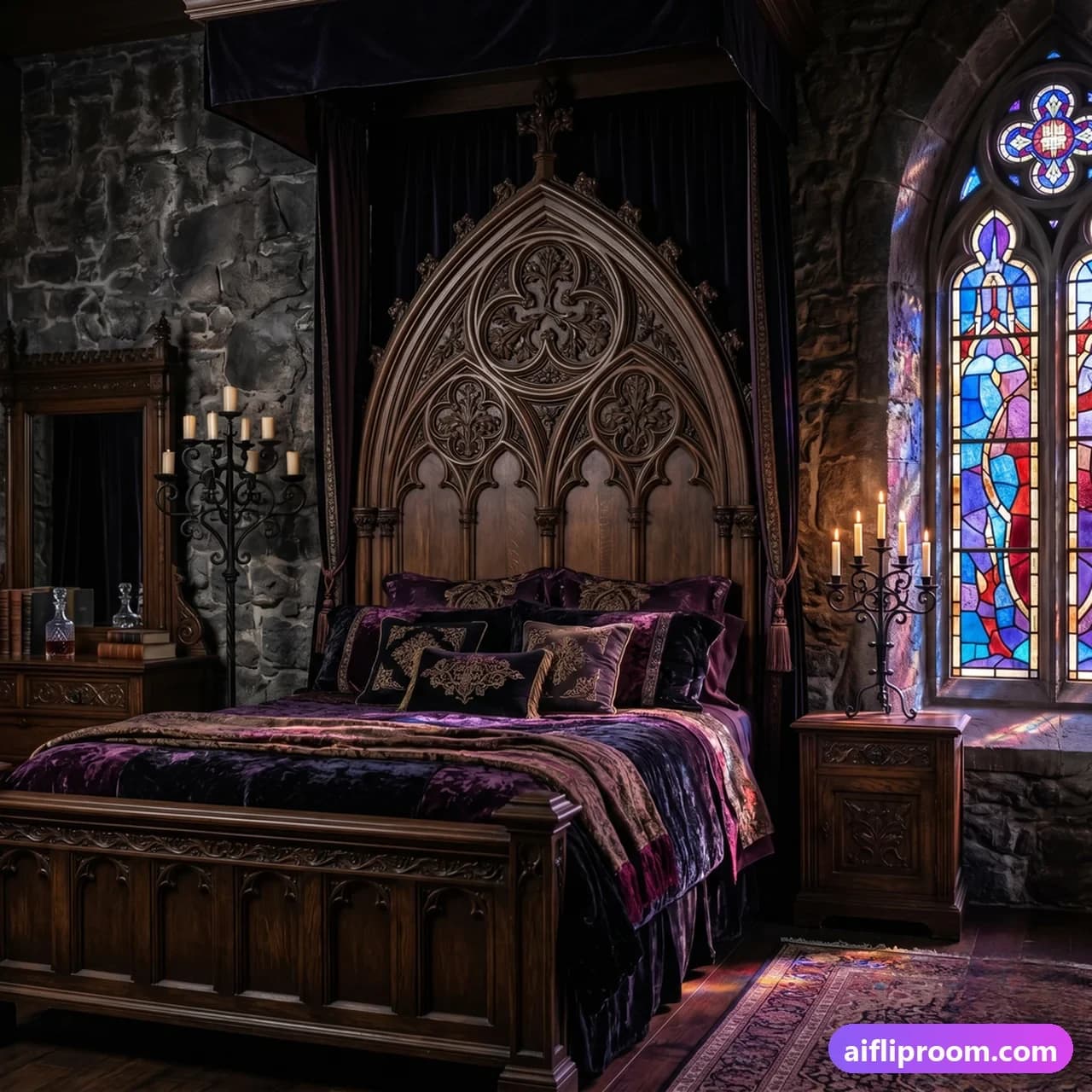
What is Gothic Revival interior design?
Gothic Revival interiors are dramatic, romantic and a little theatrical — they borrow the language of medieval cathedrals and castles and bring it into the home. The signatures are unmistakable: pointed-arch shapes in headboards, mirrors and joinery; dark stone or deeply coloured walls; stained-glass windows casting patterns of coloured light. Carved dark-oak furniture, iron candelabra and deep purple and black velvet textiles complete the mood. The palette is rich and shadowed, the lighting low and atmospheric. Done well, the look is mysterious and characterful rather than gloomy — it commits fully to a strong, romantic identity. In staging, Gothic Revival is a bold choice for bedrooms and statement rooms, best in properties with strong period architecture, and it suits buyers who want an atmospheric home with real drama.
Where Gothic Revival comes from
Gothic Revival is a nineteenth-century movement that looked back at medieval architecture and decided it had been abandoned too readily. Its champions argued that the pointed arch, the rib vault and the honest expression of structure were morally as well as visually superior to the classical styles then in fashion, and they applied that conviction to churches, universities, parliaments and eventually houses. The domestic version borrowed the vocabulary — arches, tracery, quatrefoils, dark carved oak, stained glass, heraldic pattern — and turned it into a way of decorating. It is worth separating from the medieval original, which was far less comfortable and much more colourful, and from modern gothic-adjacent decorating, which is mostly about darkness and drama rather than about architecture.
Key elements of Gothic Revival
- Pointed-arch shapes
- Dark stone or deeply coloured walls
- Stained-glass windows and coloured light
- Carved dark-oak furniture
- Iron candelabra and fixtures
- Deep purple and black velvet textiles
When to use Gothic Revival
Bedrooms and statement rooms for buyers who want a bold, romantic, atmospheric home. Striking in properties with strong period architecture.
Gothic Revival colours and materials
Deep and jewelled against dark timber. Charcoal, near-black, forest green, burgundy, deep blue and aubergine, lifted by the reds, golds and blues of stained glass and by antique gold or brass detail. Stone grey appears in floors and fireplaces. Materials are carved oak and walnut, wrought iron, leaded and stained glass, velvet, damask, heraldic and trellis-patterned textiles, and encaustic tile. Ceilings are often the darkest surface rather than the lightest, which is unusual and is part of why the rooms feel enclosing. Nothing is pale, nothing is glossy in a modern way, and nothing is minimal.
Gothic Revival room by room
Living room in Gothic Revival
A stone or carved timber fireplace as the anchor, ideally with a pointed or arched opening. Deep-buttoned velvet seating in burgundy or forest green, a heavy carved table, and a patterned rug over dark boards. Panelled or papered walls in a strong colour, with a heraldic or trellis pattern if you commit to paper. Iron or brass candle-style lighting, low and warm. Where a window can carry it, a stained or leaded panel changes the whole room by colouring the light that comes through it.
Dining room in Gothic Revival
The most natural room for the style, because dining rooms are used at night. A long refectory-style table in dark oak, high-backed carved chairs, and an iron chandelier with candle-shaped lights. Panelled walls, a large tapestry or a heavy patterned paper, and encaustic or stone flooring. Keep the lighting genuinely low. A gothic dining room that works is one where the corners are in shadow.
Bedroom in Gothic Revival
A four-poster or a tall carved headboard, heavy curtains in velvet or damask, and bedding in a deep colour with a lighter linen layer so the bed does not disappear. Dark walls, a small fireplace if the room has one, and a carved chest or wardrobe. One arched mirror. This is the room where the style is easiest to overdo — leaving some plainness in the bedding and the floor keeps it dramatic rather than oppressive.
Library or study in Gothic Revival
Floor-to-ceiling dark shelving, a heavy desk, a leather chair, and a lamp with a green or amber shade. A globe, a stack of books left open, an iron sconce. If the room has a window, a leaded or stained panel in the upper light. Gothic Revival was in large part a scholarly movement, and a study is where that shows most convincingly.
Entrance hall in Gothic Revival
Encaustic or stone tile, panelled or papered walls in a deep colour, an iron lantern, and a carved hall stand or bench. An arched mirror or an arched doorway if the architecture allows. Halls are passed through, so they can take the full darkness of the style without anyone having to live inside it.
Gothic Revival mistakes to avoid
- Confusing Gothic Revival with Halloween. Skulls, cobwebs and novelty props are a costume; the style is architectural and was built by serious craftsmen.
- Darkness with no light plan. These rooms need many small warm sources — candles, sconces, table lamps. One dim overhead fixture produces gloom rather than atmosphere.
- Adding arches to a house that has none. Pointed arches on plasterboard read as scenery. Better to lead with furniture, colour, textiles and lighting where the architecture cannot support the shapes.
- Everything carved. The originals set ornament against large plain surfaces — panelling, stone, plain plaster. Continuous carving loses the contrast that makes it read.
- Using it in a small, low, dark room. The style assumes height. In a modest room, use one element — a colour, a mirror, a light fitting — and stop.
Gothic Revival questions, answered
What is Gothic Revival interior design?
A nineteenth-century revival of medieval architectural forms applied to buildings and interiors: pointed arches, tracery, quatrefoils, rib vaults, dark carved oak, stained and leaded glass, heraldic pattern and deep jewel colours. It was a deliberate reaction against the classical styles that preceded it.
What is the difference between Gothic and dark academia?
Gothic Revival is architectural and specific, built on medieval forms and craftsmanship. Dark academia is a contemporary online aesthetic about scholarship and atmosphere — tweed, books, brass lamps, moody light — and it borrows from several periods without committing to any. Gothic has arches; dark academia has bookshelves.
Can I do gothic style without a gothic house?
Yes, by leading with the things that are portable: deep colour, velvet and damask, carved or heavy dark furniture, iron lighting, and one arched mirror or arched-topped piece. Skip fake structural arches and applied tracery, which need real architecture to look like anything other than decoration.
What colours are gothic interiors?
Charcoal and near-black, forest green, burgundy, deep blue and aubergine, against dark carved timber and stone grey. Antique gold and the coloured light from stained glass provide the lift. Ceilings are often dark too, which is one of the details that separates the style from ordinary dark decorating.
Is gothic styling suitable for a property listing?
Only for genuinely gothic or high-Victorian properties being marketed on character, and even then a lighter period-sympathetic scheme usually reaches more buyers. For most homes it narrows the audience considerably, since staging works by helping buyers imagine themselves in the room rather than admiring someone else's atmosphere.
Guides to read next
Longer reads on getting a room photographed and restaged well.
- See Your Own Room in a New Style Before You Buy AnythingPreview your actual room in a new style before buying furniture or hiring anyone: what a preview settles, what it can't, and five steps to a useful one.
- How to Photograph Rooms for Virtual Staging: 7 RulesDaylight, lamps off, a level phone at chest height, the 1x lens not 0.5x, one room per frame, clear surfaces — seven habits that make AI staging look real.
- What Is Virtual Staging? The Complete Guide: How It Works, Cost, Rules, ExamplesVirtual staging explained in plain language: how AI furnishes a photo of a real room, what it costs, what agents think of it (NAR 2025), who it helps, the rules and how to spot bad staging.
See your room in Gothic Revival
Upload a photo and our AI restages it in the Gothic Revival look in 15–60 seconds, depending on how much detail your room has — keeping your walls, windows and layout intact.
Try Gothic Revival on your room