Art Deco Interior Design
Geometric patterns, metallic finishes, bold colors, 1920s glamour.
Stage your room in Art Deco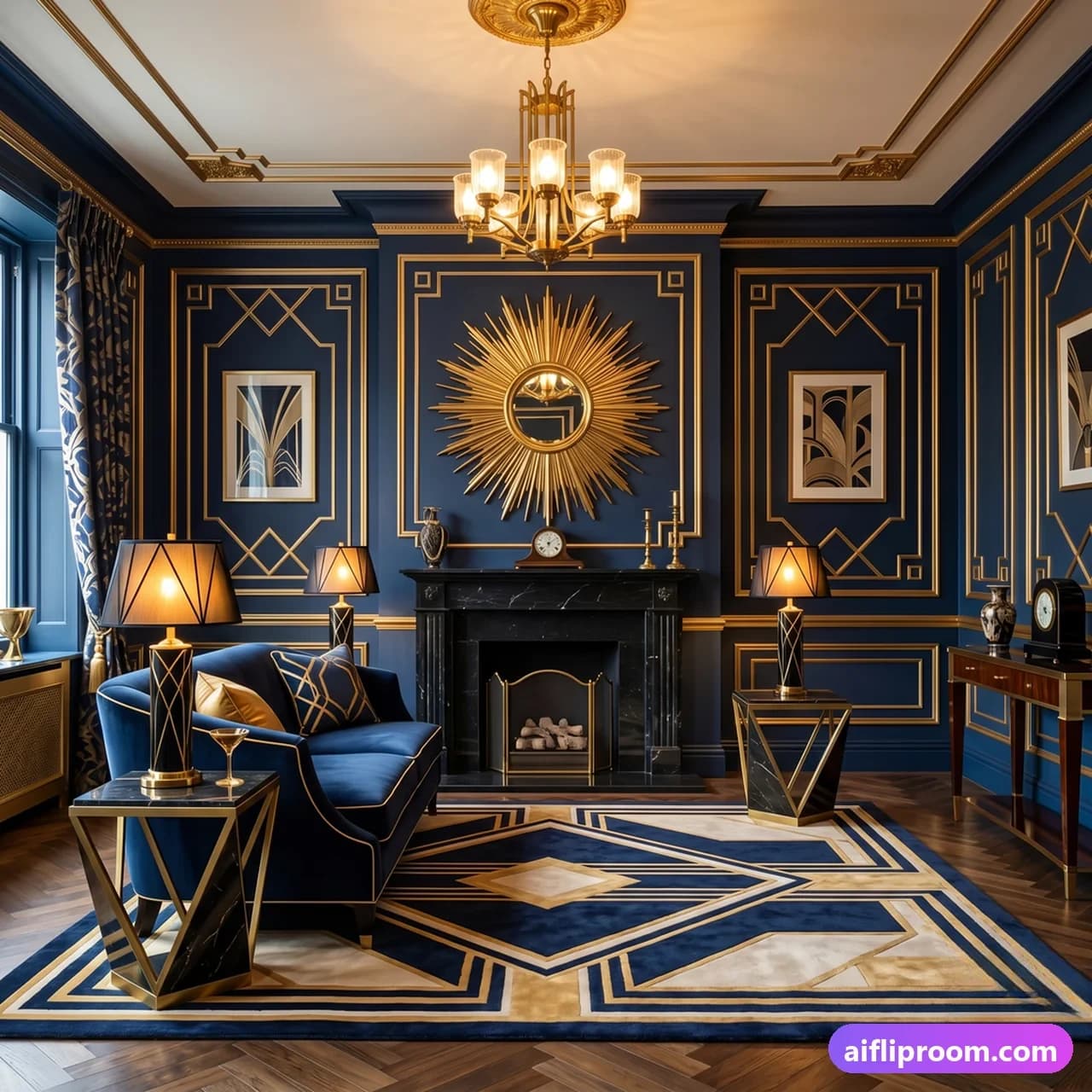
What is Art Deco interior design?
Art Deco emerged in the 1920s and 30s as a style of glamour, optimism and modern confidence — and it still reads that way today. It is bold and graphic where many styles are soft: strong geometric patterns, sunbursts, chevrons and stepped forms appear on walls, floors and furniture. Metallics in gold, brass and chrome catch the light, and the palette runs to rich jewel tones — emerald, sapphire, black — rather than neutrals. Surfaces are glossy and reflective, with lacquer, mirror and polished stone, and lighting is treated as jewellery for the room. Arrangements are symmetrical and deliberately dramatic. The overall effect is one of polished, high-impact luxury with a strong period identity. In staging, Art Deco is a striking choice for upscale listings and for properties with strong architecture that can stand up to — and show off — its drama.
Where Art Deco comes from
Art Deco takes its name from a 1925 Paris exhibition of decorative and industrial arts, and it belongs to a specific mood: the confidence of the 1920s and 1930s, when speed, machines and travel were glamorous and design wanted to look like the future. It drew on Cubism, on Egyptian and Aztec motifs uncovered by the archaeology of the period, and on the streamlined shapes of ocean liners and aircraft. Where the Art Nouveau it replaced was organic and curling, Deco is geometric, symmetrical and deliberately luxurious — exotic veneers, lacquer, chrome, mirror and inlay, all executed with visible precision. It is the last widely loved style that was unapologetic about ornament.
Key elements of Art Deco
- Bold geometric patterns — sunbursts, chevrons
- Metallic finishes in gold, brass and chrome
- Rich jewel-tone colours
- Glossy lacquered and mirrored surfaces
- Statement, jewellery-like lighting
- Symmetrical, dramatic arrangements
When to use Art Deco
Living rooms, bars and primary suites. A glamorous, high-impact look for upscale listings and properties with strong architecture.
Art Deco colours and materials
High contrast and rich. Black and cream or black and white as the structural pair, with jewel tones over the top: emerald, sapphire, ruby, deep amethyst and mustard. Metallics are essential and are the style's signature — gold, brass, chrome and polished nickel. Materials run to lacquered and burled wood, ebony and walnut veneer, marble, mirror and mirrored furniture, velvet, satin and shagreen. Pattern is geometric and confident: chevrons, sunbursts, fans, stepped forms, zigzags. Nothing about the style is subtle, and attempts to make it subtle usually remove the reason to use it.
Art Deco room by room
Living room in Art Deco
A velvet sofa with a curved or channelled back in emerald, sapphire or oxblood, a mirrored or marble-topped coffee table, and a pair of club chairs in leather or velvet. A geometric rug — chevron, fan or stepped pattern — anchors the arrangement. Lighting is where Deco declares itself: a sunburst mirror above the fireplace, a sculptural chrome or brass floor lamp, and a fixture with real geometry overhead. Keep the walls dark or cream and the symmetry strict; Deco rooms are composed rather than arranged.
Bedroom in Art Deco
An upholstered bed with a tall fan-shaped or channelled headboard, satin or high-sheen bedding in a jewel tone, and a pair of mirrored or lacquered nightstands. Matching lamps with geometric bases. A vanity table with a large round mirror is period-correct and gives the room its centrepiece. Use a geometric rug and hang curtains in a heavy fabric with a defined heading — Deco does not do casual window treatments.
Bathroom in Art Deco
The room where Deco is most achievable at reasonable cost. Black and white geometric floor tile, metro or fan-shaped wall tile with a contrasting border, a pedestal or console basin, and polished chrome or brass fittings. A round or fan-shaped mirror, wall sconces mounted either side rather than a light above, and one bold colour in the towels or a painted panel. Symmetry is the whole trick here.
Dining room in Art Deco
A lacquered or veneered table with a strong base, upholstered chairs with curved backs, and a geometric chandelier or a pair of matching pendants. A mirrored or high-gloss sideboard along one wall with a sunburst mirror above it. A bar cart is not optional in a room styled this way — the period invented the ritual and the object suits the style perfectly. Keep the tableware simple; the room is already doing plenty.
Entryway in Art Deco
Black and white geometric floor tile, a console with a mirrored or lacquered front, a fan or sunburst mirror above, and a pair of wall lights either side. Deco entryways are theatrical on purpose — the style is about arrival — and a small hallway can carry more drama than a large room because you pass through it rather than live in it.
Art Deco mistakes to avoid
- Doing it by halves. Deco is a committed style. One geometric cushion in an otherwise neutral room reads as a mistake rather than a nod.
- Gold on everything. The metallics need something to shine against — black, cream, dark velvet. Gold on gold flattens into brass-coloured mush.
- Ignoring symmetry. Deco is composed around a centre line. Asymmetric arrangements lose the formality that makes the style feel designed rather than decorated.
- Cheap mirrored furniture. Thin, wobbly mirrored pieces with visible edges are the single most obvious giveaway. Fewer and better is the rule.
- Mixing it with rustic or coastal. Deco is urban, polished and formal, and it does not blend with styles built on raw materials and informality.
Art Deco questions, answered
What is the difference between Art Deco and Art Nouveau?
Art Nouveau came first, roughly 1890 to 1910, and is organic — flowing lines, plant forms, asymmetry, soft muted colour. Art Deco replaced it in the 1920s and is its opposite: geometric, symmetrical, machine-inspired, high-contrast and metallic. If the lines curve like a vine it is Nouveau; if they step, fan or zigzag it is Deco.
How do I add Art Deco touches without a full redesign?
Three high-impact, low-commitment moves: a sunburst or fan-shaped mirror, a geometric rug, and lighting with real Deco geometry. A velvet chair in a jewel tone or a bar cart in brass will carry the idea further. Keep the rest of the room plain and dark-ish so the pieces have something to stand against.
Is Art Deco suitable for a small room?
It suits small formal rooms unusually well — entryways, powder rooms, bars — because mirror expands the space and the drama is easier to take in short doses. In a small living room, choose one bold element and let everything else be quiet, or the room will feel crowded rather than glamorous.
What patterns are used in Art Deco?
Chevrons and zigzags, sunbursts and fans, stepped or ziggurat forms, concentric circles, scallops, and stylised geometric florals. They appear in flooring, rugs, tile, inlay and fabric. The pattern is always ordered and symmetrical, never loose.
Is Art Deco a good choice for staging a property?
It is a strong choice for period apartments of the era, city flats and any property being marketed on character rather than neutrality. It is a poor choice for a broad-market family home, because it is a decisive style and staging generally works best when buyers can imagine their own things in the room.
Guides to read next
Longer reads on getting a room photographed and restaged well.
- See Your Own Room in a New Style Before You Buy AnythingPreview your actual room in a new style before buying furniture or hiring anyone: what a preview settles, what it can't, and five steps to a useful one.
- How to Photograph Rooms for Virtual Staging: 7 RulesDaylight, lamps off, a level phone at chest height, the 1x lens not 0.5x, one room per frame, clear surfaces — seven habits that make AI staging look real.
- What Is Virtual Staging? The Complete Guide: How It Works, Cost, Rules, ExamplesVirtual staging explained in plain language: how AI furnishes a photo of a real room, what it costs, what agents think of it (NAR 2025), who it helps, the rules and how to spot bad staging.
See your room in Art Deco
Upload a photo and our AI restages it in the Art Deco look in 15–60 seconds, depending on how much detail your room has — keeping your walls, windows and layout intact.
Try Art Deco on your room