Japanese Zen Interior Design
Tatami, shoji screens, bonsai, stone garden, absolute stillness.
Stage your room in Japanese Zen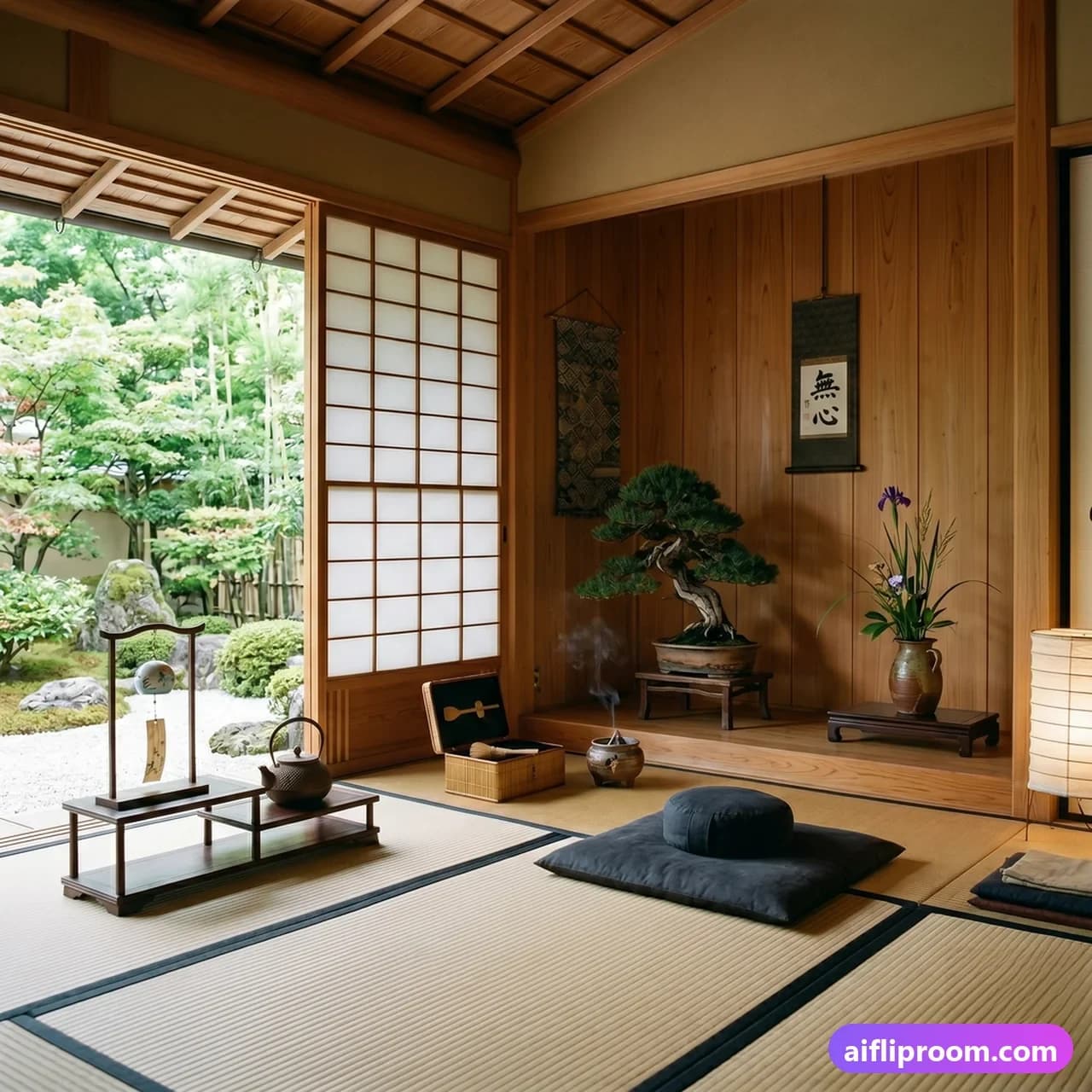
What is Japanese Zen interior design?
Japanese Zen interiors are designed for one thing above all: stillness. Rooted in Zen Buddhism and traditional Japanese living, the style treats empty space as essential rather than unfinished, and removes everything that does not serve calm. Tatami mats define the floor; shoji paper screens diffuse light softly and divide space without walls; natural wood and bamboo carry warmth. A tokonoma-style alcove holds a single, considered arrangement — a branch, a scroll — and nothing competes with it. The palette is muted and natural, the layout near-empty, the light soft and even. The result is a deeply restful, contemplative room. In staging, Japanese Zen is a serene, distinctive choice for bedrooms and meditation or yoga rooms, and it speaks to buyers who want a calm, grounding home.
Where Japanese Zen comes from
Traditional Japanese rooms were designed around a set of constraints that produced, almost incidentally, one of the most influential interiors in the world. Timber frame construction meant walls could be light and movable, so shoji and fusuma screens slide rather than swing and a room can change size during the day. Tatami mats standardised proportion — rooms are still measured in mats — and set the height of everything, because life happened at floor level. Storage went into built-in cupboards so the floor stayed clear. The Zen influence added the rest: an alcove holding a single scroll or arrangement, asymmetry rather than symmetry, and the conviction that empty space is an active part of a room rather than the absence of furniture.
Key elements of Japanese Zen
- Tatami mat flooring
- Shoji paper screen doors
- A minimal, near-empty layout
- Natural wood and bamboo
- A tokonoma alcove with a single arrangement
- Soft, even natural light
When to use Japanese Zen
Bedrooms and meditation or yoga rooms. A serene, distinctive look for buyers who want a calm, contemplative home.
Japanese Zen colours and materials
Almost entirely natural and almost entirely quiet. The colour comes from materials rather than paint: the pale straw of tatami, the warm brown of cedar, cypress and keyaki, the off-white of paper screens, the grey of stone, the black of iron and lacquer. Accents, when they exist, are deep indigo, moss green or a single red. Surfaces are matt and tactile — paper, timber, plaster, stone, raw silk, cotton. Nothing is glossy and nothing is bright. The one strong contrast permitted is dark timber framing against pale paper, which is where the style gets its graphic quality.
Japanese Zen room by room
Living room in Japanese Zen
Keep the centre of the room empty and arrange low seating around the edges — a floor cushion, a low sofa, a small table. Storage should be built in and closed so nothing sits out. If the architecture allows a niche or a shelf recess, treat it as the room's single focal point and put one thing in it: a scroll, a branch, a ceramic. Screens or slatted timber panels filter light rather than blocking it. The measure of success is that the room feels larger empty than it would furnished.
Bedroom in Japanese Zen
A futon or a very low platform bed, plain cotton or linen bedding in white or indigo, and nothing on the walls. Built-in or concealed storage, a paper lamp for low light, and a tatami or plain matting floor if the room can take it. Sliding screens instead of curtains where possible. This is the room where the style is most achievable in an ordinary house, because a bedroom needs very little to function.
Bathroom in Japanese Zen
The Japanese bathroom separates washing from soaking, and the deep soaking tub is the part worth borrowing. Timber — traditionally hinoki cypress — stone, and a wet-room layout with a drained floor. Plain matt tile, a wooden stool and bucket, one plant. Keep the fittings simple and the surfaces clear. Even without a proper soaking tub, a timber duckboard and a stone basin move a standard bathroom a long way toward the style.
Tea or meditation room in Japanese Zen
If there is a spare small room, this is what the style does better than anything else. Tatami or matting, a low table, floor cushions, a single alcove with one object, and a window looking onto something green. No storage on display, no electronics, no decoration. It needs very little space and it is the clearest expression of the whole idea.
Garden view in Japanese Zen
Traditional Japanese interiors are designed around what you can see from them. Where a window or door looks onto any planting, arrange the room so the view is framed from a seated position, and keep the sill clear. Even a courtyard of gravel, one shrub and a stone changes the room it is seen from. This relationship between inside and outside is not decoration in this style; it is structural.
Japanese Zen mistakes to avoid
- Adding Buddha statues and bamboo. Decorative orientalism is not the style — traditional rooms are notably bare, and the objects that do appear are functional or seasonal.
- Keeping the clutter and adding a screen. The look is produced by concealed storage and empty floor. A shoji panel in front of a full room changes nothing.
- Symmetry. Japanese arrangement is deliberately off-centre; matched pairs either side of a bed or a fireplace read as Western.
- Bright, even ceiling light. Shadow and soft diffusion through paper are half the effect.
- Using dark timber everywhere. The contrast between dark frame and pale paper or plaster is what gives the style its clarity; all-dark rooms lose it.
Japanese Zen questions, answered
What is the difference between Japanese Zen and Japandi?
Japanese Zen is the older tradition itself — tatami, shoji, floor-level living, built-in storage, alcove, asymmetry. Japandi is a modern hybrid that borrows its restraint and pairs it with Scandinavian comfort: raised furniture, wool and sheepskin, warmer neutrals. Zen is austerer and closer to the source; Japandi is softer and easier to live in for people not used to it.
Do I need tatami mats for a Zen interior?
No. Tatami sets the proportion and the floor-level habit in a traditional room, but the essentials that travel are concealed storage, a clear floor, low furniture, natural materials, filtered light and one focal object. Plain matting or a light timber floor gets most of the way there.
How do I get the look in a small flat?
It suits small spaces unusually well. Solve storage first so nothing has to sit out, keep furniture low, use a slatted timber or paper screen to divide rather than a wall, choose one warm low light source, and leave one surface deliberately empty. The style's whole instinct is to make a small room feel larger by removing rather than by rearranging.
What is a tokonoma?
A shallow recessed alcove in a traditional Japanese room, slightly raised, holding a single hanging scroll and usually one seasonal flower arrangement or object. It is the focal point of the room and its contents change with the season. In a modern home the equivalent is a single niche or shelf treated as the one place decoration is allowed.
Is Zen styling good for staging a property?
It photographs as exceptionally calm and makes small rooms read as larger, which are both useful. The risk is the same as with any very sparse style: buyers can struggle to judge how their own furniture would fit. A slightly furnished version — low seating, a rug, one plant — keeps the calm and gives the eye something to measure against.
Guides to read next
Longer reads on getting a room photographed and restaged well.
- See Your Own Room in a New Style Before You Buy AnythingPreview your actual room in a new style before buying furniture or hiring anyone: what a preview settles, what it can't, and five steps to a useful one.
- How to Photograph Rooms for Virtual Staging: 7 RulesDaylight, lamps off, a level phone at chest height, the 1x lens not 0.5x, one room per frame, clear surfaces — seven habits that make AI staging look real.
- What Is Virtual Staging? The Complete Guide: How It Works, Cost, Rules, ExamplesVirtual staging explained in plain language: how AI furnishes a photo of a real room, what it costs, what agents think of it (NAR 2025), who it helps, the rules and how to spot bad staging.
See your room in Japanese Zen
Upload a photo and our AI restages it in the Japanese Zen look in 15–60 seconds, depending on how much detail your room has — keeping your walls, windows and layout intact.
Try Japanese Zen on your room