Southwestern Interior Design
American desert palette — adobe walls, Navajo patterns, terracotta, leather.
Stage your room in Southwestern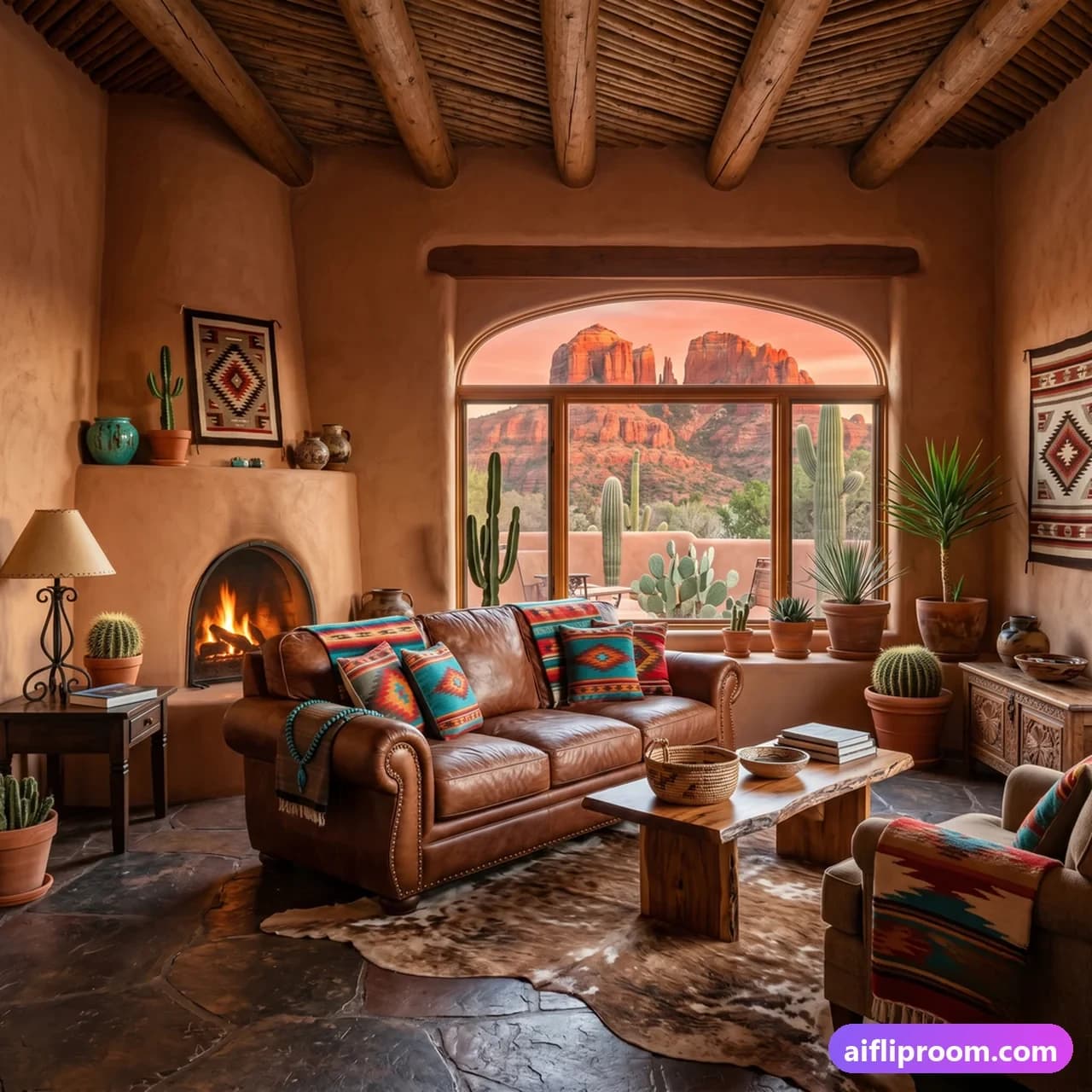
What is Southwestern interior design?
Southwestern style draws on the landscape and cultures of the American desert — Arizona, New Mexico and the wider Sonoran region. It is warm, grounded and earthy. Adobe-style walls in terracotta and clay set the backdrop; Navajo-inspired woven patterns appear on rugs and textiles; leather furniture and turquoise accents add craft and colour. Wooden ceiling beams, known as vigas, and pottery in clay and terracotta complete the picture, while cacti and desert plants tie the room to its setting. The palette is sunbaked — rust, sand, ochre — lifted by turquoise. The result is a characterful, rooted look with a strong regional identity. In staging, Southwestern style suits living rooms in warm-climate and desert-region properties, and it appeals to buyers who want a grounded, distinctive home.
Where Southwestern comes from
Southwestern design comes from the American Southwest, where three building traditions met: Indigenous Pueblo construction in adobe, Spanish colonial architecture, and later Anglo-American settlement. Thick earthen walls moderated extreme temperature swings, small deep-set windows kept out sun, and rounded openings and vigas — the projecting roof beams — came from how the buildings were actually made. The textiles, pottery and weaving that define the look are living Indigenous craft traditions, principally Navajo and Pueblo, not historical motifs. That matters practically as well as ethically: buying genuine work from Native artisans gets you better objects and supports the people who make them, while mass-produced imitations are both worse and, in the case of falsely labelled goods, illegal in the United States.
Key elements of Southwestern
- Adobe-style walls in warm terracotta
- Navajo-inspired woven patterns
- Leather furniture with turquoise accents
- Wooden ceiling beams (vigas)
- Clay and terracotta pottery
- A sunbaked palette of rust, sand and ochre
When to use Southwestern
Living rooms in warm-climate and desert-region properties. Appeals to buyers who want a grounded, characterful home with a strong regional identity.
Southwestern colours and materials
The desert at different times of day. Sand, adobe pink, terracotta and clay as the base, with turquoise, burnt orange, rust, mustard and deep red as accents, and sage and cactus green from the planting. Black appears in ironwork and pottery. Materials are earthen plaster and adobe, rough timber beams and posts, leather and hide, hand-woven wool, terracotta and clay pottery, wrought iron, and woven baskets. Pattern is geometric and comes from weaving — stepped, banded, diamond forms. Everything is matt, warm and slightly rough; nothing is polished.
Southwestern room by room
Living room in Southwestern
Plastered walls in a warm adobe or sand tone, exposed timber beams if the building allows, and a kiva-style corner fireplace if you are lucky enough to have one. A leather sofa, chairs with hide or woven upholstery, and a hand-woven wool rug in a geometric pattern. Terracotta and clay pottery in varied sizes, woven baskets, and a cactus or two in large pots. Wrought-iron lighting. Keep the walls mostly plain so the textiles and pottery carry the colour.
Bedroom in Southwestern
A carved or plain timber bed, white cotton bedding with a woven blanket folded across, and plastered walls. A wool rug, a wooden chest, and a niche or shelf holding pottery. Iron or ceramic lamps, shutters or simple linen at the window. The room should feel cool and earthen — the palette does the warmth without needing much in it.
Kitchen in Southwestern
Timber cabinetry or plastered open shelving, a tiled worktop or splashback in hand-painted Talavera-style tile, and terracotta or saltillo floor tile. Copper or clay cookware on display, woven baskets for storage, and a heavy wooden table. Iron hardware and a wrought-iron light over the table. The blue and yellow of painted tile is the one place bright colour belongs in this palette.
Dining room in Southwestern
A solid timber table with simple chairs or a bench, a wrought-iron chandelier, and a woven runner rather than a cloth. Pottery displayed on a sideboard or in a wall niche. Plastered walls with one woven textile hung as art. Keep the setting plain and let the ceramics be the decoration.
Patio or courtyard in Southwestern
Central to how these houses work. Shade from a ramada or pergola, timber or iron furniture with woven or leather seats, a fire pit or chimenea, and terracotta pots planted with agave, prickly pear and desert grasses. Gravel or flagstone underfoot, lanterns for the evening. The temperature swing between day and night is what the outdoor room exists for.
Southwestern mistakes to avoid
- Buying mass-produced imitations of Native textiles and pottery. They are worse objects, and in the United States falsely presenting goods as Native-made is against the law. Buy from Native artisans or buy something that is honestly its own thing.
- Treating living cultures as motifs. Navajo and Pueblo weaving and pottery are ongoing traditions with specific meanings, not decorative patterns to scatter.
- Too much pattern. One or two woven pieces per room, against plain plaster. Geometric pattern on the rug, the cushions, the curtains and the wall is exhausting.
- Cool or grey walls. The palette is earthen and warm; a cool base makes the whole scheme look muddy.
- Cactus everywhere. A couple of well-chosen plants in good pots read as regional. A shelf of small succulents reads as a garden centre.
Southwestern questions, answered
What defines southwestern interior design?
Earthen plastered or adobe walls, exposed timber beams and posts, rounded openings, terracotta floors, and a desert palette of sand, clay and terracotta with turquoise and burnt orange accents. Hand-woven wool textiles, clay pottery, leather and wrought iron supply the detail. The style comes from Pueblo, Spanish colonial and later American building traditions in the American Southwest.
How do I buy southwestern textiles and pottery responsibly?
Buy directly from Native artisans, from tribal cooperatives, or from dealers who name the maker and the community. In the United States the Indian Arts and Crafts Act makes it illegal to market goods as Native-produced when they are not, so a seller who can name the artist is both more trustworthy and more likely to be selling genuine work. If something is inspired rather than authentic, it is better sold and bought as exactly that.
What is the difference between southwestern and desert modern?
Southwestern is traditional and textile-rich: adobe, beams, woven rugs, pottery, wrought iron. Desert modern is a contemporary style that borrows the same palette and landscape but pairs it with clean-lined mid-century and modern furniture, large glass and minimal ornament. Same desert, very different furniture.
What colours are southwestern?
Sand, adobe pink, terracotta and clay as the base, with turquoise, burnt orange, rust, mustard and deep red as accents, plus sage and cactus green. Everything is warm and matt. Cool greys and cold whites sit outside the palette entirely.
Does southwestern styling work outside the Southwest?
The palette and materials travel well — warm earth tones, leather, wool, pottery and plaster read as grounded anywhere. The architectural elements, adobe walls and vigas, do not, and reproducing them elsewhere tends to look like scenery. Leading with colour, textile and pottery is the version that works.
Guides to read next
Longer reads on getting a room photographed and restaged well.
- See Your Own Room in a New Style Before You Buy AnythingPreview your actual room in a new style before buying furniture or hiring anyone: what a preview settles, what it can't, and five steps to a useful one.
- How to Photograph Rooms for Virtual Staging: 7 RulesDaylight, lamps off, a level phone at chest height, the 1x lens not 0.5x, one room per frame, clear surfaces — seven habits that make AI staging look real.
- What Is Virtual Staging? The Complete Guide: How It Works, Cost, Rules, ExamplesVirtual staging explained in plain language: how AI furnishes a photo of a real room, what it costs, what agents think of it (NAR 2025), who it helps, the rules and how to spot bad staging.
See your room in Southwestern
Upload a photo and our AI restages it in the Southwestern look in 15–60 seconds, depending on how much detail your room has — keeping your walls, windows and layout intact.
Try Southwestern on your room