Tuscan / Italian Interior Design
Stone walls, hand-hewn beams, wrought iron, ochre warmth, villa charm.
Stage your room in Tuscan / Italian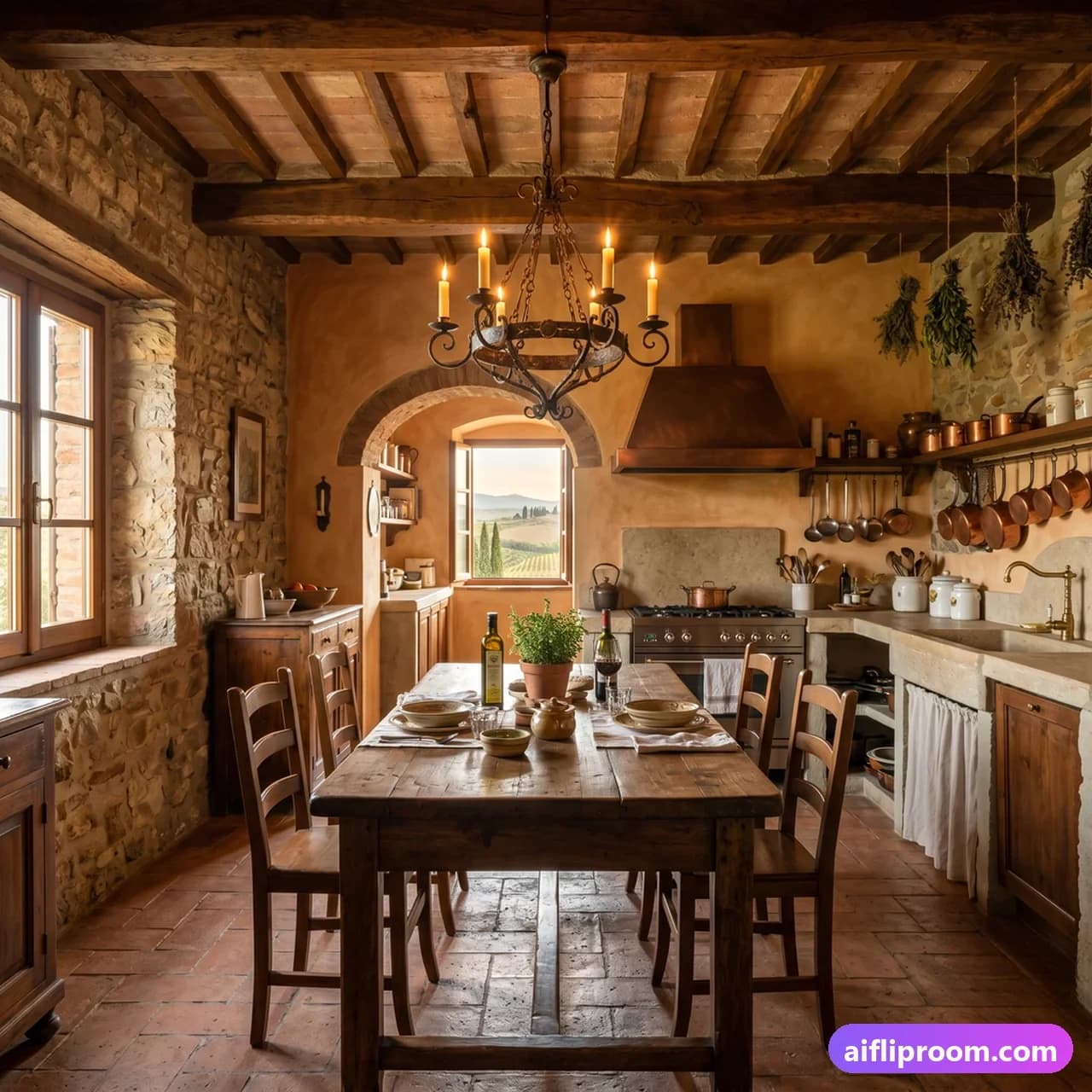
What is Tuscan / Italian interior design?
Tuscan, or Italian, style evokes the rural villas and farmhouses of central Italy — homes that have been warm, hospitable and unhurried for centuries. It is built from honest, weathered materials. Exposed stone walls and hand-hewn wooden ceiling beams give a room age and structure; terracotta floor tiles run warm underfoot; warm ochre and sienna walls glow in the light. Wrought-iron lighting and details add craft, and the furniture is rustic and substantial, built to last and to gather around. There is nothing precious here — the look is generous and lived-in. The overall feeling is warm, gracious and timeless. In staging, Tuscan style is a natural fit for kitchens, dining rooms and living rooms in countryside and villa-style properties, where it works with the architecture and feels effortlessly inviting.
Where Tuscan / Italian comes from
Tuscan interiors come from farmhouses built out of the hillside they sit on. Thick stone walls, small windows, terracotta floors and heavy chestnut beams were structural answers to heat, and the plaster over them was tinted with local earth, which is where the ochres, siennas and umbers come from. Furniture was made locally in oak and walnut, wrought iron did the work that lighter materials could not, and the kitchen was the centre of everything because it held the fire. The style became a fixture of North American decorating in the 1990s and 2000s in a much heavier, darker and more ornate form than anything in Italy, and that version — deep gold walls, elaborate ironwork, faux-aged everything — is what now reads as dated. The original is simpler and much lighter than its reputation.
Key elements of Tuscan / Italian
- Exposed stone walls
- Hand-hewn wooden ceiling beams
- Terracotta floor tiles
- Wrought-iron lighting and details
- Warm ochre and sienna walls
- Rustic, substantial wood furniture
When to use Tuscan / Italian
Kitchens, dining rooms and living rooms. A warm, characterful look for countryside and villa-style properties.
Tuscan / Italian colours and materials
Earth pigments straight from the ground: ochre, sienna, umber, terracotta and warm sand, with olive and sage green, and the deep red of local wine and tile. Cream and stone provide the relief. Woods are mid-toned chestnut, oak and walnut, and iron is black and hand-forged. Materials are lime plaster with visible variation, stone, terracotta tile, wrought iron, linen, and glazed ceramic in yellow, green and blue. The mistake almost everyone makes is saturating the palette — authentic Tuscan colour is dusty and sun-worn, closer to a plaster wall than to a paint chart.
Tuscan / Italian room by room
Kitchen in Tuscan / Italian
The centre of the house and the room worth doing properly. A heavy wooden table large enough to work at and eat at, stone or timber worktops, and open shelving or a plate rack holding glazed ceramics. A range set into a plastered recess, copper pans hanging within reach, and terracotta tile underfoot. Cabinetry in plain timber or painted a chalky olive or cream. Garlic, herbs, oil and a bowl of tomatoes on the counter — Tuscan kitchens look best in use, and staging one spotless misses what makes it appealing.
Living room in Tuscan / Italian
Plastered walls in a warm sand or pale ochre, exposed beams if the building has them, and a stone fireplace as the focal point. A comfortable linen sofa, leather or timber chairs, and a worn rug over terracotta or timber flooring. A large wooden chest or credenza, wrought-iron lighting, and one or two pieces of art or an old mirror. Keep the room sparse — these were not crowded houses.
Bedroom in Tuscan / Italian
A wrought-iron or simple wooden bed, white linen bedding, and plastered walls in a soft warm tone. Shutters at the window. A wooden chest, a rush-seated chair, and a rug beside the bed. One iron light fitting or a pair of simple wall lights. The room should feel cool and plain — the colour and the material do the work, and almost nothing else is needed.
Dining room in Tuscan / Italian
A long wooden table with a scrubbed top, simple chairs or a bench, and a wrought-iron chandelier. A credenza holding glassware and ceramics, plastered walls, and a stone or tile floor. Linen napkins, a jug of wine, plain white plates. As in the kitchen, informality is correct; a formally set table belongs to a different style.
Terrace or courtyard in Tuscan / Italian
As important as any interior room. A wooden or stone table under a pergola with vines over it, simple chairs, terracotta pots with lemon, rosemary, olive and geranium, and gravel or stone underfoot. Lanterns or string lights for the evening. This is where the house was actually used for half the year, and reproducing it even at balcony scale changes how the interior feels.
Tuscan / Italian mistakes to avoid
- Saturated gold and burgundy walls. The 2000s version of Tuscan is what dated; real Tuscan plaster is dusty, uneven and much paler than people expect.
- Ornate faux finishes. Sponged, ragged and stencilled walls read as decorating from twenty years ago. Plain lime plaster with natural variation is both more authentic and calmer.
- Heavy carved reproduction furniture. Farmhouse pieces were simple and sturdy. Elaborate carving belongs to Italian formal styles, not to this one.
- Iron everywhere. Wrought iron is structural — a light fitting, a bed, a rail. Iron accessories on every surface turn it into a theme.
- Crowding the rooms. These houses were sparsely furnished with a few large pieces. Filling them loses the calm entirely.
Tuscan / Italian questions, answered
What is Tuscan interior design?
The interior style of rural Tuscan and central Italian farmhouses: thick plastered walls in earth tones, exposed timber beams, terracotta floors, stone fireplaces, wrought iron and simple locally made wooden furniture. The kitchen is the centre of the house and the outdoor terrace is treated as another room.
Why does Tuscan style look dated?
Because the version that spread through North American housing in the 1990s and 2000s was much heavier than the original — saturated gold and burgundy walls, sponged faux finishes, ornate ironwork and elaborate reproduction furniture. That specific interpretation dated badly. The actual Tuscan farmhouse look, which is pale, plain and sparse, has not.
What colours are authentic Tuscan?
Earth pigments: ochre, sienna, umber, terracotta and warm sand, with olive and sage, cream and stone. All of them are dusty and slightly faded rather than rich. If a colour looks vivid on the wall, it is almost certainly two or three shades too strong.
What is the difference between Tuscan and broader Mediterranean style?
Tuscan is one regional branch and is the warmest and earthiest of them — ochre, chestnut, iron, terracotta. The wider Mediterranean look, especially its Greek and Spanish coastal versions, is lighter and more whitewashed, with blue accents and less timber. Tuscan feels like a hillside farmhouse; coastal Mediterranean feels like a house by the sea.
Can I do Tuscan style in a modern home?
Yes, by leading with plaster, palette and material rather than architecture. A limewash or textured plaster wall in a soft ochre, a heavy wooden table, iron lighting, terracotta pots and linen will carry it. Skip fake beams and applied stone, which need a building that already has them to look like anything but scenery.
Guides to read next
Longer reads on getting a room photographed and restaged well.
- See Your Own Room in a New Style Before You Buy AnythingPreview your actual room in a new style before buying furniture or hiring anyone: what a preview settles, what it can't, and five steps to a useful one.
- How to Photograph Rooms for Virtual Staging: 7 RulesDaylight, lamps off, a level phone at chest height, the 1x lens not 0.5x, one room per frame, clear surfaces — seven habits that make AI staging look real.
- What Is Virtual Staging? The Complete Guide: How It Works, Cost, Rules, ExamplesVirtual staging explained in plain language: how AI furnishes a photo of a real room, what it costs, what agents think of it (NAR 2025), who it helps, the rules and how to spot bad staging.
See your room in Tuscan / Italian
Upload a photo and our AI restages it in the Tuscan / Italian look in 15–60 seconds, depending on how much detail your room has — keeping your walls, windows and layout intact.
Try Tuscan / Italian on your room