Moroccan Interior Design
Zellige tiles, brass lanterns, carved arches, jewel tones.
Stage your room in Moroccan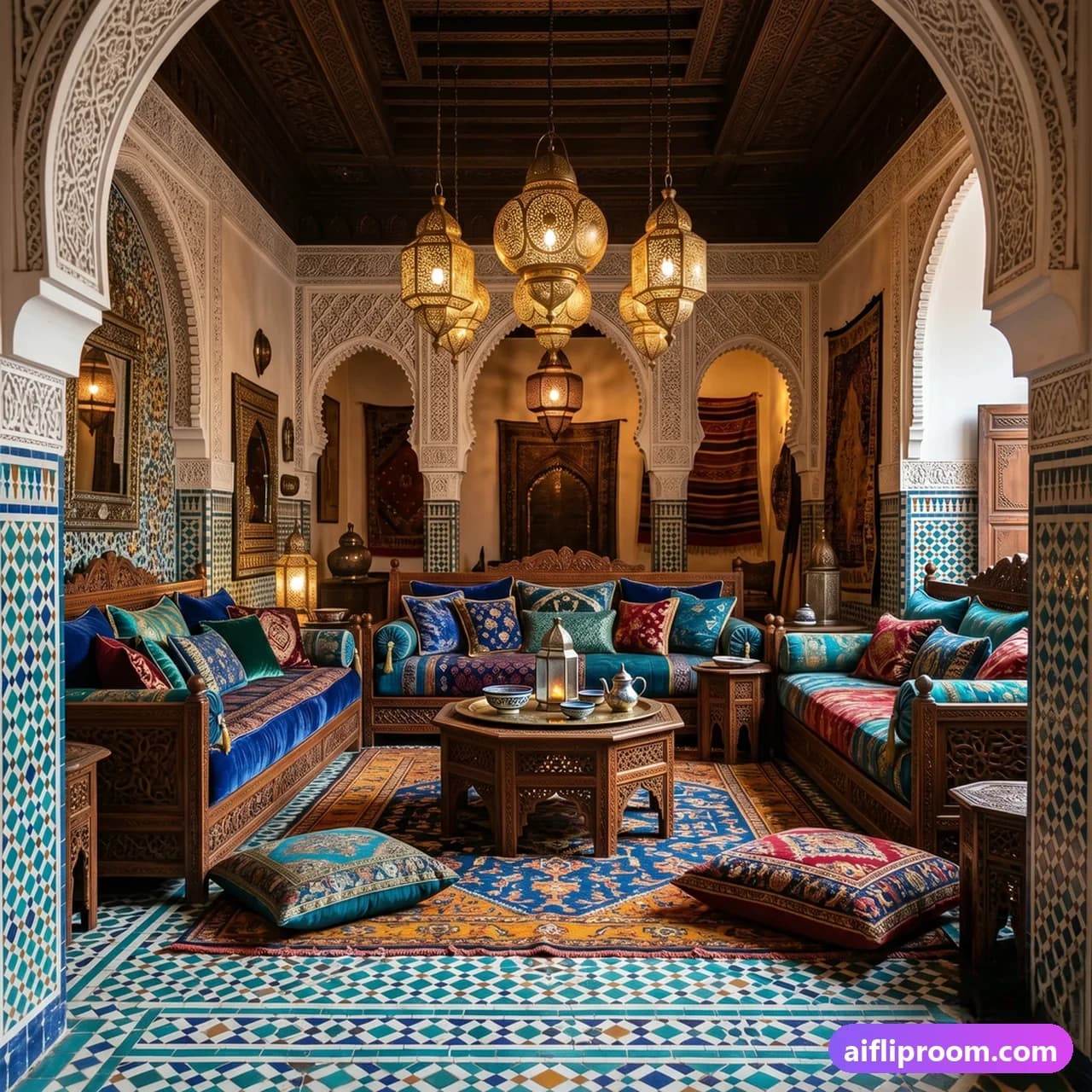
What is Moroccan interior design?
Moroccan style is rich, sensory and deeply handcrafted — a look built from centuries of pattern, colour and skilled work. Hand-painted zellige tile, in turquoise and cobalt, covers floors and walls; carved plaster and arched forms shape doorways and niches; brass and metal lanterns hang overhead, scattering patterned light. The palette is warm and jewel-toned, layered with kilim rugs and textiles that pile up without apology. Furniture sits low and is often carved, and every surface seems to carry a pattern. Nothing here is plain, yet the warmth and craft keep it inviting rather than overwhelming. In staging, Moroccan style is a striking choice for living rooms and lounges where you want real warmth, drama and a strong sense of place, and it appeals to buyers drawn to exotic, characterful interiors.
Where Moroccan comes from
Moroccan interiors are a meeting point of several traditions — Amazigh, Arab, Andalusian and, later, French — worked out over centuries in a hot climate. The riad, a house built inward around a courtyard, is the organising idea: blank outside walls, all the light and life turned toward a central open space with water and planting in it. Thick walls and small openings kept the heat out; tadelakt plaster made surfaces waterproof and luminous; zellige, cut and set by hand, gave craftsmen a way to make pattern without depicting figures. The carved plaster, the cedar ceilings and the layered rugs all came from workshops where the skill passed down through families. It is one of the most genuinely handmade styles in circulation, and that is exactly what the mass-produced version loses.
Key elements of Moroccan
- Hand-painted zellige tile in turquoise and cobalt
- Carved plaster and arched forms
- Hanging brass and metal lanterns
- A warm, jewel-toned palette
- Layered kilim rugs and textiles
- Low, carved-wood furniture
When to use Moroccan
Living rooms and lounges where you want warmth, drama and a strong sense of place. Appeals to buyers drawn to exotic, characterful interiors.
Moroccan colours and materials
A warm earthen base — sand, clay, ochre, terracotta and the pinkish tone of Marrakech plaster — with jewel accents over it: cobalt and turquoise, emerald, saffron, deep rose and aubergine. Brass and copper everywhere, usually pierced or hammered. Materials are tadelakt and lime plaster, hand-cut zellige with its uneven glaze, carved cedar and beech, wrought iron, hand-knotted wool rugs, leather pouffes, and cotton or silk with woven or embroidered detail. Pattern is geometric and interlacing rather than figurative, and it appears on floors, in tile bands and in textiles rather than on every surface at once.
Moroccan room by room
Living room in Moroccan
Seat the room low and around the edges, as a traditional salon does: a long banquette or a deep sofa with plenty of cushions in mixed patterns sharing a colour, leather pouffes for extra seating, and a low brass or carved wood table in the middle. Layer two rugs — a flatweave under a knotted one. Plaster walls in a warm clay tone, a band of zellige or a carved plaster detail if the budget allows one, and pierced brass lanterns casting patterned shadow. Keep the centre of the floor open so the room can hold people.
Bedroom in Moroccan
A low bed, white cotton or linen bedding, and a wall behind it in tadelakt or a warm plaster. One or two hand-knotted rugs, a carved wooden chest, and a pierced lantern or a pair of wall sconces for low patterned light. Keep the textiles to two or three patterns in one colour family, and let the wall finish be the main event. Shutters or a simple linen curtain at the window.
Bathroom in Moroccan
The room where Moroccan design is most copied and most worth copying. Tadelakt on the walls and often on the basin itself, zellige tile in a single strong colour, a brass tap, an arched niche and an arched mirror. The unevenness of hand-cut tile and hand-applied plaster is the point — a machine-perfect version of the same room reads as a hotel bathroom. Add a wooden stool, linen towels and one plant.
Dining area in Moroccan
A round table, low or standard height, with chairs or a banquette, and a large pierced pendant above it. Hand-glazed tagines and ceramics, brass trays used as serving surfaces, and a patterned tile floor if the room can carry one. Lighting should be warm and low so the pierced metalwork throws pattern onto the walls, which is the effect the whole lighting tradition exists for.
Courtyard or terrace in Moroccan
The heart of a riad and worth reproducing at any scale. Tile underfoot, a low table and floor seating with cushions, potted citrus and palms, and a water feature even if it is only a bowl. Lanterns for the evening and a canopy or pergola for shade. If there is a balcony rather than a courtyard, the same ingredients scaled down still work.
Moroccan mistakes to avoid
- Buying machine-made zellige. The whole character of the tile is in the irregular cut and the uneven glaze. A perfectly uniform printed version delivers none of it.
- Pattern on every surface. Traditional rooms have large areas of plain plaster between the decorated ones. Continuous pattern is exhausting and, historically, wrong.
- Treating it as a theme. Lanterns, pouffes and a camel print bought together produce a restaurant. One or two genuinely handmade pieces do more than a dozen souvenirs.
- Cool white walls. The plaster tones are warm, pink and earthen; a cool base makes the jewel colours look garish rather than rich.
- Bright overhead lighting. The pierced lanterns exist to throw pattern; a bright ceiling fixture erases the effect entirely.
Moroccan questions, answered
What is zellige tile?
Hand-cut glazed terracotta tile from Morocco, chipped to shape by hand and set into geometric patterns. Its defining quality is irregularity — variation in thickness, edge and glaze, so a finished surface has visible movement and light. That irregularity is why it looks alive and why machine-made imitations do not.
What is tadelakt?
A traditional Moroccan lime plaster, polished with a stone and sealed with black soap, which makes it waterproof and gives it a soft, slightly luminous, seamless finish. It is used on walls, basins and baths, and it is one of the few genuinely waterproof surfaces that has no grout lines at all.
How do I add Moroccan touches without a full redesign?
Three high-impact moves: a pierced brass or iron lantern for the light it throws, a hand-knotted rug, and one arched shape — a mirror, a niche or a painted arch behind a bed. A leather pouffe and a few cushions in geometric weaves finish it. Keep the walls plain and warm so the pieces have room to read.
What colours are Moroccan interiors?
A warm earthen base of sand, clay, ochre and terracotta, with jewel accents in cobalt, turquoise, emerald, saffron and deep rose. Brass and copper run through everything. The base should be the larger part by a long way — the jewel tones are accents, not the scheme.
Is Moroccan style suitable for staging a property?
As a full scheme it is too specific for most listings, since it is a decisive look and staging works best when buyers can imagine their own things in a room. A restrained version — plaster walls, one rug, warm metal lighting — reads as characterful without committing the property to a theme, and that is usually the better use of it.
Guides to read next
Longer reads on getting a room photographed and restaged well.
- See Your Own Room in a New Style Before You Buy AnythingPreview your actual room in a new style before buying furniture or hiring anyone: what a preview settles, what it can't, and five steps to a useful one.
- How to Photograph Rooms for Virtual Staging: 7 RulesDaylight, lamps off, a level phone at chest height, the 1x lens not 0.5x, one room per frame, clear surfaces — seven habits that make AI staging look real.
- What Is Virtual Staging? The Complete Guide: How It Works, Cost, Rules, ExamplesVirtual staging explained in plain language: how AI furnishes a photo of a real room, what it costs, what agents think of it (NAR 2025), who it helps, the rules and how to spot bad staging.
See your room in Moroccan
Upload a photo and our AI restages it in the Moroccan look in 15–60 seconds, depending on how much detail your room has — keeping your walls, windows and layout intact.
Try Moroccan on your room