Maximalist Interior Design
Layered patterns, rich colors, bold textures, abundant decor.
Stage your room in Maximalist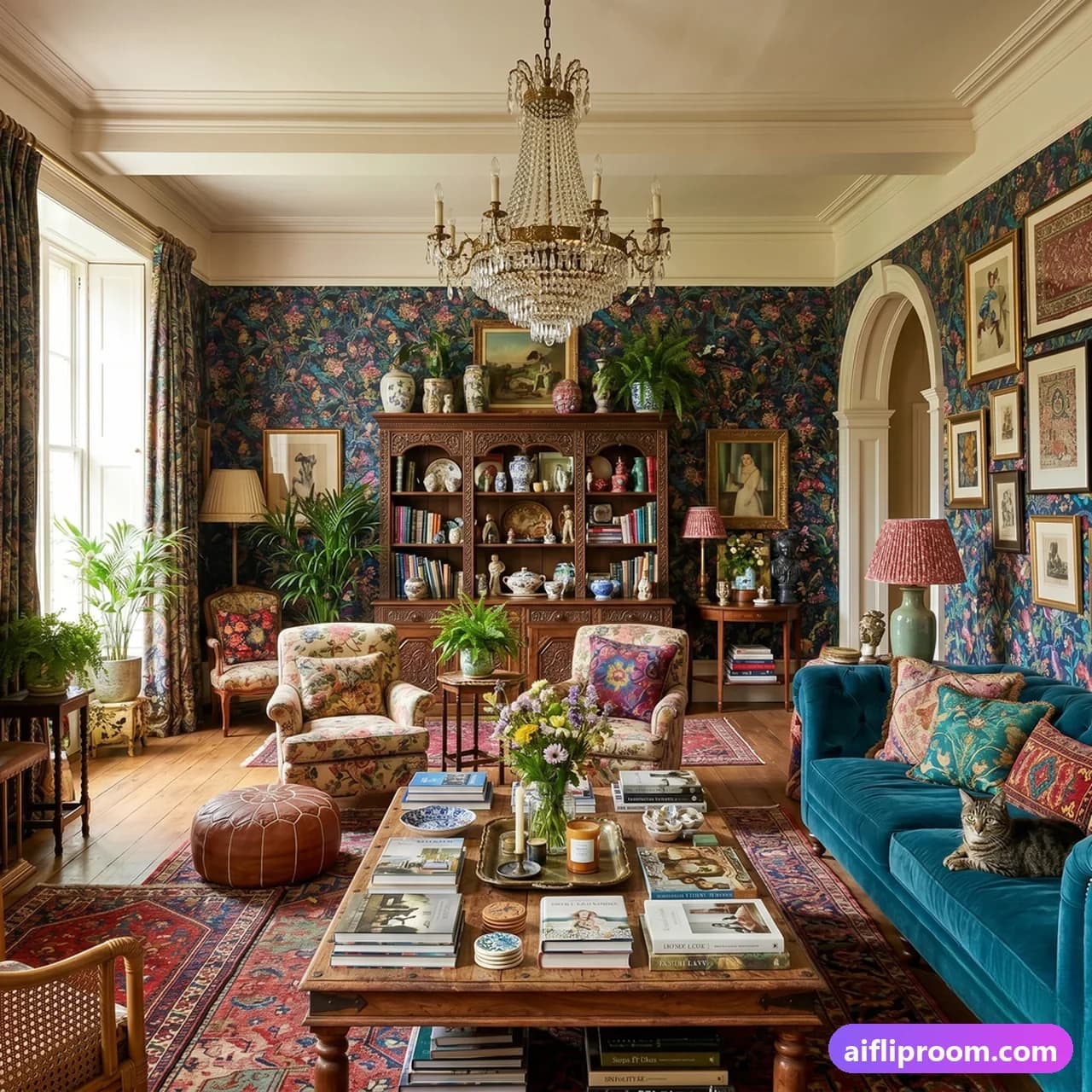
What is Maximalist interior design?
Maximalism is the confident opposite of minimalism: where one strips a room back, the other layers it up. The principle is “more is more” — rich colour, abundant pattern, texture upon texture, and decor that fills a room with personality. But good maximalism is not chaos; it is curation turned up loud. Saturated colours and layered patterns are held together by a designer's eye, gallery walls are hung with intent, and statement furniture and art give each room a clear point of view. Bold wallpaper or painted walls set the tone. The result is a space that feels alive, characterful and unmistakably someone's. In staging, maximalism is a high-impact choice for buyers who want drama and individuality rather than a blank canvas; it performs best in rooms with good light and strong architecture that can carry the energy.
Where Maximalist comes from
Maximalism is best understood as a reaction. After two decades in which grey, beige and empty surfaces were the default, a generation of decorators pushed hard the other way — saturated colour, pattern on pattern, collections displayed rather than stored, walls covered rather than left blank. The instinct is not new; nineteenth-century interiors were densely layered as a matter of course, and the mid-century had its own maximalist streak. What is new is that it is now a choice rather than a convention, which changes how it has to be done. A Victorian room accumulated over decades. A maximalist room today has to look as though it did, and the difference between one that works and one that does not is whether the layering has an underlying order.
Key elements of Maximalist
- Rich, saturated colours
- Layered patterns and textures
- Gallery walls and abundant, intentional decor
- Statement furniture and art
- Bold wallpaper or painted walls
- A curated, fearless, but cohesive mix
When to use Maximalist
Living rooms and dining spaces aimed at buyers who want character and drama. Best in rooms with good light and architecture to carry the energy.
Maximalist colours and materials
Rich, deep and confident: emerald, teal, sapphire, oxblood, mustard, aubergine, terracotta and hot pink, frequently several of them in the same room. Walls are dark or strongly coloured far more often than white, and wallpaper is a first choice rather than a last resort. Materials are lush — velvet, silk, brocade, lacquer, brass, marble, mirror — with plenty of pattern in the textiles. The organising trick that keeps it from chaos is repetition: pick two or three colours and make sure each one appears at least three times around the room, at different scales. Without that, the room is not maximalist, it is just full.
Maximalist room by room
Living room in Maximalist
Paint or paper the walls in something decisive — this is not a style that works over magnolia. A velvet sofa in a deep colour, armchairs in a contrasting pattern, a patterned rug that shares one colour with both. Layer art across the wall in a proper gallery arrangement rather than a single centred piece. Plants, books, ceramics and objects on every horizontal surface, but grouped rather than spread. The room should reward looking at it twice, and the way you make that happen is scale variation: one enormous pattern, one medium, one small.
Bedroom in Maximalist
A patterned or upholstered headboard, bedding that mixes at least two patterns from the same family, and a wallpaper or strong colour behind the bed. Lamps with decorative bases and coloured or patterned shades. A rug with real pattern, and art hung right up to the ceiling. Maximalist bedrooms feel enveloping rather than restful in the minimalist sense, and for a lot of people that is exactly why they sleep better in them.
Dining room in Maximalist
The best room in the house for the style, because dining rooms are used in the evening under low light and can carry more drama than a room you sit in all day. Dark walls, a bold chandelier, chairs upholstered in a pattern, a large piece of art or a full gallery wall, and a sideboard displaying glassware and ceramics. Candles rather than bright overhead light. If you only commit to one maximalist room, make it this one.
Hallway in Maximalist
A hallway is passed through rather than lived in, which makes it the safest place to be bold. Strong wallpaper, a runner with pattern, art hung densely, a painted door in an unexpected colour. It sets the tone for the whole house in the ten seconds someone spends in it, and nobody has to sit in it all evening.
Home office in Maximalist
Books, art, objects and colour all have somewhere to go in a working room, and the style suits shelves better than any other. Papered or deeply painted walls, a patterned rug, open shelving arranged as display rather than storage, and a desk lamp with presence. The one discipline is keeping the working surface itself clear, or the room stops being usable.
Maximalist mistakes to avoid
- More is not the method. Maximalism is layering with a rule underneath — usually a repeated palette. Without that, a full room reads as a room nobody has tidied.
- Patterns at the same scale. Three medium-sized florals fight. One large, one medium and one small, sharing a colour, sit together.
- Timid colour. Half-committing produces the worst outcome: a beige room with too many objects in it. If the walls stay pale, the style has nothing to push against.
- Displaying everything you own. Editing still exists here; the collections on show should be chosen, and the rest stored.
- Ignoring the light. Dark, layered rooms need several warm light sources or they turn gloomy rather than atmospheric.
Maximalist questions, answered
What is maximalist interior design?
A deliberately layered approach built on rich colour, mixed pattern, displayed collections and decorated walls. It is the opposite instinct to minimalism: where minimalism removes until nothing is unnecessary, maximalism adds until the room has personality. Done properly it is highly organised — the layering follows a repeated palette and a deliberate mix of pattern scales.
How do I mix patterns without it looking chaotic?
Two rules cover most of it. Share a colour: every pattern in the room should contain at least one shade the others also contain. And vary the scale: one large pattern, one medium, one small. If a combination still feels wrong, it is usually because two patterns are the same size rather than because there are too many.
Does maximalism work in a small room?
Often better than in a large one. Small rooms are hard to make feel spacious anyway, so leaning into enclosure works with the space rather than against it. Dark walls, pattern and dense art make a small hallway, cloakroom or dining room feel deliberate rather than cramped.
What is the difference between maximalist and eclectic?
Eclectic means mixing periods and styles, and it can be sparse. Maximalism is about density and richness, and it can be stylistically consistent. A room with three well-chosen pieces from three eras is eclectic and not maximalist; a room densely layered entirely in one period is maximalist and not eclectic.
Is maximalism a good idea for staging a property?
Generally not for the main rooms. Staging works by helping buyers imagine their own life in a space, and a strongly personal scheme makes that harder. It can be effective in a single small room — a hallway or dining room — to give a listing character, provided the principal rooms stay neutral.
Guides to read next
Longer reads on getting a room photographed and restaged well.
- See Your Own Room in a New Style Before You Buy AnythingPreview your actual room in a new style before buying furniture or hiring anyone: what a preview settles, what it can't, and five steps to a useful one.
- How to Photograph Rooms for Virtual Staging: 7 RulesDaylight, lamps off, a level phone at chest height, the 1x lens not 0.5x, one room per frame, clear surfaces — seven habits that make AI staging look real.
- What Is Virtual Staging? The Complete Guide: How It Works, Cost, Rules, ExamplesVirtual staging explained in plain language: how AI furnishes a photo of a real room, what it costs, what agents think of it (NAR 2025), who it helps, the rules and how to spot bad staging.
See your room in Maximalist
Upload a photo and our AI restages it in the Maximalist look in 15–60 seconds, depending on how much detail your room has — keeping your walls, windows and layout intact.
Try Maximalist on your room