Mid-Century Interior Design
Organic shapes, teak wood, retro furniture from the 50s and 60s.
Stage your room in Mid-Century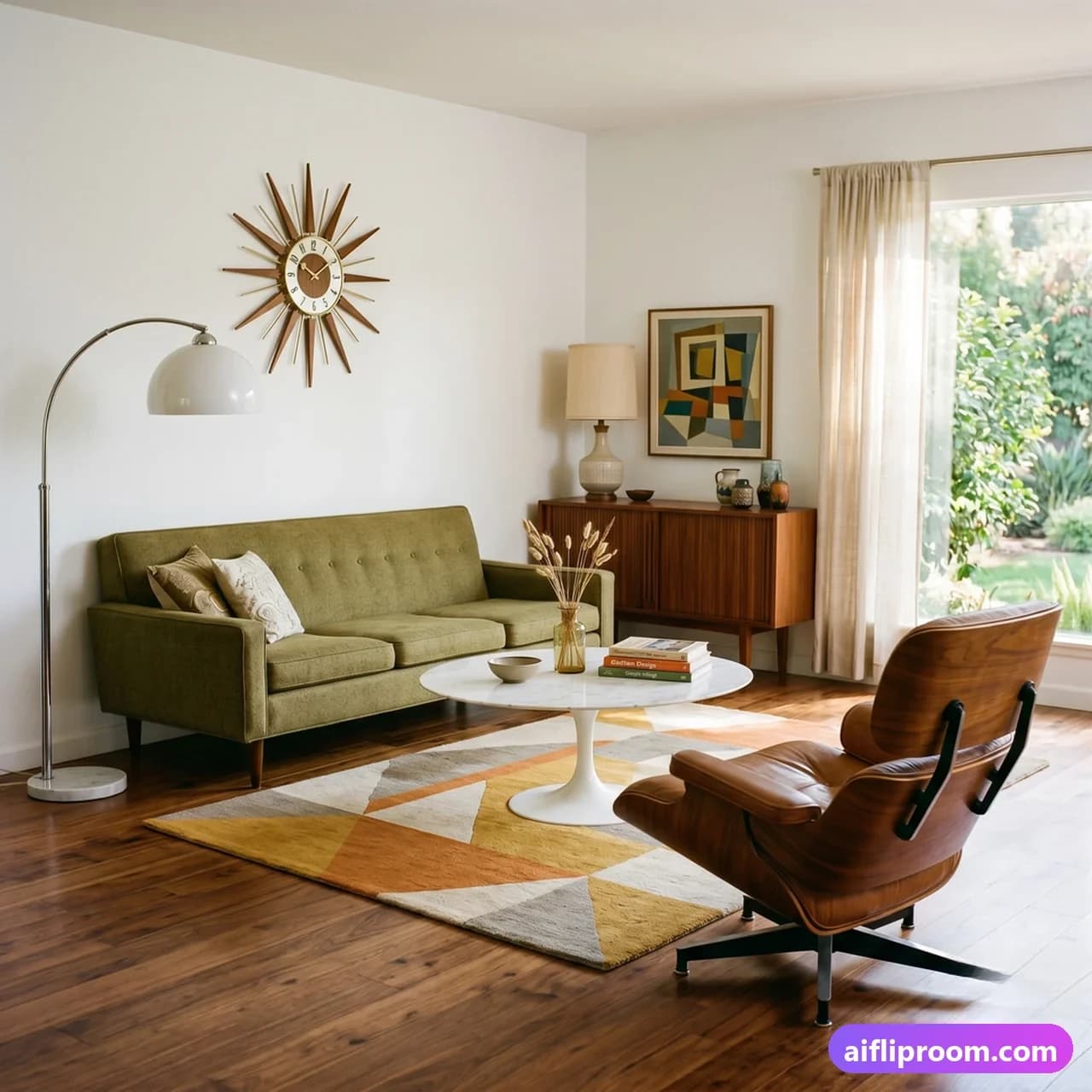
What is Mid-Century interior design?
Mid-century modern is the look of the 1950s and 60s, and it has never really gone away — which says a lot about how well it works. It came out of a post-war optimism about design: furniture should be functional, beautiful and made for everyday life. The signatures are warm woods like teak and walnut, tapered or peg legs that make pieces feel light, and organic, sculptural shapes that soften the era's clean lines. The palette is warm and confident, often a neutral base lifted by mustard, olive or burnt-orange accents, and lighting is a feature in itself — think globe and sputnik fixtures. The overall feel is stylish but relaxed, never fussy. In staging, mid-century modern is a reliable winner: it reads as characterful and design-aware to a very wide range of buyers without feeling like a costume.
Where Mid-Century comes from
Mid-century modern covers roughly the 1940s to the mid-1960s, when post-war optimism, new manufacturing techniques and a housing boom collided. Moulded plywood, fibreglass and foam made curved, light, comfortable furniture possible for the first time at scale, and designers on both sides of the Atlantic — American, Danish, Brazilian — set out to make it beautiful and affordable at once. Houses of the period opened up: bigger windows, fewer internal walls, a deliberate relationship between inside and garden. The reason the style has never really gone away is that it solved problems we still have. The pieces are small-footprint, they sit on legs so rooms read larger, and they were designed to be comfortable rather than imposing.
Key elements of Mid-Century
- Warm woods — teak and walnut
- Tapered and peg legs that lift each piece
- Organic, sculptural shapes softening clean lines
- A warm palette with mustard, olive or burnt-orange accents
- Statement lighting — globe and sputnik fixtures
- Functional, uncluttered silhouettes
When to use Mid-Century
Living rooms and dining spaces. A perennial favourite that reads as stylish and characterful to a wide range of buyers without dating a listing.
Mid-Century colours and materials
Warm woods first — teak, walnut and rosewood in an oiled finish that shows the grain. Around them, a base of warm white, camel or soft grey, then the period's saturated but earthy accents: mustard, burnt orange, olive, teal, ochre and a dusty red. Materials run to leather, wool bouclé, tweed and rattan, with brass or black metal for legs and lighting. Pattern exists but is geometric and controlled — a graphic rug, one bold curtain fabric. What is out of place is anything glossy, ornate or grey-on-grey; the whole style depends on warmth in the timber.
Mid-Century room by room
Living room in Mid-Century
A low sofa with tapered wooden legs, a walnut or teak sideboard along one wall, one sculptural lounge chair and a round or organically shaped coffee table. Keep everything raised off the floor — visible legs are the single most recognisable trait of the style and the reason mid-century rooms feel airy. A large graphic rug and one arced or globe floor lamp complete it. Storage belongs in the sideboard, and the sideboard belongs against the longest wall, which is exactly how these rooms were laid out originally.
Bedroom in Mid-Century
A low platform bed in warm timber with a simple headboard, matching or deliberately mismatched wooden nightstands on legs, and bedding in white with one period accent — mustard, olive or burnt orange. Wall-mounted brass or black reading lights keep the small surfaces clear. A long low dresser rather than a tall chest reinforces the horizontal emphasis, and a piece of abstract or geometric art above it is exactly right for the period.
Kitchen in Mid-Century
Flat-fronted timber or coloured cabinets, slim horizontal handles, and a plain worktop. The period liked colour in kitchens far more than we do now — a soft avocado, teal or butter yellow on the lower run is authentic rather than eccentric. Add a small round table with tulip or spindle-legged chairs, a globe pendant above it, and open shelving holding ceramics with some warmth to them.
Dining room in Mid-Century
An oval or round table in teak or walnut with a pedestal or splayed legs, and chairs with moulded shells or spindle backs. A single sculptural pendant, hung low. This is the room where mid-century furniture is most recognisable and most available, so it is a good place to put one genuine vintage piece if the budget allows one — an original table will carry a room full of newer things.
Home office in Mid-Century
A slim writing desk on tapered legs rather than a bulky workstation, a leather or bouclé task chair, and a low bookcase instead of a tall one. Mid-century workspaces look calm because the furniture is small and the floor stays visible. One brass desk lamp, one plant in a ceramic pot, and a piece of geometric art is the entire scheme.
Mid-Century mistakes to avoid
- Buying only reproductions of the same three famous chairs. A room of icons looks like a showroom; one recognisable piece surrounded by simpler ones looks like a home.
- Going grey. Grey walls, grey sofa and grey rug drain the warmth that teak and walnut exist to provide. Warm white, camel and soft earth tones are the right base.
- Skipping the legs. Chunky, floor-touching furniture is the fastest way to lose the style, because the airiness comes entirely from what you can see underneath.
- Overloading the pattern. One graphic element per room — a rug, a curtain, an artwork. Three of them at once turns period charm into a costume.
- Treating it as a museum. These were everyday objects designed to be used. A room where nothing may be touched misses what the movement was actually about.
Mid-Century questions, answered
What is the difference between mid-century modern and modern?
Mid-century modern is a specific period within the broader modern movement — roughly 1945 to 1965 — with its own vocabulary: warm timber, tapered legs, organic curves, saturated earthy colour. Modern in general is cooler, more neutral and less playful. In practice, if there is walnut, a splayed leg and a mustard cushion, it is mid-century; if it is white, grey and rectilinear, it is modern.
Is mid-century modern still popular?
It has been continuously popular for longer than almost any other twentieth-century style, and there is a practical reason. The furniture has a small footprint, sits on legs and suits the size of contemporary homes, which is not true of most period furniture. It also mixes comfortably with modern and Scandinavian pieces, so it rarely looks dated.
What woods are used in mid-century furniture?
Teak and walnut above all, with rosewood in higher-end pieces and oak in the Scandinavian branch of the style. The finish is as important as the species: oiled or lightly lacquered so the grain reads. A high-gloss finish on the correct wood still looks wrong.
How do I mix mid-century with what I already own?
Start with one substantial piece — a sideboard, a dining table or a lounge chair — and let the rest of the room be plain. Mid-century pieces are strong enough that a single one sets the tone. Keep the walls neutral and warm, put the new piece where it can be seen in full, and resist buying a second icon for at least a while.
Does mid-century modern suit a property listing?
Very well, and especially for apartments, bungalows and any home built between the 1950s and 1970s, where it matches the architecture. The small-scale furniture also photographs generously in modest rooms. It is less suited to very traditional period homes, where the contrast can read as unresolved rather than deliberate.
Guides to read next
Longer reads on getting a room photographed and restaged well.
- See Your Own Room in a New Style Before You Buy AnythingPreview your actual room in a new style before buying furniture or hiring anyone: what a preview settles, what it can't, and five steps to a useful one.
- How to Photograph Rooms for Virtual Staging: 7 RulesDaylight, lamps off, a level phone at chest height, the 1x lens not 0.5x, one room per frame, clear surfaces — seven habits that make AI staging look real.
- What Is Virtual Staging? The Complete Guide: How It Works, Cost, Rules, ExamplesVirtual staging explained in plain language: how AI furnishes a photo of a real room, what it costs, what agents think of it (NAR 2025), who it helps, the rules and how to spot bad staging.
See your room in Mid-Century
Upload a photo and our AI restages it in the Mid-Century look in 15–60 seconds, depending on how much detail your room has — keeping your walls, windows and layout intact.
Try Mid-Century on your room