BC Virtual Staging Rules: What BCFSA's AI Guideline Says
AI Flip Room · 12 min read
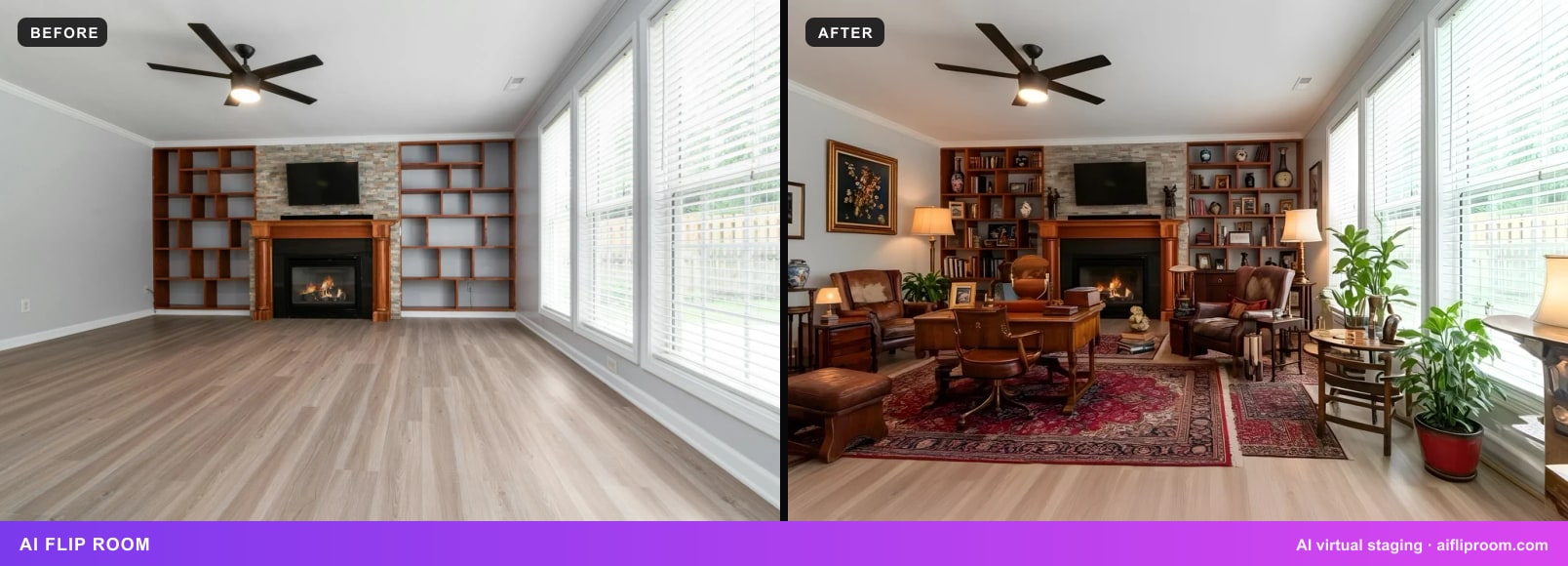
British Columbia is the one jurisdiction of the three we have read where the regulator itself has written about artificial intelligence in real estate, rather than leaving the question to an MLS rulebook or a statute about photographs. The BC Financial Services Authority published its Artificial Intelligence Guideline on 22 February 2024, and it addresses virtual staging by name: it "may be okay", provided altered photos are labelled.
It also says things that matter more to a working agent than the staging sentence does, and almost nobody quoting it mentions them — above all, what has to happen before a client's photograph goes into an AI tool. Both halves are below, quoted from the guideline, with the Rules it cites read section by section on BC Laws. We make an AI staging tool, which is a reason to be careful here rather than casual. This is not legal advice.
Is virtual staging allowed in BC?
Yes, with a label. BCFSA's Artificial Intelligence Guideline of 22 February 2024 says using an AI tool to virtually stage a house "may be okay", provided altered or enhanced photos and videos are labelled so a potential buyer is not misled. That is guidance; the binding rule underneath it is the ban on false or misleading advertising.
The passage sits in a part of the guideline headed "Advertising Considerations". Before the sentence everyone quotes, BCFSA anticipates the tools themselves: it expects software that will "enhance the marketability of various pictures and videos (e.g., removing imperfections, filling rooms with virtual designer décor and/or fixtures, modernizing the space, etc.)", and then warns that "you must be careful not to make false representations in your advertising." Here is the sentence that follows, word for word:
Three things are worth drawing out of that.
The regulator says it may be okay. That is a more permissive starting position than either the Ontario MLS rulebook or the California statute takes, and it comes from the body that disciplines licensees rather than from a listing platform.
The permission is conditional on labelling. BCFSA's word is "should", and its closing phrase is "clear labeling is imperative". Unlabelled is the case the guideline is warning about.
The guideline names the sections it is interpreting — and it calls itself an interpretation. Its own preamble says BCFSA's guidelines "provide BCFSA's interpretation of the Real Estate Services Act". The binding text is the Rules, and we come to them below.
Do staged photos need a label in BC?
BCFSA says you should: its phrase is "clear labeling is imperative". But a guideline is not a rule with must in it. What binds you is section 41 of the Real Estate Services Rules — no advertising you know, or ought to know, is false or misleading — and a label is how an altered photo stays clear of it.
What a label should look like is the subject of our disclosure guide: a badge on the image, a line in the listing description, or the original shown beside the staged frame. BC prescribes none of them. Nothing in the guideline or the Rules requires an unaltered original next to a staged image — that is California's rule — but keeping one costs nothing, and it is the first thing a careful buyer is entitled to ask for.
The label also has a limit, and BCFSA drew it three years before it wrote about AI. Its Advertising Guidelines, published 4 May 2021, have a short section on photo-enhancing software: "you must use caution so as to not alter or enhance photographs in any way that would misrepresent aspects of the property." Then the example: "While editing out such items as a garbage can or an automobile parked in a driveway would be acceptable, removing nearby power lines or changing any physical characteristic of a property such that it results in a misrepresentation would not be acceptable." A label discloses that an image was edited; it does not license changing the property. Furnish the room; leave the walls, windows, ceiling, floors, fixtures, damage and view exactly as photographed.
Which Rules sections apply?
The guideline lists six sections of the Real Estate Services Rules: 28, 30, 33, 34, 40 and 41. For a staged photo the operative one is 41, the ban on false or misleading advertising. Section 40 is about identification — brokerage, licensee and team names — and says nothing about images; 33 and 34 are the duties of honesty and reasonable care.
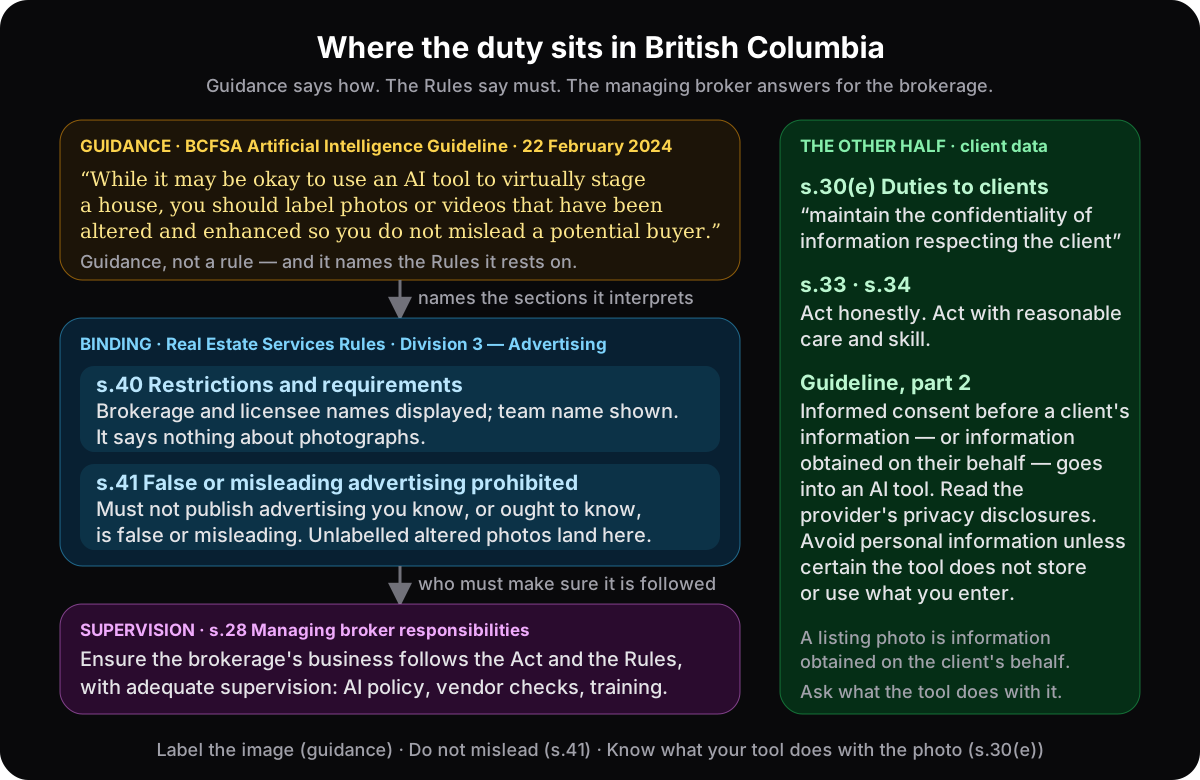
Here is what each of the six actually says, from the consolidation of the Real Estate Services Rules on BC Laws current to 1 September 2026 (last amended 1 July 2024):
- Section 41 — False or misleading advertising prohibited. In full: "A licensee must not publish real estate advertising that the licensee knows, or reasonably ought to know, contains a false or misleading statement or misrepresentation concerning real estate, a trade in real estate or the provision of real estate services." This is the sentence a staged photo has to survive.
- Section 40 — Restrictions and requirements. The brokerage's licensee name must be displayed "in a prominent and easily readable way"; individuals and personal real estate corporations must be identified by their licensee names; a team's name must appear. Nothing about photographs, alteration or AI.
- Sections 33 and 34. One sentence each: when providing real estate services a licensee "must act honestly" and "must act with reasonable care and skill".
- Section 30 — Duties to clients. A list of ten. The one the guideline is pointing at is (e): "maintain the confidentiality of information respecting the client". Also (d): advise the client to seek independent professional advice on matters outside the licensee's expertise — which is why the guideline says AI advice is no substitute for a qualified professional.
- Section 28 — Managing broker responsibilities. The managing broker must ensure the brokerage's business "is carried out competently and in accordance with the Act, the regulations and these rules" and that there is "an adequate level of supervision". That is why the guideline closes with a section addressed to managing brokers: brokerage AI policies, vendor due diligence, training.
One definition matters as much as any section. "Real estate advertising" in the Rules means any form of identification, promotion, solicitation or representation relating to real estate — a sign, a website, a social post, a brochure. Section 41 therefore reaches every place you publish a staged image, not only the MLS.
What about the client's photos and data?
BCFSA says to obtain a client's informed consent before their information — "and information obtained on their behalf" — goes into an AI tool, to review the provider's privacy disclosures, and to avoid entering personal information unless you are certain the tool does not store or use it. A photograph of a client's home is information obtained on their behalf.
This is the half of the guideline almost nobody quotes. The staging paragraph gets extracted and repeated; the second part, "Protect Client Information When Using AI", is arguably more consequential for an agent who uses any AI tool at all.
For staging that is worth thinking about properly. Uploading a listing photograph to a third-party tool is a processing decision, and the guideline's position is that you should know what the provider does with it and that the client should have agreed. In practice that means two things: a line in the listing agreement, or a separate written consent, saying that photographs may be processed by a named staging tool; and a provider whose privacy policy you have actually read. The guideline also says, plainly, that you "should also refrain from using AI tools without your client's express consent."
Under the guideline sits Rules section 30(e), the duty to "maintain the confidentiality of information respecting the client". Above the individual licensee sits the managing broker, whose section 28 duty to supervise is why the guideline asks brokerages to "establish clear brokerage policies and procedures regarding the use of AI tools and how client information is handled" and to vet third-party vendors' "data handling practices". If your brokerage has no AI policy yet, the guideline is the document to hand your managing broker.
How does BC compare with Ontario and California?
Three places, three instruments. Ontario applies an accuracy test through an MLS rulebook and says nothing about labels. California legislates a procedure: a conspicuous statement, a link to the original, and inside CRMLS the original beside the staged image. British Columbia gives regulator guidance — label it — resting on a general ban on misleading advertising. One habit satisfies all three.
| British Columbia | Ontario | California | |
|---|---|---|---|
| Who sets the rule | The regulator: BCFSA's Artificial Intelligence Guideline (22 February 2024), interpreting the Real Estate Services Rules | PropTx MLS Rules, the listing platform's rulebook; above it, RECO under the TRESA Code of Ethics | The state: AB 723 adds section 10140.8 to the Business and Professions Code; CRMLS rule 11.5.2 sits on top for its members |
| The gist | Guidance. Virtual staging "may be okay"; label altered photos; false or misleading advertising is prohibited | An accuracy test. Altered or AI-created images and digital staging are banned if they "do not accurately depict the listed real estate" (rule 5.01) | A procedure. Say the image was altered, link to the original, never change the property itself |
| Label required? | "You should label" — guidance, backed by the binding ban on misleading advertising (Rules section 41) | Not for staged images — 5.01 requires labels only for drawings, floor plans, maps and aerial or distance photos. Absence is not permission | Yes. A "reasonably conspicuous" statement on or adjacent to the image (statute), and "virtually staged" or similar in the photo description (CRMLS) |
| Original required? | Not required. Keep it available | No pairing rule. The only minimum is one image of the property (rule 3.07(c)) | Yes. A link, URL or QR code to the unaltered image (statute); the original immediately before or after the staged one (CRMLS) |
| What is forbidden | Altering a photo so it misrepresents the property — BCFSA's own example is removing nearby power lines | Any altered image that does not accurately depict the property | Adding, removing or modifying any real part of the property; AI landscaping; unlabelled digital de-cluttering |
| Source | BCFSA AI Guideline · BCFSA Advertising Guidelines · Real Estate Services Rules | PropTx MLS Rules (PDF) · our full read | AB 723 text · CRMLS guidance · our full read |
That one habit: never alter the property itself, always label a staged image plainly, and keep an unaltered photograph of the same room available. It is stricter than BC or Ontario asks and roughly what California requires — and it is defensible in all three. The Ontario and California articles quote their sources the way this one does: what the Ontario MLS rules actually say and virtual staging rules in California. The principles behind all three are in our disclosure guide.
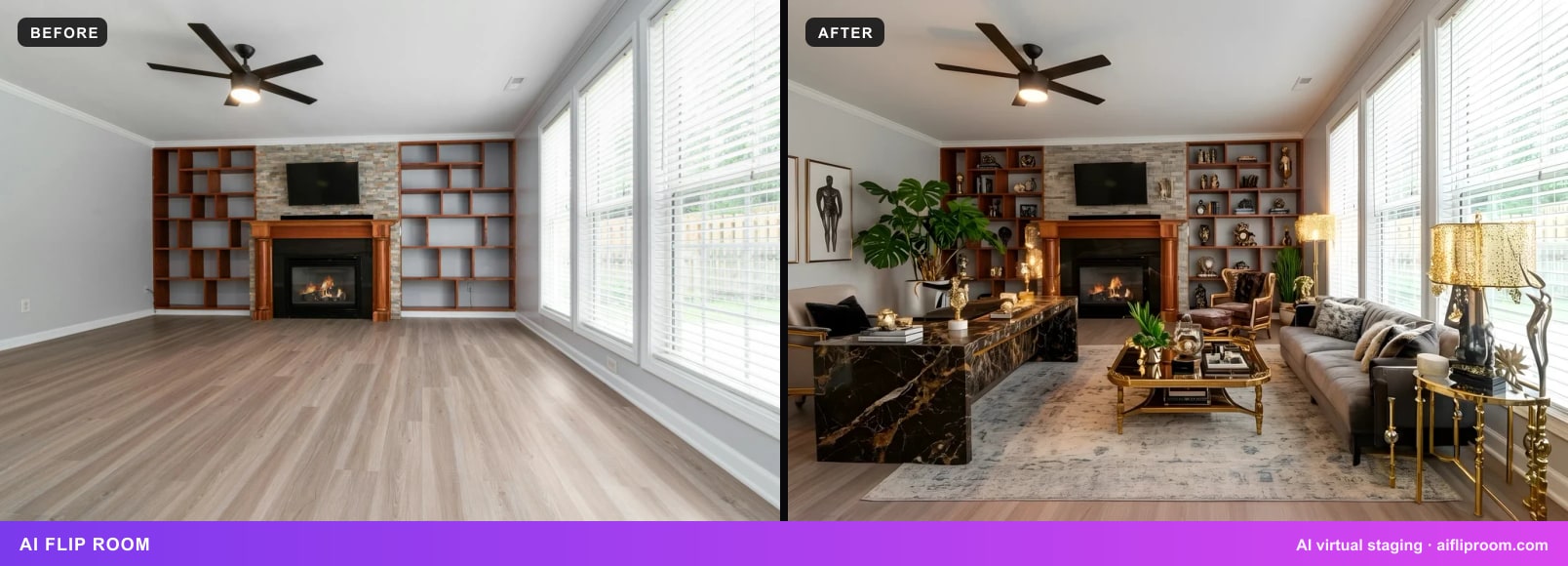
What does a labelled, honest render look like?
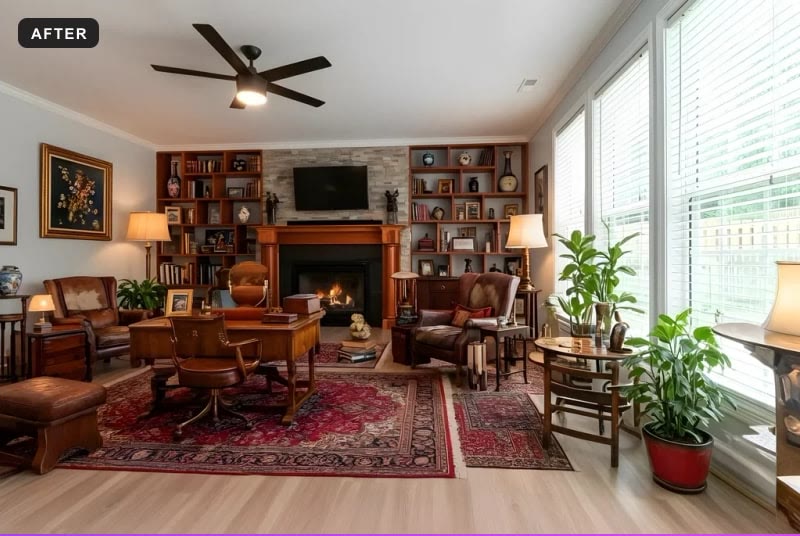
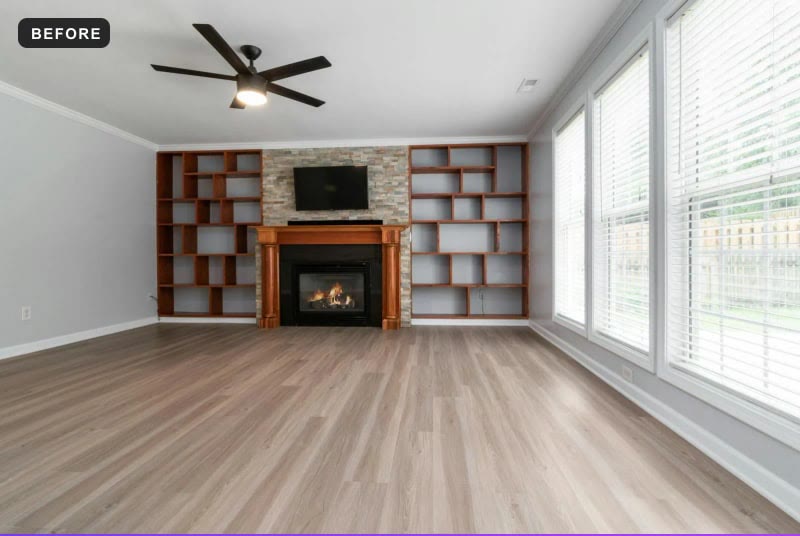
Like the pair below: the same frame twice, with only movable things added. Check the parts that are not furniture — the ceiling fan, the crown moulding, the stone fireplace, both shelving units and both windows are where the photographer left them. That is what BCFSA's "altered and enhanced" label should be sitting on: a room furnished, not a property changed.
What else does the guideline say?
Three more things, all short. You remain accountable for the accuracy of anything AI produces — "not only to written text but to pictures as well". You should tell clients and the public when AI tools are being used. And AI systems can carry systemic bias, a warning aimed mainly at tenant screening rather than at photographs.
Accuracy. The guideline is blunt that AI tools "are designed to 'guess' answers to questions they do not have complete information on", and that licensees who use AI-generated content "remain accountable for the accuracy of any real estate advertising they publish". If AI writes your listing copy, you own the errors — and the same sentence covers the render.
Transparency. "You should also communicate to clients and the public when AI tools are being utilized and explain their potential impacts and limitations to maintain transparency." The example given is an AI chatbot answering while you are unavailable. A "virtually staged" label is the same principle applied to a photograph.
Bias. A section on systemic bias, with tenant screening as the example. Not about imaging — but a reminder that the regulator is thinking about AI across the whole of practice, not only about pretty photographs.
What should a BC agent actually do?
Label every altered image plainly, where a buyer will see it. Never alter the property — furnish it. Get the seller's written consent before their photographs go into any AI tool, and read that tool's privacy policy first. Verify AI-written copy before it is published. Keep the unedited original of every staged frame. And read the guideline itself; it is short.
- Label every altered image, plainly, in a way a buyer will actually see. BCFSA's word is "imperative".
- Do not alter the property. Furnish; do not change walls, dimensions, condition or fixtures. Section 41 is about misrepresentation, and changing the property is the clearest form of it.
- Get consent for the photographs. A sentence in the listing agreement naming the tool, or a separate written consent, before the first upload.
- Check what your tools do with uploaded photographs, and be ready to say so if asked. The guideline puts that duty on you, not on the vendor.
- Verify AI-written copy before it is published. You are accountable for it.
- Ask your managing broker for the brokerage's AI policy. If there is none, section 28 and the guideline's closing section are the reason there should be.
If most of your listings are vacant, our page for listing agents shows how a staging tool fits inside that position: furnish the room, keep its geometry, keep the original, and know what happens to the photo.
Sourcing, plainly
Every quotation above is from three documents, each fetched and read for this article on 10 September 2026:
- BCFSA's Artificial Intelligence Guideline, published 22 February 2024 — the staging paragraph, the client-information section, the accuracy and transparency passages, the list of Rules sections and the managing-broker section.
- BCFSA's Advertising Guidelines, published 4 May 2021 — the photo-enhancing software passage.
- The Real Estate Services Rules, B.C. Reg. 209/2021, in the BC Laws consolidation current to 1 September 2026 and last amended 1 July 2024 — sections 28, 30, 33, 34, 40 and 41, and the definition of real estate advertising.
The section numbers are no longer reported second-hand: we have read each of the six on BC Laws, and they are as the guideline lists them. The one-line summaries of them above are ours; the quoted words are theirs.
This is not legal advice. Guidance is not law, and both change. Confirm with your managing broker or with BCFSA, and if you think we have read something wrong, tell us.
Questions BC agents ask
Is AI virtual staging allowed in British Columbia?+
Yes, according to the regulator. BCFSA's Artificial Intelligence Guideline of 22 February 2024 says it "may be okay to use an AI tool to virtually stage a house", provided altered or enhanced photos and videos are labelled so a potential buyer is not misled. The guideline is BCFSA's interpretation; the binding text is section 41 of the Real Estate Services Rules, which prohibits false or misleading advertising. Label it, and do not change the property itself.
Does BC require the original photo next to the virtually staged one?+
No. Neither the guideline nor the Rules require an unaltered original beside a staged image, or a link to one — that is California's requirement, under AB 723 and CRMLS rule 11.5.2. BC asks for a label. We recommend keeping the untouched original at full size anyway: it is the simplest answer when a buyer asks whether a window was really that size, and the most persuasive disclosure there is.
Do I need the seller's consent before uploading their photos to an AI staging tool?+
The guideline says yes. It tells licensees to acquire "informed consent before using their information (and information obtained on their behalf) in an AI tool", to review the provider's privacy disclosures, and to avoid entering personal information unless certain the tool does not store or use it. A listing photograph is information obtained on the seller's behalf. A sentence in the listing agreement naming the tool, or a separate written consent, covers it.
Does the BC guidance apply to my own website and social media, or only the MLS?+
Everywhere you publish. The Rules define real estate advertising as any form of identification, promotion, solicitation or representation relating to real estate — a sign, a website, a social post, a brochure — and section 41's ban on false or misleading advertising attaches to all of it. The guideline is BCFSA's reading of those Rules, so its labelling advice travels with the image. Label the staged frame wherever it appears, and keep the original.
Last checked against BCFSA's Artificial Intelligence Guideline (22 February 2024), its Advertising Guidelines (4 May 2021) and the Real Estate Services Rules consolidation current to 1 September 2026, on 10 September 2026. Guidance and rules change; verify before relying on this.
See it on your own room
Upload a photo and watch AI restage your space in 15–60 seconds, depending on how much detail it has — free to try, no credit card.
Try AI Flip Room freeRelated reading
Virtual Staging Disclosure Rules: How to Label Staged Photos
Why disclosure is required, three ways to label a virtually staged photo, what you may change vs never touch, and the Ontario, California and BC rules.
Ontario Virtual Staging Rules: PropTx MLS Rule 5.01, Quoted
Is virtual staging banned on the Ontario MLS? We read the PropTx rulebook: rule 5.01 quoted, the missing "one unstaged photo" rule, and where the line is.
California Virtual Staging Rules: AB 723 + CRMLS 11.5.2
Since 1 January 2026 California regulates altered listing photos by statute. What AB 723 requires, what CRMLS 11.5.2 adds, the $250 fine, and a checklist.