California Virtual Staging Rules: AB 723 + CRMLS 11.5.2
AI Flip Room · 8 min read
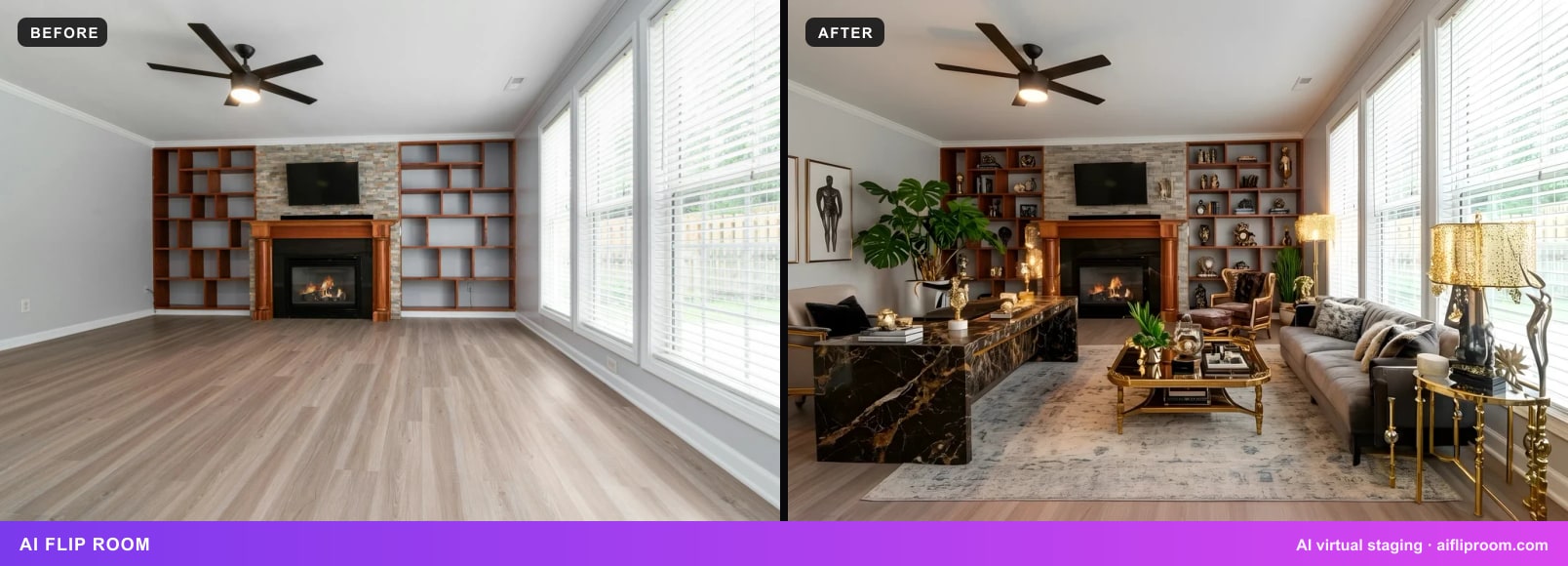
California is the one place where virtual staging stopped being a question of board policy and became a question of state law. Most of what you will read about it online conflates the two, or quotes an MLS rule as though it were the statute. They are separate obligations, they say different things, and you have to satisfy both.
This article covers what each one actually requires, with the primary sources linked. It is not legal advice. We make an AI virtual staging tool, which is a reason to be careful with this rather than casual.
Is virtual staging legal in California?
Yes. Neither the statute nor the CRMLS rule bans it. Since 1 January 2026, California treats a virtually staged photo as a digitally altered image that must be disclosed: a visible statement that it was altered, a link to the original, and — inside CRMLS — the original placed right next to it. Furnish the room; never alter the property.
The rest of this article is the detail: what the statute says, what the MLS adds, how to tell an altered image from an adjusted one, and what a compliant gallery looks like.
What does AB 723 require?
AB 723 adds section 10140.8 to the Business and Professions Code. A licensee who uses a digitally altered image in advertising for the sale of real property must include a reasonably conspicuous statement that the image was altered, on or adjacent to it, and a link — a URL or QR code — to the publicly accessible original.
The bill was approved by the Governor on 10 October 2025 and chaptered as Chapter 497 of the Statutes of 2025. The codified section on the California Legislative Information site carries the note "Effective January 1, 2026" — the standard start for a chaptered statute without an urgency clause, and the date California brokerages and MLSs briefed their members on.
Three details matter in practice:
- The statement must be near the image. "On or adjacent to" is the statute's phrase — not in a footer, not three clicks away.
- The link must lead to the original. A publicly accessible website address, URL or QR code that includes, and clearly identifies, the unaltered image.
- Your own site is covered. Where the advertisement appears on a website the licensee controls, the unaltered version must be included or linked there and clearly identified. The statute reaches well beyond the MLS.
Violations are treated under the existing Real Estate Law enforcement provisions rather than through a new penalty scheme of their own.
What counts as a digitally altered image?
An image changed with photo-editing software or artificial intelligence to add, remove or change elements — the bill lists fixtures, furniture, appliances, flooring, walls, paint colour, landscaping, the facade, views through windows and neighbouring properties. Virtual staging sits squarely inside that definition. So does digitally emptying a room. Ordinary adjustments that leave the property as it is are excluded.
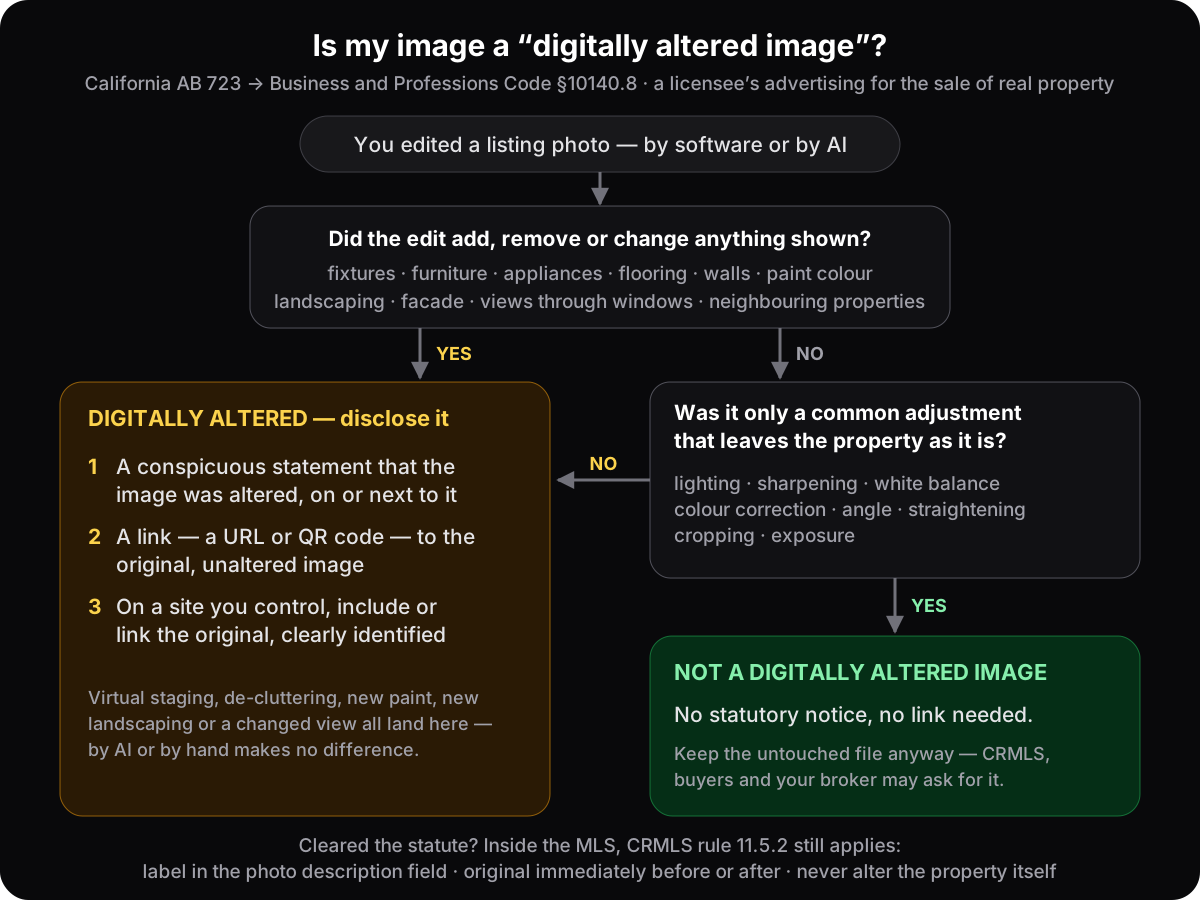
The exclusion is what keeps the rule workable. Lighting, sharpening, white balance, colour correction, angle, straightening, cropping and exposure — the ordinary work of a listing photographer — do not make an image "altered", provided they do not change how the property is represented. Without that carve-out, every professionally edited listing photograph would be a disclosure event.
What does CRMLS 11.5.2 add?
CRMLS, the largest MLS in the United States, adds procedure from the same date, 1 January 2026. Rule 11.5.2 says where the label goes — the photo description field, using "digitally enhanced", "digitally altered" or "virtually staged" — and where the original goes: immediately before or after the altered image. It also forbids altering the property itself.
CRMLS's own guidance defines a digitally altered image as one "created by or at the direction of the real estate broker or salesperson, or person acting on their behalf, that has been changed using photo editing software or artificial intelligence." From there, four requirements:
- Label the image in the photo description field. CRMLS names the acceptable terms — "digitally enhanced", "digitally altered", "virtually staged".
- Include the original. The unaltered version "must appear in the listing immediately before or after the digitally enhanced image." Not somewhere in the gallery. Adjacent.
- Do not alter the property itself. Users cannot add, remove or modify any real part of a property — wall colour, flooring, cabinets, wall dimensions, landscaping.
- AI landscaping is out entirely. CRMLS states that AI-generated landscaping images are not permitted in the MLS, because they may misrepresent the real property.
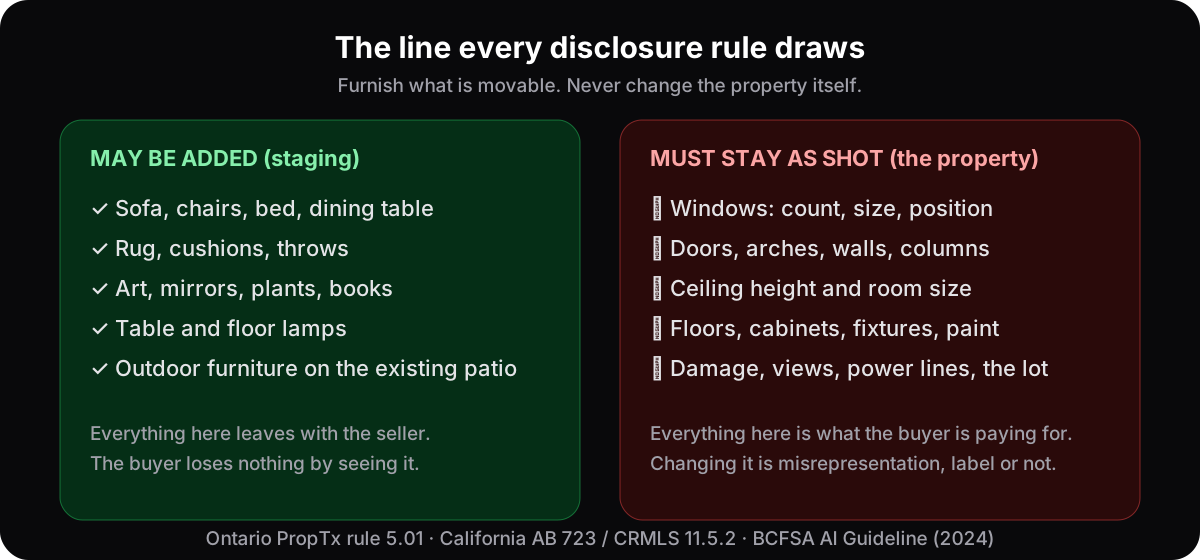
CRMLS also notes that virtually clearing a room of furniture which will not be included at closing is itself a digital alteration — a point people routinely miss, because removing things feels less like staging than adding them.
Enforcement is graduated: a warning first, then a $250 fine if it is not corrected in reasonable time. The rule and the FAQ that explains it are on CRMLS's knowledgebase.
Statute vs MLS rule
| Source | Who it binds | What it requires | Penalty | Primary source |
|---|---|---|---|---|
| AB 723 → Business and Professions Code §10140.8 (state law, in force 1 January 2026) | Every California real estate broker and salesperson, in any advertisement or promotional material for the sale of real property — MLS, own website, print, social | A reasonably conspicuous statement that the image was altered, on or adjacent to it; a link (URL or QR code) to the publicly accessible original; on a site you control, the original included or linked and clearly identified | No fine of its own — a breach is handled under the existing Real Estate Law enforcement provisions | Code section on leginfo |
| CRMLS rule 11.5.2 (MLS rule, effective 1 January 2026) | Anyone entering listings in CRMLS — its participants and subscribers | Label in the photo description field ("digitally enhanced", "digitally altered", "virtually staged"); original immediately before or after the altered image; no adding, removing or modifying any real part of the property; no AI-generated landscaping | Warning, then a $250 fine if not corrected in reasonable time | CRMLS guidance and FAQs |
How should a staged photo appear in a California listing?
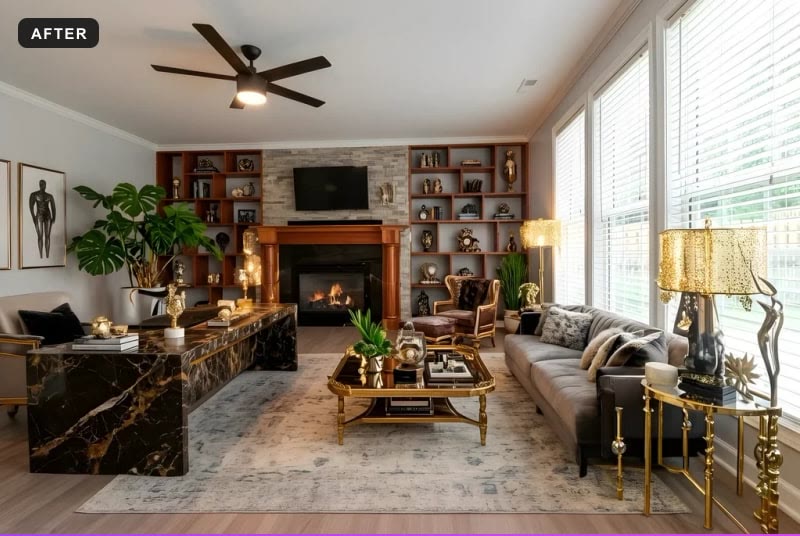
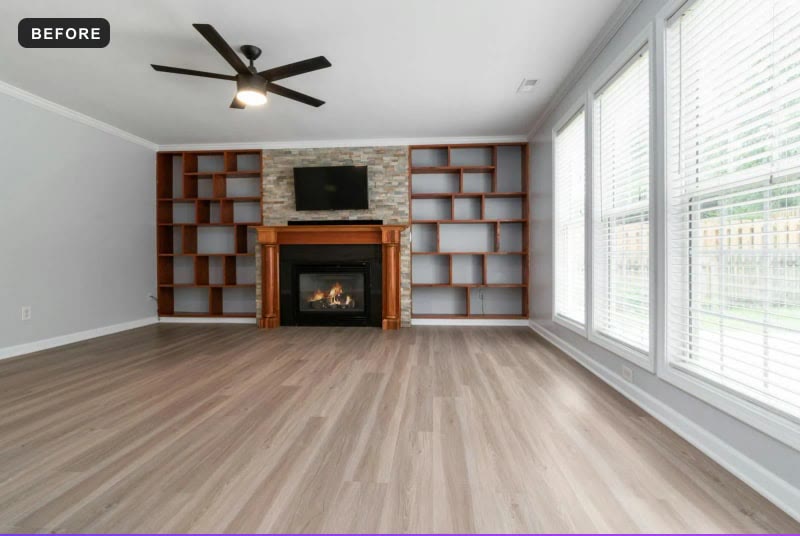
Two obligations, two places. In the CRMLS gallery: the original photo, then the staged photo (or the reverse), with the staged one labelled in its photo description field. Everywhere else you advertise: a visible statement beside the image that it was altered, plus a link or QR code to the original. The property itself untouched in both.
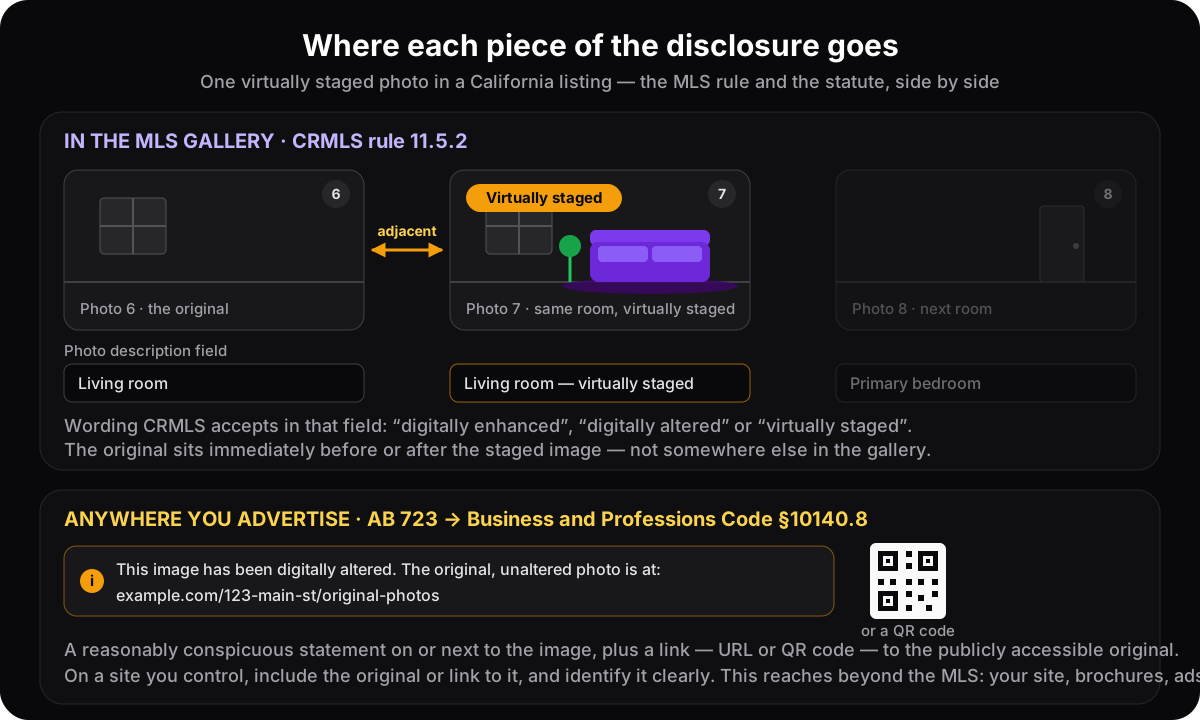
And this is what the pair itself should look like — the same room, the same frame, only movable things added:
What happens if you skip the disclosure?
Inside CRMLS, a warning first, then a $250 fine if the listing is not corrected in reasonable time. The statute sets no separate fine: a breach of section 10140.8 is a breach of the Real Estate Law, handled under the enforcement provisions that already apply to a licence. The larger cost is the buyer who drives over and feels misled.
That last point is the practical one. A California buyer who finds a staged photo with no original beside it has already found a rule breach, and we wrote up what a buyer can demand from a virtually staged listing — the original, a list of what changed besides furniture, the room dimensions, a look at the windows. A label discloses that an image was edited. It does not license changing the room, and no label rescues a render that widened a window or repainted a wall.
Where does the "one unstaged photo" rule come from?
Ontario and California solve the same problem in opposite ways, and the contrast is instructive if you list in both or write marketing that reaches both.
Ontario uses an accuracy test. Its rule prohibits altered images "that do not accurately depict the listed real estate", and then says nothing about labels, pairs or procedure — we quote it in full in what the Ontario MLS rules actually say. The judgement is left to the licensee, which makes it flexible and makes it uncertain.
California uses a procedure. It does not ask you to judge whether an image is accurate; it tells you to say the image was altered, show the original, and never change the property itself. That is more work per listing and considerably less ambiguous.
British Columbia takes a third route again: its regulator has published guidance saying virtual staging may be acceptable provided the image is labelled, with the binding duty being the prohibition on false or misleading advertising. We covered it in virtual staging rules in British Columbia.
If you want a single working habit that satisfies all three: never alter the property, always show an unaltered photograph of the same room, and always say plainly that an image is a visualisation. That is stricter than Ontario requires and roughly what California requires, and it is defensible everywhere. The principles behind all of it are in our virtual staging disclosure guide.
A checklist for California listings
The California checklist, in order
- 1Stage furniture onlySofas, rugs, art, lamps, plants. No wall colour, no flooring, no cabinets, no dimensions, no landscaping — CRMLS names each of those, and AI-generated landscaping is not permitted in the MLS at all.
- 2Keep the untouched originalFull size, same angle. You will need it twice: in the gallery next to the staged photo, and at the end of the link the statute requires.
- 3Label the staged photo in the photo description fieldUse CRMLS's own terms: "virtually staged", "digitally altered" or "digitally enhanced". A line in the public remarks alone is not where the rule puts the label.
- 4Place the original immediately before or after itAdjacent, not somewhere else in the gallery. One original for each staged image — this is the rule the "one unstaged photo per staged photo" claim comes from.
- 5Add the statutory notice and link everywhere else the image appearsYour website, brochures, portals you control, social posts: a reasonably conspicuous statement that the image was altered, plus a URL or QR code to the publicly accessible original. The statute does not stop at the MLS.
- 6Treat digital de-cluttering as alteration tooRemoving furniture that will not be there at closing is a digitally altered image under CRMLS. Label it and pair it the same way.
- 7Check your own MLSCRMLS is the largest in California but not the only one. Other MLSs may word their rule differently; your brokerage's compliance contact will know.
If you list regularly, the listing-agent workflow shows where these steps sit in preparing a listing, and if you stage listings for a living, start at our page for agents.
Sourcing, plainly
The AB 723 summary above is drawn from the bill text and the codified section on the California Legislative Information site, including the definition, the exclusions and the effective-date note. The CRMLS requirements are drawn from CRMLS's own published guidance, which is the operator's statement of its rule rather than a third-party summary.
One honest limit. We have not reviewed how the statute has been applied in practice, because at the time of writing it is new. If a detail matters to a specific listing, confirm it with your brokerage's counsel or your MLS compliance contact. If you think we have read something wrong, tell us.
Questions agents ask about California
Is virtual staging legal in California in 2026?+
Yes. Nothing in AB 723 or CRMLS rule 11.5.2 bans virtual staging. Both regulate how a staged image is presented: the statute requires a reasonably conspicuous statement that the image was altered plus a link to the original, and CRMLS requires the label in the photo description field, the original next to the staged photo, and no changes to the property itself.
Does AB 723 apply to my own website and social media, or only the MLS?+
Everywhere you advertise a property for sale. The statute covers an advertisement or other promotional material by a licensee, and it says specifically that on a website the licensee controls the unaltered image must be included or linked and clearly identified. The MLS gallery is one channel; a brochure, a listing page or a social post is another.
What wording does CRMLS accept for the label?+
CRMLS names three terms: "digitally enhanced", "digitally altered" and "virtually staged". The label goes in the photo description field of the altered image, and the original, unaltered version must appear in the listing immediately before or after it. Using one of the three exact terms avoids any argument about whether your wording was clear enough.
What is the penalty for an undisclosed virtually staged photo in California?+
Inside CRMLS, a warning first, then a $250 fine if the listing is not corrected in a reasonable time. The statute sets no separate fine: a breach of section 10140.8 is a breach of the Real Estate Law, handled under the enforcement provisions that already apply to a licence. The larger practical exposure is a buyer who feels misled.
Is removing furniture from a photo virtual staging under the rule?+
CRMLS says yes. Virtually clearing a room of furniture that will not be included at closing is a digitally altered image, and it needs the same label and the same adjacent original as a furnished render. The statute's definition also covers removing elements, not only adding them. Only ordinary photo adjustments — lighting, white balance, cropping, exposure — sit outside it.
Verified against the AB 723 bill text, the codified section and CRMLS published guidance. Rules change; confirm before relying on this.
See it on your own room
Upload a photo and watch AI restage your space in 15–60 seconds, depending on how much detail it has — free to try, no credit card.
Try AI Flip Room freeRelated reading
Virtual Staging Disclosure Rules: How to Label Staged Photos
Why disclosure is required, three ways to label a virtually staged photo, what you may change vs never touch, and the Ontario, California and BC rules.
Virtually Staged Listing? 5 Things a Buyer Can Demand
AI staging is legal in Ontario, California and BC — with conditions. Here is what a buyer is entitled to ask for, what the rules actually say, and the one line no photo may cross.
Ontario Virtual Staging Rules: PropTx MLS Rule 5.01, Quoted
Is virtual staging banned on the Ontario MLS? We read the PropTx rulebook: rule 5.01 quoted, the missing "one unstaged photo" rule, and where the line is.