Arizona Virtual Staging Rules: ARMLS 8.23, MLSSAZ and the ADRE
AI Flip Room · 13 min read
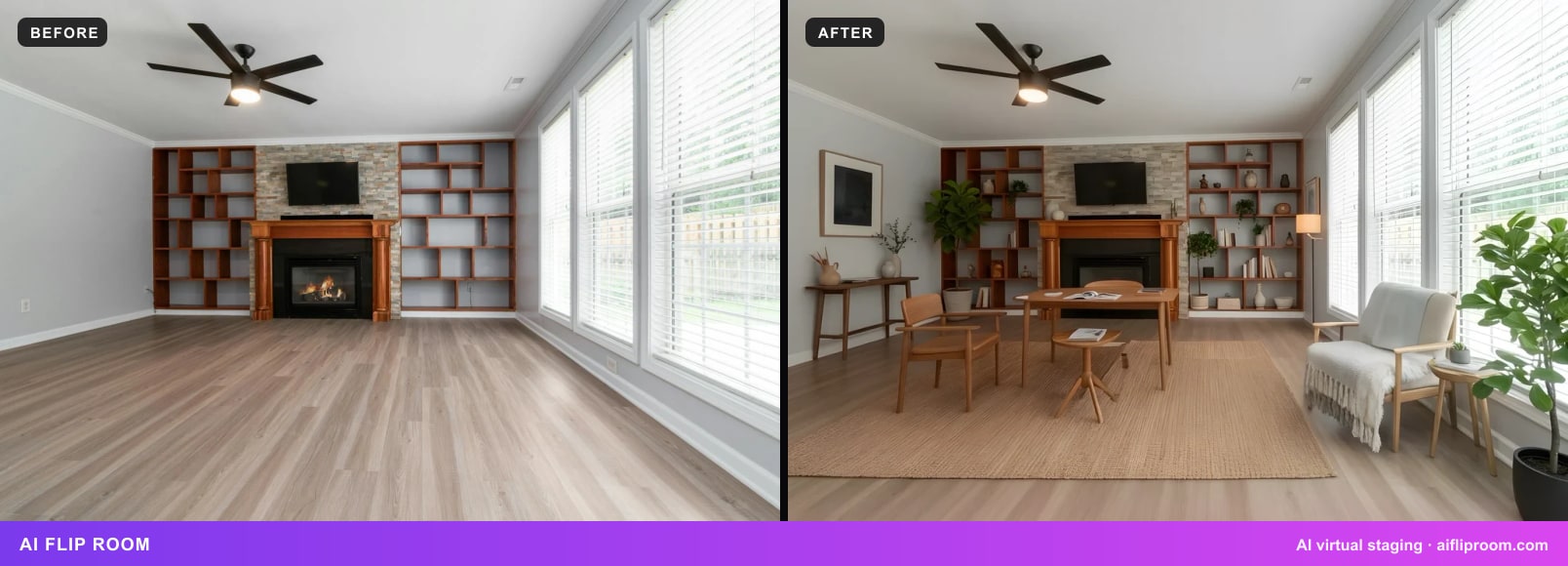
ARMLS rewrote its photo rule this year, and the change is easy to miss because it does not use the words most agents search for. Since 28 May 2026, Arizona's regional MLS calls a staged photo "Digitally Altered", puts its own watermark on it, wants the original directly before or after it, and bans every other mark on the image. Tucson's MLS has had its own rule since 2019 and puts the label somewhere else. Above both sits a state advertising rule, rewritten in December 2025, that names artificial intelligence and says nothing about staging.
The short answer: virtual staging is allowed in Arizona, as long as the photo is disclosed the way your MLS asks and does not change what is being sold. This article quotes the ARMLS rule, the Tucson rule and the state rule, explains how the ARMLS watermark works and what skipping it costs, and separates the texts from what is often written about them. It is not legal advice; where we are interpreting rather than reporting, we say so.
Is virtual staging allowed in Arizona?
Yes. ARMLS answers the question on its own page, "Is virtually staging now prohibited?": "No, virtual staging is allowed, but you are now required to disclose it with a Digitally Altered disclosure watermark." Tucson's rulebook lists "virtual home staging" among the photo enhancements it allows.
The Department of Real Estate's rules never mention virtual staging, and we found nothing on it in the state's real estate statute either. What they have is a general duty that reaches every advertisement a licensee publishes, inside an MLS or out of it. Rule R4-28-502(C) of the Arizona Administrative Code: "A licensee shall ensure that all advertising contains accurate claims and representations, and fully states factual material relating to the information advertised. A salesperson or broker shall not misrepresent the facts or create misleading or ambiguous impressions." The statute's definition of advertising, in A.R.S. 32-2101, expressly includes "any photographs, drawings or artist's presentations of physical conditions or facilities existing or to exist on the property". A listing photo is a representation, and a staged one shows a room as it does not yet look.
Neither text prescribes a label, a watermark or a pair. The format comes from the MLS.
First question: which MLS is the listing in?
The photo rule that binds you is the rule of the system you submit to. We read two.
- ARMLS, the Arizona Regional Multiple Listing Service, based in Tempe. Its rulebook defines its service area as, at a minimum, "the entire state of Arizona".
- MLSSAZ, the Multiple Listing Service of Southern Arizona, run by the Tucson Association of REALTORS®.
Other Arizona MLSs have rulebooks we have not read; if your listing goes into one, check its own wording.
What ARMLS rule 8.23 says, word for word
Three things in that text decide how you stage for ARMLS. First, the definition is wide. Staging is the textbook case — ARMLS says the phrase "Digitally Altered" "is broader, and it encompasses the act of virtually staging" — but so is taking furniture out: its own answers say decluttering a room needs the watermark, because "an image is Digitally Altered when adding, removing or changing content". Adding a fire to the fireplace needs it too. Removing a yard sign does not ("please blur" it instead), a changed sky color does not, and "standard adjustments such as brightness, contrast, color, cropping or sharpening" do not.
Second, the disclosure is not a sentence you write. Rule 8.23(n) wants "an MLS system-provided watermark applied directly to the Media", and ARMLS's page says photos uploaded to Flexmls "must use the required Flexmls Digitally Altered disclosure". A caption, a remark or your own badge does not meet that minimum. Videos and virtual tours are the exception: there, the ARMLS watermark or "Digitally Altered" in the description will do.
Third, the rule is permissive about what may be altered, as long as it is disclosed. Rule 8.23(f) bars media altered "to materially misrepresent the existing condition or existing structure of a property, unless disclosed as described in these Rules", and it reaches the "surrounding elements, such as views or neighboring structures". That is looser than most rulebooks we have read, which bar changes to the property itself; Houston's HAR is the other one that lets them through under a watermark. It does not make such changes safe in Arizona: the state rule further down still applies.
The label: ARMLS's watermark, and nothing else
ARMLS puts the watermark on for you. Its how-to guide of 26 June 2026: "To add the digitally altered disclosure to your photos in Flexmls, begin by clicking the Sunburst icon." The watermark then shows in the live listing, and the same guide warns: "IMPORTANT NOTE: After adding the watermark, it cannot be removed." Mark the right frames; a mistake means deleting the photo and uploading it again.
Everything else stays off the image. Rule 8.23(e) bans text and "watermarks of any kind except for those specifically provided by ARMLS", and ARMLS's watermark page adds: "Only place one watermark per photo." Its old Virtually Staged watermark is gone — "The ARMLS Virtually Staged watermark is no longer ARMLS-approved" — and a photo that already carries it has to be deleted, uploaded again clean and marked with the Flexmls disclosure. Other companies' watermarks "are still prohibited". If you want words as well, ARMLS points to "the media description field found in Flexmls"; our reading is that "Virtually staged" there helps a buyer and costs nothing, but it is an addition to the watermark, not a substitute.
One trap. ARMLS's older page on watermarks, written for the February 2023 version of rule 8.23, still answers the question whether the staging watermark is required with "No, the ARMLS-approved watermark is optional." That was true before 28 May 2026. It is not the rule now.
The original goes directly before or after
The second half of rule 8.23(n) is the one agents miss: "Each Media item that is Digitally Altered must be paired directly before or after with the corresponding unaltered original Media item." ARMLS's page says it in plainer words: "Subscribers must upload the original, unaltered photo directly before or after the watermarked, altered version." Every staged frame has its empty twin next to it in the gallery order — not at the end, not in a separate set.
For a vacant listing, this is the rule that shapes the gallery. Ten staged rooms means twenty photos, in pairs. Which photo leads is still your choice: ARMLS's how-to notes that the primary photo need not be the front exterior, as long as a front exterior photo is added within four days of the listing going active. Our reading: lead with the staged living room, put its original second, and a buyer understands the whole gallery from the first two frames.
Outdoors: what ARMLS allows, and what we would leave alone
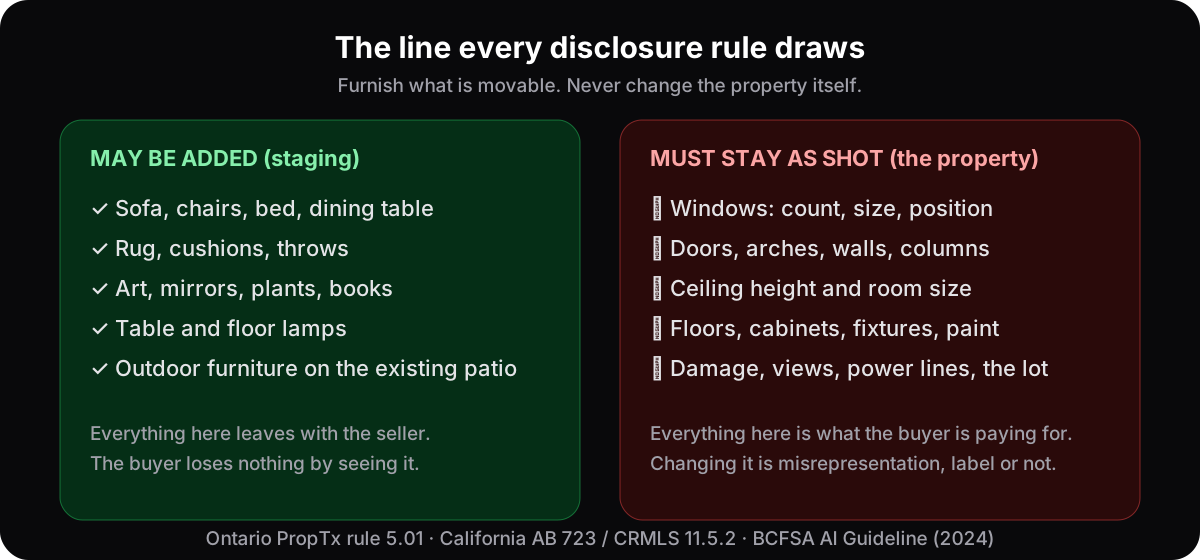
ARMLS is relaxed about the yard. Its post on virtually staged photos: "you can add patio furniture to the backyard, improve the pool features, or enhance the landscaping", or remove "the unsightly trash cans at the end of the driveway" — "But the Digitally Altered disclosure is required." The power lines that other rulebooks single out appear on ARMLS's page as an example of an altered photo, not a banned one.
Our reading: patio furniture on the existing patio, watermarked and paired, is staging. A greener lawn, a bigger pool or a garden that is not there is a picture of a different property, and R4-28-502(C) asks whether the advertisement creates a "misleading or ambiguous" impression, not whether it carried a watermark. A buyer who drives out to bare dirt where the render showed turf has been misled, disclosure or not. Furnish the patio; leave the ground as photographed.
Tucson: MLSSAZ wants the label along the top
The Multiple Listing Service of Southern Arizona has had a staging rule since January 2019, in section 1.19(I) of its Rules and Regulations (PDF): "Photo enhancements are allowed as follows: saturation of color, brightness & contrast, cropping of size, and virtual home staging. Virtual staged photos must include a “virtual staged” disclosure prominently placed along the top of the image. Virtually staged photos must also include an unmodified copy of the photo adjacent to the staged photo."
So in Tucson the label goes on the image, in a fixed place, and the original goes beside it. The same section bars "borders, banners, graphics, writing, logos" on photos, which reads as a ban on text; our reading is that the staging label is the exception the rule itself creates, and nothing else should be written on the photo. Section 1.18(b) bans "company/vendor branding" in photos, and 1.19(F) says "People in photos shall need to be cropped out". Photographs "may only depict the physical traits of the property for sale" and its surroundings.
The fine: MLSSAZ's schedule, as updated in July 2024, lists "Section 1.19 Submitting Photos to MLS" at $150, and says verifiable violations "will incur an immediate fine".
Text on the photo, and our stamp
The two Arizona rulebooks we read disagree about words on a photo. ARMLS allows none except its own watermarks; MLSSAZ requires one line along the top of a staged photo and bans the rest.
If you stage with our tool: the optional "Virtually Staged · AI Flip Room" stamp sits in the bottom corner and carries our name. On ARMLS it is exactly the kind of mark rule 8.23(e) bans, so switch it off — on Pro, Agency and Room Pack renders it is a switch on the generate screen — and apply the Flexmls Digitally Altered disclosure instead. On MLSSAZ, switch it off as well, and add a plain line reading "Virtually Staged" along the top of the image in your photo editor; our reading is that this is what the rule's "virtual staged" disclosure asks for. Free renders carry a tiled watermark, which both rulebooks would catch; they are for judging, not for a listing.
Above every MLS: Arizona's advertising rule
The Department of Real Estate rewrote its advertising rule, R4-28-502, by a rulemaking published at 31 A.A.R. 4267 on 7 November 2025 and in force since 13 December 2025. Three parts of it matter for a staged photo.
- (C), the duty. Advertising must contain "accurate claims and representations", and a licensee may not "misrepresent the facts or create misleading or ambiguous impressions". The words "or ambiguous" are new; copies of the rule that end at "misleading impressions" show the version from 2005.
- (K), the medium. "The use of an electronic medium, such as the Internet, Artificial Intelligence, or web site technology, that targets residents of this State with the offering of a property interest or real estate brokerage services constitutes the dissemination of advertising". An AI-generated listing image is advertising like any other.
- (G), who answers for it. The designated broker "is responsible for the advertising of all real estate activity". Your broker's staging policy may be stricter than the MLS's, and ARMLS's older page said as much: "your broker may have different requirements".
We quote the rule from the official Arizona Administrative Code, Supplement 26-2 of 30 June 2026, in the Internet Archive's copy of 27 July 2026 (PDF), because the Secretary of State's site would not serve the file to us directly.
The one place the code speaks about altered pictures is the rule on developers' advertising, R4-28-504(G), written for new developments rather than resale listings: "Pictorial or illustrative depictions, other than unmodified photographs of the property being offered, shall bear a prominent disclosure identifying the nature of the depiction, such as artist’s conceptions, architectural designs, designs created with artificial intelligence, engineer renderings, 3-d modeling, or other types of renderings". It does not bind an agent listing a resale home. Our reading: it shows how the Department treats a picture that is not a plain photograph of the property — it gets a prominent label.
The sanctions sit in the statute. Under A.R.S. 32-2153, the commissioner may suspend or revoke the license of a licensee who has "Pursued a course of misrepresentation", "Knowingly authorized, directed, connived at or aided in the publication, advertisement, distribution or circulation of any material false or misleading statement or representation", or "Made any substantial misrepresentation". Under A.R.S. 32-2160.01, a licensee who has violated the chapter or a rule "may be assessed a civil penalty by the commissioner, after a hearing, in an amount not to exceed one thousand dollars for each infraction".
We looked for an Arizona bill on altered or AI-generated listing images and found none in the Legislature's 2026 session. California has a statute on altered listing images and New York has bills; Arizona, so far, has its advertising rule and its MLSs.
What happens if you get it wrong?
On ARMLS, the money arrives in stages. The rule took effect on 28 May 2026; from June to November 2026 ARMLS enforced it "with no fines issued"; from December 2026, "ARMLS will issue a $200 fine for any violation of this policy". The Penalty Policy (PDF) files rule 8.23 media violations at $200, gives the first Penalty Violation in a calendar year "a warning notice in lieu of a fine" unless its table says otherwise, and counts several violations in the same listing as one. From the third violation of $200 or more in a year, a hearing panel can go "up to a maximum of $15,000" and suspend MLS access. Separately, "ARMLS shall have the right to immediately remove any Media from a Listing that is not in compliance with this rule."
On MLSSAZ, $150 for a breach of the photo rule. Above both, the Department of Real Estate can fine up to $1,000 per infraction after a hearing and suspend or revoke the license. And beside all of it stands the buyer who drove out to a backyard that exists only in the render.
What people write versus what the rules say
| What you will read elsewhere | What the Arizona text says |
|---|---|
| "The MLS offers an approved 'Virtually Staged' watermark" | ARMLS: "The ARMLS Virtually Staged watermark is no longer ARMLS-approved." Since 28 May 2026 the disclosure is the Flexmls "Digitally Altered" watermark. |
| "The ARMLS-approved watermark is optional" | True before 28 May 2026, and still written on ARMLS's older watermark page. Rule 8.23(n) now requires "an MLS system-provided watermark" on every altered photo, and the original directly before or after it. |
| "A salesperson or broker shall not misrepresent the facts or create misleading impressions" | That is the 2005 text, still shown by some online copies of the code. The rule in force since 13 December 2025 says "misleading or ambiguous impressions", and names "Artificial Intelligence" as an electronic medium of advertising. |
What should an Arizona agent actually do?
- Check which MLS the listing goes into before you stage, and follow that rulebook.
- On ARMLS, mark every altered photo with the Flexmls Digitally Altered disclosure — staged, decluttered or otherwise changed in content, not just brightened or cropped — and put nothing else on the image.
- Upload each original directly before or after its staged version; on MLSSAZ, adjacent to it.
- On MLSSAZ, write "Virtually Staged" along the top of each staged photo, and keep logos and other text off.
- Stage furniture and décor only. Floors, walls, windows, fixtures, the pool, the yard and any damage stay as photographed, whatever a watermark would allow.
- No people in the photos. ARMLS allows them only in the background; MLSSAZ wants them cropped out.
- Keep the original of every staged frame; on both MLSs it belongs in the listing anyway.
If most of your listings are vacant, our page for listing agents shows how staging fits into that: furnish the room, keep its geometry, keep the original.
Why we wrote this
We make an AI virtual staging tool, and both Arizona rulebooks we read ask our users to switch our own stamp off, which is a reason to be precise rather than reassuring. Every quotation above can be checked against the ARMLS Rules & Regulations (PDF) and Penalty Policy (PDF), ARMLS's pages on digitally altered media, adding the watermark, virtually staged photos and watermarks, the MLSSAZ Rules and Regulations (PDF) and their 2024 update (archived PDF), rules R4-28-502 and R4-28-504 in Supplement 26-2 of the Arizona Administrative Code (archived PDF), and A.R.S. 32-2101, 32-2153 and 32-2160.01. The points about the description field, about our stamp, about outdoor alterations, about MLSSAZ's ban on writing and about the developers' rule are labelled as our interpretation. For the general principles, see our virtual staging disclosure guide; for the other state that wants the original beside the staged photo, California; for a state whose MLSs keep text off the photo, Florida.
Questions Arizona agents ask
Is virtual staging legal in Arizona?+
Yes. ARMLS answers the question itself: "No, virtual staging is allowed, but you are now required to disclose it with a Digitally Altered disclosure watermark." Tucson's MLSSAZ lists "virtual home staging" among the photo enhancements it allows, with a label along the top and the unmodified photo beside it. No Arizona statute or Department of Real Estate rule mentions staging; what binds every licensee is rule R4-28-502(C): advertising must contain "accurate claims and representations" and may not "create misleading or ambiguous impressions". Furniture in an empty room, disclosed, passes; a render that changes the property does not, watermark or not.
Do I have to put "Virtually Staged" on the photo?+
Not on ARMLS. What goes on the photo there is the MLS's own "Digitally Altered" watermark, applied in Flexmls with the sunburst icon; ARMLS says its old Virtually Staged watermark "is no longer ARMLS-approved", and rule 8.23(e) bans any other text or watermark on the image. Words can go in "the media description field found in Flexmls", as an addition to the watermark rather than a substitute. On MLSSAZ in Tucson, yes: the rule asks for a "virtual staged" disclosure "prominently placed along the top of the image".
Do I have to show the original photo next to the staged one?+
Yes, on both Arizona MLSs we read. ARMLS rule 8.23(n): each altered item "must be paired directly before or after with the corresponding unaltered original Media item". MLSSAZ section 1.19(I): "an unmodified copy of the photo adjacent to the staged photo". Upload the original right before or right after its staged frame, not at the end of the gallery.
When do ARMLS fines start, and how much are they?+
The rule took effect on 28 May 2026. ARMLS ran an education phase from June to November 2026 "with no fines issued"; from December 2026, "ARMLS will issue a $200 fine for any violation of this policy". The Penalty Policy adds two details: unless its table says otherwise, the first Penalty Violation in a calendar year draws "a warning notice in lieu of a fine", and several violations in one listing "shall be treated as one violation". A third violation of $200 or more in the same year can go to a hearing panel, with fines up to $15,000 and suspension from the MLS.
Does decluttering, removing a yard sign or changing the sky need the watermark?+
ARMLS's own answers: decluttering a room, yes, because "an image is Digitally Altered when adding, removing or changing content"; removing valuables, yes; adding a fire to the fireplace, yes. A yard sign, no: "please blur" it instead. A changed sky color, no, though ARMLS invites you to submit the photo for review if you are unsure. Brightness, contrast, color, cropping and sharpening are "not considered Digitally Altered".
Is there an Arizona law on AI or virtually staged listing photos?+
Not one that names them. The Department of Real Estate rewrote its advertising rule, R4-28-502, with effect from 13 December 2025: it now names "Artificial Intelligence" among the electronic media whose use counts as advertising, and it bans "misleading or ambiguous impressions". The statute's definition of advertising already covered "any photographs, drawings or artist's presentations of physical conditions or facilities existing or to exist on the property". The only rule that asks for a label on a picture, R4-28-504(G), is about developers' advertising: depictions "other than unmodified photographs of the property being offered" need "a prominent disclosure". We found no bill on altered listing photos in the Legislature's 2026 session.
Last checked against the ARMLS Rules & Regulations last updated 28 May 2026 (rules 1.29, 6 and 8.23) and Penalty Policy published 28 May 2026, ARMLS's pages on digitally altered media, adding the watermark, virtually staged photos and watermarks, the MLSSAZ Rules and Regulations effective 22 March 2022 (sections 1.18 and 1.19) and their update adopted 29 July 2024, rules R4-28-502 and R4-28-504 of the Arizona Administrative Code (Supplement 26-2, 30 June 2026) and A.R.S. 32-2101, 32-2153 and 32-2160.01, on 5 October 2026. Rules change; verify before relying on this.
See it on your own room
Upload a photo and watch AI restage your space in 15–60 seconds, depending on how much detail it has — free to try, no credit card.
Try AI Flip Room freeRelated reading
Virtual Staging Disclosure Rules: How to Label Staged Photos
Why disclosure is required, three ways to label a virtually staged photo, what you may change vs never touch, and the rules of ten jurisdictions compared.
California Virtual Staging Rules: AB 723 + CRMLS 11.5.2
Since 1 January 2026 California regulates altered listing photos by statute. What AB 723 requires, what CRMLS 11.5.2 adds, the $250 fine, and a checklist.
Virtually Staged Listing? 5 Things a Buyer Can Demand
AI staging is legal in Ontario, BC, Quebec, Alberta, California, New York, Florida, Texas, Washington and Arizona, with conditions: what a buyer can demand.