Australia Virtual Staging Rules: Consumer Law, the States, realestate.com.au and Domain
AI Flip Room · 19 min read
Australia has no virtual staging rule that we could find, and no MLS to write one. What it has is a national consumer law that bans misleading conduct, a licensing law and a regulator in each state that say the same thing to agents, and two listing portals, realestate.com.au and Domain, whose policies decide what a photo may carry. In its current version, amended September 2026, one of those policies names AI directly: realestate.com.au will not publish a photo "generated or edited using artificial intelligence (AI) tools" unless it does not mislead and "the AI usage is clearly disclosed in a prominent location on or adjacent to the relevant content". And one state has written the words "digitally generated or altered images" into a statute, the first we found to do so: NSW, for rental advertisements, in an Act assented to on 2 October 2026 that was not yet in force when we checked.
The short answer: virtual staging is allowed in Australia, as long as the photo shows the room furnished rather than changing what the property is, and as long as you say so where the portal and, soon in NSW rentals, the law want it said. This article quotes the Consumer Law, the agent laws and regulators of the five states we read, the two portals and the new NSW section, sets out what to do, explains what a slip costs, and separates what the texts say from what you will read elsewhere. It is not legal advice; where we are interpreting rather than reporting, we say so.
Is virtual staging allowed in Australia?
Yes, as far as every law and regulator page we read goes: none bans it and none mentions it. The Australian Consumer Law (PDF), Schedule 2 to the Competition and Consumer Act 2010, in the compilation of 1 July 2026, bans in section 18 any conduct "that is misleading or deceptive or is likely to mislead or deceive" and in section 30 any "false or misleading representation concerning the characteristics of the land", "the location of the land" or "the existence or availability of facilities associated with the land" in connection with a sale or its promotion. The words photograph, image and staging appear nowhere in the Schedule. The ACCC puts it in one line: "It is illegal for real estate agents to mislead consumers, regardless of whether this is deliberate or not." It also says what it does not do: "We don't administer the specific real estate laws." Those are state laws, and so are the regulator pages that come closest to a photo rule.
First question: which state, and which portal?
Two things decide which text binds you. The state fixes the licensing law and the regulator; the portal fixes what the photo may carry. We read five states and both national portals.
- New South Wales. NSW Fair Trading's advertising guidelines for property agents are the most detailed regulator text we found on editing photographs: three lines, quoted below. Its misrepresentation page adds section 52 of the Property and Stock Agents Act 2002, under which an agent must not induce a contract by "any statement, representation or promise that is false, misleading or deceptive (whether to the knowledge of the agent or not)", with "a court penalty of up to $110,000". The Act itself sits on a site that refused our reader, so we quote the regulator's page.
- Victoria. Consumer Affairs Victoria says agents "should not use photographs that give the wrong impression of a property", including photos "digitally or otherwise enhanced to hide undesirable features or promote other features", and that "An offence can occur whether or not you intended to mislead or deceive." Section 42(4) of the Estate Agents Act 1980 (PDF) makes publishing "any false or misleading statement or representation concerning any property" in an advertisement an offence.
- Queensland. Section 212 of the Property Occupations Act 2014 says a licensee or salesperson "must not represent to someone else anything that is false or misleading relating to the letting, exchange or sale of real property", and adds that a representation is false or misleading "if it would reasonably tend to lead to a belief in the existence of a state of affairs that does not in fact exist". The Office of Fair Trading's property advertising page is about price, not photos.
- Western Australia. The code of conduct (PDF) for agents and sales representatives, in force since 5 October 2016, asks in rule 7 for honesty "in all dealings with the client, other agents and sales representatives, and other persons involved in a transaction" and in rule 11 bans conduct "that is misleading or deceptive or is likely to mislead or deceive within the meaning of the Australian Consumer Law (WA) Part 2-1".
- South Australia. Section 36 of the Land and Business (Sale and Conveyancing) Act 1994 (PDF) makes "a false or misleading representation for the purpose of inducing another person to" sell or buy land an offence, with a maximum penalty of $20,000 "or imprisonment for 1 year".
The ACT, the Northern Territory and Tasmania we have not read; as the ACCC says, real estate laws "are state and territory-based", so check theirs before relying on this one. Then the portal: realestate.com.au's Acceptable Use Policy and Domain's rules for images are quoted below, and a listing on both must satisfy both.
The rules, word for word
Three things in those texts decide how you stage in Australia. First, the only rule that prescribes a disclosure is a portal's: realestate.com.au's clause 4.1.40, which wants the AI use "clearly disclosed in a prominent location on or adjacent to the relevant content". No state law or regulator we read asks for a staging label on a sale listing; the NSW rental section, when it commences, will ask for "the fact the images are digitally generated or altered" where the image would mislead.
Second, the line is drawn by the regulators in the language of features, not furniture: NSW's "digitally removing or adding features", Victoria's "enhanced to hide undesirable features or promote other features". Neither page mentions staging, so neither grants it an exception; our reading of where furniture falls is below.
Third, the two portals treat text on the image in opposite ways. realestate.com.au contemplates a disclosure "on or adjacent to" the content and tolerates a watermark only if it is transparent, colourless, in the bottom right corner and no more than 15% of the image; Domain allows no "text or corporate message" on an image at all.
What to do on each portal
| realestate.com.au | Domain | |
|---|---|---|
| Where the disclosure goes | Required for AI content: "in a prominent location on or adjacent to the relevant content". Ours: the property description, and the image where you can | Not prescribed. Ours: the property description, and the original beside the staged photo |
| Words | Not prescribed. Ours: "One or more photos are virtually staged with AI. The furniture shown is not included." | Not prescribed. The same sentence |
| Text on the photo | Allowed unless it is text "that we consider detracts from the quality of the image"; a watermark only if transparent, "with no colour", bottom right, no more than 15% of the image | Not allowed: "Images may not include any text or corporate message"; a watermark only "according to these specifications" |
| Our stamp | The plain "Virtually Staged." without our name, bottom corner, or off | Off |
| Original | Not required. Keep it | Not required. Keep it, and consider showing it beside the staged photo |
| What may not change | Anything that would "mislead prospective buyers or renters on the nature, condition, or features of the property being marketed or the surrounding area" | Images must be "current and unembellished representations of the opportunity" and "of the actual property" |
| What a slip costs | "suspending or deleting a specific listing", up to "terminating or suspending your subscription" | Removal and "an official warning"; after two, an infringement |
Our disclosure wording tool gives this kind of answer for the other markets in this series; for Australia, use the table above.
And in each state
| NSW | Victoria | Queensland | WA | SA | |
|---|---|---|---|---|---|
| Who sets the rule | NSW Fair Trading, under the Property and Stock Agents Act 2002 and the Consumer Law | Consumer Affairs Victoria, under the Estate Agents Act 1980 and the Consumer Law | The Office of Fair Trading, under the Property Occupations Act 2014 and the Consumer Law | Consumer Protection, under the code of conduct made under the Real Estate and Business Agents Act 1978 and the Consumer Law | The state, under the Land and Business (Sale and Conveyancing) Act 1994 and the Consumer Law |
| What it says about photos | Agents "must not" "change the appearance of a property by digitally removing or adding features" or "zoom in on a photograph of a view"; photos touched up "to hide undesirable characteristics or enhance other features" "could also mislead consumers" | No photos "digitally or otherwise enhanced to hide undesirable features or promote other features" | Nothing on photos; any representation "false or misleading relating to the letting, exchange or sale of real property" is banned | Nothing on photos; honesty, and no conduct "misleading or deceptive" within the Consumer Law | Nothing on photos; no "false or misleading representation" to induce a sale or purchase |
| What a slip costs | Section 52: "up to $110,000" | Section 42(4): 25 penalty units, $5,227.50 | Section 212: 540 penalty units, $93,258 | The Consumer Law penalties, up to $2,500,000 for a person | Section 36: $20,000 "or imprisonment for 1 year" |
Text on the photo, and our stamp
realestate.com.au's policy is written for agency branding, not for staging labels, and the two clauses that touch a label point in different directions. Clause 4.1.8 bans "any watermark, including an agency name" unless it is "a transparent watermark with no colour inserted in the bottom right hand corner of the image with surface area no greater than 15% of the total image's surface area"; clause 4.1.11 bans text in a photo "that we consider detracts from the quality of the image on a listing" and branded objects "such as signboards, cars and coffee cups". Clause 4.1.40 then asks for the AI disclosure "on or adjacent to the relevant content". Our reading: a small, plain "Virtually staged with AI" in the bottom right corner is the disclosure 4.1.40 asks for and not the branding 4.1.8 and 4.1.11 ban; a stamp that carries a company name is the branding. The same sentence in the description is "adjacent", and we would put it there in every case.
Domain is simpler: "Images may not include any text or corporate message", "Images may not include a logo", and a watermark only "according to these specifications", which are not on the page we read. On Domain the words go in the description and the original goes beside the staged photo. Make it a separate image, not a side-by-side: Domain also bans images that "display a collage or combination of photos or other images within one frame".
Neither regulator page says anything about words on a photo beyond NSW's "location shot" label for a photo that has "not been taken on the property being offered for sale". NSW does say what a label is for: "Property advertisements should use photographs that are accurately labelled to prevent consumer doubt."
If you stage with our tool: the optional "Virtually Staged · AI Flip Room" stamp sits in the bottom corner and carries our name. On realestate.com.au that is a watermark with a company name in it, which clause 4.1.8 allows only as a colourless transparent mark in the bottom right corner — so switch to the plain setting or switch it off. On Domain switch it off entirely: no text on the image. On Pro, Agency and Room Pack renders the generate screen offers three settings: our stamp, a plain "Virtually Staged." without our name, and no stamp. The plain setting is the one to use on realestate.com.au if you want the label on the image; it does not mention AI, so the sentence in the description is still what discloses the AI there. Free renders carry a tiled watermark, which neither portal would accept; they are for judging, not for a listing.
The original photo
No rule we read in Australia asks for the unstaged original, on either portal or in any state. Keep it anyway, for every staged frame, and send it to anyone who asks. It is the quickest answer to the only question that matters under every text above: whether the images still "truthfully and fairly represent that property". On Domain, where the image may carry no text, the original beside the staged photo is also the clearest disclosure available. NSW Fair Trading's page is explicit that the burden stays with the agent: "Agents cannot avoid liability simply by claiming that the buyer or consumer should have made reasonable enquiries and checked the information provided."
What may change: the features test
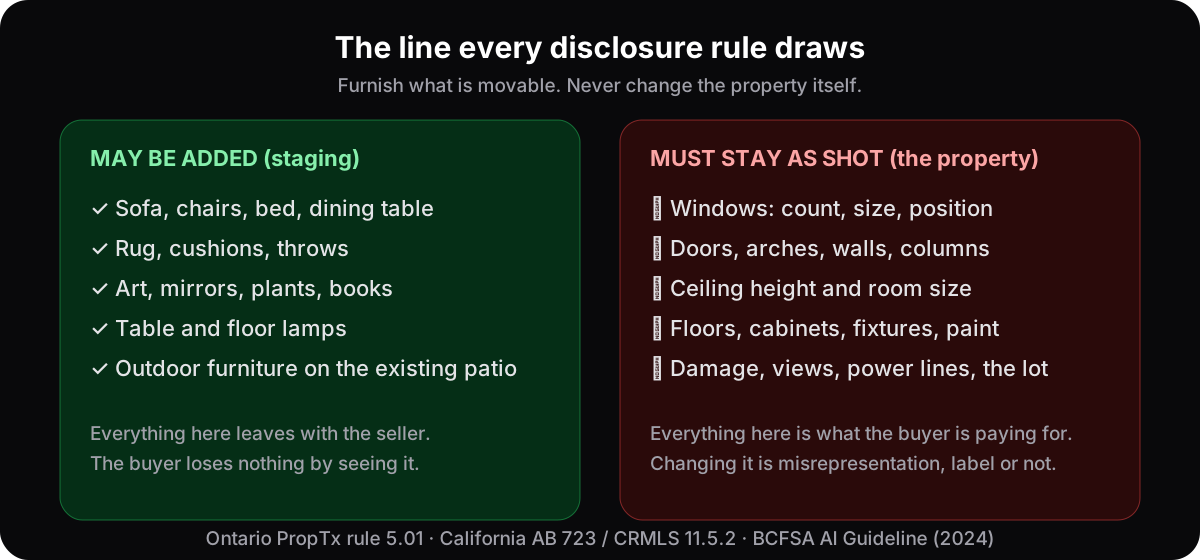
No law or regulator page we read names the furniture. The tests are about the property. NSW: agents must not "change the appearance of a property by digitally removing or adding features", with one carve-out, "adjusting the lighting effects only to compensate for poor lighting may be acceptable", and must not "zoom in on a photograph of a view from the property to make that view appear closer"; photos "touched up to hide undesirable characteristics or enhance other features" "could also mislead consumers". Victoria: no photos "digitally or otherwise enhanced to hide undesirable features or promote other features", and none "accompanied by comments or other photographs that suggest a property has views, or is close to amenities" it is not. realestate.com.au: nothing that would "mislead prospective buyers or renters on the nature, condition, or features of the property being marketed or the surrounding area". Domain: "current and unembellished representations".
Our reading. Furniture, rugs, art, lamps and plants in an empty room: not a feature of the property, so staging, disclosed. Replacing the seller's furniture with digital pieces: the same, disclosed the same way, with the original kept. New paint, flooring, countertops, a greener lawn, a brighter view, a removed power line or a neighbour's wall: those are features of the property or "the surrounding area", and changing them is what NSW and Victoria describe, label or not. The one edit NSW allows by name is lighting "only to compensate for poor lighting"; a render that lightens the walls into a different colour is not that. And a photo "taken a long time ago" that "is no longer an accurate portrayal of the property" fails in NSW on its own, staged or not, so stage the photo of the room as it is now.
The one place where a text does name furniture is the NSW rental law's ministerial release: "artificially generated furniture that shows a double bed in a bedroom that is only large enough to fit a single". That is staging that changes the apparent size of the room, which is a feature; staging that keeps the room's proportions is not what the release describes.
What happens if you get it wrong?
None of the texts names a fine for undisclosed or over-edited staging. What follows is the line each would apply to a misleading photo, and that choice is our reading.
Under the Consumer Law, section 30 is in Part 3-1, and section 224 caps the pecuniary penalty for a person at $2,500,000 and for a body corporate at "the greater of the amounts mentioned in subsection (3A)": "$100,000,000", "3 times the value of that benefit" or "30% of the body corporate's adjusted turnover during the breach turnover period". Section 152 makes the same representation a criminal offence of "strict liability". NSW Fair Trading's advertising page still prints the older ceiling, "The maximum penalty in the case of a person is $220,000 and for a company is $1.1 million"; the compilation of 1 July 2026 says otherwise, and Queensland's own page gives the current figure for an individual, "up to $2.5 million per breach".
In NSW, section 52 of the Property and Stock Agents Act 2002 carries "a court penalty of up to $110,000", and liability runs "whether or not they knew the representation was false, misleading or deceptive", with a defence for an agent who "did not know, and had no reasonable cause to suspect". In Victoria, section 42(4) of the Estate Agents Act 1980 is an offence with a maximum of 25 penalty units, which at the 2026-27 value of $209.10 is $5,227.50. In Queensland, section 212 of the Property Occupations Act 2014 carries 540 penalty units, which at $172.70 a unit from 1 July 2026 is $93,258. In South Australia, section 36 carries $20,000 "or imprisonment for 1 year", and the prosecution need not show the agent knew: "it is not necessary for the prosecution to establish that the defendant knew the representation to be false or misleading", though it is a defence to prove "reasonable ground to believe, and did believe, the representation to be true". In Western Australia the code of conduct names no figure; the Consumer Law's apply.
The portals act faster than any court. Domain: "the listing will be removed and the agency will be sent an official warning. After two warnings, an infringement will be sent to the agency to cover administration costs." realestate.com.au, clause 5.2: "suspending or deleting a specific listing", "reducing the visibility of an agent or agency profile", up to "terminating or suspending your subscription".
The NSW rental law: the first Australian law we found to say "digitally generated or altered images"
On 2 October 2026 the Residential Tenancies Amendment (Protection of Personal Information) Act 2026 received assent as Act 38 of 2026, after the Legislative Assembly passed it with an amendment on 21 October 2025 and the Legislative Council on 24 September 2026. Its text as passed by both Houses (PDF) inserts section 22B into the Residential Tenancies Act 2010. Subsection (5): "A landlord or landlord's agent must not include in an advertisement or other offer relating to residential premises offered for rent digitally generated or altered images that would be reasonably likely to mislead or deceive a person unless the following is stated in the advertisement or offer— (a) the fact the images are digitally generated or altered, (b) other information prescribed by the regulations." The maximum penalty is "for an individual—50 penalty units, or (b) otherwise—200 penalty units", which the ministerial release of 29 June 2025 put at "$5,500 for individuals and $22,000 for businesses". Subsection (6) lets the Secretary "issue guidelines in relation to determining whether digitally generated or altered images would be reasonably likely to mislead or deceive a person".
Three things to know. It is about rentals: the section speaks of "residential premises offered for rent", and nothing in the Act touches a sale listing. It is not yet in force: apart from one item on pets, which commenced on assent, the Act commences "on a day or days to be appointed by proclamation", and on 13 October 2026 we found no proclamation; the bill page shows assent and nothing after it, and the bill's explanatory note describes the disclosure as applying to images "reasonably likely to mislead or deceive a person". And it is a disclosure rule, not a ban: an altered image that would mislead may still run if the advertisement states "the fact the images are digitally generated or altered". The minister's release is where staging is named: the disclosure is for "altered photographs in rental advertisements that could mislead renters, such as using artificially generated furniture that shows a double bed in a bedroom that is only large enough to fit a single, or digitally modifying photos to obscure property damage". Our reading: a staged rental photo that keeps the room's true size and says it is staged, in the words of the section, is what the law asks for; one that squeezes a double bed into a single room is what it was written against, and no label fixes it on realestate.com.au either.
What people write versus what the texts say
| What you will read elsewhere | What the Australian texts say |
|---|---|
| "Every Australian state and territory permits virtual staging as long as the listing makes clear that the photos have been digitally altered." | No state or territory text we read mentions virtual staging, and none grants a permission conditional on a label. What exists is a ban on misleading representations about property in the Consumer Law and in each state's agent law, plus realestate.com.au's own condition that AI edits be disclosed. The ACT, the Northern Territory and Tasmania we have not read. |
| The "typical industry phrase" is "virtually staged for illustrative purposes — furniture not included", "included in the property description or as a watermark on the staged image" | No text prescribes a phrase. realestate.com.au asks that the AI use be "clearly disclosed in a prominent location on or adjacent to the relevant content"; Domain allows no text on the image at all, so a watermark there breaks its rule. |
| The NSW bill "remained before the Legislative Council when checked on September 10, 2026" and "is not an enacted virtual-staging disclosure law" | The Council passed it on 24 September 2026 and it was assented to on 2 October 2026 as Act 38 of 2026. It is still not in force, it covers rentals only, and it is a disclosure rule for images "reasonably likely to mislead or deceive"; the page was right for the day it was checked and is out of date now. |
What should an Australian agent actually do?
- Check which portal and which state the listing is in; a listing on both portals must satisfy both.
- Disclose in the description, every time: One or more photos are virtually staged with AI. The furniture shown is not included. On realestate.com.au that is the disclosure clause 4.1.40 requires for AI-edited photos; everywhere else it is what the misleading-conduct test rewards.
- On the image, only where the portal allows it. On realestate.com.au a small, plain, colourless "Virtually staged with AI" in the bottom right corner, with no company name; on Domain nothing on the image.
- Stage furniture only. Furniture, rugs, art, lamps, plants. Walls, floors, finishes, windows, the view, the lawn, the power lines and the neighbour's wall stay as photographed; "adding features" and "enhanced to hide undesirable features" are the words the regulators use.
- Keep the room's true size. The example NSW chose for its rental law is a double bed in a single-bed room.
- Keep the original of every staged frame, and on Domain show it as a separate photo next to the staged one, never combined in one frame.
- Use a current photo. A staged render of a room that has since deteriorated or changed fails NSW's test before any furniture is added.
If most of your listings are vacant, our page for listing agents shows how staging fits into that: furnish the room, keep its geometry, keep the original.
Why we wrote this
We make an AI virtual staging tool, and in Australia our branded stamp has to come off on both portals, which is a reason to be precise rather than reassuring. Every quotation above can be checked against the Australian Consumer Law (PDF) and the ACCC's real estate page; NSW Fair Trading's advertising guidelines and misrepresentation page; Consumer Affairs Victoria, its penalties page and the Estate Agents Act 1980 (PDF); Queensland's Property Occupations Act 2014, the Office of Fair Trading's property advertising page and the penalty unit regulation; Western Australia's code of conduct (PDF) and the page that publishes it; South Australia's Land and Business (Sale and Conveyancing) Act 1994 (PDF); realestate.com.au's Acceptable Use Policy and Domain's help page on breach listings and images; and, for NSW rentals, the bill as passed (PDF), the bill page and the ministerial release. The points about where furniture falls under the features tests, about a label on the image, about our stamp, about which penalty line would apply and about the rental law are labelled as our interpretation. For the general principles, see our virtual staging disclosure guide; for another market where the platform, not the law, prescribes the label, Colorado; for a country where the rules come from provincial regulators rather than listing systems, Canada.
Questions Australian agents ask
Is virtual staging allowed in Australia?+
Yes, as far as the texts go: no Australian statute, regulation or regulator page we read bans it, and none mentions it. What every one of them bans is a misleading photo. The Australian Consumer Law, section 18, bans conduct that is "misleading or deceptive or is likely to mislead or deceive", and section 30 bans a "false or misleading representation concerning the characteristics of the land"; the ACCC says it is "illegal for real estate agents to mislead consumers, regardless of whether this is deliberate or not". NSW Fair Trading adds that agents must not "change the appearance of a property by digitally removing or adding features"; Consumer Affairs Victoria, that agents should not use photos "digitally or otherwise enhanced to hide undesirable features or promote other features". Our reading: furniture in an empty room, labelled as such, changes no feature of the property; a render that changes the room does, label or not. And realestate.com.au now makes disclosure of AI editing a condition of publishing the photo.
Do I have to label a virtually staged photo in Australia?+
On realestate.com.au, yes, if the photo was made or edited with AI: clause 4.1.40 of its Acceptable Use Policy allows AI-generated or AI-edited content only where it is "not likely to mislead" and "the AI usage is clearly disclosed in a prominent location on or adjacent to the relevant content". On Domain, no clause says so, but images must be "current and unembellished representations of the opportunity", and we would not call an undisclosed staged photo unembellished. No state law we read prescribes a staging label for a sale; NSW's new rental law will require a statement that images are "digitally generated or altered" where they are "reasonably likely to mislead or deceive a person". Our wording for every listing: "One or more photos are virtually staged with AI. The furniture shown is not included." in the property description, and, where the portal allows text on the image, a plain "Virtually staged with AI" on each staged frame.
Can I put "Virtually staged" on the photo itself?+
On realestate.com.au, our reading is yes, if it is plain and small: clause 4.1.40 itself contemplates a disclosure "on or adjacent to the relevant content", clause 4.1.11 only bars text "that we consider detracts from the quality of the image", and clause 4.1.8 bars any watermark "including an agency name" unless it is "a transparent watermark with no colour inserted in the bottom right hand corner of the image with surface area no greater than 15% of the total image's surface area". So: no company name, no colour, bottom right, small. On Domain, no: "Images may not include any text or corporate message", and a watermark only "according to these specifications", which we have not read; put the words in the description there. Neither regulator page says anything about words on a photo beyond NSW's "location shot" label for photos not taken on the property.
Do I have to show the original photo next to the staged one?+
No Australian rule we read asks for it, on either portal or in any state. Keep it anyway and send it to anyone who asks: NSW Fair Trading's test is whether the images "truthfully and fairly represent that property", Domain's is "unembellished representations", and the unstaged original is the quickest proof that only the furniture changed. On Domain, where text on the image is not allowed, the original beside the staged photo is also the clearest disclosure you can give.
What does a mistake cost?+
Under the Consumer Law, a false or misleading representation about the characteristics of land can draw a pecuniary penalty of up to $2,500,000 for a person and, for a company, the greater of $100,000,000, three times the benefit or 30% of turnover; NSW Fair Trading's page still prints the older figures, "$220,000" for a person and "$1.1 million" for a company. In NSW, section 52 of the Property and Stock Agents Act 2002 carries "a court penalty of up to $110,000". In Victoria, section 42(4) of the Estate Agents Act 1980 is an offence with a maximum of 25 penalty units, $5,227.50 at the 2026-27 value of $209.10. In Queensland, section 212 of the Property Occupations Act 2014 carries 540 penalty units, $93,258 at $172.70 a unit from 1 July 2026. In South Australia, section 36 of the Land and Business (Sale and Conveyancing) Act 1994 carries $20,000 "or imprisonment for 1 year". On the portals the listing comes down: Domain removes it and warns the agency, and "After two warnings, an infringement will be sent to the agency to cover administration costs"; realestate.com.au may be "suspending or deleting a specific listing" or "terminating or suspending your subscription".
Does the new NSW law on altered images apply to virtual staging?+
Yes, to rentals in NSW, once it is in force. The Residential Tenancies Amendment (Protection of Personal Information) Act 2026, passed by the Legislative Council on 24 September 2026 and assented to on 2 October 2026 as Act 38 of 2026, inserts section 22B into the Residential Tenancies Act 2010. Subsection (5) says a landlord or agent "must not include in an advertisement or other offer relating to residential premises offered for rent digitally generated or altered images that would be reasonably likely to mislead or deceive a person" unless the advertisement states "the fact the images are digitally generated or altered"; the maximum penalty is 50 penalty units for an individual and 200 penalty units otherwise, which the minister's release of 29 June 2025 put at "$5,500 for individuals and $22,000 for businesses". The release's example is staging: "artificially generated furniture that shows a double bed in a bedroom that is only large enough to fit a single". The section commences "on a day or days to be appointed by proclamation", and we found no proclamation when we checked on 13 October 2026. It does not apply to sales listings, and the test is whether the image would mislead, so a staged photo that keeps the room's true size and says it is staged is, in our reading, exactly what the section wants.
Last checked against the Australian Consumer Law (Compilation No. 165, 1 July 2026), the ACCC's real estate page, NSW Fair Trading's advertising guidelines (updated 21 September 2026) and misrepresentation page (8 July 2026), the Residential Tenancies Amendment (Protection of Personal Information) Act 2026 as passed, Consumer Affairs Victoria's advertising page (September 2026) and penalties page, the Estate Agents Act 1980 (No. 134, 26 November 2025), the Property Occupations Act 2014 and the Office of Fair Trading's advertising page (1 July 2026), the Western Australian code of conduct of 2016, the Land and Business (Sale and Conveyancing) Act 1994 (15 January 2026), realestate.com.au's Acceptable Use Policy (September 2026) and Domain's image rules (26 May 2026), on 13 October 2026. Rules change; verify before relying on this.
See it on your own room
Upload a photo and watch AI restage your space in 15–60 seconds, depending on how much detail it has — free to try, no credit card.
Try AI Flip Room freeGot a question about this?
Something unclear or not covered? Ask here. We read every question and answer the useful ones right in the article. Nothing you write is published.
Related reading
Virtual Staging Disclosure Rules: How to Label Staged Photos
Why disclosure is required, three ways to label a virtually staged photo, what you may change vs never touch, and the rules of fifteen jurisdictions compared.
Colorado Virtual Staging Rules: REcolorado, IRES and elevateMLS
Is virtual staging allowed in Colorado? Yes. REcolorado allows it outright, IRES has no rule, and elevateMLS in Colorado Springs wants the exact words "Virtually Staged".
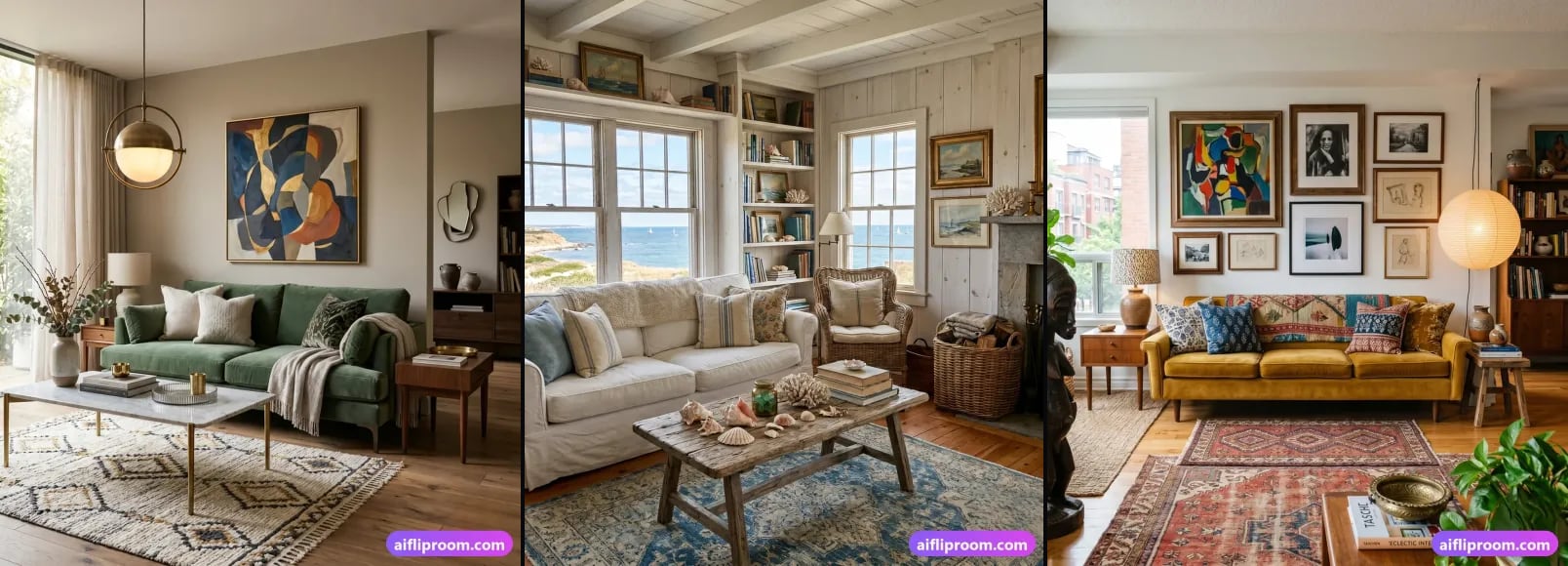
Virtually Staged Listing? 5 Things a Buyer Can Demand
AI staging is legal in Ontario, BC, Quebec, Alberta, California, New York, Florida, Texas, Washington, Arizona, Illinois, Georgia, Colorado, Australia and Bright MLS, with conditions: what to demand.