Quebec Virtual Staging Rules: OACIQ's AI Label, Quoted in English and French
AI Flip Room · 8 min read
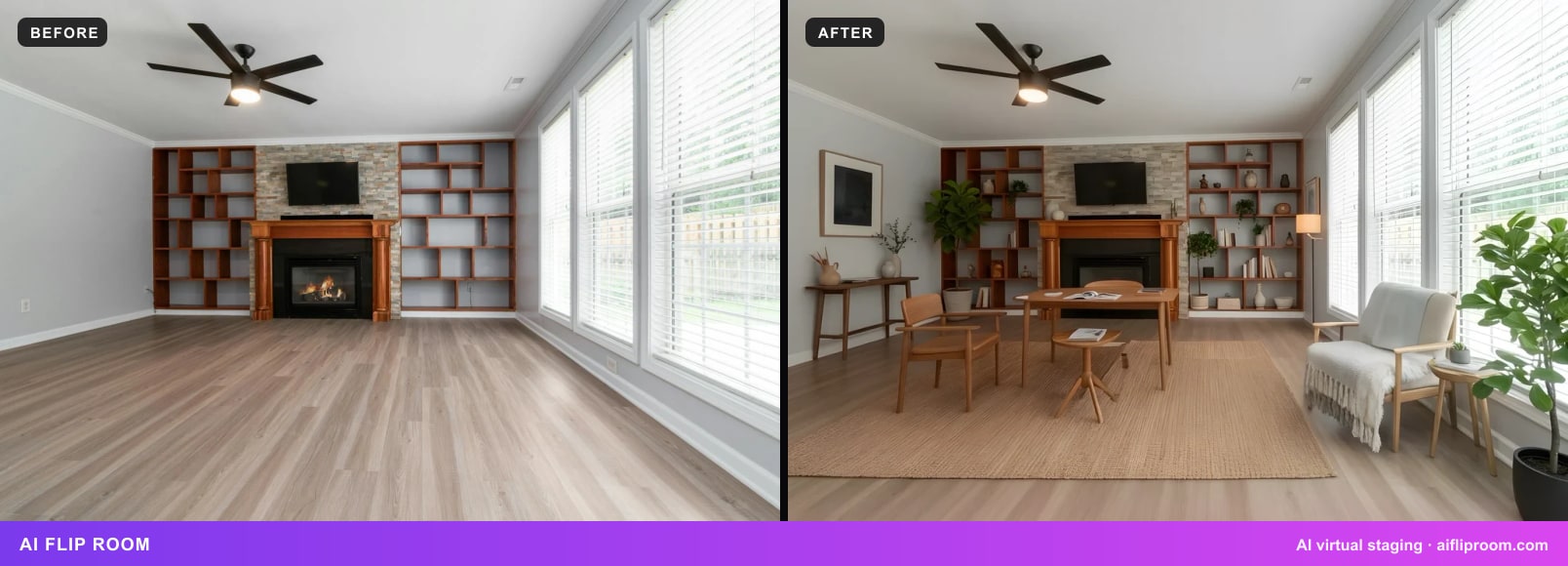
Quebec is the province where the real estate regulator has gone furthest on AI images. The OACIQ's advertising guideline, last updated in June 2026, has a section on artificial intelligence that names virtual staging, sets a minimum label and tells brokers to keep their original photos. It is short, it is specific, and most articles about "Quebec virtual staging rules" quote none of it.
The short answer: virtual staging is allowed in Quebec, as long as the advertisement carries a clear and visible statement that the image was generated with AI, and the image does not change what is actually being sold. This article quotes the guideline in English and French, the regulation it rests on, and the penalties behind it. It is not legal advice; where we are interpreting rather than reporting, we say so.
Is virtual staging allowed in Quebec?
Yes. The OACIQ (Organisme d'autoréglementation du courtage immobilier du Québec) does not ban AI or virtual staging. Its advertising guideline lists virtual staging among the uses of AI that need a label, alongside adding furniture, changing the season or the light, and illustrating a project that is not built yet. Disclosed, those are permitted. Not permitted is an image that changes the property itself.
The guideline is not a statute. It is the regulator's reading of the rules brokers already have to follow — mainly section 112 of the Regulation respecting brokerage requirements, professional conduct of brokers and advertising, which bans advertising that is "false, misleading or incomplete or that leaves out a material fact". The guideline tells you how the OACIQ applies that section to AI images.
What OACIQ's section 6.3.1 says, word for word
Section 6.3.1 is titled "Using artificial intelligence and other technological tools in advertising". It starts with the standard every advertisement has to meet when AI is involved: consistent, truthful, verifiable, complete, clear and understandable. Then comes the requirement:
The same section lists when the statement applies, in the OACIQ's words: when AI is used to "change the appearance of a property without touching the structure or making substantial changes (e.g., adding furniture, artificially creating a seasonal atmosphere, or adjusting the lighting)", to "carry out virtual staging or visual transformations", to "generate images that could alter the original version", or to "illustrate a real estate project to be built or an off-plan sale".
It also says who carries the risk: "Real estate brokers remain responsible for the accuracy and truthfulness of advertisements, even when the ads are produced by AI or any other technological tool." The tool is not responsible for what you publish. You are.
What the label has to say, and in which language
The OACIQ gives one example — "Image generated by artificial intelligence" — and calls it a minimum. It does not prescribe a phrase, so "Virtually staged with AI" or "Mobilier ajouté virtuellement par IA" would serve the same purpose. What it does require is that the statement is clear and visible and that it prevents "any confusion or misinterpretation of the reality represented". A note buried three screens below the photo is hard to call visible.
Language is where we stop reporting and start reasoning. The Charter of the French language says commercial advertising "must be in French", or in French and another language "provided that French is markedly predominant" (section 58). A listing is commercial advertising. Our reading is that the label should be in French, with English beside it if you want both. We have not found an OQLF or OACIQ text that applies the Charter to photo labels specifically, so treat this as a cautious default rather than a quoted rule.
If you stage with our tool: the default corner badge reads "Virtually Staged · AI Flip Room", in English. For a Quebec listing, add the French statement in the photo caption or on the image itself.
Keep the originals: Quebec's own requirement
This is the part that sets Quebec apart. Under the guideline's "key point" list, brokers must, among other things:
- validate all content before publication, and review everything AI generated;
- disclose any changes resulting from AI;
- "never use AI to hide defects, alter the structure, or misrepresent a property";
- check the rules of the platforms where the listing appears;
- keep on record "original versions of photos, human intervention and validation, context of use", "so that the public can be informed and the original photos can be made available upon request".
Compare the three provinces and the one state we have covered. Ontario's MLS rulebook has no pairing rule and no labelling rule for staged photos. British Columbia's regulator asks for a label and has no pairing rule. California makes you show the original, beside the staged image or behind a link. Quebec makes you keep it and hand it over when asked. In practice that means one habit: never delete the unedited frame, and keep it with the listing file.
A buyer who asks for the original is asking for something they are entitled to see; our guide to what buyers can demand from a staged listing covers what a good answer looks like.
Where is the line between staging and misrepresentation?
The guideline draws it plainly: "Images that fundamentally alter the actual appearance of a property violate the regulations and laws in force." Adding furniture, a rug or a lamp leaves the property as it is; it is on the list of uses that simply need the label. Hiding a crack, adding a window, raising a ceiling or erasing the power lines outside changes what the buyer is paying for, and no label repairs it.
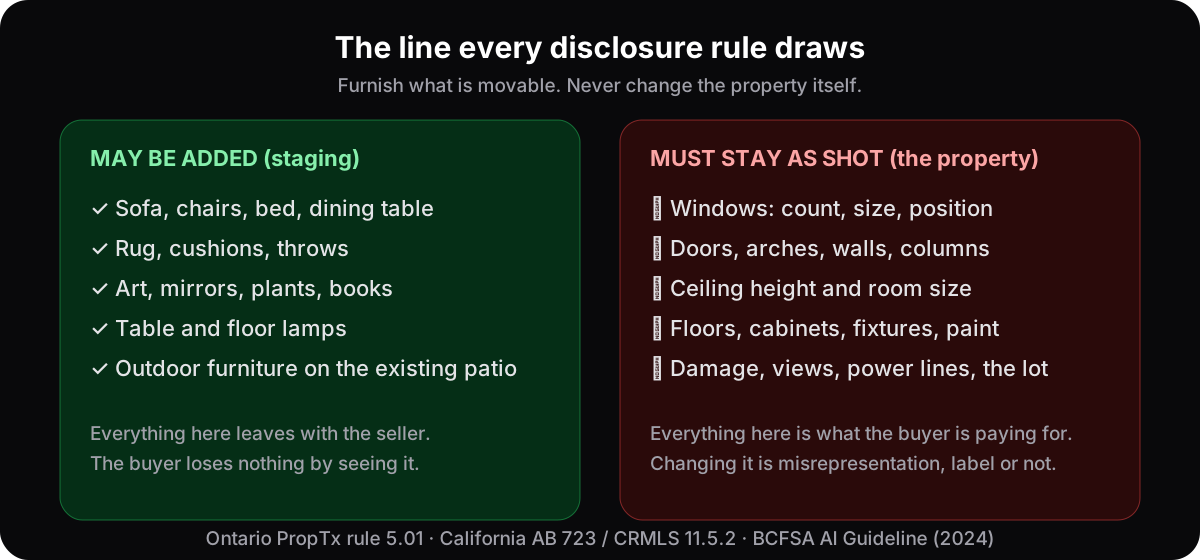
The regulation behind this is not new. Section 83 already required brokers to inform the parties "without exaggeration, concealment or misrepresentation", and section 112 bans advertising that leaves out a material fact. An AI image that hides a defect does both.
Old photos and copyright
The same section has a paragraph that most summaries skip. Before reusing existing photos — from a previous listing, another brokerage or a photographer — the broker must check who holds the copyright and respect the terms for both publishing and modifying the images. The OACIQ adds a warning worth reading twice: the brokers' professional liability insurance fund (FARCIQ) excludes claims for copyright infringement. Staging a photo you had no right to edit is a cost the insurance will not cover.
What about Centris?
Centris, Quebec's MLS, publishes its rules for brokers behind a login, and we have not read them, so we do not quote them here. The OACIQ itself tells brokers to check the rules of the platforms where they advertise. Two public facts: Centris's terms of use contain an AI clause, but it covers a redecorating tool for buyers that Centris added in 2025, not listing photos; and Quebec brokers have commonly posted the original photo right after the enhanced one on Centris — and the OACIQ has said publicly that the AI label is needed all the same.
What happens if you get it wrong?
Misleading advertising is a breach of the regulation, and the Real Estate Brokerage Act sets the penalties. Under section 98, the OACIQ disciplinary committee can reprimand a broker, suspend or revoke the licence, impose conditions, order training, or impose "a fine of not less than $2,500 nor more than $62,500 for each count", doubled for a second offence. Where an offence continues, each day counts as a separate offence.
We found one public case with AI photos so far: in February 2026 a brokerage in Terrebonne apologised for an AI-retouched photo of a house for sale and said it should not have been published. No disciplinary action had been reported when the story ran.
What people write versus what the guideline says
| What you will read elsewhere | What the OACIQ text says |
|---|---|
| "Quebec agents must write 'virtually staged' next to each image" | A clear and visible statement, such as "Image generated by artificial intelligence". No fixed phrase is prescribed. |
| "You must publish one untouched photo of every staged room" | Keep the originals on file and make them available on request. Publishing them is practice, not a rule. |
| "Breaking the rules gets you expelled from the MLS" | That is a US MLS concept. Quebec's sanctions are in section 98 of the Real Estate Brokerage Act. |
| "Section 112 bans confusing ads" | Section 112 bans advertising that is false, misleading, incomplete or leaves out a material fact. "Confuse" appears in the guideline's heading, not in the regulation. |
| Rules about « suggestion de décoration » and the EU AI Act | Those are about France and the European Union, not Quebec. Same language, different law. |
What should a Quebec broker actually do?
- Label every AI image with a clear, visible statement, in French — for example « Image générée par l'intelligence artificielle ».
- Furnish, never alter. Movable furniture, decor and light only; walls, windows, floors, fixtures, defects and views stay as photographed.
- Keep the originals and a note of who checked the image, with the listing file.
- Check the platform's rules — Centris, and any portal you syndicate to.
- Check the copyright before editing a photo you did not commission.
If most of your listings are vacant, our page for listing agents shows how staging fits into that: furnish the room, keep its geometry, keep the original.
Why we wrote this
We make an AI virtual staging tool, so we have an interest in the answer being permissive. Every quotation above can be checked against the OACIQ guideline, the Regulation and the Real Estate Brokerage Act; the language point is labelled as our interpretation. For the general principles, see our guide to virtual staging disclosure rules.
Questions Quebec brokers ask
Is virtual staging legal in Quebec?+
Yes. OACIQ's advertising guideline lists virtual staging among the uses of AI that need a label, which means it is permitted when it is disclosed. What is not permitted is an image that fundamentally alters the actual appearance of the property, hides a defect or changes its structure.
What label does OACIQ require on an AI-staged photo?+
A clear and visible statement, such as "Image generated by artificial intelligence" (« Image générée par l'intelligence artificielle » in the French text). OACIQ calls it a minimum requirement and gives it as an example, so the exact wording is yours; "virtually staged" is not prescribed, but the statement has to make clear that the image is not a plain photograph.
Does the label have to be in French?+
OACIQ's guideline does not say. The Charter of the French language requires commercial advertising to be in French, or bilingual with French markedly predominant, and a listing is advertising. Our reading is that the label should be in French, with English beside it if you want; we have not found an OQLF or OACIQ text that applies the Charter to photo labels specifically.
Do I have to publish the unedited photo next to the staged one?+
Not under the guideline. It asks brokers to keep the originals, and the record of how AI was used and checked, so the original photos can be made available on request. Many brokers post the original next to the staged version on Centris anyway; that is good practice, not an OACIQ rule.
What can happen if a staged photo misleads?+
Misleading advertising breaches section 112 of the brokerage Regulation. Under section 98 of the Real Estate Brokerage Act, the disciplinary committee can reprimand, suspend or revoke a licence, or fine $2,500 to $62,500 per count, doubled for a repeat offence.
Last checked against OACIQ guideline section 6.3.1 (last update 17 June 2026), the Regulation C-73.2, r. 1 and the Real Estate Brokerage Act C-73.2 on 2 October 2026. Rules change; verify before relying on this.
See it on your own room
Upload a photo and watch AI restage your space in 15–60 seconds, depending on how much detail it has — free to try, no credit card.
Try AI Flip Room freeRelated reading
Ontario Virtual Staging Rules: PropTx MLS Rule 5.01, Quoted
Is virtual staging banned on the Ontario MLS? We read the PropTx rulebook: rule 5.01 quoted, the missing "one unstaged photo" rule, and where the line is.
BC Virtual Staging Rules: What BCFSA's AI Guideline Says
BCFSA's 2024 AI guideline, quoted: virtual staging may be okay if labelled, which Rules sections apply, and the client-data consent point most agents miss.
California Virtual Staging Rules: AB 723 + CRMLS 11.5.2
Since 1 January 2026 California regulates altered listing photos by statute. What AB 723 requires, what CRMLS 11.5.2 adds, the $250 fine, and a checklist.