Texas Virtual Staging Rules: HAR, NTREIS, Unlock MLS and SABOR
AI Flip Room · 12 min read
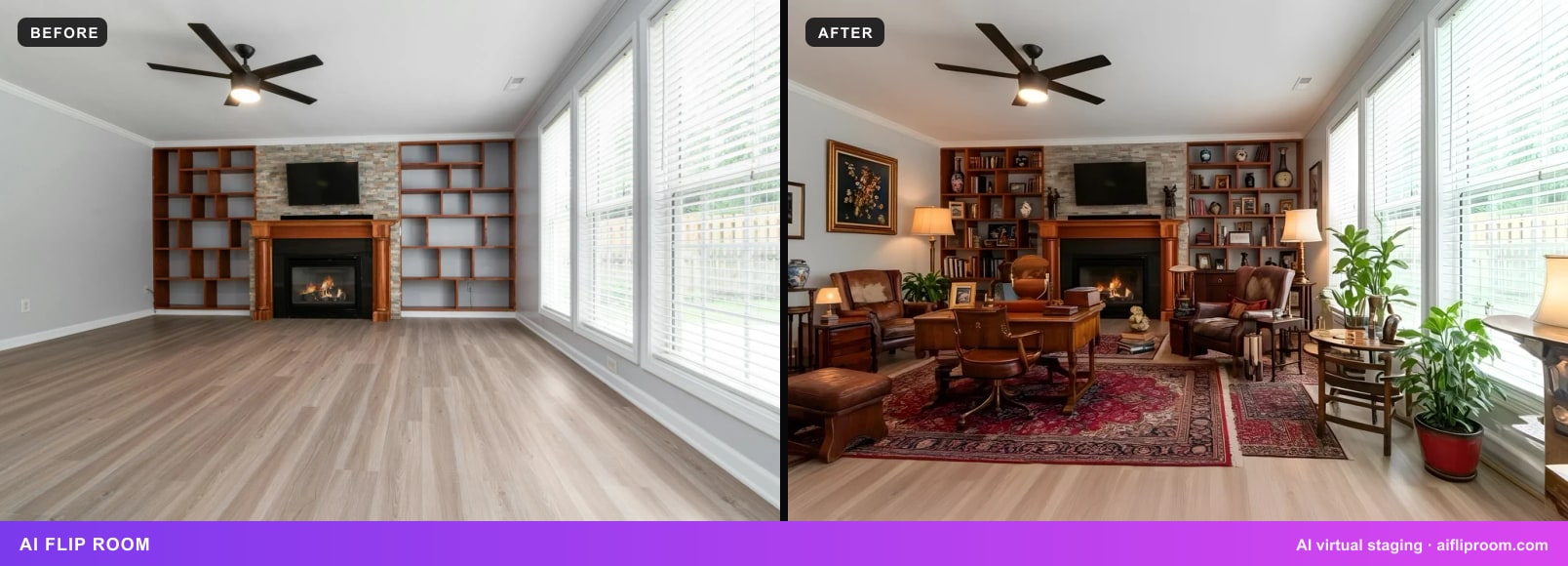
Texas has no statute or TREC rule that mentions virtual staging. What it has is four MLS rulebooks that do, and they do not agree. Houston's wants a note in the photo description and saves its watermark for images that change the property. Austin's wants the unstaged view beside the staged one. Dallas–Fort Worth's never uses the words and bans only what misrepresents. San Antonio's wants a pick-list option ticked. Above all of them sits one line of state law on advertising, and a TREC rule that explains what the line means.
The short answer: virtual staging is allowed in Texas, as long as the photo adds furniture rather than changing the property, and it is disclosed the way your MLS asks. This article quotes the four rulebooks, sets the state law beside them, and separates what the texts say from what is often written about them. It is not legal advice; where we are interpreting rather than reporting, we say so.
Is virtual staging allowed in Texas?
Yes. No Texas rule we read bans it, and two of the four rulebooks permit it in so many words: HAR's "Digital images may include the use of virtual staging" and SABOR's identical sentence. The Real Estate License Act, chapter 1101 of the Occupations Code, never mentions photographs, images or AI. What it has is a ground for discipline that reaches every advertisement a licence holder publishes, inside an MLS or out of it: an advertisement that "misleads or is likely to deceive the public" or "tends to create a misleading impression" (section 1101.652(b)(23)). Beside it sits (b)(2), conduct "that is dishonest or in bad faith or that demonstrates untrustworthiness".
TREC's advertising rule says what that means. 22 TAC 535.155 defines an advertisement as "any form of communication by or on behalf of a license holder designed to attract the public to use real estate brokerage services", which includes "all electronic media including email, text messages, social media, the Internet", and lists what misleads. First on the list, in (d)(1): an advertisement "that is inaccurate in any material fact or representation". A listing photo is a representation. Rule 535.156(d) adds the duty behind it: "A license holder has a duty to convey accurate information to members of the public with whom the license holder deals."
Neither rule prescribes a label, a watermark or a pair. The format comes from the MLS.
First question: which MLS is the listing in?
Texas is several MLS markets, and the photo rule that binds you is the rule of the system you submit to. We read four.
- HAR, the Houston Association of REALTORS®, whose MLS is run by the Houston Realtors Information Service.
- NTREIS, North Texas Real Estate Information Systems, the Dallas–Fort Worth MLS shared by MetroTex and the region's other associations.
- Unlock MLS, the Austin Board of REALTORS®' system, formerly ACTRIS.
- SABOR, the San Antonio Board of REALTORS®.
Other Texas MLSs have rulebooks we have not read; if your listing goes into one, check its own wording.
What HAR says, word for word
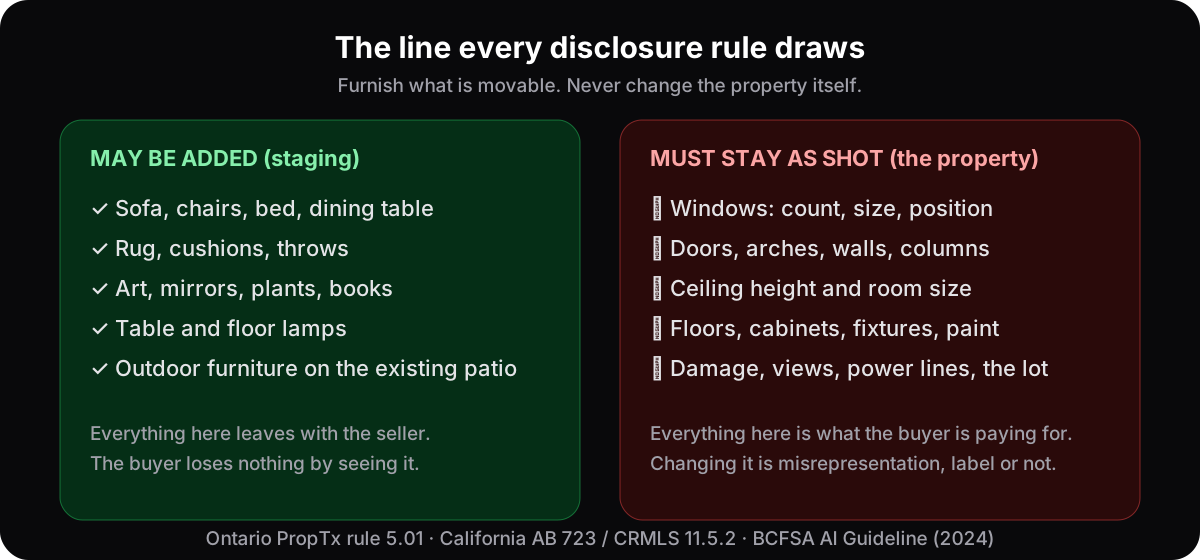
Two regimes sit in that text, and most summaries blur them. The first is staging: furniture and wall décor, "personal property" that leaves with the seller. For that, HAR asks for one thing — "clearly indicate in the Photo Description the image has been virtually staged" — and nothing on the image. The second is alteration of "real property characteristics": a new floor, a rendered pool, a removed wall. Those images may stay in the listing, but under a watermark of fixed wording and size, beside "an unaltered image with the same view", and never as the primary photo. A furnished-only render is the first case, not the second.
The charge is the same for both: item 8 of HAR's schedule puts an automatic $250 on the first failure to comply with Rule 1.25 and $500 on each additional one. Item 9 names smaller amounts for the paragraphs on required photo counts and on contact information in images; the staging paragraphs are not listed separately, so our reading is that item 8 applies to them.
Dallas–Fort Worth: NTREIS bans what misrepresents, not what furnishes
The NTREIS rulebook, approved as amended 16 October 2024 (PDF), never uses the words "virtual staging". Its rule 7.30 is a rule about truthfulness: "Only a true current photograph of Listed Property may be placed in the “Property Photograph” section without decorative borders, other embellishments, or any digitally enhanced modifications that would misrepresent the true condition or appearance of the property." The same rule bans the agent's name, phone number and web address from the photograph and picture-description fields, and allows a "representative photo of the proposed house" only for incomplete construction, with "a statement affirming that a representative photo is in use" in the Photo Description.
So the question in North Texas is not whether a photo was edited but whether the edit misrepresents the property. MetroTex, one of the shareholder associations that own NTREIS, said so in May 2026: "Virtual staging is acceptable in many cases, but large-scale virtual renovations can become problematic." Its examples of the problem are remodelled kitchens, new flooring and structural upgrades that do not exist, and outdoors, "Adding unrealistically green grass, landscaping, trees, or exterior enhancements that do not exist may misrepresent the condition of the property" (MetroTex, Common MLS Violations to Avoid in 2026). Our reading: a furnished room with the floor, walls and windows as photographed is a true photograph with furniture in it; a disclosure in the picture description costs nothing and settles the question before anyone asks.
MetroTex said it again in July 2026, in guidance on listing photos: "NTREIS MLS Rule 7.30 prohibits listing photos that include branding, contact information, or misleading modifications that don't accurately portray the listed property." Its heading draws the line in one sentence, "Virtual Staging Has Its Place. Virtual Renovations Don't.", and under "Keep the Landscaping Real" it names the garden outright: no bright green grass, mature trees, flower beds or shrubs that are not there (MetroTex: picture-perfect MLS listing photos). The same line every rule in this article draws, said more bluntly about the lawn.
Austin: Unlock MLS wants the unstaged view
Unlock MLS's Rules and Regulations, September 2026 edition (PDF), are the only Texas rulebook we read that asks for a pair. Rule 2.15, Digital Images: "Images with virtual staging (i.e., use of software to add furnishings) must include a non-virtually staged image of the same view." The rule does not say where the unstaged image goes, which is looser than California's CRMLS (immediately before or after) or upstate New York (directly before). It does say what every image must be: "an accurate representation of the property in its current state".
What Unlock does not ask for is a label. The words "virtually staged" appear nowhere as a required field or caption. And it is hostile to text on images: digital images "should not contain contact information such as names, phone numbers, email addresses or web site addresses, including use of embedded, overlaid, or digitally stamped information", and the MLS "reserves the right to reject or remove any digital image submitted that includes any embedded, overlaid, or digitally stamped text, personal advertising or promotion, as well as people or persons". The rulebook says of itself that it "is updated frequently"; we do not know in which edition the sentence about the pair first appeared.
San Antonio: SABOR and the pick list
SABOR's MLS Rules and Regulations, revised 18 September 2024 (PDF), use HAR's definition almost word for word in section 1.2(b): "Digital images may include the use of virtual staging which is limited to the addition of furnishings and wall décor that would otherwise be considered personal property and not conveyed in the sale of the property." The disclosure is a field, not a sentence: "Participants shall indicate by selecting virtually staged option on the pick list under photo description if home was virtually staged."
The same paragraph is the clearest list in Texas of what staging may not touch: "Digital images shall not contain digitally enhanced modifications that alter or misrepresent the condition or appearance of the listed property's structure or grounds included in the sale or lease. (e.g. adding or modifying a swimming pool or landscaping, removal of objects such as powerlines, utility boxes, fire hydrants etc.)" Images "shall not include any person", and may not carry "signs or other identification of the Brokerage and/or Agent or contact phone numbers". There is no watermark rule and no pairing rule. Section 16.24 restates the general duty: participants "shall present a true picture in their advertising and representations to the public".
Text on the photo, and our stamp
No Texas rulebook we read requires a label on the image for a furnished-only photo, and three of the four are unfriendly to text on photos: NTREIS bans "decorative borders, other embellishments", Unlock may remove "any embedded, overlaid, or digitally stamped text", and SABOR bans identification of the brokerage or agent. HAR bans "legible contact information such as names" in images, with its own watermark the only text it asks for, and only for altered property.
If you stage with our tool: the optional "Virtually Staged · AI Flip Room" stamp is text with a name in it. Our reading: for a Texas listing, switch the stamp off — on Pro, Agency and Room Pack renders it is a switch on the generate screen — and put the disclosure where your MLS keeps it: the Photo Description on HAR, the pick list on SABOR, and on Unlock the unstaged view beside the staged one. NTREIS asks for no label; the picture description is where we would put one anyway. Free renders carry a tiled watermark, which these rules would catch; they are for judging, not for a listing.
Above every MLS: Texas's advertising law
TREC has written plainly about what section 1101.652(b)(23) means. In its article on advertising rules: "Under Texas law, a license holder may not 'create a misleading impression' in their advertisement." The one photograph it uses as an example is not a staged room but a postcard: "An example of a misleading advertisement of this nature would be if a license holder sent out 'Just Sold' postcards with her contact information and a picture of a recently sold property that she did not help to sell." The principle carries over: a photo that shows the property as something it is not creates a misleading impression, label or not.
The sanction is in section 1101.702: "The amount of an administrative penalty may not exceed $5,000 for each violation", and "Each day a violation continues or occurs may be considered a separate violation for purposes of imposing a penalty." Section 1101.652 itself lets the Commission suspend or revoke the licence.
We looked for a Texas bill on altered or AI-generated listing images and found none. The Legislature meets in regular session in odd-numbered years; the 89th regular session ran from January to June 2025, and its records show no bill on the subject. The next regular session opens in January 2027, so no such bill could have been filed in 2026 outside a special session. California has a statute on altered listing images and New York has bills; Texas, so far, has its general rule.
What happens if you get it wrong?
On HAR, the charge is automatic: $250 for the first failure to comply with Rule 1.25 and $500 for each additional one, and HRIS may remove any image it "deems to be inappropriate, inaccurate, or objectionable" (Rule 1.25.5). NTREIS sends alleged violations of rule 7.30 to its enforcement procedure, whose menu runs from a warning letter to a fine "not to exceed $15,000" and suspension. SABOR charges a minimum of $100 for incorrect or incomplete listing information after a window to correct it. Unlock MLS publishes no amount for photo violations.
Above the MLS, TREC can fine up to $5,000 per violation, counting each day separately, and suspend or revoke the licence. And beside all of it stands the buyer who drove out to a kitchen that exists only in the render.
What people write versus what the rules say
| What you will read elsewhere | What the Texas text says |
|---|---|
| "TREC adopted an AI-photo rule in 2026, with an MLS flag and fines of up to $2,000" | We found no such rule. Section 535.155's history shows its last amendment taking effect on 4 September 2018; TREC's site has no bulletin or FAQ on AI or staged images; MLS field names are set by the MLSs, not the Commission. |
| "North Texas bans edited listing photos outright" | NTREIS rule 7.30 bans modifications "that would misrepresent the true condition or appearance of the property". MetroTex, May 2026: "Virtual staging is acceptable in many cases, but large-scale virtual renovations can become problematic." |
| "HAR wants the disclosure in the marketing remarks" | Rule 1.25.1 names the Photo Description. |
| "HAR requires a watermark on every staged photo" | Only on images "modified or enhanced to alter real property characteristics". A furnished-only image needs the note in the Photo Description and no watermark. |
| "Austin's MLS has no staging rule" | Unlock MLS's September 2026 rulebook, rule 2.15: staged images "must include a non-virtually staged image of the same view". |
| "TREC requires a 'clear and conspicuous' staging label" | Rule 535.155 does not mention photos, staging or labels; its "readily noticeable" wording is about the names of the licence holder and broker. The MLS sets the format. |
| "Texas requires an EXIF tag or a note in the file name" | Nothing in the statute, the TREC rules or the four rulebooks we read. |
What should a Texas agent actually do?
- Check which MLS the listing goes into before you stage, and follow that rulebook.
- On HAR, write it in the Photo Description of every staged image; on SABOR, select the virtually staged option on the pick list; on NTREIS, say so in the picture description.
- On Unlock, upload the unstaged view of every staged frame as well.
- Stage furniture and décor only. Floors, walls, windows, fixtures, the lot and any damage stay as photographed. If a render has changed the property, on HAR it needs the watermark, the pair and a different primary photo; everywhere else, it needs to go.
- Keep text, logos and watermarks off listing photos, ours included, unless your MLS asks for one.
- Keep the original of every staged frame.
If most of your listings are vacant, our page for listing agents shows how staging fits into that: furnish the room, keep its geometry, keep the original.
Why we wrote this
We make an AI virtual staging tool, and every Texas rulebook we read gives our users a reason to switch our own stamp off, which is a reason to be precise rather than reassuring. Every quotation above can be checked against the HAR MLS Rules (PDF), the NTREIS Rules and Regulations (PDF) and MetroTex's May 2026 guidance, the Unlock MLS Rules and Regulations (PDF), the SABOR MLS Rules and Regulations (PDF), section 1101.652 and section 1101.702 of the Occupations Code, and TREC rules 535.155 and 535.156. The points about which HAR charge applies to staging, about our stamp and about NTREIS and a furnished room are labelled as our interpretation. We did not read NTREIS's rulebook on its own site, which was unavailable on the day; the copy we read is the one its Arlington member board publishes. For the general principles, see our virtual staging disclosure guide; for a state where the label also stays off the photo, Florida; for one where it must go on it, New York.
Questions Texas agents ask
Is virtual staging legal in Texas?+
Yes. No Texas statute, TREC rule or MLS rulebook we read bans it. Houston's HAR and San Antonio's SABOR permit it in so many words, Austin's Unlock MLS permits it with an unstaged image of the same view, and NTREIS in Dallas–Fort Worth accepts any true photograph without modifications that misrepresent the property. Above all four sits section 1101.652(b)(23) of the Occupations Code: an advertisement may not mislead, be likely to deceive, or create a misleading impression. Staging that adds furniture passes that test; staging that changes the property does not, whatever the caption says.
Do I have to write "virtually staged" on the photo itself?+
No rulebook we read in Texas requires it. HAR wants the note in the Photo Description; SABOR wants the virtually staged option selected on the pick list under the photo description. HAR's watermark is required only when an image alters real property characteristics, and then its text and size are fixed. NTREIS allows no "decorative borders, other embellishments", and Unlock MLS "reserves the right to reject or remove any digital image" with "embedded, overlaid, or digitally stamped text". Our reading: put the label in the fields and keep text off the image.
Do I have to show the original photo next to the staged one?+
In Austin, yes: Unlock MLS rule 2.15 says images with virtual staging "must include a non-virtually staged image of the same view". On HAR, only when the image alters real property: then the unaltered view goes beside it and the altered image cannot be the primary photo; a furnished-only image needs no pair. NTREIS and SABOR have no pairing rule. Keep the original anyway; it is your answer if a buyer or TREC asks.
Is there a Texas law or TREC rule on AI or virtually staged listing photos?+
Not that we found. TREC's advertising rule, 22 TAC 535.155, does not contain the words photo, image, virtual, staged or artificial intelligence, and the regulation history on Cornell's Legal Information Institute shows its last amendment taking effect on 4 September 2018. TREC's own FAQ and articles on advertising never mention staging. The Legislature sits in odd-numbered years; we found no bill on altered listing photographs in the 2025 regular session, and the next one opens in January 2027. A "TREC rule" you may have seen quoted online, with a 2026 date, an MLS field name and a fine of up to $2,000, is not in the Administrative Code or on TREC's site.
What is the penalty for a misleading staged photo in Texas?+
On HAR, an automatic $250 for the first breach of Rule 1.25 and $500 for each additional one. NTREIS and SABOR set no separate amount for photos: NTREIS's disciplinary menu runs up to a fine "not to exceed $15,000", and SABOR charges a minimum of $100 for incorrect or incomplete listing information. Before TREC, section 1101.702 allows an administrative penalty of up to $5,000 for each violation, with each day a violation continues counted separately, and section 1101.652 lets the Commission suspend or revoke the licence.
Last checked against the HAR MLS Rules dated 8 June 2026 (Rules 1.25.1 and 1.25.5 and the schedule of charges), the NTREIS MLS Rules and Regulations approved as amended 16 October 2024 (rule 7.30), the Unlock MLS Rules and Regulations of September 2026 (rule 2.15), the SABOR MLS Rules and Regulations revised 18 September 2024 (sections 1.2(b) and 16.24), sections 1101.652 and 1101.702 of the Texas Occupations Code and 22 TAC 535.155 and 535.156, on 4 October 2026. Rules change; verify before relying on this.
See it on your own room
Upload a photo and watch AI restage your space in 15–60 seconds, depending on how much detail it has — free to try, no credit card.
Try AI Flip Room freeRelated reading
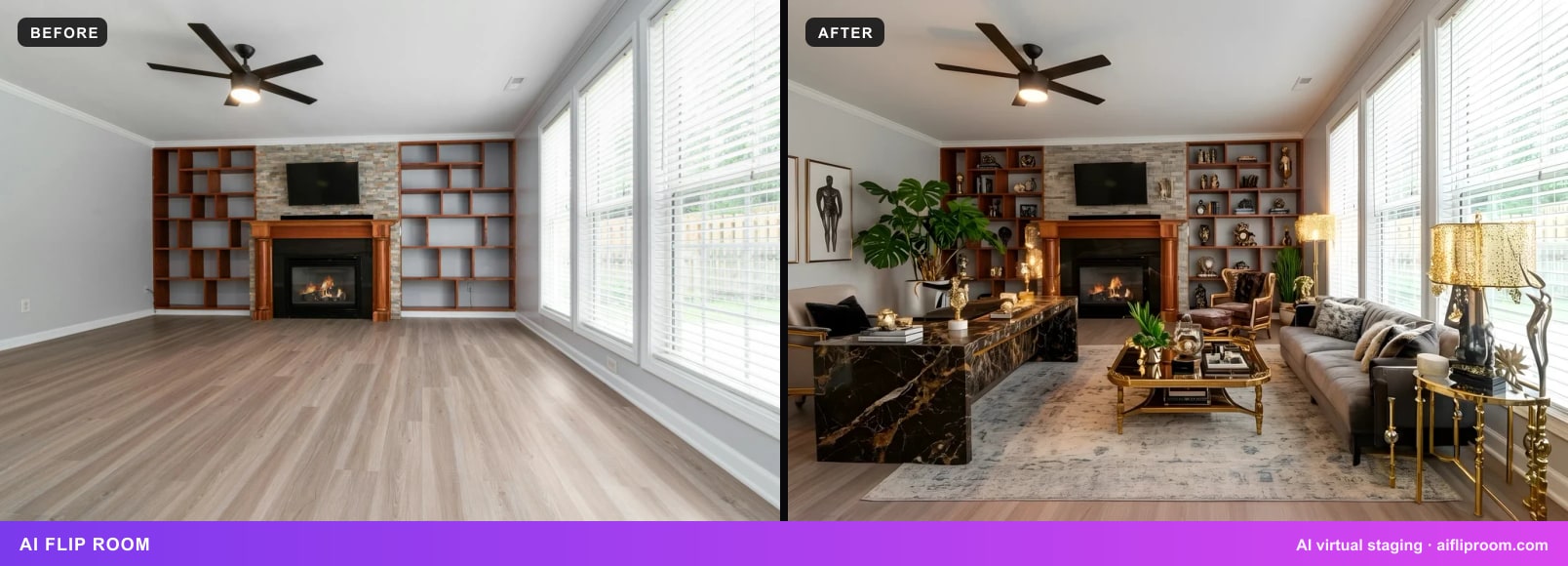
Virtual Staging Disclosure Rules: How to Label Staged Photos
Why disclosure is required, three ways to label a virtually staged photo, what you may change vs never touch, and the rules of nine jurisdictions compared.
Florida Virtual Staging Rules: Stellar MLS, Miami and Beaches
Is virtual staging allowed in Florida? Stellar MLS wants the disclosure in the photo description and the remarks, never on the photo. Four MLSs and the law, quoted.
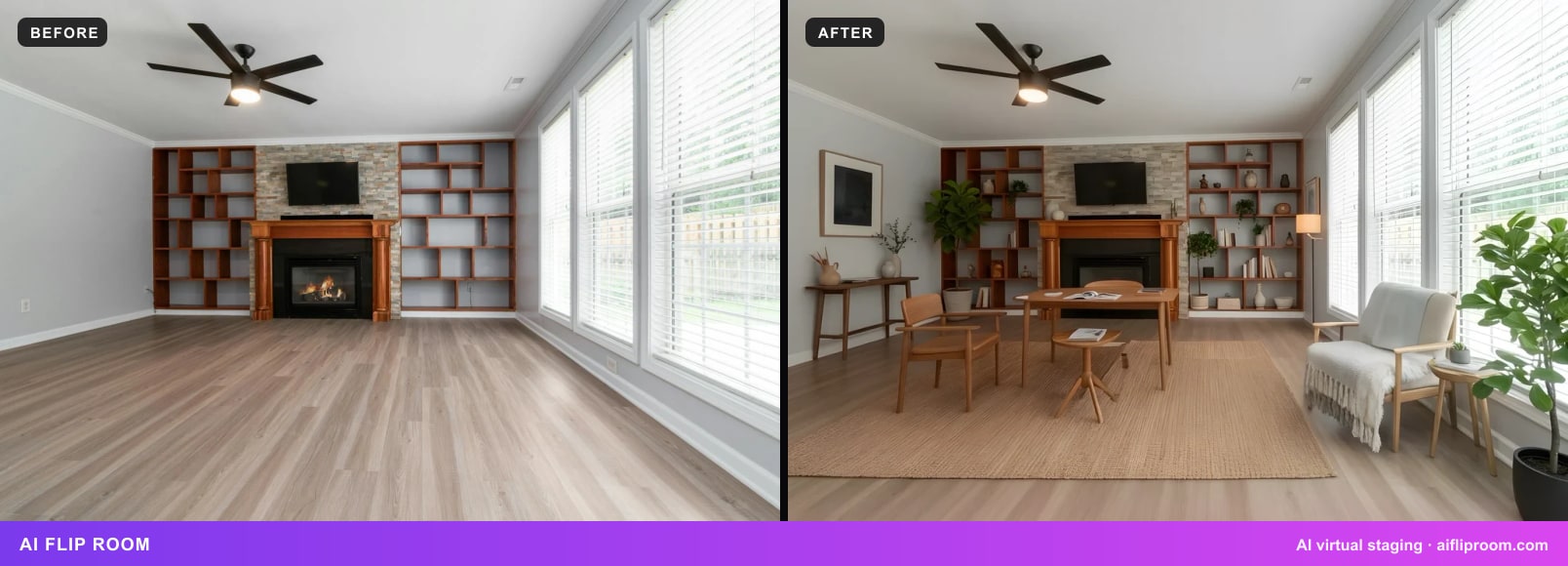
Virtually Staged Listing? 5 Things a Buyer Can Demand
AI staging is legal in Ontario, BC, Quebec, Alberta, California, New York, Florida, Texas and Washington, with conditions: what a buyer can demand.