New York Virtual Staging Rules: NYSAMLS, REBNY RLS and OneKey
AI Flip Room · 10 min read
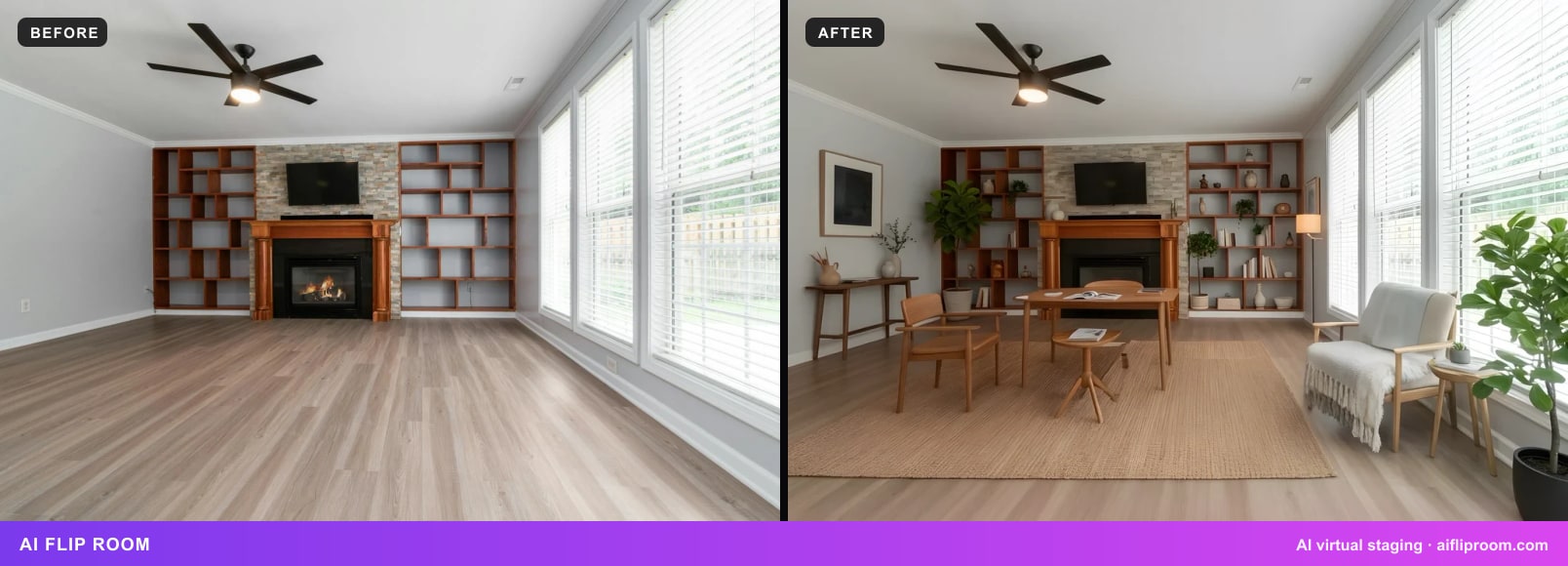
New York has no statute that mentions virtual staging, and the one rulebook we found that does covers only part of the state. Since 1 September 2026 the MLSs of the New York State Alliance, Buffalo's and Rochester's among them, require the words "Virtually Staged" on the photo itself and the unedited original right before it — one of the most specific rules we have read in this series. In New York City and on Long Island we found only accuracy rules. Above every MLS sits the state's advertising regulation, and in Albany three bills would add a disclosure law.
The short answer: virtual staging is allowed in New York, as long as the photo adds furniture rather than changing the property, and it is disclosed the way your MLS asks. This article quotes the upstate rule, says what we could and could not find for the city and Long Island, and separates the law from the bills. It is not legal advice; where we are interpreting rather than reporting, we say so.
Is virtual staging allowed in New York?
Yes. No New York rule we read bans it. The one New York MLS rulebook we found that names it, the Alliance's, permits it in so many words: "Images may include virtual staging". The state's licensing rules cover every licensee's advertising, in an MLS or out of it, and they ask for accuracy rather than a label: advertisements "shall include an honest and accurate description of the property to be sold or leased" (19 NYCRR 175.25(c)(9)).
First question: which MLS is the listing in?
New York is several MLS markets, and the photo rule that binds you is the rule of the system you submit to.
- Upstate: the New York State Alliance of MLSs (NYSAMLS). A joint venture of three MLS companies: WNYREIS in Buffalo, UNYREIS in Rochester and CNYIS in Syracuse. The Rochester association's MLS page lists eleven local MLSs in the shared database, from Ithaca and Elmira-Corning to Cortland and the Mohawk Valley.
- New York City: REBNY's Residential Listing Service (RLS). The Real Estate Board of New York says the RLS covers the five boroughs (RLS FAQ).
- Long Island and the Hudson Valley: OneKey® MLS. By its own account it carries listings from Nassau, Suffolk, Westchester, the Bronx, Queens and several Hudson Valley counties, with partial coverage of Manhattan and Brooklyn (OneKey, February 2026).
A Bronx or Queens listing can sit in both of the last two. Other New York MLSs have rulebooks we have not read; if your listing goes into one, check its own wording.
What the upstate rule says, word for word
Two things in that text are stricter than anything else we have read. The label is on the image, in fixed words — "Virtually Staged.", not a similar term. And the original goes directly before the staged photo, where California's CRMLS accepts before or after.
We read the copies adopted by WNYREIS and UNYREIS, both effective 1 September 2026; their photo rules match. The Rochester association says the Alliance rules apply to all listing data in the shared database, but we did not find a Syracuse copy to confirm it.
What changed on 1 September 2026
The previous edition, effective 1 March 2026, read the other way round: text on photos was banned, staging was the exception, and the overlay was optional. "Text on a photo is not allowed with the exception of virtually staged photos. If using a text overlay, it should read “This photo is virtually staged”." It did not ask for the original at all.
The September edition makes the overlay mandatory, shortens it to "Virtually Staged.", adds the original-first rule and says a caption or the remarks alone do not count. It also brings AI into section 1.2: "It is the responsibility of the Designated REALTOR® to ensure accuracy at all times including any AI generated content." Anything written before September, the old "This photo is virtually staged" wording included, describes a rule that no longer applies.
The overlay, the watermark ban and our stamp
The paragraph that requires the overlay also bans watermarks, and "Office, agent, and personal promotion information/signature elements are prohibited from being included anywhere on the property photo." Besides the staging overlay, the rule mentions one other kind of text on a photo: an optional overlay describing the property's features or location.
If you stage with our tool: the optional "Virtually Staged · AI Flip Room" stamp is not the overlay the rule describes. It carries our name, and the rule says the overlay "must read “Virtually Staged.”" Our reading: for an upstate upload, switch the stamp off — on Pro, Agency and Room Pack renders it is a switch on the generate screen — and add a plain "Virtually Staged" overlay in your photo editor. Free renders carry a tiled watermark, which the rule bans; they are for judging, not for a listing.
Two more lines of the same rule matter before you stage. The first photo must be "an unaltered exterior view of the home", so the cover shot is never the staged one. And no photo may show a person, real or computer-generated, so no rendered family at the table.
New York City and Long Island: no staging rule we could find
REBNY's RLS. We searched the whole Universal Co-Brokerage Agreement Rules and Regulations, January 2026 (PDF). It has no provision on staged, altered or AI images. What it has is a data rule — entries "found to have incomplete mandatory items or incorrect data, will be in violation" (Article III, section 4) — a data policy that counts photographs as listing content, and a ban on agent names and contact details in photographs (Article I, section 5 C).
OneKey® MLS. Its Rules and Procedures manual is for subscribers, so we could not read it end to end. Its public violation overview, updated 24 September 2026, quotes section 307, Accurate Images and Attachments: images attached to a listing "must accurately reflect only information or descriptions of the listed Property". We found no staging rule in OneKey's public pages; that is not proof the manual has none.
Our reading for both: neither system tells you how to label a staged photo, so the state's accuracy rule decides. Label it plainly, in the photo description or the remarks, keep the original, and ask the compliance desk before putting text on the image itself.
Above every MLS: the state's advertising rules
Paragraph (c)(9) of the Department of State's advertising regulation is a description rule, and the Department reads it as covering pictures. Its alert of 13 November 2025 on AI-generated listing images paraphrases it as "an honest and accurate depiction of the property being sold or leased", and quotes the Secretary of State: "these automated technology tools may produce misleading or exaggerated representation of properties".
The sanction sits in Real Property Law section 441-c: the Department may revoke or suspend a licence "for dishonest or misleading advertising", or instead "impose a fine not exceeding two thousand dollars". The same alert adds that General Business Law sections 349, 350 and 350-a, on deceptive acts and false advertising, could bring "substantial monetary penalties" to anyone who advertises misleadingly, licensed or not.
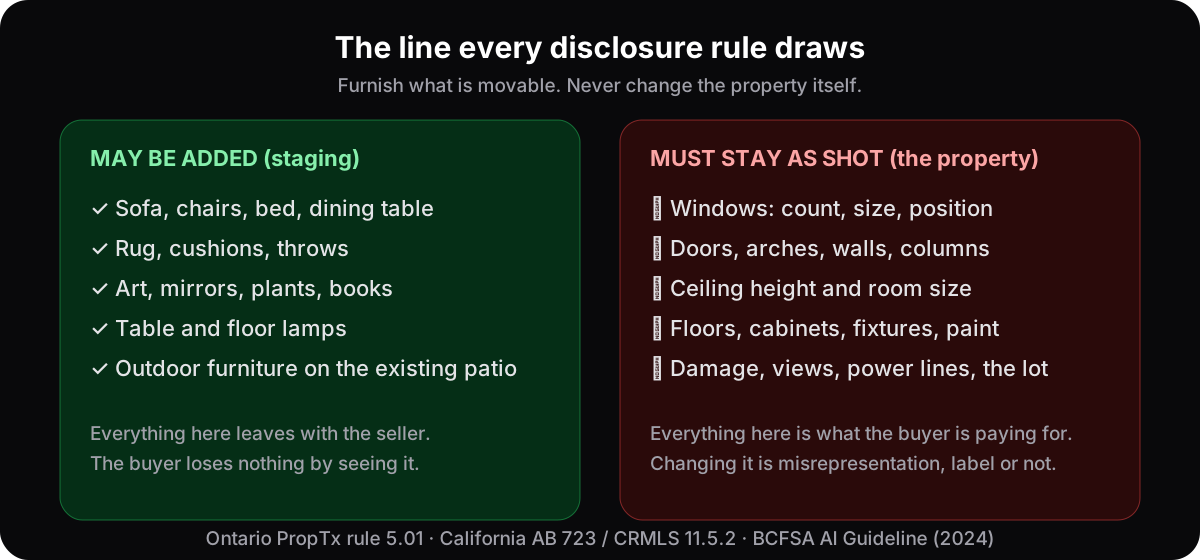
Neither the regulation nor the alert prescribes a label. A labelled, furnished room is an honest description; a room with a repaired ceiling or a bigger window is not, whatever it says in the corner.
Bills that are not law yet
Three bills in the 2025–2026 session would write a disclosure rule into state law. On 2 October 2026 none had passed either house.
- S9584 and its Assembly twin A11403 would add section 349-i to the General Business Law, making materially misleading listing images a deceptive practice. One clause is about staging: "Where virtual staging is used, a digital representation shall disclose that furnishings or finishes were digitally added." A licensee's violation would count as untrustworthiness under section 441-c. The Senate bill was committed to the Judiciary Committee on 28 April 2026; the Assembly bill has sat in Consumer Affairs and Protection since 15 May.
- A11635, introduced on 29 July 2026 and referred to the Housing Committee, would add section 443-b to the Real Property Law. It reads much like California's AB 723: a statement "conspicuously located on or adjacent to each altered image" and, on a website, the unaltered version or a link to it. It would bind brokers, sellers, owners and property managers, for sales and leases alike.
New York City is moving separately on rentals. The city's Rental Ripoff Hearing Report (PDF), released on 16 July 2026, says the Department of Consumer and Worker Protection "seeks to curb misleading rental listings by using its rulemaking authority under the Consumer Protection Law to require that any rental listings containing digitally altered photos include a clear and conspicuous disclosure to consumers that the photos have been modified by AI or were digitally altered." On 2 October 2026 we found no such proposed rule on the city's rules site.
What happens if you get it wrong?
On an upstate Alliance MLS, the photo rule says the MLS "may remove the violation and/or fine the Participant". Section 7.1 sets the routine: the first notice is educational and gives the brokerage 48 hours to correct before the fine is assessed; a second notice for the same rule can bring an immediate fine. The amounts are in an Appendix A that is not part of the public rulebook.
On OneKey, its support page for the accurate-images rule says staff "will immediately remove any photo or image that violates" section 307, and that the violation carries an automatic fine; the amount is in the subscriber rulebook. Under state law, the Department of State can reprimand, fine up to $2,000, suspend or revoke a licence for dishonest or misleading advertising.
What people write versus what the rules say
| What you will read elsewhere | What the New York text says |
|---|---|
| "New York passed a law on AI listing photos" | Not by 2 October 2026. S9584/A11403 and A11635 are in committee. What applies now is the general rule: an honest and accurate description (19 NYCRR 175.25(c)(9)), enforced under Real Property Law section 441-c. |
| "Upstate, write 'This photo is virtually staged' on the image" | That was the optional wording of the March 2026 edition. Since 1 September the overlay is required and must read "Virtually Staged." |
| "A line in the remarks covers the whole gallery" | Not on an Alliance MLS: disclosure "ONLY in photo captions, Public/Private Remarks, is NOT acceptable". |
| "Every New York MLS requires a 'Virtually Staged' label" | Of the three systems we checked, only the Alliance does. REBNY's January 2026 rulebook has no provision on staged images, and OneKey's public pages show only an accuracy rule. |
| "New York City now requires AI labels on rental listings" | The city announced in July 2026 that it would make such a rule. We found no proposed rule by 2 October 2026. |
What should a New York agent actually do?
- Check which MLS the listing goes into before you stage, and follow that rulebook.
- Upstate, put "Virtually Staged" on every staged photo as a text overlay, and upload the unaltered original directly before it. A caption alone does not count.
- Keep logos, watermarks and people off listing photos, ours included, and keep the first photo an unaltered exterior.
- In the city and on Long Island, label plainly anyway and keep the original; ask the compliance desk before adding text to the image.
- Stage furniture and wall décor only. Walls, floors, windows, landscaping and defects stay as photographed.
- Watch the bills. If A11635 or S9584 passes, a disclosure on or near every altered image becomes state law.
If most of your listings are vacant, our page for listing agents shows how staging fits into that: furnish the room, keep its geometry, keep the original.
Why we wrote this
We make an AI virtual staging tool, and the upstate rule asks our users to switch our own stamp off, which is a reason to be precise rather than reassuring. Every quotation above can be checked against the Alliance rules effective 1 September 2026 (PDF) and the March 2026 edition (archived PDF), REBNY's UCBA (PDF), OneKey's violation overview, 19 NYCRR 175.25, Real Property Law section 441-c, the Department of State's alert, the three bills on the New York Senate's site and the city's Rental Ripoff Hearing Report (PDF). The points about our stamp, about labelling outside the Alliance and about the Syracuse copy are labelled as our interpretation. For the general principles, see our virtual staging disclosure guide; for the other rule that asks for the original beside the staged photo, California.
Questions New York agents ask
Is virtual staging legal in New York?+
Yes. No New York rule we read bans it, and the upstate Alliance rulebook permits it in so many words — "Images may include virtual staging" — limited to furnishings and wall décor. Every licensee's advertising must give "an honest and accurate description of the property" (19 NYCRR 175.25(c)(9)), so staging may add furniture but may not change the property. How you disclose it depends on the MLS.
Do I have to put "Virtually Staged" on the photo itself?+
On an upstate Alliance MLS, yes: since 1 September 2026 a text overlay reading "Virtually Staged." is required on every staged photo, and a caption or a line in the remarks alone is not acceptable. REBNY's RLS rulebook and the OneKey pages we could read set no labelling rule; label anyway, and ask the compliance desk before adding text to the image.
Do I have to show the original photo next to the staged one?+
Upstate, yes: the original, unaltered photo must be uploaded directly before the staged version. That is stricter than California's CRMLS, which accepts before or after. We found no pairing rule in REBNY's RLS rulebook or in OneKey's public pages. Keep the original anyway; it is your answer if a buyer or the Department of State asks.
Is there a New York law on AI or virtually staged listing photos?+
Not yet. Senate bill S9584 and its Assembly twin A11403 would require staged images to disclose that furnishings or finishes were digitally added; Assembly bill A11635 would require a statement on or next to each altered image and the original online. On 2 October 2026 all three were in committee. New York City has announced a disclosure rule for rental listings but not proposed it.
What is the penalty for a misleading staged photo in New York?+
Under Real Property Law section 441-c the Department of State can reprimand a licensee, fine up to $2,000, or suspend or revoke the licence for dishonest or misleading advertising. On an upstate Alliance MLS the photo can be removed and the participant fined if it is not corrected within 48 hours; the amounts sit in an appendix that is not public. OneKey's support pages describe removal and an automatic fine.
Last checked against the New York State Alliance of MLSs' Multiple Listing Rules and Regulations (effective 1 September 2026, in the copies adopted by WNYREIS and UNYREIS, and the edition effective 1 March 2026), REBNY's RLS Universal Co-Brokerage Agreement Rules and Regulations (January 2026), OneKey® MLS's support pages on section 307, 19 NYCRR 175.25, Real Property Law section 441-c, the Department of State's alert of 13 November 2025, bills S9584, A11403 and A11635, and the city's Rental Ripoff Hearing Report (July 2026), on 2 October 2026. OneKey's full rulebook is for subscribers only. Rules change; verify before relying on this.
See it on your own room
Upload a photo and watch AI restage your space in 15–60 seconds, depending on how much detail it has — free to try, no credit card.
Try AI Flip Room freeRelated reading
Virtual Staging Disclosure Rules: How to Label Staged Photos
Why disclosure is required, three ways to label a virtually staged photo, what you may change vs never touch, and the rules of seven jurisdictions compared.
California Virtual Staging Rules: AB 723 + CRMLS 11.5.2
Since 1 January 2026 California regulates altered listing photos by statute. What AB 723 requires, what CRMLS 11.5.2 adds, the $250 fine, and a checklist.
Virtually Staged Listing? 5 Things a Buyer Can Demand
AI staging is legal in Ontario, BC, Quebec, Alberta, California, New York and Florida, with conditions. What a buyer can demand and the line no photo may cross.