Bright MLS Virtual Staging Rules: Maryland, Pennsylvania, Virginia and DC
AI Flip Room · 17 min read
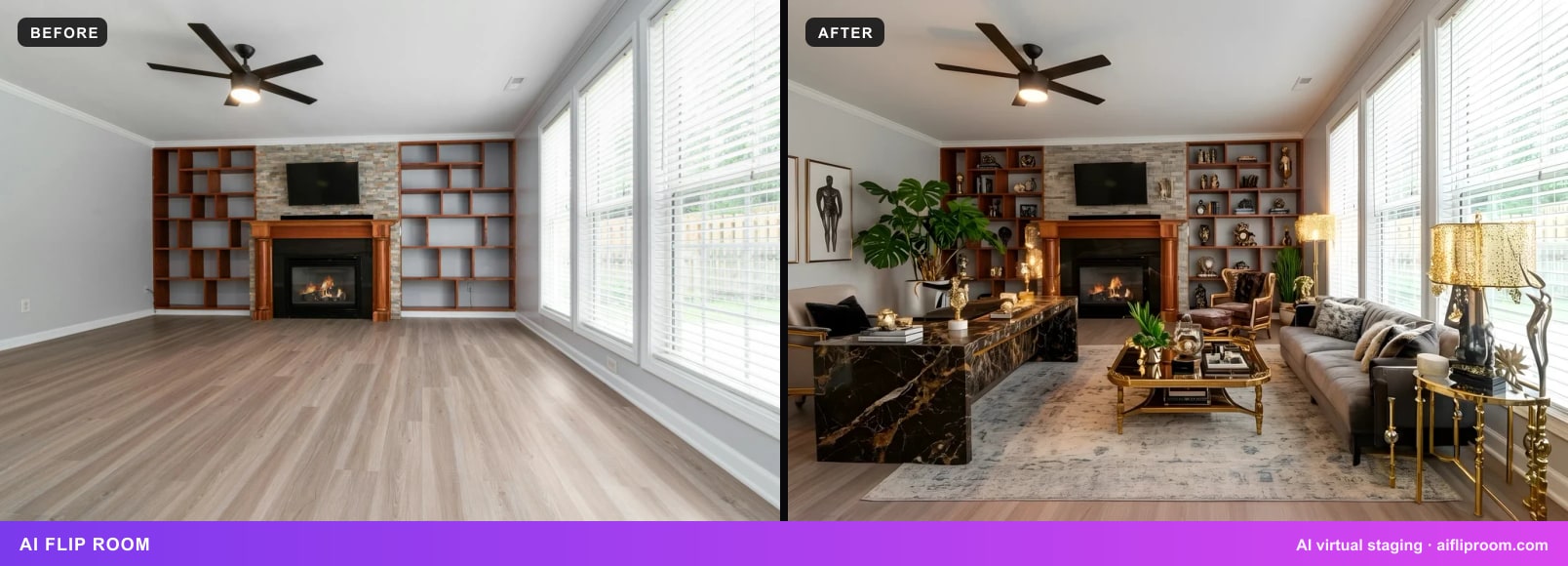
Bright MLS rewrote its rulebook this summer, and virtual staging came out of it with a precise address. Since 22 July 2026 a staged photo on Bright is allowed, the definition names generative AI, and the disclosure has to appear in two places: the Private Remarks and the Public Remarks. Until then, Bright's 2021 policy said only that staging "must be disclosed in the MLS". What has not changed is the line itself: furniture and décor may be added; power lines, water towers and roads may not be removed. Above the MLS, Maryland, Pennsylvania and Virginia each ban misleading advertising, and none of their rules mentions a staged photo.
The short answer: virtual staging is allowed on Bright MLS, as long as the photo adds personal property rather than changing what the owner cannot control, nothing is written on the image, and both remarks fields say the photos are virtually staged. This article quotes the Bright rules and help articles and the laws of the three largest Bright states, explains what a slip costs, and separates the texts from what is often written about them. It is not legal advice; where we are interpreting rather than reporting, we say so.
Is virtual staging allowed on Bright MLS?
Yes. Bright's help article on virtual staging, dated 27 July 2026, answers the question in one line: "Yes, Bright does not prohibit virtual staging in listings." The rules behind it are Bright's Rules Governing Use of Bright’s Services (PDF), effective 22 July 2026, which Bright publishes on its rules page. Appendix C, the policy on images and documents, defines staging and sets its limits; Appendix D lists it among the disclosures a listing must carry; Appendix I sets the fines.
Which listings the rules bind. Bright's service area, in Appendix A, "includes all counties in Delaware, Maryland, and the District of Columbia, and the following counties" — a list of counties in New Jersey, Pennsylvania, Virginia and West Virginia. That is six states and DC. Parts of the region are also served by other MLSs whose rulebooks we have not read; if your listing goes into one of them, check its own wording.
No state law we read names virtual staging. We read the real estate rules of the three largest Bright states, Maryland, Pennsylvania and Virginia, and they set a general duty not to mislead; the format of the disclosure comes from the MLS.
What the Bright rules say, word for word
Three things in that text decide how you stage for Bright. First, the disclosure has an address, and it is two fields, not one: the definition says "must be disclosed in the Private and Public Remarks", Appendix D repeats it, and the help article puts BOTH in capitals. Appendix D also gives the words: the remarks "must state that the image is virtually staged or digitally modified".
Second, the definition now covers AI and edits, not only furniture added to an empty room. Bright's 2021 policy defined staging as "using software to create a photo or conceptual rendering of what a room or property could look like, if it was staged or lived in". The 2026 text reads "using software (including Generative AI) to create or modify a photo or conceptual rendering". A render from an AI tool is staging in Bright's terms, and so is a photo modified rather than created.
Third, the test is ownership, not realism. The rule never asks whether an edit looks plausible; it asks whether the thing added or removed is "within a property owner’s control". Furniture, mirrors, artwork and plants are "personal property items not conveyed with the real property" and may go in. A view that cannot be seen from the window may not; power lines, water towers and roads may not come out.
Where the disclosure goes: both remarks fields
Rule 1.8.3 says "Appendix D lists disclosures required to be submitted to the Bright Database", and Appendix D opens: "The following disclosures are required to be included in a listing’s information if applicable". Item 8 is virtual staging, and its instruction is the Private Remarks and the Public Remarks, both of them. Our reading of the wording: one plain sentence in each field, such as Some photos are virtually staged., or digitally modified where the edit was more than furniture. Rule 1.8.2 adds that remarks "may not contain marketing information about a subscriber", so the sentence names the fact, not the service that did the staging.
What we could not check is whether Bright's listing input also has a separate checkbox or field for staging; that needs a subscriber login, and the rules speak only of the remarks. If your input screen offers one, use it as well.
What may change: the owner's control test
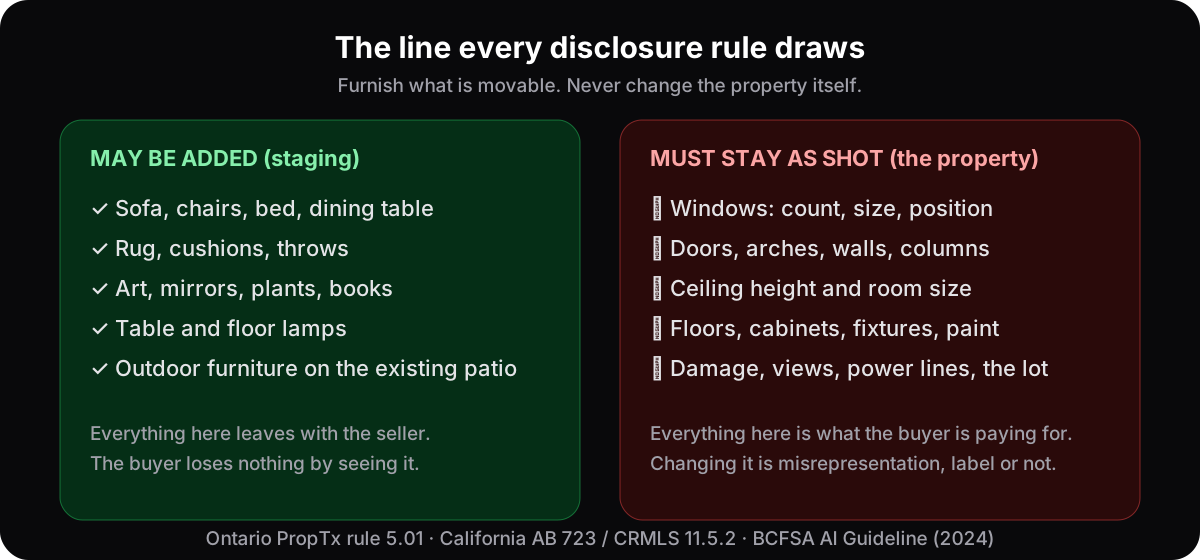
Bright's examples do most of the work. In: "digital photos of furniture, mirrors, artwork, plants, or similar items", into an empty room or in place of the furniture that is there. Out: "a view of a scene that is not physically possible from the specified location in the real world", and the removal of "power lines, water towers, or nearby roads". The principle behind both lists is the same: the buyer is paying for the real property and its surroundings, and personal property leaves with the seller.
Our reading of the cases the rule does not name. A greener lawn, a new kitchen, a wall taken out: not personal property, so not staging, and outside what section 4.B permits. Replacing the seller's furniture with digital pieces: permitted in so many words, because 4.B allows Bright's users "to remove existing furniture from a photo and replace it with digital images" — disclose it in both remarks. Emptying a room and leaving it bare is not named; Appendix D's "digitally modified" covers it, and we would disclose it the same way. Patio furniture on the existing deck: personal property, so in, disclosed; the deck, the lawn and the sky stay as photographed. A rendering of a home that is not built yet: allowed under 4.B for To-Be-Built and Under Construction listings.
Virginia REALTORS® drew the same line in a legal hotline answer of 28 September 2026: "removing non-permanent items from a photo does not violate the duty of REALTORS® to present a true picture in advertising, while removing permanent features would violate that duty."
Text on the photo, and our stamp
Section 3.A of Appendix C lists what a listing photo or rendering "may not include". Among them: "Images of any identifiable person, whether real, animated, computer-generated, or otherwise"; "Contact or identifying information or any text or graphics that have been added or superimposed"; and "Signs or identifying logos". Rule 1.7 adds: "No branded photos/videos may be submitted." Section 2 wants the exterior photograph to be "an unbranded, curbside view of the property that shows the property upon arrival", and says images "may not convey any marketed or promotional messages made on behalf of the listing broker or associated subscriber". Bright's photo requirements article of 1 June 2026 spells it out for third parties: "You may not add or superimpose any graphics or contact information (including names, phone numbers, or email addresses) for the listing office, listing agents, sellers, or any third-party service providers." And under section 2.D, "Bright may remove any image, document, or other information that does not conform to the Rules."
If you stage with our tool: the optional "Virtually Staged · AI Flip Room" stamp sits in the bottom corner and carries our name. On Bright that is text added to the photo, which section 3.A bans, and the name of a service provider on the image, which the photo article rules out — so switch it off (on Pro, Agency and Room Pack renders it is a switch on the generate screen) and put the words in both remarks instead. Whether a plain "Virtually Staged" line without a name counts as added text is a question Bright has not answered in anything we read; our reading is that it does, and that the remarks do the job without it. The one place Bright accepts the disclosure on the image is a To-Be-Built or Under Construction listing. Free renders carry a tiled watermark, which section 3.A would catch; they are for judging, not for a listing. And check every render for people before it goes in: Bright bans them even when they are computer-generated.
Before 22 July 2026: the 2021 policy
Until the new rules, Bright's Policy on Images and Documents in the MLS (PDF), dated 8 April 2021, governed photos. Its section on staging, 4.E, defined it without AI and asked for one thing: "Virtually-staged photo(s)/rendering(s) must be disclosed in the MLS." It named no field. Its ban on outside elements used almost the same example, "removing power lines, water towers, or nearby highways", and it already kept "any text or graphics that have been added or superimposed" off photos. The 2021 file is still linked from an older help article on photos, so you may come across it; Bright's current help page on its image policy, dated 11 September 2026, is headed "Policy on Images and Documents (Bright Rules Appendix C)".
The fines changed too. Bright's rulebook of October 2019 (archived PDF) allowed an "appropriate, reasonable fine not to exceed $15,000"; the 2026 rules replace the ceiling with fixed amounts.
What happens if you get it wrong?
Appendix I of the rules sets the fines in one table, and virtual staging has no line of its own. The rules do not say which line an undisclosed staged photo falls under; our reading is that it is one of two, and both cost $250. "Public Remarks Violation" is $250 and carries no warning. "Required Disclosures Missing from Listing" is $250 and carries one: "In most circumstances, subscribers have two calendar days to correct inaccurate data within the system and reply to compliance notices from Bright." A branded photo — "Branded Media (photos, virtual tours, documents)" — is $250 with no warning, and "Inaccurate Listing Information" is $150 with a warning.
There is no escalation by amount: "For repeat offenses, the same fine amount will be issued repeatedly." But "Subscribers may receive no more than three sanctions in a calendar year before the subscriber is required to attend a hearing", and Bright may suspend an account for repeat offences. An appeal must be requested "no later than 20 calendar days after Bright issued the sanction". And "The broker is ultimately responsible and accountable for all actions of all subscribers affiliated with the broker."
Above the MLS sit the state regulators, with their own ceilings: up to $5,000 for each violation in Maryland, up to $1,000 under Pennsylvania's licensing act or up to $10,000 per violation under its general law for licensing boards, and up to $2,500 for each violation in Virginia. In Maryland and Pennsylvania the licence itself can also be suspended or revoked.
Above the MLS: Maryland, Pennsylvania and Virginia
None of the three states has a rule on staged photos or AI; each has a general duty that covers them.
Maryland. The Real Estate Commission's code of ethics, COMAR 09.11.02.01, defines an advertisement as "any representation, promotion, or solicitation directed to consumers, by any means of communication", and says: "The licensee in advertising shall be especially careful to present a true picture." The statute, section 17-322 of the Business Occupations and Professions article, lets the Commission discipline a licensee who "advertises in any misleading or untruthful manner", and "may impose a penalty not exceeding $5,000 for each violation", weighing among other things "the harm caused by the violation" and "the good faith of the licensee". We searched every section of chapters 01, 02 and 05 of COMAR Subtitle 11 for artificial intelligence, photograph and virtual and found none of them; image appears only in a rule about team names.
Pennsylvania. Section 604 of the Real Estate Licensing and Registration Act lists among prohibited acts "Making any substantial misrepresentation" and "Any misleading or untruthful advertising", with "fines not exceeding $1,000". Since 2020 a general law for the state's licensing boards, 63 Pa.C.S. Chapter 31 (Act 53 of 2020), adds in section 3108 "a civil penalty of not more than $10,000 per violation" for breaking a licensing act or a board's regulations, though not twice for the same violation. The Commission's rules, 49 Pa. Code Chapter 35, say in section 35.282 that a licensee "may not give assurances or advice concerning an aspect of a real estate transaction that he knows, or reasonably should be expected to know, is incorrect, inaccurate or improbable". We searched the whole chapter: no artificial intelligence, image or virtual, and the one photograph is a sketch or photo of its sign that a real estate school submits for approval. The schedule of civil penalties for brokers, section 43b.8, prices advertising a property without the seller's authority or the owner's written consent at $250 for a first offence and $500 for a second, and has no line about photos.
Virginia. Since 1 April 2026, 18VAC135-20-190 says: "Any property information provided by and in control of the licensee in any advertising must be consistent with the property condition and the property's current contract status." The version before the amendment said "Electronic media listing information must be consistent with the property description and actual status of the listing." 18VAC135-20-300 adds "Knowingly making any material misrepresentation", and section 54.1-2131 of the Code of Virginia: "Licensees shall treat all prospective buyers honestly and shall not knowingly give them false information." Under section 54.1-202, a regulatory board's monetary penalty "shall not exceed $2,500 for each violation". We searched all 61 sections of chapter 20 for artificial intelligence, photograph, image, render and virtual: none.
Our reading of all three: a staged photo that shows a room as it could be furnished, disclosed in both remarks, presents "a true picture" of what is for sale; a render that adds a view, removes a road or hides damage is what Maryland and Pennsylvania call "misleading or untruthful" advertising and Virginia a "material misrepresentation", and no remark cures that. For Delaware, the District of Columbia, New Jersey and West Virginia we did not read the regulators' rules; the Bright rules apply to listings there just the same.
Bills to watch
Pennsylvania has three bills on AI in advertising, none written about real estate. SB 806, the Artificial Intelligence Deceptive Advertising Act, passed the Senate 48-2 on 10 June 2026, went to the House Communications & Technology committee on 12 June 2026 and was "Reported as committed" on 5 October 2026. Its text bans "an advertisement that uses synthetic content in a manner that creates a false consumer perception about the nature, origin or authenticity of the goods or services" without a disclosure that "must state that the advertisement contains content that was modified or generated using artificial intelligence", to be "permanent or extraordinarily difficult to remove" where technically feasible, with "A civil fine that does not exceed $3,000." HB 95, the Artificial Intelligence Transparency in Advertising Act, passed the House 124-78 on 17 June 2026 and went to the Senate committee on 22 June 2026. SB 1349, on provenance labels for AI content, has been in committee since 4 June 2026. Our reading: a staged photo disclosed in both remarks does not create "a false consumer perception", but if one of these passes, check how it treats listing photos.
New Jersey's A4728 is the one bill in the region written about listing photos, and we could not open its text; the state legislature's site did not load for us. Its sponsors' office described it on 15 May 2026, after it cleared the Assembly Housing Committee, as a bill that "would prohibit landlords and property owners from using generative AI or photo editing software to deceptively alter listing images, with the exception of photos with staged furniture", adding: "A photo used for a listing must reflect the current state of the unit and not be older than five years." That is the sponsors' summary, not the bill. In Maryland, the 2026 bills our search for artificial intelligence turned up were HB 895, on dynamic pricing, which became Chapter 154, and HB 1261, on AI toys; neither is about photos. In Virginia and the District of Columbia we found no bill on altered listing images.
What the associations tell their members
The state REALTOR® associations say much the same as the rules. In Pennsylvania, a post of 5 June 2026 on the association's blog quotes Hank Lerner: "Things like minor cosmetic cleanups or virtual staging are likely to be acceptable", adding that "some MLSs may actually have specific rules requiring this sort of disclosure" — Bright, since July, is one. In 2009 he had asked what readers would think of a photo that "digitally turned a gravel driveway into an asphalt driveway". An article in the Maryland REALTORS® magazine, in its February/March 2024 issue, warned: "It is important to use caution when using “enhanced” imagery", because "For listings, these changes may constitute false advertising so proceed with caution." Virginia REALTORS® advised on 12 December 2019 "to always disclose in the MLS (or wherever you post these pictures) that the virtually-staged scene is an example of how the property could look, not necessarily how it does look", and in its answer of 28 September 2026 that "it is still a good practice to disclose that the photo has been digitally edited". Above them, the NAR Code of Ethics prohibits "otherwise misleading consumers, including use of misleading images".
What people write versus what the rules say
| What you will read elsewhere | What the Bright text says |
|---|---|
| Staging "must be disclosed in the MLS"; where: "Not specified in the policy"; source: "Images policy §4.E, Feb 2024" | That is the policy of 8 April 2021, section 4.E, not a 2024 text. Since 22 July 2026 the rules name the place: "the Private and Public Remarks must state that the image is virtually staged or digitally modified". |
| "Virtual staging disclosure policy covering 7 states and DC." | Appendix A: all counties in Delaware, Maryland and the District of Columbia, plus listed counties in New Jersey, Pennsylvania, Virginia and West Virginia — six states and DC. |
| Bright "requires that altered, manipulated, or enhanced photos be disclosed" | Close, but Bright's words are not "enhanced": the remarks must say the image is "virtually staged or digitally modified". |
| "Virtually staged photos or renderings must be disclosed, and edits may not add or remove visual elements outside the property owner's control." | Correct on substance; it leaves out where. Both the Private and the Public Remarks. |
What should a Bright agent actually do?
- Say it in both remarks. The Private Remarks and the Public Remarks, in plain words: Some photos are virtually staged. Both fields, on every listing with a staged photo.
- Nothing on the image. No stamp, no logo, no caption text: section 3.A bans added or superimposed text and graphics, and rule 1.7 bans branded photos.
- Stage personal property only. Furniture, mirrors, artwork, plants. The view, the power lines, the roads, the lawn, the walls and any damage stay as photographed.
- No people. Bright bans identifiable people, "computer-generated" ones included; check every render.
- Include the exterior. Every listing needs "an unbranded, curbside view of the property that shows the property upon arrival"; a staged room cannot stand in for it.
- Keep the original of every staged frame. Bright does not ask you to upload it; a buyer, a broker or a complaint will.
- Check which MLS the listing goes into. Bright's rules bind Bright listings; another MLS in the region has its own rulebook.
If most of your listings are vacant, our page for listing agents shows how staging fits into that: furnish the room, keep its geometry, keep the original.
Why we wrote this
We make an AI virtual staging tool, and the Bright rules ask our users to switch our own stamp off, which is a reason to be precise rather than reassuring. Every quotation above can be checked against the Bright MLS Rules (PDF) and the page that publishes them, Bright's help articles of 27 July 2026, 1 June 2026 and 11 September 2026, the 2021 policy (PDF) and the October 2019 rulebook (archived PDF); in Maryland, COMAR 09.11.02.01, COMAR Subtitle 11 and section 17-322; in Pennsylvania, section 604 of the licensing act, 63 Pa.C.S. Chapter 31, 49 Pa. Code Chapter 35, section 35.282 and section 43b.8; in Virginia, 18VAC135-20-190 and its earlier version, 18VAC135-20-300, the full chapter and sections 54.1-202 and 54.1-2131 of the Code; the bill pages for SB 806, HB 95, SB 1349, HB 895 and HB 1261; the A4728 press release; and the association posts linked above. The points about our stamp, about a plain label on the image, about the wording of the remarks, about decluttering, the lawn and the view, about which fine line would apply and about which edits the state duties would catch are labelled as our interpretation. For the general principles, see our virtual staging disclosure guide; for another MLS that keeps the label off the photo and in the listing's text, Florida; for one that takes it as a field, Illinois; for the opposite approach, a watermark and the original beside the staged photo, Arizona.
Questions Bright MLS agents ask
Is virtual staging allowed on Bright MLS?+
Yes. Bright's help article of 27 July 2026 answers it in two sentences: "Yes, Bright does not prohibit virtual staging in listings. The virtual staging must reflect a true picture of the property and must be disclosed in BOTH the Private and Public remarks fields." The rules behind it, effective 22 July 2026, allow furniture, mirrors, artwork and plants in a photo and ban adding or removing anything outside the owner's control, such as power lines, water towers or nearby roads.
Do I have to put "Virtually Staged" on the photo?+
No, and our reading is that on Bright you should not. The rules put the disclosure in the remarks — "the Private and Public Remarks must state that the image is virtually staged or digitally modified" — and section 3.A of Appendix C keeps "any text or graphics that have been added or superimposed" off listing photos. We found no Bright statement on whether a plain "Virtually Staged" line counts, so we treat it as added text and keep it off. The exception is a To-Be-Built or Under Construction listing, where staged images may be disclosed "in the Private and Public Remarks or in the photos/videos".
Do I have to show the original photo next to the staged one?+
Not on Bright: neither the rules of 22 July 2026 nor Bright's help article asks for an original, a pair or a link. Keep it anyway. It is what you hand a buyer who asks whether the room is really that size, and the state duties apply whether or not the MLS asked for a pair — in Virginia, for example, licensees must treat buyers honestly and "shall not knowingly give them false information".
What does a mistake cost on Bright?+
Bright's fine table, in Appendix I, has no line for virtual staging, and the rules do not say which line an undisclosed staged photo would fall under. The two nearest both cost $250: "Public Remarks Violation", issued without a warning, and "Required Disclosures Missing from Listing", issued after one — in most cases subscribers "have two calendar days to correct inaccurate data within the system and reply to compliance notices from Bright". A branded photo, "Branded Media", is $250 with no warning. There is no ladder: "For repeat offenses, the same fine amount will be issued repeatedly", a subscriber may receive "no more than three sanctions in a calendar year" before a hearing is required, and an appeal must be asked for "no later than 20 calendar days" after the sanction. The broker "is ultimately responsible and accountable" for every subscriber in the firm.
Can I remove the power lines, add a view or green up the lawn?+
No. Section 4.A uses the first two as its own examples: editing in "a view of a scene that is not physically possible from the specified location in the real world is prohibited", and so is removing "power lines, water towers, or nearby roads". Our reading of the lawn: it is not one of the "personal property items not conveyed with the real property" that section 4.B permits, it is part of what the buyer is buying, so it stays as photographed. A sofa on the existing patio is personal property and may go in, disclosed in both remarks.
Is there a Maryland, Pennsylvania or Virginia law on AI or staged listing photos?+
Not one that names them. We read the real estate rules of all three states — Maryland's COMAR 09.11, Pennsylvania's 49 Pa. Code Chapter 35 and Virginia's 18VAC135-20 — and none mentions artificial intelligence or virtual staging; each bans misleading advertising in general. Pennsylvania has two AI advertising bills moving: SB 806, the Artificial Intelligence Deceptive Advertising Act, passed the Senate 48-2 on 10 June 2026 and was "Reported as committed" by a House committee on 5 October 2026; HB 95 passed the House 124-78 on 17 June 2026. Both are about AI in advertising in general, not about listing photos. In Maryland, Virginia and the District of Columbia we found no bill on altered listing images. In New Jersey, part of which Bright serves, bill A4728 would cover listing photos; we could not open its text, and describe it below from its sponsors' press release.
Last checked against the Bright MLS Rules effective 22 July 2026 (Appendix A on the service area, Appendix C on images, Appendix D on disclosures and the fine table in Appendix I), Bright's help articles of 1 June 2026, 27 July 2026 and 11 September 2026, the Bright policy of 8 April 2021, COMAR 09.11 and section 17-322 in Maryland, section 604 of the Pennsylvania licensing act, 63 Pa.C.S. section 3108 and 49 Pa. Code Chapter 35, 18VAC135-20 and sections 54.1-202 and 54.1-2131 of the Code of Virginia, and the bill pages of the Pennsylvania and Maryland legislatures, on 6 October 2026. Rules change; verify before relying on this.
See it on your own room
Upload a photo and watch AI restage your space in 15–60 seconds, depending on how much detail it has — free to try, no credit card.
Try AI Flip Room freeRelated reading
Virtual Staging Disclosure Rules: How to Label Staged Photos
Why disclosure is required, three ways to label a virtually staged photo, what you may change vs never touch, and the rules of twelve jurisdictions compared.
Florida Virtual Staging Rules: Stellar MLS, Miami and Beaches
Is virtual staging allowed in Florida? Stellar MLS wants the disclosure in the photo description and the remarks, never on the photo. Four MLSs and the law, quoted.
Virtually Staged Listing? 5 Things a Buyer Can Demand
AI staging is legal in Ontario, BC, Quebec, Alberta, California, New York, Florida, Texas, Washington, Arizona, Illinois and Bright MLS states, with conditions: what a buyer can demand.