Illinois Virtual Staging Rules: MRED Section 6.2, MARIS and the License Act
AI Flip Room · 15 min read
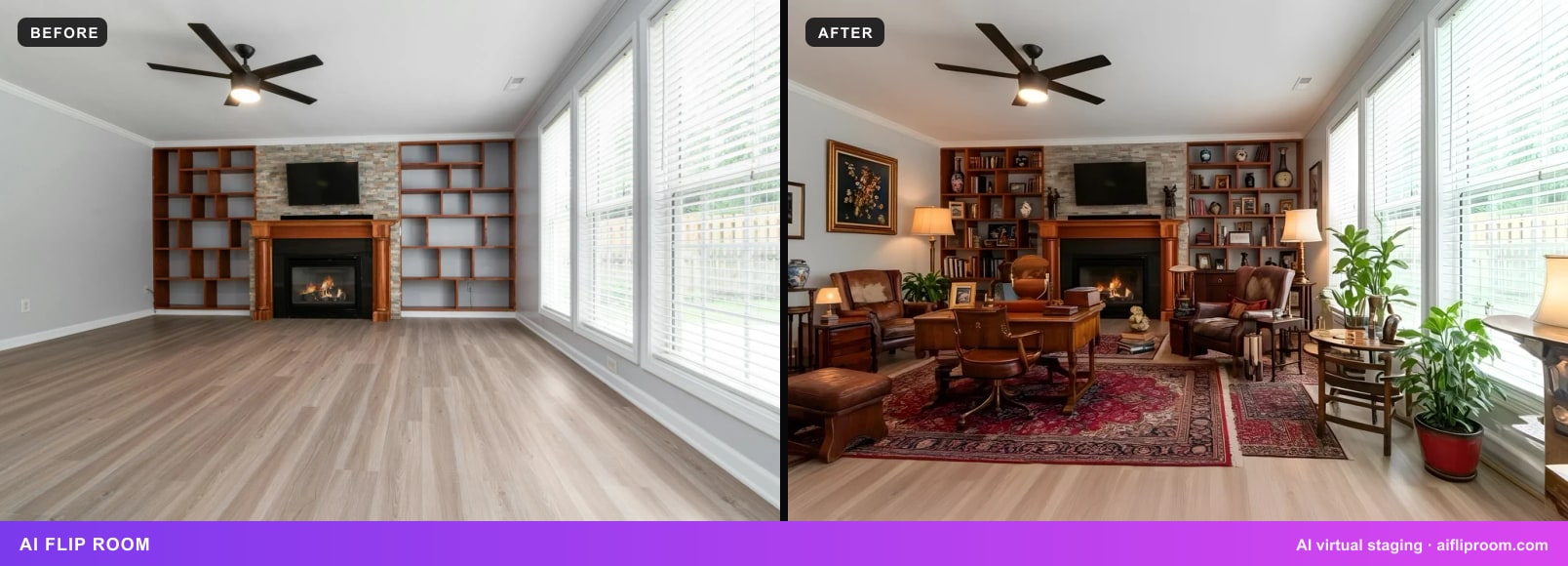
Illinois has had a virtual staging rule for longer than most states, and it is the quiet kind. MRED, the MLS of the Chicago area and much of the state, has permitted "virtually staged photos" in section 6.2 of its rulebook since at least its 2014 edition, limited them to furniture and other personal property, and asked for one thing in return: a Y in a field. No watermark, no original beside the staged photo. The text has barely changed in twelve years; what changed around it is the software and the photos agents upload. In the Metro East, across the river from St. Louis, a different MLS applies a different rule. Above both sits a licensing law that bans misleading advertising and never mentions a picture.
The short answer: virtual staging is allowed in Illinois, as long as the photo adds personal property rather than changing what the owner cannot control, and the listing says so in the field MRED provides. This article quotes the MRED rule, the MARIS rule and the state law, explains where the disclosure goes and what a slip costs, and separates the texts from what is often written about them. It is not legal advice; where we are interpreting rather than reporting, we say so.
Is virtual staging allowed in Illinois?
Yes. MRED's rulebook, revised 14 May 2026, opens section 6.2 by saying that it "defines and permits the use of “virtually staged photos” within the following parameters". The definition is wide — "using photo editing software to create a photo or conceptual rendering of what a room and/or property could look like, if it was staged or lived in" — and the permission is narrow: "personal property items not conveyed with the real property", with furniture, mirrors, artwork and plants as the examples.
No Illinois statute or regulator's rule mentions staging. We read the whole Real Estate License Act of 2000 and every section of its rules, 68 Ill. Adm. Code Part 1450, and neither uses the words virtual staging, photograph or artificial intelligence. What they have is a general duty, in section 10-30 of the Act: "No advertising, whether in print, via the Internet, or through social media, digital forums, or any other media, shall be fraudulent, deceptive, inherently misleading, or proven to be misleading in practice. Advertising shall be considered misleading or untruthful if, when taken as a whole, there is a distinct and reasonable possibility that it will be misunderstood or will deceive the ordinary consumer." The Act's definition of a "Medium of advertising", in section 1-10, is any method of communication "intended to influence the general public to use or purchase a particular good or service or real estate", print, electronic, social media and digital forums included. A listing photo is such a communication, and a staged one shows a room as it does not yet look.
Neither text prescribes a label, a field or a pair. The format comes from the MLS.
First question: which MLS is the listing in?
The photo rule that binds you is the rule of the system you submit to. We read two.
- MRED, Midwest Real Estate Data, based in Lisle. It serves the Chicago area and, by its own count in a 2022 release, sixteen REALTOR® associations across 43 Illinois counties and "more than 50,000 real estate professionals". Its rulebook is the one most Illinois listings answer to.
- MARIS, Mid America Regional Information Systems, the St. Louis MLS, whose owners include the Southwestern Illinois Board of REALTORS® and whose service area is "the states of Missouri and Illinois". Metro East listings go here, under a different photo rule.
Other Illinois MLSs — the RMLS Alliance that serves Springfield, Peoria and the Quad Cities, and the systems of the Rockford and Bloomington associations — have rulebooks we could not find or read; if your listing goes into one, check its own wording.
What MRED section 6.2 says, word for word
Three things in that text decide how you stage for MRED. First, the test is ownership, not realism. The rule never asks whether an edit looks plausible; it asks whether the thing added or removed is "within a property owner’s control". Furniture, mirrors, artwork and plants are "personal property items not conveyed with the real property" and may go in. A skyline that cannot be seen from the window may not; power lines, water towers and highways may not come out. The examples are MRED's own, and they are the clearest statement of the furnish-but-do-not-alter line we have read in any rulebook.
Second, the disclosure is a field, not a mark. "Disclosure of virtually staged photo(s)/rendering(s) is required in the specified field." The rule says nothing about a watermark, a caption or a label on the image, and nothing about showing the original.
Third, the rule is old and stable. The same section, with the same definition, the same examples and the same sentence on disclosure, appears in the editions revised 2 September 2014 and 28 February 2019; the only difference is a hyphen, "virtually-staged" then, "virtually staged" now. Where Arizona's ARMLS and California's CRMLS rewrote their photo rules this year, MRED's revision of 14 May 2026 left section 6.2 as it was.
The disclosure: one field, not a watermark
MRED's Residential Glossary of Fields (PDF), dated 17 August 2024, names the field: "Are Any Property Photos Virtually Staged?" The instruction under it begins "Enter [Y] or [N]." It repeats the rulebook's definition, points to section 6.2, and says what Y does: "If Y is indicated, a note will be added to all Broker and Client Detail reports and the photo browser." So the system writes the disclosure for you, on every report and beside the photos, once the field is answered.
That is the whole mechanism. There is no MLS watermark to apply, as there is in Arizona, and no requirement that the empty room sit next to the furnished one, as there is in California or upstate New York. The glossary marks required fields with an asterisk; whether this field carries one we could not confirm from the PDF's layout, so we do not claim it. Our reading: answer Y whenever any photo was staged, and repeat the fact in a sentence in the remarks. The rulebook says the remarks' "verbiage and language restrictions/prohibitions" apply to photo captions and photo remarks too, but a plain Some photos are virtually staged breaks none of them.
What we could not find is the text of the note itself. MRED's documents say a note is added; they do not print it. If you need the exact words a buyer sees, ask MRED.
What may change: the owner's control test
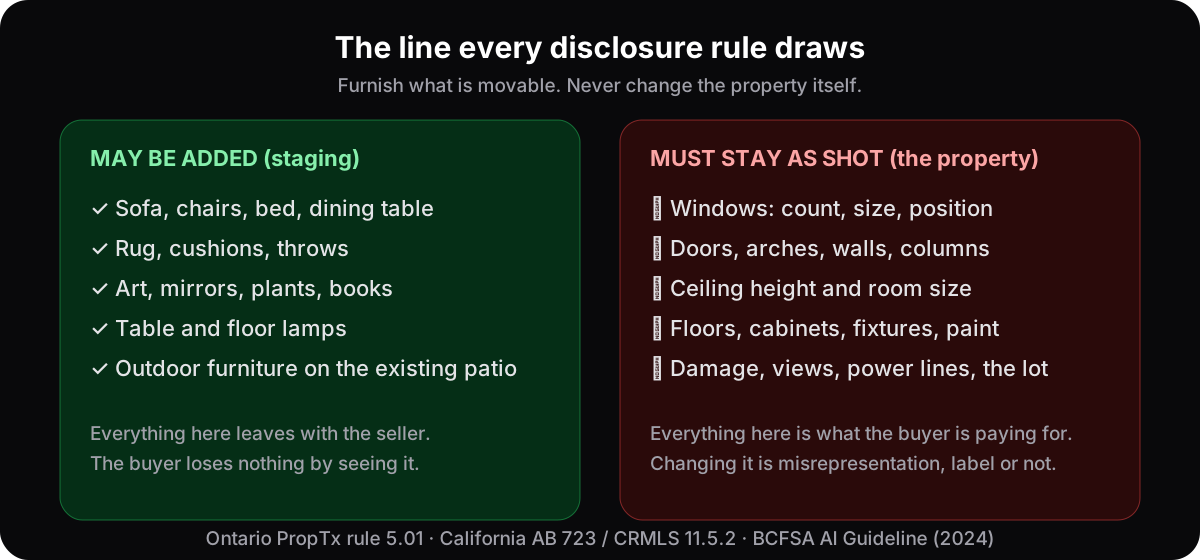
MRED's examples do most of the work here. In: "digital photos of furniture, mirrors, artwork, plants, etc.", into an empty room or in place of the furniture that is there. Out: "a view of CloudGate (aka the Chicago Bean)" where none exists, and the removal of "power lines, water towers and/or nearby highways". The principle behind both lists is the same: the buyer is paying for the real property and its surroundings, and personal property leaves with the seller.
Our reading of the cases the rule does not name. A greener lawn, a new kitchen, a wall taken out: not personal property, so not staging, whatever the field says. Replacing the seller's furniture with digital pieces: permitted in so many words, because 6.2.3 allows "Removing existing furniture from a photo and replacing it with digital images of furniture" — answer Y in the field. Emptying a room and leaving it bare is not named, and we would treat it the same way. Patio furniture on the existing deck: personal property, so in, disclosed; the deck, the lawn and the sky stay as photographed. A rendering of a room in a house that is not built yet: allowed under 6.2.3.1 for To-Be Built and Under Construction listings, disclosed the same way.
Text on the photo, and our stamp
Section 6.1.1 is MRED's general photo rule, and it is strict about what may appear on an image. Photos "should pertain strictly to the subject property and may not prominently display any names, contact information (digital or otherwise), URLs and/or links, QR codes (or similar) REALTOR® or realty office logos and/or branding, for sale signs, persons, collages, or audio/video/text commentary". The same section wants the primary photo to be "an exterior shot of the residence/business", allows "a sketch or artist’s rendering" only for vacant land or proposed construction, and bans using photos "without written permission from the intellectual property owner", at an automatic $250 for each submission.
If you stage with our tool: the optional "Virtually Staged · AI Flip Room" stamp sits in the bottom corner and carries our name. On MRED that is branding on a photo, which 6.1.1 bans, so switch it off — on Pro, Agency and Room Pack renders it is a switch on the generate screen — and answer the field instead. Whether a plain "Virtually Staged" line without a logo counts as "text commentary" is a question MRED has not answered in anything we read; our reading is that it is text, and that the field plus a sentence in the remarks does the job without it. Free renders carry a tiled watermark, which 6.1.1 would catch; they are for judging, not for a listing.
Metro East: MARIS asks for the original, but not for staging
MARIS counts the Southwestern Illinois Board of REALTORS® among its owners, and its Rules and Regulations (PDF), last revised 23 August 2024, take a different route. Its photo and video standards: "Photos/videos entered the MLS must at all times accurately represent the listed property; or otherwise indicated that the photo/video has been visually altered. Virtually staged photos/videos or modifications to chattel are not required to disclose virtual staging to the property." And: "Photos/videos that have been visually altered must be submitted with the non-altered original photo/video in succession during photo upload or video playback."
Read together, our understanding is this: an altered photo on MARIS must be marked as altered and followed by the unaltered original, but staging — furniture, chattel — is carved out of that duty. Text is another matter: photographs "shall not include any added text regardless of message, or any marketing or promotional messages made on behalf of the listing broker or seller", and "should not include people or pets". So on MARIS, as on MRED, nothing is written on the image, our stamp stays off, and the words go in the remarks.
MARIS fines by escalation, under section 7.3, for repeat breaches of the same rule: "a minimum of $100 fine", then "a minimum of $250 fine" with at least seven days' suspension, then "a minimum of $1000 fine and minimum of 30-day suspension".
Above every MLS: the Real Estate License Act
The state's rule is short and general. Section 10-30 of the Act, in the version in force since 1 January 2024, bans advertising that is "fraudulent, deceptive, inherently misleading, or proven to be misleading in practice", and adds a test: advertising is misleading "if, when taken as a whole, there is a distinct and reasonable possibility that it will be misunderstood or will deceive the ordinary consumer". The rules under the Act, in 68 Ill. Adm. Code 1450.715, amended with effect from 7 July 2025, list what counts as deceptive advertising and end the list with "Misleading consumers"; 1450.720 tells licensees to review their websites and digital platforms so that the information "is current and not misleading".
None of this names a photo. We searched the whole Act and all 104 section files of Part 1450 for photograph, image, virtual staging and artificial intelligence; the only hit for image is about a broker's logo. The duty is general, and the picture is covered by it. Our reading: a staged photo that shows the room as it could be furnished, disclosed in the field, is not "inherently misleading"; a render that adds a view, removes a highway or hides damage can "deceive the ordinary consumer", and no field answer cures that.
The sanctions sit in section 20-20. The Department "may refuse to issue or renew a license, may place on probation, suspend, or revoke any license, reprimand, or take any other disciplinary or non-disciplinary action as the Department may deem proper and impose a fine not to exceed $25,000 for each violation", and the grounds include "Advertising that is inaccurate, misleading, or contrary to the provisions of the Act", "Making any substantial misrepresentation or untruthful advertising", and "Pursuing a continued and flagrant course of misrepresentation".
What the state's REALTOR® association tells its members fits the same line. In 2018, explaining a change to Standard of Practice 12-10 that the National Association's directors approved at their November 2017 meeting, Illinois REALTORS® wrote: "When posting photos, please be careful not to alter the photo, such as removing parts of the landscape, a building or other structures and ensure that your photos are an actual representation of the property." In 2020, on virtual tours: "make sure you get proper permissions from the seller to use these staging technologies". The 2026 Code of Ethics keeps the standard, prohibiting REALTORS® from "otherwise misleading consumers, including use of misleading images".
We looked for an Illinois bill on altered or AI-generated listing images in the 104th General Assembly and found none. SB3364, introduced on 4 February 2026, would have made it a civil rights violation to "use artificial intelligence in a real estate transaction without providing notice to the other person engaging in the real estate transaction"; it was re-referred to the Assignments committee on 22 May 2026 and went no further. Three bills on provenance labels for AI-generated images — SB3263, SB1929 and HB4711 — were sent back to committee and went no further. The one AI bill that passed, SB 315, became Public Act 104-0538 on 6 July 2026 and is about safety frameworks for large frontier developers. California has a statute on altered listing images; Illinois, so far, has its advertising rule and its MLSs.
What happens if you get it wrong?
On MRED, the money is in the photo rule rather than the staging rule. Section 6.2 has no fine line of its own in the rulebook's schedule; section 6.1.1 does, and it climbs per office once you have been told: "$250.00 fine for first occurrence after notification, $300.00 for the second occurrence per office, $500.00 for the third occurrence per office, and $1,000.00 for every occurrence thereafter". A required field reported wrong is $250 under section 9.10, and such a fine "may be corrected by the Participant prior to the levy of a fine"; repeated data misrepresentation can draw $2,500 for each further occurrence under section 9.17, "until a 12-month period without occurrences is established". MRED's Compliance department assesses fines "administratively, without any hearing", subject to appeal, and the rulebook treats its rules and fines as minimums for the associations it serves.
On MARIS, a repeat breach of the same rule escalates from $100 to $250 and a week's suspension, then to $1,000 and thirty days. Above both, the Department can fine up to $25,000 for each violation and suspend or revoke the licence. And beside all of it stands the buyer who drove out to a backyard under power lines the render had removed.
What people write versus what the rules say
| What you will read elsewhere | What the Illinois text says |
|---|---|
| "add a visible ’Virtually Staged’ watermark to every altered photo—semi-transparent, positioned bottom-left or bottom-right" | MRED section 6.2.3: disclosure is "required in the specified field". Nothing in the rulebook asks for a watermark, and 6.1.1 bans "audio/video/text commentary" and "logos and/or branding" on photos. On MARIS, added text on a photo is banned "regardless of message". |
| Search results for connectMLS staging rules surface a help page whose snippet says photos need a stamp or watermark and no original | That page belongs to a Connecticut MLS on the same connectMLS software, not to MRED, and we could not open it to check the snippet. MRED's own text is the one above: a field, no watermark, and no text on the image. |
| "MRED permits virtual staging for personal property items but prohibits edits that introduce impossible views or remove external elements beyond the owner’s control, such as power lines or nearby highways." | Correct, and worth saying so: that is sections 6.2.2.1, 6.2.2.2 and 6.2.3 in one sentence. |
What should an Illinois agent actually do?
- Check which MLS the listing goes into before you stage, and follow that rulebook.
- On MRED, answer the field. "Are Any Property Photos Virtually Staged?" — Y if any photo was staged, digitally decluttered or rendered. The system adds the note to the reports and the photo browser for you.
- Say it again in the remarks, in plain words. The field is the rule; the sentence is the courtesy.
- Nothing on the image. No stamp, no logo, no caption text: section 6.1.1 on MRED, the added-text ban on MARIS.
- Stage personal property only. Furniture, mirrors, artwork, plants. The view, the power lines, the lawn, the walls and any damage stay as photographed.
- No people in the photos. MRED lists persons among what a photo may not display; MARIS says no people or pets.
- Keep the original of every staged frame. MRED does not ask you to upload it; a buyer, a broker or a complaint will.
- Lead with the exterior. MRED wants the primary photo to be an exterior shot, so the staged living room is never frame one.
If most of your listings are vacant, our page for listing agents shows how staging fits into that: furnish the room, keep its geometry, keep the original.
Why we wrote this
We make an AI virtual staging tool, and both Illinois rulebooks we read ask our users to switch our own stamp off, which is a reason to be precise rather than reassuring. Every quotation above can be checked against the MRED Rules and Regulations (PDF) and the page that publishes them, the Residential Glossary of Fields (PDF), the earlier editions of 28 February 2019 (PDF) and 2 September 2014 (PDF), the MARIS Rules and Regulations (PDF), sections 1-10, 10-30 and 20-20 of the Real Estate License Act of 2000, rules 1450.715 and 1450.720 of the Illinois Administrative Code, the bill pages for SB3364, SB3263, SB1929, HB4711 and SB 315, and the Illinois REALTORS® posts of 16 April 2018 and 26 June 2020. The points about our stamp, about a plain label on the image, about decluttering, about the lawn and the view, about how MARIS's two sentences fit together and about which edits the state's duty would catch are labelled as our interpretation. For the general principles, see our virtual staging disclosure guide; for another state whose main MLS keeps the label off the photo and in the listing's fields, Florida; for the opposite approach, a watermark and the original beside the staged photo, Arizona.
Questions Illinois agents ask
Is virtual staging legal in Illinois?+
Yes. No Illinois statute or Department of Financial and Professional Regulation rule mentions virtual staging; we searched the whole Real Estate License Act of 2000 and all 104 sections of its rules, and neither contains the words virtual staging, photograph or artificial intelligence. What binds every licensee is section 10-30 of the Act: "No advertising, whether in print, via the Internet, or through social media, digital forums, or any other media, shall be fraudulent, deceptive, inherently misleading, or proven to be misleading in practice." The detail comes from the MLS: MRED's section 6.2 permits staging, limits it to personal property and wants it disclosed in one field.
Do I have to put "Virtually Staged" on the photo?+
Not on MRED, and our reading is that you should not. The rulebook puts the disclosure "in the specified field" — "Are Any Property Photos Virtually Staged?" — and section 6.1.1 keeps "audio/video/text commentary" and "logos and/or branding" off photos. We found no MRED statement on whether a plain "Virtually Staged" line counts as text commentary, so we treat it as text and keep it off: answer the field, and repeat the fact in the remarks if you like. On MARIS, in the Metro East, text on a photo is banned outright: photographs "shall not include any added text regardless of message".
Do I have to show the original photo next to the staged one?+
Not on MRED: section 6.2 asks for the field and says nothing about an original. MARIS does want altered photos "submitted with the non-altered original photo/video in succession during photo upload or video playback", but in the next sentence exempts staging: "Virtually staged photos/videos or modifications to chattel are not required to disclose virtual staging to the property." Keep the original anyway. It is what you hand a buyer who asks whether the room is really that size, and section 20-20 of the License Act disciplines "substantial misrepresentation" whether or not an MLS rule was broken.
What does a mistake cost on MRED?+
The rulebook has no fine line for section 6.2 itself. The photo rule, 6.1.1, carries a ladder: once an office has been notified, "$250.00 fine for first occurrence after notification, $300.00 for the second occurrence per office, $500.00 for the third occurrence per office, and $1,000.00 for every occurrence thereafter". Failing to report a required field correctly is $250 under section 9.10, and such a fine "may be corrected by the Participant prior to the levy of a fine"; whether the staging field is one of the required ones we could not confirm from the glossary's layout. Repeated data misrepresentation can draw $2,500 for each further occurrence under section 9.17. The Compliance department assesses fines "administratively, without any hearing", subject to appeal, and the rulebook treats its rules and fines as minimums for the associations MRED serves.
Can I remove the power lines, add a skyline view or green up the lawn?+
No, and this is the part of section 6.2 that MRED wrote most clearly. Section 6.2.2.1 bans adding "visual elements not within a property owner’s control", with the example of "a view of CloudGate (aka the Chicago Bean)" edited in where it cannot be seen; 6.2.2.2 bans removing them, with the example "Removing power lines, water towers and/or nearby highways". Our reading of the lawn: it is not personal property either, it is part of what the buyer is buying, so it stays as photographed. A sofa on the existing patio is personal property and may go in, disclosed in the field.
Is there an Illinois law on AI or virtually staged listing photos?+
Not one that names them. The Real Estate License Act of 2000 bans misleading advertising in general, and its rules, amended with effect from 7 July 2025, list "Misleading consumers" among the kinds of deceptive advertising; neither text mentions photographs, renderings or artificial intelligence. In the 104th General Assembly we found no bill on altered listing images. The closest, SB3364, introduced on 4 February 2026, would have made it a civil rights violation to use artificial intelligence in a real estate transaction without notice to the other party; it was re-referred to the Assignments committee on 22 May 2026 and went no further. The one AI bill that became law, SB 315, now Public Act 104-0538 of 6 July 2026, is about safety frameworks for large frontier developers, not photos.
Last checked against the MRED Rules and Regulations revised 14 May 2026 (sections 6.1.1, 6.2 and the fine schedule) and the editions revised 28 February 2019 and 2 September 2014, the MRED Residential Glossary of Fields of 17 August 2024, the MARIS Rules and Regulations last revised 23 August 2024 (photo and video standards and section 7.3), sections 1-10, 10-30 and 20-20 of the Real Estate License Act of 2000, rules 1450.715 and 1450.720 of 68 Ill. Adm. Code Part 1450, and the bill status pages of the 104th General Assembly, on 5 October 2026. Rules change; verify before relying on this.
See it on your own room
Upload a photo and watch AI restage your space in 15–60 seconds, depending on how much detail it has — free to try, no credit card.
Try AI Flip Room freeRelated reading
Virtual Staging Disclosure Rules: How to Label Staged Photos
Why disclosure is required, three ways to label a virtually staged photo, what you may change vs never touch, and the rules of eleven jurisdictions compared.
Florida Virtual Staging Rules: Stellar MLS, Miami and Beaches
Is virtual staging allowed in Florida? Stellar MLS wants the disclosure in the photo description and the remarks, never on the photo. Four MLSs and the law, quoted.
Virtually Staged Listing? 5 Things a Buyer Can Demand
AI staging is legal in Ontario, BC, Quebec, Alberta, California, New York, Florida, Texas, Washington, Arizona and Illinois, with conditions: what a buyer can demand.