Washington State Virtual Staging Rules: NWMLS, the DOL and the Law
AI Flip Room · 9 min read
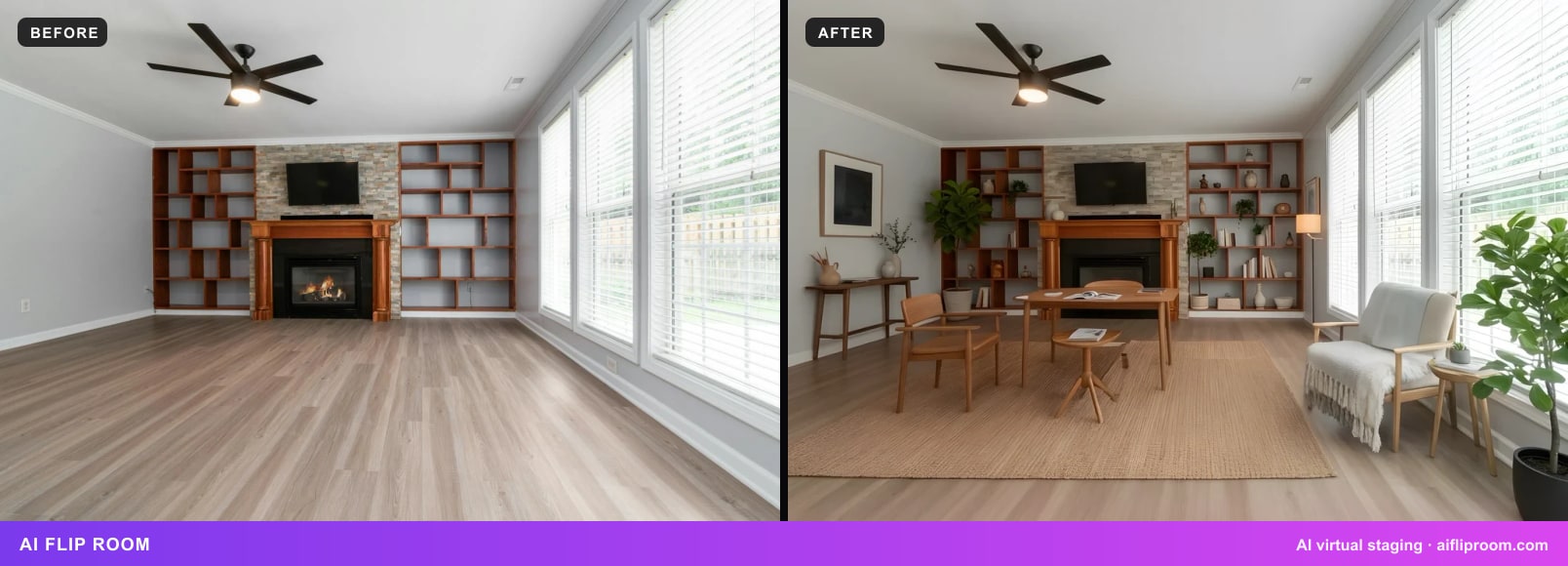
Washington is the state where we could verify the least, and this article says so rather than filling the gap. The law and the Department of Licensing's rules never mention staging, altered photos or AI. The rulebook that most of the state's listings follow, Northwest MLS's, is published to members only. The one open MLS rulebook we found, Spokane's, has no staging rule. And the 2026 law that headlines call Washington's AI disclosure act binds the companies that build AI systems, not the brokers who use them.
The short answer: virtual staging is allowed in Washington State, as long as the photo adds furniture rather than changing the property and the buyer is told. What binds every licensee is a sentence in the licensing statute about false descriptions, read through a guideline the DOL wrote about advertising. What your MLS adds on top, you will have to read in its rulebook; we tell you below what a secondary source says it contains, and that we could not check it. It is not legal advice; where we are interpreting rather than reporting, we say so.
Is virtual staging allowed in Washington?
Yes. Chapter 18.85 RCW, the statute on real estate brokers and managing brokers, does not contain the words photograph, image, staging or artificial intelligence. Nor does chapter 308-124 WAC, the Department of Licensing's rulebook. What the statute has is a list of grounds for discipline in RCW 18.85.361, and three of them reach a listing photo.
The second ground is the one to read twice. It is not limited to lies: a licensee is liable for a false description they "knew or, by the exercise of reasonable care and inquiry, could have known" was false. A render that quietly widened a window is a false description of the property whether or not the agent noticed; comparing the staged image with the original is the reasonable care. Ground (3) adds "any material fraud, misrepresentation, concealment", and ground (23) "any conduct in a real estate transaction which demonstrates bad faith, dishonesty, untrustworthiness, or incompetence". Ground (8) is the only one about advertising as such, and it is about the firm's name, which must appear "in a clear and conspicuous manner in the advertisement".
The regulator: one advertising rule, and a guideline
The DOL's rules on advertising fit in one section, WAC 308-124B-210, and it is about names: "A firm must operate under their firm name or an assumed name as licensed", and all advertising "must include the firm name or an assumed name as licensed". Nothing in it about photographs. (A section number you may see cited as the advertising rule, WAC 308-124C-115, is about notifying the department of a lawsuit.)
The substance is in the DOL's Real Estate Advertising Guidelines (PDF), form RE-620-400, dated October 2017, which open with the caution that "These are guidelines only. This guide does not include every possible advertising situation and it is not legal advice." Their test is quoted in full above: the DOL reads "the literal meaning of the advertisement and the general impression it creates", needs no proof that a consumer was misled, and holds a careless licensee as responsible as a dishonest one. The guideline's examples are about words — a "green belt" the broker knows is about to be logged, a "nearly new roof in great condition" over a known leak — and its one passage on photographs is about copyright: licensees "must avoid using, in all advertising, photographs, images, text, graphs, illustrations and other content that broker does not own or have a license to use". The words virtual, staging and altered do not appear.
Our reading: a staged photo is an advertisement, its "general impression" is what a buyer takes from it, and a furnished room with the walls, windows and floor as photographed gives a true impression once the buyer knows the furniture is rendered. A photo that changes the room gives a false one, and no caption repairs it.
NWMLS: the rule most of the state follows is not public
Northwest Multiple Listing Service covers Seattle and most of the state. Its rules are not on its website: the public pages offer a member login and nothing else, and no open copy of the rulebook exists that we could find. We did not read it, and we will not quote it as though we had.
What we can report is the best secondary source we found. Rockwell Institute, a Washington licensing school, published an article on 15 January 2026, Using AI to Stage a Home: Tips for Washington Brokers, which says: "Rule 105(d) requires that any photo or video that has been altered to show a different appearance of the property must be clearly labeled as 'virtually staged.'" It adds that the label may go on the image itself or in the photo description, that it should be clear and conspicuous, and that NWMLS prohibits photos that include people. It says nothing about the original photo, about watermarks, about fines, or about what staging may not change.
That is a summary by a third party, and the rule number and wording may have moved since. Vendors' pages describe the NWMLS rule in several incompatible ways — a watermark, a photo-type designation, interiors only, no exteriors — none of them citing the text, and we are not repeating any of them. If you list on NWMLS, open the rules from your login or ask its compliance desk, and read the staging rule yourself before your next upload.
If you stage with our tool: on NWMLS the secondary source says a label on the image is acceptable, which is what the optional "Virtually Staged · AI Flip Room" stamp is, but we could not verify that against the rulebook. Our reading: put "virtually staged" in the photo description whatever you do with the image, and confirm with NWMLS whether text on a photo is permitted before you rely on the stamp. Free renders carry a tiled watermark and are for judging, not for a listing.
Spokane: no staging rule
The Spokane Association of REALTORS® publishes its MLS Rules and Regulations, revised April 2021 (PDF). Section 1.15, Photographs, asks for an exterior photo first: "The first photo of all improved property submitted to the MLS within the service area of the Association must be an exterior photo of the property, to include the primary structure". Section 1.3.0 requires accurate listing data. The words virtual, staged, altered and enhanced appear nowhere. Its violations schedule files "erroneous, misleading, incomplete, or inaccurate listing information" under Tier 1 without naming an amount. We found no newer edition.
The 2026 AI act is about providers, not listings
Washington passed an AI disclosure law this year, and it is easy to misread. E2SHB 1170, Chapter 167, Laws of 2026, "Informing users when content is developed or modified by artificial intelligence", passed the House on 13 February 2026 and the Senate on 4 March, was signed on 24 March, and takes effect on 1 February 2027. Its duties fall on a "covered provider": "a person or entity that creates, codes, or otherwise produces a generative artificial intelligence system that has over 1,000,000 monthly users and is publicly accessible within the geographic boundaries of the state to consumers for personal use". The Attorney General enforces it. The session law does not contain the words real estate, listing, broker or advertising.
So it adds nothing to a listing agent's duties. It may change what the tools do — a large provider will have to offer and embed disclosures in what it generates — but the duty to tell a buyer that a photo was staged comes from RCW 18.85.361 and your MLS, and it already exists. We found no Washington bill in the 2025–26 biennium on altered listing photographs as such.
What happens if you get it wrong?
Before the DOL, RCW 18.235.110 allows "Payment of a fine for each violation found by the disciplinary authority, not to exceed five thousand dollars per violation", alongside suspension and revocation. NWMLS's fine schedule is members-only, like its rules; Spokane names no amount. Beside the regulator stands the buyer who drove out to a room the render invented, and the brokerage that has to answer for it.
What people write versus what the rules say
| What you will read elsewhere | What the Washington text says |
|---|---|
| "Washington's new AI law requires AI listing photos to be labelled" | HB 1170 binds "covered providers" — makers of generative AI systems with over a million monthly users — from 1 February 2027, is enforced by the Attorney General, and never mentions real estate, listings or brokers. |
| "NWMLS requires a watermark on virtually staged photos" | We could not read the rulebook. The secondary source we trust most says the label may go on the image or in the photo description. Do not rely on either version without the rulebook. |
| "WAC 308-124C-115 is Washington's advertising rule" | That section is about notifying the DOL of a suit or complaint. The only advertising rule in the DOL's chapter is WAC 308-124B-210, and it is about the firm's name. |
| "The DOL fines $10,000 or $25,000 per violation" | RCW 18.235.110: "not to exceed five thousand dollars per violation". |
| "Washington requires an EXIF tag or a note in the file" | Nothing in chapter 18.85 RCW, the WAC, the DOL guideline or the published Spokane rules. HB 1170 puts the duty to mark AI output on the provider, not on the licensee. |
What should a Washington agent actually do?
- Read your MLS's staging rule yourself. On NWMLS that means the members' rulebook; the secondary account above is a pointer, not the text.
- Label every staged image in the photo description, and on the image too if your MLS allows text there. Nothing in Washington law objects to a label; everything in it objects to a missing one.
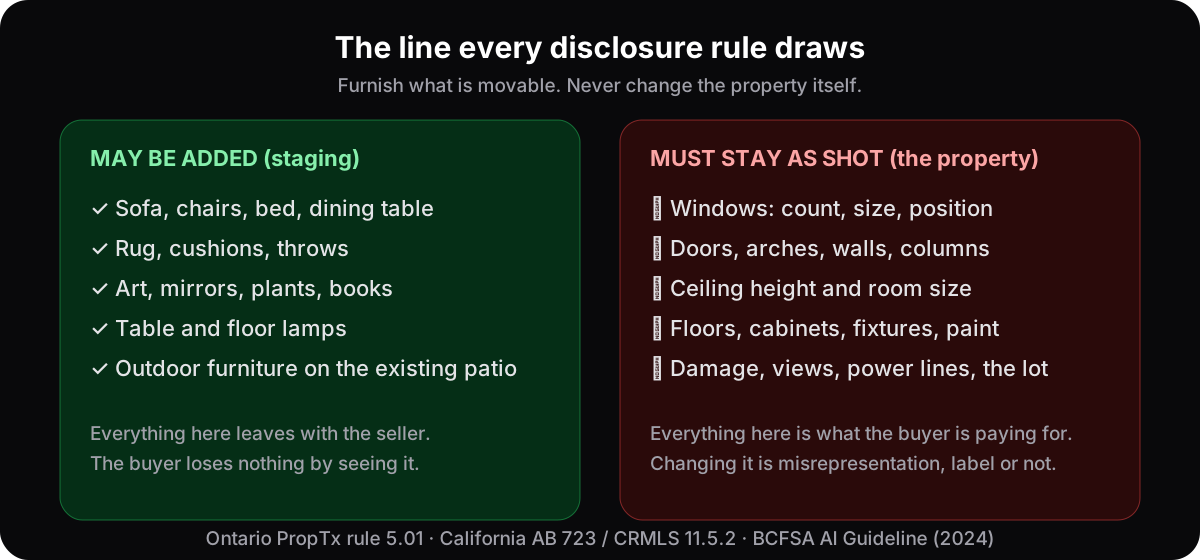
- Stage furniture and décor only. Floors, walls, windows, fixtures, the view and any damage stay as photographed. The DOL judges the "general impression", and a label does not change what a render did to the room.
- No people in the photos, which the secondary source says NWMLS prohibits and which is a safe habit everywhere.
- Keep the original of every staged frame; it is the record of what reasonable care would have shown.
If most of your listings are vacant, our page for listing agents shows how staging fits into that: furnish the room, keep its geometry, keep the original.
Why we wrote this
We make an AI virtual staging tool, and Washington is a state where the honest answer about its main MLS is "we could not read the rule", which is a reason to say so rather than to guess. Every quotation above can be checked against RCW 18.85.361, RCW 18.235.110, WAC 308-124B-210, the DOL's Real Estate Advertising Guidelines (PDF), the Spokane MLS rules (PDF), the bill page and session law for HB 1170, and Rockwell Institute's article. The passages on NWMLS rest on that article alone and are marked as such; the points about the "general impression" of a staged photo and about our stamp are our interpretation. For the general principles, see our virtual staging disclosure guide; for a state whose rulebooks are public and quoted in full, Texas; for the strictest neighbour, California.
Questions Washington agents ask
Is virtual staging legal in Washington State?+
Yes. No Washington statute or Department of Licensing rule bans it, and none mentions it. What applies is the general rule: RCW 18.85.361(2) lets the DOL discipline a licensee for distributing "false statements, descriptions or promises" the licensee knew, or with reasonable care could have known, to be false, and the DOL's advertising guideline says an advertisement must not be "capable of misleading a reasonable consumer". A furnished photo of a real room, disclosed, is an honest description; a photo with a new floor or a wider window is not, whatever the caption says.
What does NWMLS require for virtually staged photos?+
We cannot quote it: the NWMLS rulebook is available to members only, and the MLS's public site has no copy. The best secondary source we found, an article by a Washington licensing school dated 15 January 2026, says Rule 105(d) requires any photo or video "altered to show a different appearance of the property" to be "clearly labeled as 'virtually staged'", on the image or in the photo description, and that NWMLS prohibits photos that include people. Treat that as a summary, not the rule: open the rules from your NWMLS login, or ask its compliance desk, before relying on it. Nothing we found says NWMLS requires a watermark or the original beside the staged photo; nothing we found says it does not.
Do I have to show the original photo next to the staged one?+
No published Washington rule requires it. The DOL guideline does not mention it, and the Spokane MLS rules have no staging provision at all. We could not read the NWMLS rules, so we cannot say what they ask. Keep the original of every staged frame anyway; under RCW 18.85.361(2) a licensee is judged by what reasonable care would have shown, and the unedited photo is the proof of what the room really looked like.
Does Washington's new AI law apply to listing photos?+
Not to the agent who posts them. E2SHB 1170, Chapter 167 of the Laws of 2026, signed on 24 March 2026, binds a "covered provider": "a person or entity that creates, codes, or otherwise produces a generative artificial intelligence system that has over 1,000,000 monthly users". It takes effect on 1 February 2027, is enforced by the Attorney General, and does not contain the words real estate, listing or broker. Your duty to disclose a staged photo comes from RCW 18.85.361 and your MLS, not from this act.
What is the penalty for a misleading staged photo in Washington?+
Under RCW 18.235.110 the DOL may order "Payment of a fine for each violation found by the disciplinary authority, not to exceed five thousand dollars per violation", and may suspend or revoke the licence. NWMLS's fine schedule is not published. Spokane's rulebook files "erroneous, misleading, incomplete, or inaccurate listing information" under its Tier 1 violations without naming an amount.
Last checked against RCW 18.85.361 and RCW 18.235.110 as published by the Legislature, WAC 308-124B-210, the Department of Licensing's Real Estate Advertising Guidelines (form RE-620-400, October 2017), the Spokane Association of REALTORS® MLS Rules and Regulations revised April 2021, the session law for E2SHB 1170 (Chapter 167, Laws of 2026) and Rockwell Institute's article of 15 January 2026, on 4 October 2026. The NWMLS rules were not available to us; verify its staging rule in the members' rulebook before relying on this.
See it on your own room
Upload a photo and watch AI restage your space in 15–60 seconds, depending on how much detail it has — free to try, no credit card.
Try AI Flip Room freeRelated reading
Virtual Staging Disclosure Rules: How to Label Staged Photos
Why disclosure is required, three ways to label a virtually staged photo, what you may change vs never touch, and the rules of nine jurisdictions compared.
California Virtual Staging Rules: AB 723 + CRMLS 11.5.2
Since 1 January 2026 California regulates altered listing photos by statute. What AB 723 requires, what CRMLS 11.5.2 adds, the $250 fine, and a checklist.
Virtually Staged Listing? 5 Things a Buyer Can Demand
AI staging is legal in Ontario, BC, Quebec, Alberta, California, New York, Florida, Texas and Washington, with conditions: what a buyer can demand.