Alberta Virtual Staging Rules: MLS Rule 2.04, Staged vs Enhanced
AI Flip Room · 8 min read
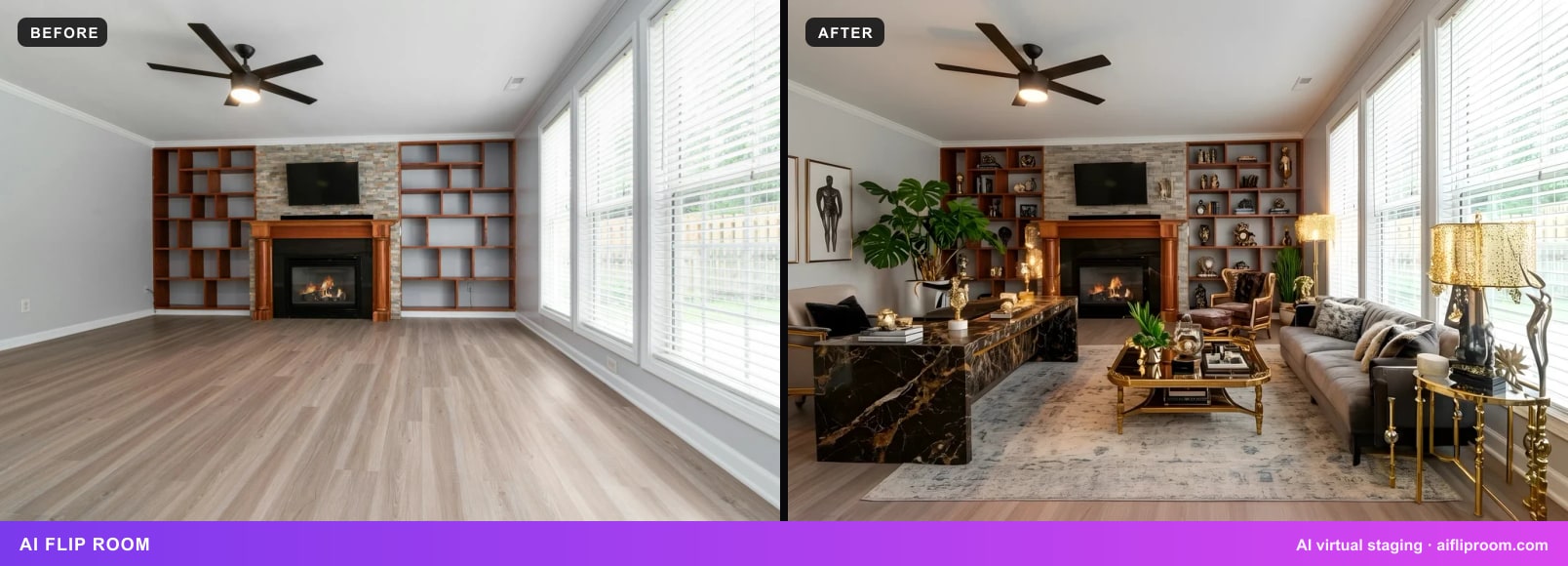
Of the provinces we have covered, Alberta is the one where the MLS rulebook itself defines virtual staging. The provincial MLS® rules, shared by ten boards from Calgary and Edmonton to Fort McMurray and Medicine Hat, define virtual staging, define the thing it must never turn into — virtual enhancing — and say exactly where the disclosure goes. It fits in five sentences, and most articles about "Alberta virtual staging rules" quote none of them.
The short answer: virtual staging is allowed in Alberta, as long as the listing's public remarks say so and the image adds furniture rather than changing the property. This article quotes the rules, the regulator's rule above them and what enforcement looks like in practice. It is not legal advice; where we are interpreting rather than reporting, we say so.
Is virtual staging allowed in Alberta?
Yes. The Provincial MLS® System Listing & Practice Rules for Alberta REALTORS® permit virtual staging on one condition — disclosure in the public remarks — and forbid something else by name: virtual enhancing. The rulebook is a joint document of ten Alberta boards and the Alberta Real Estate Association, so the same text applies whether the listing is on the Calgary board's system or Edmonton's.
The disclosure is not a suggestion. The rulebook's preamble says: "These rules are fully binding on Members where the phrasing of a particular section or sentence indicates that a Member shall or must abide by the procedure or action indicated." The staging rule says "must".
What the Alberta MLS rules say, word for word
Two definitions and two rules do all the work:
The rules never mention artificial intelligence. The test is what the image shows, not how it was made: an AI render and a hand-edited one are judged the same way. Regulators elsewhere in Canada have written about AI — British Columbia's and Quebec's — but we did not find an equivalent from Alberta's regulator. In Alberta the photo rule lives in the MLS rulebook, as it does in Ontario; the difference is that Ontario's rulebook never uses the phrase "virtual staging", and Alberta's defines it.
Staging or enhancing: where Alberta draws the line
The definition of virtual staging is narrow, and three phrases carry it. Unattached goods (chattels): things that leave with the seller — a sofa, a bed, a rug, a lamp. Of realistic size: a sofa shrunk to make a small room look big is not staging under this definition. To give perspective on room dimensions: the purpose is scale, not a makeover.
Virtual enhancing is the other side: changing, adding or augmenting features "that would materially affect the property value", with walls and the layout, location, size or type of windows as the examples. Rule 2.04 h keeps virtually enhanced images off the MLS® System altogether, along with "any photos that may misrepresent the property". A label does not rescue them.
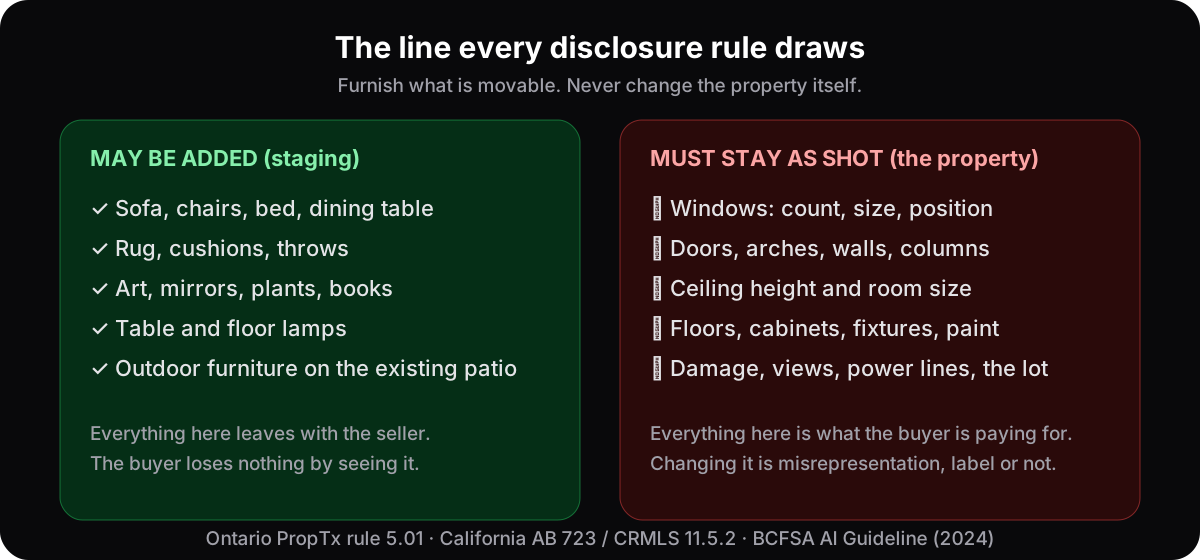
Between the two definitions sits a grey band the rules do not spell out: a new paint colour, a different floor, a swapped countertop. Our reading: none of these is a chattel, so none of them is virtual staging under rule 1.01 ii, and anything that changes what a buyer believes they are paying for is either enhancing or a photo that may misrepresent the property. Stage the things that move; leave everything else as photographed.
Where the disclosure goes, and the text-on-photo problem
Rule 2.04 g puts the disclosure in the public remarks on the board's MLS® System. One plain sentence covers a whole gallery, for example: "Some photos are virtually staged." That wording is ours; the rules do not prescribe one.
The image itself is less clear. Rule 2.04 b says: "Photographs or artists' renderings shall not include any wording or other embellishments not related to the property, such as, but not limited to: corporate logos, advertisements, Member contact information or any messages other than “Sample Photo”." A logo on a listing photo is plainly out. A plain "Virtually staged" label is harder to call: it is arguably related to the property, and it is also a message other than "Sample Photo". The text does not settle it, and we have not found a board statement that does. Until your board says otherwise, put the disclosure where the rule asks for it, and ask before adding any text to the image.
If you stage with our tool: the optional "Virtually Staged · AI Flip Room" stamp carries our name, and rule 2.04 b does not allow corporate logos on listing photos. For an Alberta MLS® upload, switch the stamp off — on Pro, Agency and Room Pack renders it is a toggle — and disclose in the public remarks instead.
No pairing rule, but keep the original
Alberta does not require the unedited photo beside the staged one. That rule belongs to California, where CRMLS wants the original immediately before or after the staged image, and to upstate New York, where the Alliance MLS rules want it directly before; Quebec makes brokers keep the originals on file. Alberta asks for neither, but keeping the original costs nothing, and it is your record of what the room looked like if a buyer or the board asks. Our guide to what buyers can demand from a staged listing covers that conversation.
Three more image rules in section 2.04 matter before you stage anything:
- Stage your own file, not the MLS copy. Images uploaded to the MLS® System become the board's property (2.04 c), and "Any alteration of an image owned by the Board is prohibited" (2.04 d). Our reading: work from the photographer's original, not a download from the listing.
- Old listing photos need permission. Using images from an active or previous listing requires "the written consent of the former Listing Brokerage" (2.04 e). Restaging last year's photos starts with that consent, not with a render.
- No people. Images uploaded to the MLS® System "shall not contain any persons" (2.04 i), so no staged family at the dinner table.
Above the MLS: RECA's rule against misleading conduct
The MLS rules bind board members on the board's system. Your website, social media and print sit under the regulator, the Real Estate Council of Alberta (RECA). We did not find RECA guidance on AI images or virtual staging, and its advertising guidelines, dated January 2016, do not address altered photos. What applies is the general duty in section 42 of the Real Estate Act Rules: licensees must not "make representations or carry on conduct that is reckless or intentional and that misleads or deceives any person or is likely to do so".
The MLS rulebook repeats the duty for its members in rule 6.05: no advertising that is "inaccurate, misleading or in any way misrepresents the Member's services or the Seller's property". A staged photo that hides a crack or adds a window fails both, wherever it is published.
What happens if you get it wrong?
There are two tracks. On the MLS® System, section 9 of the rules leaves sanctions to "each Board's policy and procedure". The Calgary Real Estate Board described its own to Real Estate Magazine in March 2026: non-compliant images are flagged weekly, and the board follows an "inform then enforce" model — an educational advisory for a first offence, escalating financial penalties after that, and a disciplinary hearing on the fourth occurrence. CREB does not disclose the amounts, and its chair said that, to her knowledge, no case had yet reached a hearing.
With the regulator, misleading conduct can go to a RECA hearing panel. Under section 43(1)(d) of the Real Estate Act, the panel can order a licensee to pay a fine "not exceeding $25 000, for each finding of conduct deserving of sanction" — one of several orders it can make, alongside a reprimand, conditions on the licence, or its suspension or cancellation.
What people write versus what the rules say
| What you will read elsewhere | What the Alberta text says |
|---|---|
| "CREA requires a watermark on staged photos" | Real Estate Magazine reported in March 2026 that CREA and REALTOR.ca do not regulate AI use in listings. The only watermark in Alberta's rules is the board's own, which it may add to show it owns the image (rule 2.04 c). |
| "These are Calgary's rules" | They are provincial: one rulebook written jointly by ten Alberta boards, Calgary and Edmonton among them, and the Alberta Real Estate Association. Each board enforces it under its own policy (section 9); CREB is the one that has described how in public. |
| "Alberta requires the unaltered original alongside" | There is no pairing rule in the Alberta text. That is California's CRMLS, and upstate New York's Alliance MLS. |
| "Put 'virtually staged' on every photo" | The rule asks for disclosure in the public remarks, and rule 2.04 b restricts text on the photo itself. |
| "AI images are banned on the Alberta MLS" | The rules never mention AI. They ban virtually enhanced images and photos that may misrepresent the property, whatever made them. |
What should an Alberta agent actually do?
- Disclose in the public remarks whenever a listing has a virtually staged image.
- Stage, never enhance. Unattached furniture and decor at realistic size; walls, windows, floors, fixtures and views stay as photographed.
- Keep logos off the photo, ours included, and ask your board before adding any text to it.
- Work from your own original, and get written consent before reusing another listing's photos.
- Keep the original of every staged frame with the listing file.
If most of your listings are vacant, our page for listing agents shows how staging fits into that: furnish the room, keep its geometry, keep the original.
Why we wrote this
We make an AI virtual staging tool, so we have an interest in the answer being permissive. Every quotation above can be checked against the Alberta MLS® rules (PDF), the Real Estate Act Rules and the Real Estate Act; the CREB detail is from Real Estate Magazine's report of 30 March 2026; the points about text on photos, the grey band and the MLS copy are labelled as our interpretation. For the general principles, see our guide to virtual staging disclosure rules.
Questions Alberta agents ask
Is virtual staging legal in Alberta?+
Yes. The provincial MLS® rules define virtual staging and permit it on one condition: the listing brokerage must disclose it in the public remarks on the board's MLS® System (rule 2.04 g). What is not permitted is virtual enhancing — changing walls, the layout or windows — or any photo that may misrepresent the property (rule 2.04 h).
What is the difference between virtual staging and virtual enhancing?+
Virtual staging adds unattached goods — chattels — of realistic size, to give a sense of the room's dimensions. Virtual enhancing changes, adds or augments features that would materially affect the property value; the rules give walls and the layout, location, size or type of windows as examples. Furniture leaves with the seller; walls and windows do not.
Can I put a "Virtually staged" label on the photo itself?+
The rules do not answer this directly. Rule 2.04 b bars wording not related to the property and any messages other than “Sample Photo”, and names corporate logos and advertisements. Whether a plain staging label counts as related to the property is not settled in the text, and we have not found a board statement on it. The disclosure the rules require goes in the public remarks; if you also want a label on the image, ask your board first, and leave logos off.
Do I have to show the original photo next to the staged one?+
No. Alberta's rules have no pairing requirement; that is a rule of California's CRMLS (11.5.2) and upstate New York's Alliance MLS. Keep the original anyway, with the listing file: it is your record of what the room looked like if a buyer or the board asks.
What happens if a staged photo breaks the rules?+
On the MLS® System, each board applies its own policy (section 9 of the rules). CREB told Real Estate Magazine in March 2026 that it flags non-compliant images weekly, starts with an educational advisory, escalates with financial penalties it does not disclose, and sends a fourth violation to a disciplinary hearing. Separately, a misleading photo can breach section 42(a) of the Real Estate Act Rules, and a RECA hearing panel can fine up to $25,000 for each finding (Real Estate Act, section 43(1)(d)).
Last checked against the Provincial MLS® System Listing & Practice Rules for Alberta REALTORS® (January 2024), the Real Estate Act Rules (current as of 17 July 2023) and the Real Estate Act, RSA 2000 c R-5, on 2 October 2026. The January 2024 edition is the newest public copy we could find; the Alberta Real Estate Association's own rules page is for members only. Rules change; verify before relying on this.
See it on your own room
Upload a photo and watch AI restage your space in 15–60 seconds, depending on how much detail it has — free to try, no credit card.
Try AI Flip Room freeRelated reading
Ontario Virtual Staging Rules: PropTx MLS Rule 5.01, Quoted
Is virtual staging banned on the Ontario MLS? We read the PropTx rulebook: rule 5.01 quoted, the missing "one unstaged photo" rule, and where the line is.
BC Virtual Staging Rules: What BCFSA's AI Guideline Says
BCFSA's 2024 AI guideline, quoted: virtual staging may be okay if labelled, which Rules sections apply, and the client-data consent point most agents miss.
Quebec Virtual Staging Rules: OACIQ's AI Label, Quoted in English and French
Is virtual staging allowed in Quebec? OACIQ guideline 6.3.1 names it, asks for a visible AI label and kept originals. Quoted in English and French.