Home Staging and Virtual Staging Statistics 2026, With Sources
AI Flip Room · 4 min read
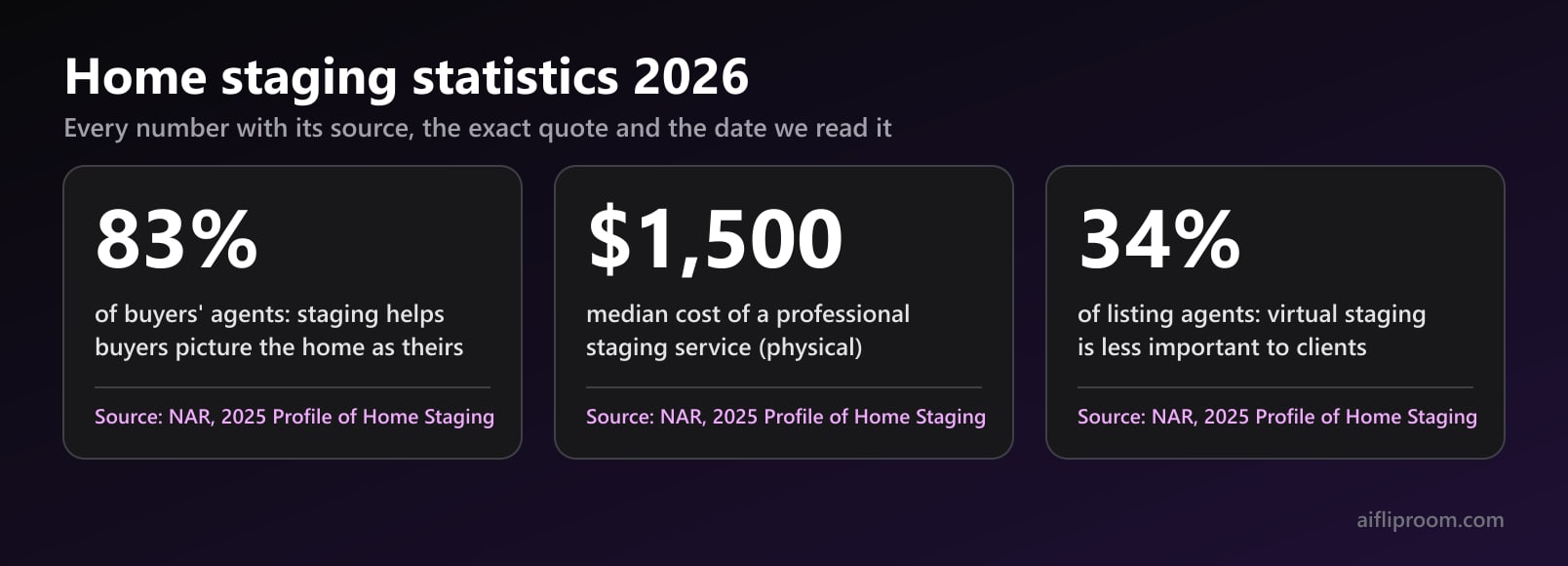
Staging numbers travel. A percentage gets quoted in a listing presentation, then in a blog post, then in an article that credits it to a survey that never said it. This page goes the other way. Every number has its own card with what it measures, the source's own words, a link to the original, the date we read it and a button that copies a ready citation.
We make an AI virtual staging tool, so we have an interest in this topic. That is why the numbers come from the people who collected them, mostly the National Association of Realtors (NAR) and the Real Estate Staging Association (RESA), and why our own data is labelled as ours.
How to read these numbers
Three things to know before you quote any of them.
- Most of them are about physical staging. Real furniture in a real house. Three NAR cards rate virtual staging, our own cards cover AI renders, and none of them measures a sale.
- Most of them are opinions. NAR asks agents what they saw. "49% of listing agents said staging reduced time on market" is a survey answer, not a count of days.
- The original beats this page. Link to the source first. If our page helped you find it, a link to the card is welcome too; the Copy citation button copies both.
The NAR survey behind most of them
NAR's 2025 Profile of Home Staging is where most staging statistics come from. NAR asked its members, not buyers or sellers, and it asked about the homes they had worked on. Most cards below link to NAR's free press release. Four come from the full report, which NAR sells and gives free to members, and each of those says so.
1,266usable answers from Realtors behind NAR's 2025 staging numbers
What it measures: An online survey sent to a random sample of 49,806 active Realtors in February 2025. The response rate was 2.5% and the margin of error ±2.75% at 95% confidence.
“In February 2025, NAR invited a random sample of 49,806 active Realtors® to complete an online survey. … NAR received 1,266 usable responses for an overall response rate of 2.5%. … At the 95% confidence level, the margin of error is +/- 2.75%.”
Physical staging: what agents see
83%of buyers' agents said staging made it easier for a buyer to picture the home as their future home
What it measures: Buyers' agents in NAR's February 2025 survey. It is the agents' view of their buyers, not a survey of buyers.
“A majority (83%) of home buyers' real estate agents said staging a home made it easier for a buyer to envision the property as their future home.”
49%of listing agents said staging reduced the time a home spent on the market
What it measures: Listing (sellers') agents in NAR's 2025 survey: 30% saw a slight decrease and 19% a significant one. These are observations, not measured days on market.
“almost half (49%) of home sellers' agents observed that home staging reduced the time homes spent on the market … When homes were staged, 30% of home sellers' real estate agents observed slight decreases in time on the housing market, while 19% noted a significant reduction in selling time.”
29%of agents said staging their sellers' homes led to a 1% to 10% increase in the dollar value offered
What it measures: Agents in NAR's 2025 survey describing offers on homes they staged. An observation, not a measured sale price.
“Nearly three out of 10 (29%) real estate agents reported that staging their sellers' homes led to a 1% to 10% increase in the dollar value offered”
17%of buyers' agents said staging increased the dollar value offered by 1% to 5%, compared with similar unstaged homes
What it measures: Buyers' agents in NAR's 2025 survey. The next card shows how many saw no effect on price.
“Seventeen percent of home buyers' real estate agents said that staging a home resulted in a 1% to 5% increase in the dollar value offered, compared to similar, un-staged homes on the market.”
41%of buyers' agents said staging had no impact on the dollar value offered
What it measures: Buyers' agents in NAR's 2025 survey. On NAR's chart it is the largest single answer to the question about price.
“Forty-one percent of buyers' agents indicated that staging a home had no impact on the dollar value that was offered.”
From NAR's full report, which NAR sells and gives free to members. The free press release does not have this figure; the link goes to NAR's page for the report.
37%of buyers' agents said the living room was the most important room to stage
What it measures: Buyers' agents in NAR's 2025 survey choosing the room that mattered most to buyers: living room 37%, primary bedroom 34%, kitchen 23%.
“Staging the living room was most important for home buyers (37%), followed by the primary bedroom (34%) and kitchen (23%).”
73%of buyers' agents said listing photos were highly important to their clients
What it measures: Buyers' agents in NAR's 2025 survey rating what a listing should have: photos 73%, physical staging 57%, videos 48%, virtual tours 43%.
“Home buyers' agents emphasized that including photos (73%), traditional physical staging (57%), videos (48%) and virtual tours (43%) in their listings were highly important to their clients.”
58%of agents said buyers were disappointed by how homes looked compared with homes on TV shows
What it measures: Respondents to NAR's 2025 survey, all of them agents, describing their buyers' reactions.
“58% said that buyers were disappointed by how homes looked compared to those portrayed on TV shows.”
Physical staging: who stages, which rooms, what it costs
$1,500median cost of a professional staging service, against $500 when the listing agent staged the home
What it measures: Listing agents in NAR's 2025 survey who staged homes. Physical staging only; the survey gives no cost for virtual staging.
“The median cost for using a staging service was $1,500, compared to $500 when the home sellers' agent handled the staging themselves.”
51%of listing agents did not stage homes before listing them for sale
What it measures: Listing agents in NAR's 2025 survey describing their usual practice.
“More than half (51%) of home sellers' agents did not stage homes before listing them for sale”
21%of listing agents staged all their sellers' homes before listing
What it measures: Listing agents in NAR's 2025 survey. Another 10% staged only homes that were difficult to sell.
“Twenty-one percent of home sellers' real estate agents reported staging all their sellers' homes prior to listing … while 10% only staged homes that were difficult to sell.”
91%the living room, the room staged most often
What it measures: Rooms typically staged, as reported by listing agents in NAR's 2025 survey: living room 91%, primary bedroom 83%, dining room 69%, kitchen 68%.
“Among home sellers, the most commonly staged rooms were the living room (91%), primary bedroom (83%), dining room (69%) and kitchen (68%).”
88%of listing agents said photos were much more or more important to their clients
What it measures: Listing agents in NAR's 2025 survey: photos 88%, videos 47%, physical staging 43%. A rating of photos, not a speed of sale.
“Among home sellers' real estate agents, incorporating photos (88%), videos (47%) and traditional physical staging (43%) in their listings were much more or more important to their clients.”
To turn the $1,500 median into a number for one listing, the staging cost calculator sets it against what each day on the market costs. For what virtual staging costs per photo, see our virtual staging cost guide.
Virtual staging: what agents say
NAR's 2025 survey asked how important virtual staging is to clients. It did not ask whether virtually staged homes sell faster or for more, and we found no independent study that did.
34%of listing agents said virtual staging was less important to their clients
What it measures: Listing agents in NAR's 2025 survey rating virtual staging among listing features; 24% said it was equally important. It measures importance, not results.
“In contrast, 34% of home sellers' agents considered virtual staging to be less important, while 24% felt it was equally important to their clients.”
38%of buyers' agents said virtual staging was less important to their clients
What it measures: Buyers' agents in NAR's 2025 survey. On NAR's chart the full split is 5% much more important, 13% more important, 31% equal, 38% less and 13% much less important.
“Thirty-three percent of buyers' agents said that both virtual tours and videos were of equal importance, and 38 percent said that virtual staging was of less importance. … Virtual staging 5% 13% 31% 38% 13%”
From NAR's full report, which NAR sells and gives free to members; the second part of the quote is the virtual staging row of its chart. The link goes to NAR's page for the report.
8%of listing agents only stage homes virtually
What it measures: Listing agents in NAR's 2025 survey choosing how they stage before listing. A row of NAR's chart, not a line in the press release.
“Only virtually stage homes 8%”
From NAR's full report, which NAR sells and gives free to members. The link goes to NAR's page for the report.
20 homesthe median number of homes buyers expected to view virtually, against eight in person
What it measures: Agents in NAR's 2025 survey describing buyers who had an expectation. This is viewing homes online, not virtual staging.
“Among those who did have an expectation, their buyers expected to view a median of eight homes in person and a median of 20 homes virtually.”
From NAR's full report, which NAR sells and gives free to members. The link goes to NAR's page for the report.
Before you use a virtually staged photo at all, check your MLS. Some require a label on the photo, some want the original photo next to it, and some only forbid changing the property. Our MLS rules by state and province quote what each one says.
Staging industry data: RESA
RESA is the trade association of home stagers. Its numbers come from stagers reporting their own sales, so they describe how staged homes did, not what staging caused. RESA says this itself.
10 daysaverage days on market for homes staged by RESA members and sold from January to June 2026
What it measures: 170 US properties reported by stagers through RESA's Sold Over List Price Club and Days on Market Club. There is no group of unstaged homes to compare with.
“Average days on market: 10 days across 170 properties … Results reflect participating properties, not all staged homes, and do not isolate staging’s effect or guarantee outcomes.”
Self-reported by stagers about their own projects. RESA's own caveat is the second part of the quote.
$4,934average staging investment on homes staged by RESA members, January to June 2026
What it measures: 233 US properties reported by stagers to RESA. Professional physical staging; an average, so a few large projects pull it up, and not comparable with NAR's median.
“Average staging investment: $4,934 across 233 properties”
87%RESA's 2012 claim that homes staged before listing sell 87 percent faster
What it measures: RESA compared 359 homes staged before listing, which got an offer in 26 days on average, with 89 other homes that sat unstaged for 166 days on average before their owners called a stager. Different homes, and days to an offer set against days on market. Data from 2012.
“RESA studied 89 homes that were previously on the market that were not staged. The unstaged homes remained on the market for 166 days, on average, before the home owners called in a professional stager. … RESA evaluated 359 homes that were staged but this time before the homes ever went on the market. The homes, on average, received an offer within 26 days after being professionally staged and listed. … “When [home owners] invest in staging before listing, they sell 87 percent faster.””
Secondary source: NAR reporting RESA's 2012 study. We could not open RESA's original document, and NAR marks this page as archived.
AI virtual staging: our own data
These numbers are ours: AI Flip Room's render log and our automatic checker, from what breaks in AI virtual staging. They measure how often AI changes the room it is furnishing, not how listings sell. They come from one tool, ours, and a few hundred renders.
46.7%of 300 AI-staged renders came back as drafts that failed our automatic check
What it measures: 300 render requests from 131 accounts on AI Flip Room, 1 August to 21 October 2026, our own account left out; 160 passed (53.3%).
“160 passed our checker (53.3%), 140 came back as drafts (46.7%).”
AI Flip Room data: our render log and our own checker. A draft is our checker's flag, not a proven defect; the method is in the linked article.
11.9%of renders were drafts after we changed the first-attempt model on 27 September, down from 64.3% before
What it measures: The same render log, split at the model change: 199 renders before 27 September, 101 after.
“Before 27 September, 64.3% of renders were drafts. After it, 11.9%.”
AI Flip Room data: our render log and our own checker.
22 of 34drafts with checker notes had a window added, removed, resized or changed
What it measures: Drafts with written checker notes, 25 September to 21 October 2026. One draft can break several things: 13 had an archway or opening changed, 8 a camera move, 7 a door changed.
“Of 34 drafts with notes, 22 had a window problem, 13 lost or changed an archway or opening, 8 moved the camera and 7 changed a door.”
AI Flip Room data: our checker's notes, sorted into groups by keyword.
94.1%of drafts with notes had a problem with the room itself: windows, openings, doors, ceiling or walls
What it measures: 32 of the same 34 drafts. The furniture was almost never the problem.
“32 of 34 (94.1%) had at least one problem with the structure of the room: windows, openings, doors, the ceiling or the walls.”
AI Flip Room data: our checker's notes.
62.9%of drafts were living rooms, though living rooms were 39.2% of uploaded photos
What it measures: Photos uploaded 24 September to 21 October 2026: 74 photos, 35 drafts. More windows and openings in one frame means more to lose.
“Living rooms were 39.2% of the photos but 62.9% of the drafts (22 of 35).”
AI Flip Room data: our upload log and our own checker.
Numbers we could not trace
You will see "staged homes sell 88% faster" and "73% faster" credited to NAR. We could not find either claim in NAR's 2025 Profile of Home Staging. In that report, 88% and 73% are the shares of listing agents and buyers' agents who rated photos important to their clients, as the cards above show.
The closest published claim we found is RESA's from 2012: homes staged before listing "sell 87 percent faster". It compares two different groups of homes, and days to an offer with days on market, and we could reach it only through NAR's 2013 report of it.
If you see a staging percentage without a survey, a sample size and a year, ask for them. If nobody can name them, don't repeat the number.
What these numbers can't tell you
- Whether staging causes a higher price. No source here compared staged and unstaged homes that were otherwise alike. NAR reports what agents observed; RESA reports homes its members staged.
- Whether virtual staging works like physical staging. NAR's questions about virtual staging are about importance to clients, not about results. For what is known so far, see does virtual staging sell homes?
- Anything outside the US. NAR surveys US Realtors and RESA's figures are US homes. We have not found a comparable survey for Canada, the UK or Australia yet.
- How a buyer feels at the showing. The closest number: 58% of agents said buyers were disappointed by homes compared with homes on TV. A staged photo sets an expectation too, so keep it true to the room.
How to cite this page
Each card has a Copy citation button. It copies the publisher, year, title and link of the original source and the date we read it, then the figure, then a link to that card on this page. Each card has its own address, the page address plus #stat- and the card's short name, and that is where the copied citation points.
If a source moves or publishes a new edition, write to support@aifliproom.com and we will update the card and its date.
Questions about these numbers
Do staged homes sell faster?+
Agents say so, but none of these sources measured it against a fair comparison. In NAR's 2025 survey, 49% of listing agents said staging reduced time on market; that is what they observed, not a count of days. RESA's members report short times on market for homes they staged, but there are no unstaged homes in that data to compare with.
Where does "staged homes sell 88% faster" come from?+
We could not find it in NAR's 2025 Profile of Home Staging. In that report, 88% is the share of listing agents who rated photos important to their clients. The closest published claim we found is RESA's from 2012, that homes staged before listing sell 87 percent faster, and it compares two different groups of homes.
Is there data on virtual staging itself?+
Very little. NAR's 2025 report asked agents how important virtual staging is to their clients: 34% of listing agents and 38% of buyers' agents said less important, and 8% of listing agents only stage virtually. We found no independent study of whether virtually staged listings sell faster or for more.
How should I cite a number from this page?+
Cite the original source first, and this page if it helped you find it. Each card has a Copy citation button: it copies the source, its link, the date we read it, the figure and a link to that card here. If you can, open the source yourself before you publish, because pages move and reports get new editions.
Sources are linked on each card, with the date we read them. NAR figures marked "full report" are from NAR's 2025 Profile of Home Staging, which NAR sells and gives free to members. Our own figures are from AI Flip Room's render log. This page is not legal or financial advice.
Written by the AI Flip Room team. How we write and check our guides.
See it on your own room
Upload a photo and watch AI restage your space in 15–60 seconds, depending on how much detail it has — free to try, no credit card.
Try AI Flip Room freeGot a question about this?
Something unclear or not covered? Ask here. We read every question and answer the useful ones right in the article. Nothing you write is published.
Related reading
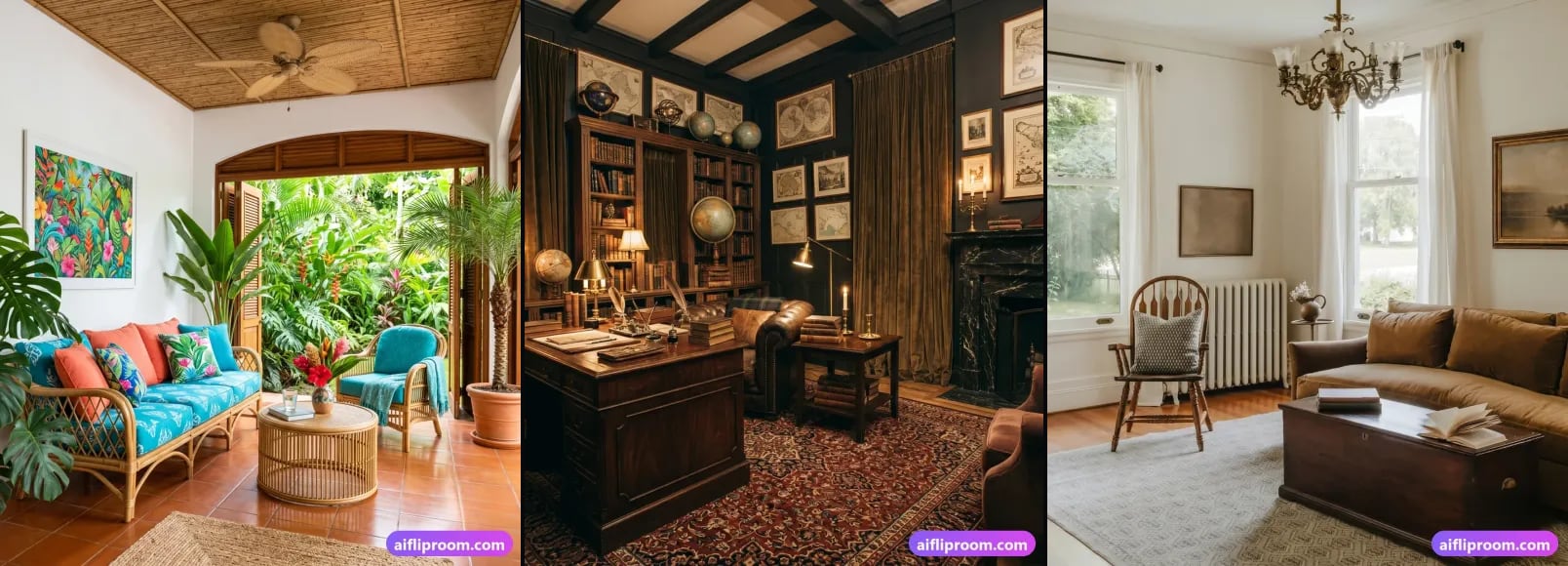
Does Virtual Staging Help Sell Homes? An Honest Answer
Virtual staging changes the photo, not the price. Where it helps, where it is wasted, what NAR's 2025 survey actually measured, and what can go wrong.

Virtual Staging Cost in 2026: Free to $75+ per Photo
Physical vs hand-done virtual staging ($10–75 per photo) vs AI (free to a few dollars). Real 2026 ranges, what drives price, and which fits your listing.
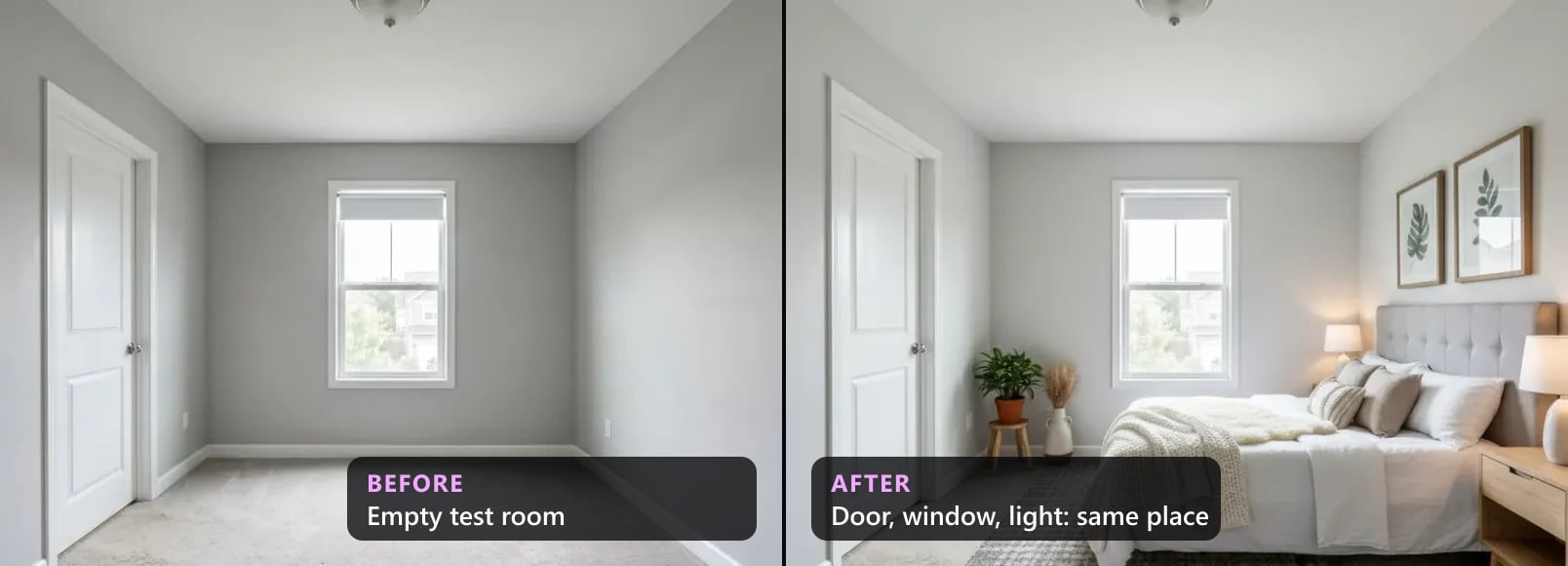
We Checked 300 AI-Staged Renders: What Breaks (2026)
Our quality checker's data on 300 AI-staged renders, Aug–Oct 2026: how many failed, what broke most (windows, archways, doors), what to check by eye.