MLS Virtual Staging Rules by State and Province (2026)
AI Flip Room · 10 min read
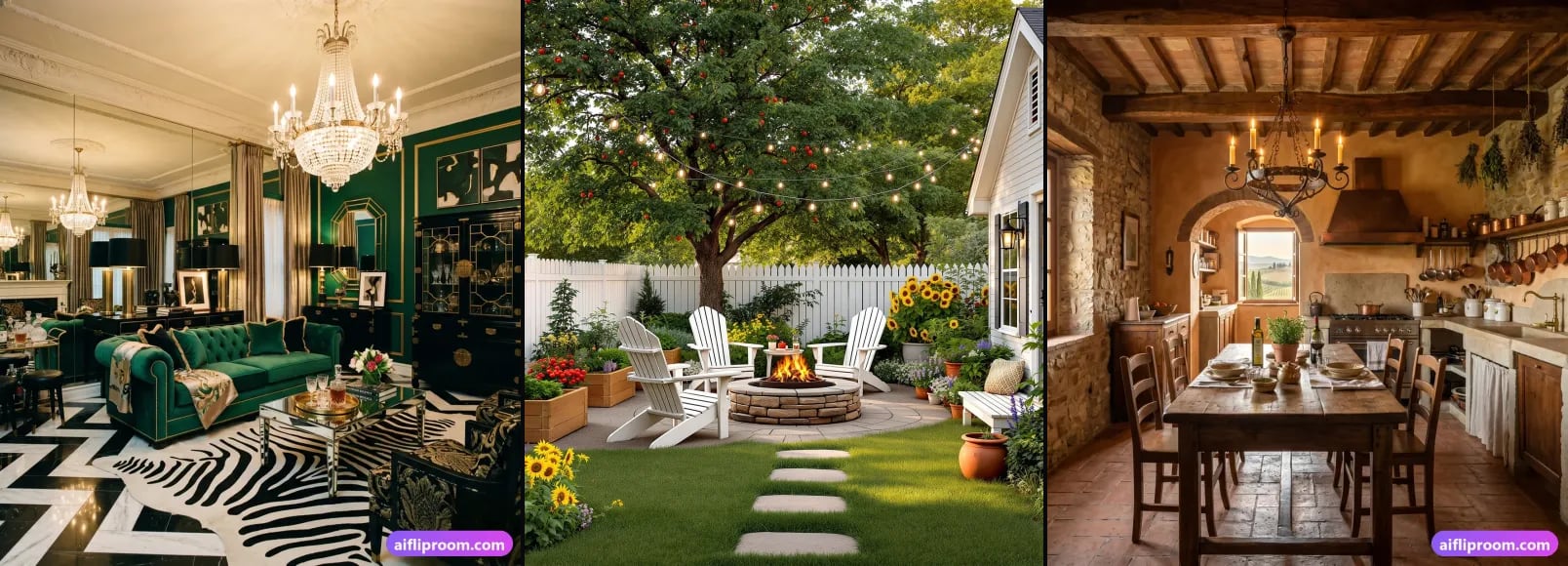
Virtual staging rules differ by state, province and MLS, but they share one core: a staged photo may add movable furniture and décor but may not change the property itself, and most of the rules also want the buyer told that the photo was staged. What differs is who writes the rule, where the label goes, and whether the unstaged original has to sit beside the staged photo.
This page puts every rule we have read in one table: sixteen jurisdictions in the United States, Canada, the United Kingdom and Australia, with Los Angeles on its own row under California because its two MLSs answer the same question differently. Each cell comes from our full article on that jurisdiction, where the rule is quoted from the primary source with the date we read it. Where an article says we could not verify something — a members-only rulebook, a policy we could not confirm is still current — the table says so too.
We make an AI staging tool, AI Flip Room, so we have an interest in staging being used. It is a reason to state the rules as they are written rather than as we would like them.
Virtual staging rules by state and province
Read across each row: who writes the rule, whether a label is required and where it goes, whether the original has to sit beside the staged photo, and the line the rule draws. "No pairing rule" means the rulebook we read does not ask for the original beside the staged photo; it does not mean showing it is a bad idea.
| Jurisdiction | Who sets the rule | Label required? | Original beside it? | The rule in one line | Full article |
|---|---|---|---|---|---|
| California | The state: AB 723, since 1 January 2026; inside CRMLS, rule 11.5.2 | Yes: a "reasonably conspicuous statement", wherever you advertise; on CRMLS, in the photo description field | Yes: a link or QR code to it (statute); on CRMLS, immediately before or after the staged photo | Never alter the property; no AI-generated landscaping. CRMLS: a warning, then a $250 fine | California rules |
| Los Angeles | CRMLS rule 11.5.2 or The MLS™/CLAW rule 11.5.1, with AB 723 on top | Yes, in both: "Digitally Altered" or "AI Altered" works in both | CRMLS: "immediately before or after". The MLS™/CLAW: no pairing rule | From 1 January 2027 a rental ad with an altered image must say so on or next to it (AB 2025) | Los Angeles rules |
| New York | Upstate, the New York State Alliance of MLSs; statewide, 19 NYCRR 175.25(c)(9) | Upstate, yes: "Virtually Staged." on the photo; remarks alone are "NOT acceptable". NYC and Long Island: no staging rule we could find | Upstate, yes: directly before the staged photo. Elsewhere, no pairing rule found | Upstate, furnishings and wall décor only | New York rules |
| Florida | Stellar MLS, SEFMLS, BeachesMLS and realMLS; statewide, section 475.25(1)(c) | Stellar: "Virtually staged" in the photo description, a box ticked and a fixed opening line in the public remarks, never on the photo. SEFMLS: no staging rule | Not on Stellar, SEFMLS or BeachesMLS. realMLS: "a non-enhanced photo", place not said | Furniture and décor only; no "small furniture to make a room appear larger" | Florida rules |
| Texas | HAR, NTREIS, Unlock MLS and SABOR; statewide, Occupations Code section 1101.652(b)(23) and TREC rule 535.155 | HAR: in the Photo Description. SABOR: a pick-list option. NTREIS never uses the words "virtual staging"; Unlock MLS asks for no label | Unlock MLS: "a non-virtually staged image of the same view". HAR: only when the property is altered. NTREIS, SABOR: no | HAR and SABOR: furnishings and wall décor only | Texas rules |
| Washington | The state: RCW 18.85.361(2) and the DOL's guideline; NWMLS's rulebook is members-only | Not verified: a secondary source says NWMLS Rule 105(d) wants photos "clearly labeled as 'virtually staged'" | No published Washington rule; we could not read NWMLS's | Advertising "must not mislead or be capable of misleading a reasonable consumer" | Washington rules |
| Arizona | ARMLS rule 8.23, since 28 May 2026; MLSSAZ in Tucson; statewide, rule R4-28-502 | ARMLS: its own "Digitally Altered" watermark and no other text. MLSSAZ: "virtual staged" along the top of the image | Yes, on both: ARMLS "directly before or after", MLSSAZ adjacent | ARMLS fines $200 from December 2026 | Arizona rules |
| Illinois | MRED section 6.2; MARIS in the Metro East; statewide, the Real Estate License Act | MRED: a Y in "Are Any Property Photos Virtually Staged?", no watermark. MARIS exempts staging | MRED: no. MARIS: "in succession" for altered photos, staging exempt | Personal property only; nothing outside the owner's control added or removed | Illinois rules |
| Bright MLS (MD, PA, VA, DC) | Bright MLS rules, effective 22 July 2026; above them, the advertising laws of Maryland, Pennsylvania and Virginia | Yes: in both the Private and Public Remarks; no added text on the photo | No | Furniture and décor in; "removing power lines, water towers, or nearby roads is not permitted" | Bright MLS rules |
| Georgia | FMLS, Georgia MLS and Hive MLS; above them, the Real Estate Commission | Yes, on all three: the public remarks. On the photo: banned on FMLS and Georgia MLS, one of two ways on Hive MLS | Georgia MLS: "immediately before or immediately after" (2020 policy; check it still applies). FMLS, Hive MLS: no | Nothing outside the owner's control removed, such as power lines | Georgia rules |
| Colorado | REcolorado, IRES and elevateMLS; above them, the Real Estate Commission's rule 6.10.C | elevateMLS: a field set to Y, "Virtually Staged" in two fields, its own watermark. REcolorado and IRES: no label asked | elevateMLS: "must also be uploaded", place not set. REcolorado, IRES: no | REcolorado: "Virtual staging is allowed." No "modifying the appearance of the landscape" | Colorado rules |
| Ontario | PropTx MLS® Rules; ITSO MLS® Rules on the Cornerstone and Brantford boards; outside the MLS, TRESA, administered by RECO | PropTx: no label rule for staged photos; its test is accuracy. ITSO: disclosed in the public remarks or by a label (rule 2.15(d)) | No pairing rule in PropTx or ITSO | PropTx rule 5.01 bans images "that do not accurately depict the listed real estate" | Ontario rules |
| British Columbia | The regulator: BCFSA's AI Guideline of 22 February 2024; the binding duty is Rules section 41 | Guidance, not a rule: staging "may be okay" if altered photos are labelled | No pairing rule | Removing nearby power lines goes too far; informed consent before client information goes into an AI tool | BC rules |
| Alberta | The provincial MLS® rules of ten boards; above them, RECA | Yes: the public remarks (rule 2.04 g); a label on the photo is unsettled (2.04 b) | No pairing rule | Staging is "unattached goods (chattels) of realistic size"; virtual enhancing is not permitted (2.04 h) | Alberta rules |
| Quebec | The regulator: OACIQ guideline section 6.3.1, updated 17 June 2026 | Yes: a clear, visible statement such as "Image generated by artificial intelligence"; in French, by our reading | Keep originals on file, available on request. California asks you to show the original; Quebec asks you to keep it | Never hide defects or alter the structure, label or not | Quebec rules |
| United Kingdom | No MLS: the Digital Markets, Competition and Consumers Act 2024, The Property Ombudsman's codes and the portals | Zoopla: a member using AI photos "will make this clear" (clause 5.1(c)). No UK law we read prescribes a label | Rightmove: AI images "alongside genuine photographs of the property". No other rule asks | The test is whether the photo misleads | UK rules |
| Australia | No MLS: the Australian Consumer Law, state regulators and the portals | realestate.com.au: AI use disclosed "on or adjacent to" the content (clause 4.1.40). Domain: no text on images | No Australian rule we read asks for it | NSW Fair Trading: no "digitally removing or adding features" | Australia rules |
Three rows carry the most caveats. Northwest MLS, which covers most of Washington, publishes its rulebook to members only, so that row rests on the law and a secondary source. In New York City and on Long Island we found no staging rule at all. And the Georgia MLS pairing rule comes from a 2020 policy we could not confirm is still current. If your listing is in one of them, check with the MLS before you rely on the table.
What is common everywhere?
You may furnish; you may not alter. Furniture, rugs, art, plants and lamps are movable and leave with the seller, so the buyer loses nothing by seeing them. Windows, doors, walls, ceilings, floors, fixtures, damage and the view are what the buyer is paying for. Our disclosure guide lists what may change and what must never be touched, item by item.
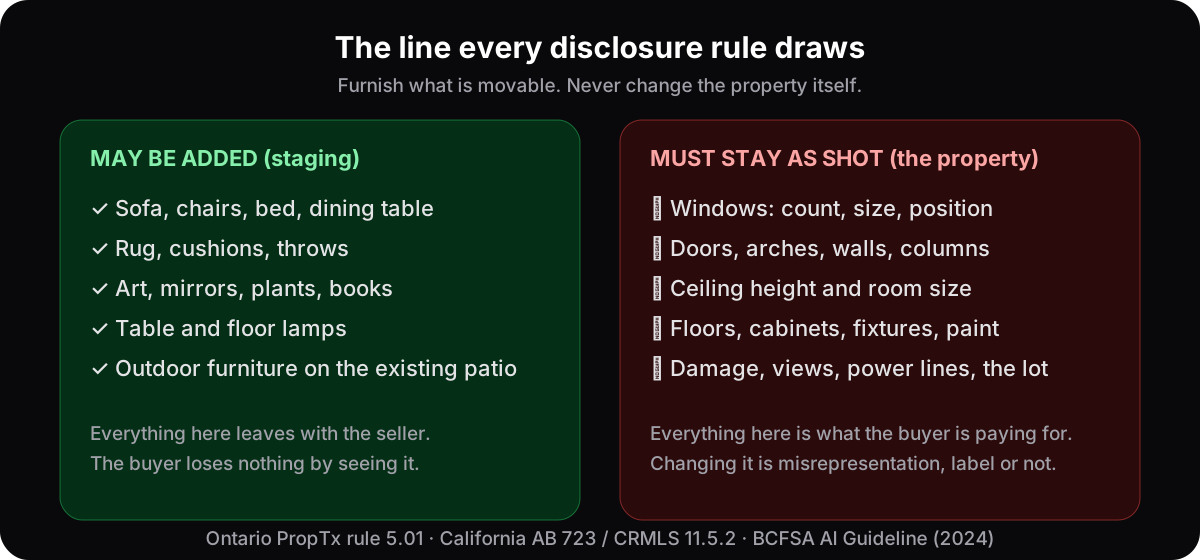
Three things recur across the series, whatever the jurisdiction:
- Furniture and décor in, the property out. Bright MLS and MRED permit "furniture, mirrors, artwork, plants" in a staged photo; Alberta's rules define staging as "unattached goods (chattels) of realistic size"; Stellar MLS bans "placing small furniture to make a room appear larger than it actually is". Removing power lines is the example of going too far in British Columbia, on Bright MLS, on MRED and on FMLS and Georgia MLS alike.
- A label does not cure an altered property. In Quebec, images that fundamentally alter a property's actual appearance break the rules, label or not; upstate New York says the same of a changed wall colour, new landscaping or a hidden defect.
- Keep the original. Even where no rule asks for it beside the staged photo, the articles recommend keeping the untouched file: it is what you hand a buyer who asks whether the room is really that size. Quebec makes it a duty: brokers must keep the original photos on file.
What differs: where the label goes
The practical difference between the rulebooks is the address of the disclosure. The same words can be required on the photo by one MLS and banned there by the next.
- On the photo. Upstate New York's Alliance MLSs require a text overlay reading "Virtually Staged."; ARMLS requires its own system-provided watermark; Tucson's MLSSAZ wants the disclosure "prominently placed along the top of the image". Hive MLS in Georgia accepts text on the photo as one of two ways, and elevateMLS in Colorado Springs puts its own watermark on photos whose Photo Remarks contain the phrase.
- In the listing's fields or remarks. Stellar MLS in Florida wants "Virtually staged" in the photo description, a ticked box and a fixed opening line in the public remarks, and calls words on the photo "strictly prohibited". Bright MLS wants both the Private and Public Remarks and bars added text on the photo. FMLS and Georgia MLS want the public remarks and keep text and watermarks off the image. MRED in Illinois takes a Y in a field. Houston's HAR and San Antonio's SABOR use the photo description, and so does CRMLS in California.
- Guidance or portal rules rather than MLS rules. British Columbia's regulator says to label altered photos; Quebec's OACIQ asks for a clear and visible AI statement; Zoopla wants AI-made photos made clear; realestate.com.au wants AI use disclosed "on or adjacent to" the content.
- No label asked. REcolorado and IRES in Colorado ask for none, and MARIS exempts staging from its altered-photo rule. In Ontario the PropTx rulebook has no label rule for staged photos and tests accuracy instead, while ITSO's rule 2.15(d), on the Cornerstone and Brantford boards, wants disclosure in the public remarks or a label. As the Ontario article puts it, that absence is not permission.
For one listing, the free disclosure wording tool does the lookup: pick the market and the MLS, and it gives the label, where it goes and the rule it comes from, quoted from these articles.
How do you use the table on a real listing?
- Find your MLS, not just your state. In Texas, Florida, Georgia, Colorado, Arizona, Illinois and New York the answer depends on the MLS the listing is in.
- Stage furniture and décor only, then check every render against the original. AI can repaint a wall or swap a light fixture, and a changed wall colour is exactly the kind of edit the rules above forbid, label or not.
- Put the label where your rule wants it, and nowhere it is banned. Some MLSs ban the same words on the photo that others require.
- Keep the original at full size, and put it beside the staged photo where your row says so.
If you list in the US or Canada, free virtual staging for listing agents has three free renders and the label rules of US and Canadian MLSs on one page, and our virtual staging page for real estate agents shows the three steps from photo to staged listing. Each article in the table gives the date we read its sources; this table was assembled from them on 23 October 2026.
Questions about virtual staging rules
Is virtual staging legal in every state and province?+
In every one we have read, yes, with the same two conditions everywhere: the image may add movable furnishings but may not change the property itself, and most of the rules also require the buyer to be told it was staged. We have not read every state and province. Where we have, the detail — where the label goes, and whether the original sits beside the staged photo — depends on the MLS, the regulator or the portal, and the table above gives it for each of the sixteen jurisdictions in the series.
Which rules require the original photo beside the staged one?+
In California, AB 723 wants a link or QR code to the original, and CRMLS wants the original immediately before or after the staged photo. Upstate, New York's Alliance MLSs want it directly before. In Arizona, ARMLS wants it directly before or after, and Tucson's MLSSAZ wants "an unmodified copy of the photo adjacent to the staged photo". Austin's Unlock MLS wants "a non-virtually staged image of the same view". Georgia MLS's 2020 photo policy wants it immediately before or immediately after the staged image; check with Georgia MLS that it still applies. On elevateMLS the original "must also be uploaded", with no place prescribed. realMLS in Northeast Florida wants "a non-enhanced photo" submitted "to show the difference", without saying where. Outside the MLS world, Rightmove wants AI images "displayed alongside genuine photographs of the property". Everywhere else in the series no rule asks for it, and our articles still recommend keeping it.
Do I have to put "Virtually Staged" on the photo itself?+
Only on some MLSs, and others ban it. Upstate New York's Alliance MLSs require a text overlay reading "Virtually Staged."; ARMLS requires its own "Digitally Altered" watermark and no other text; Tucson's MLSSAZ wants the disclosure along the top of the image. On Stellar MLS words on the photo are "strictly prohibited", FMLS says "No text may be superimposed on photos", and Bright MLS bars "any text or graphics that have been added or superimposed"; Domain allows no text on images. In Alberta, whether a plain label on the photo passes is not settled in the text. Find your row in the table before you stamp a photo.
Does a "virtually staged" label make any edit acceptable?+
No. A label says that a photo was edited, not what changed. Furniture and décor may be added; windows, walls, ceilings, floors, fixtures, damage and the view may not be changed, label or not. In Quebec, images that fundamentally alter a property's actual appearance break the rules whatever the label says; upstate New York says the same of a changed wall colour, new landscaping or a hidden defect; and British Columbia's regulator calls removing nearby power lines an edit that goes too far.
What if my state, province or MLS is not in the table?+
Check the rules of your board and your regulator before you rely on anyone else's. Every rulebook we have read, in Canada and in the United States, bans misleading advertising in some form, so until you have checked, do what the rulebooks in this series agree on: furniture and décor only, a clear label, and the original kept on file. Then read your MLS rulebook for the two details that differ most: where the label goes, and whether the original has to sit beside the staged photo.
Do the rules apply outside the MLS, on my website and social media?+
Some do. California's AB 723 applies wherever you advertise, not only in the MLS. In Ontario, your website, social and print are governed by TRESA, administered by RECO, and section 37 of the Act bans false, misleading or deceptive advertising. In California, AB 2025 adds a rule for rentals from 1 January 2027: anyone advertising a rental with an altered or fully AI-generated image must say so on or next to the image.
See it on your own room
Upload a photo and watch AI restage your space in 15–60 seconds, depending on how much detail it has — free to try, no credit card.
Try AI Flip Room freeGot a question about this?
Something unclear or not covered? Ask here. We read every question and answer the useful ones right in the article. Nothing you write is published.
Related reading
Virtual Staging Disclosure Rules: How to Label Staged Photos
Why disclosure is required, three ways to label a virtually staged photo, what you may change vs never touch, and the rules of sixteen jurisdictions compared.
Virtual Staging in Canada: Rules by Province and How It Works
Virtual staging in Canada: what Ontario, BC, Alberta and Quebec require in their own words, what it costs, and how to stage a listing photo honestly.
Virtually Staged Listing? 5 Things a Buyer Can Demand
AI staging is legal in Ontario, BC, Quebec, Alberta, California, New York, Florida, Texas, Washington, Arizona, Illinois, Georgia, Colorado, Australia, the UK and Bright MLS, with conditions.