Hamptons Interior Design
Coastal luxury — navy blue accents, shiplap, woven rattan, white linen.
Stage your room in Hamptons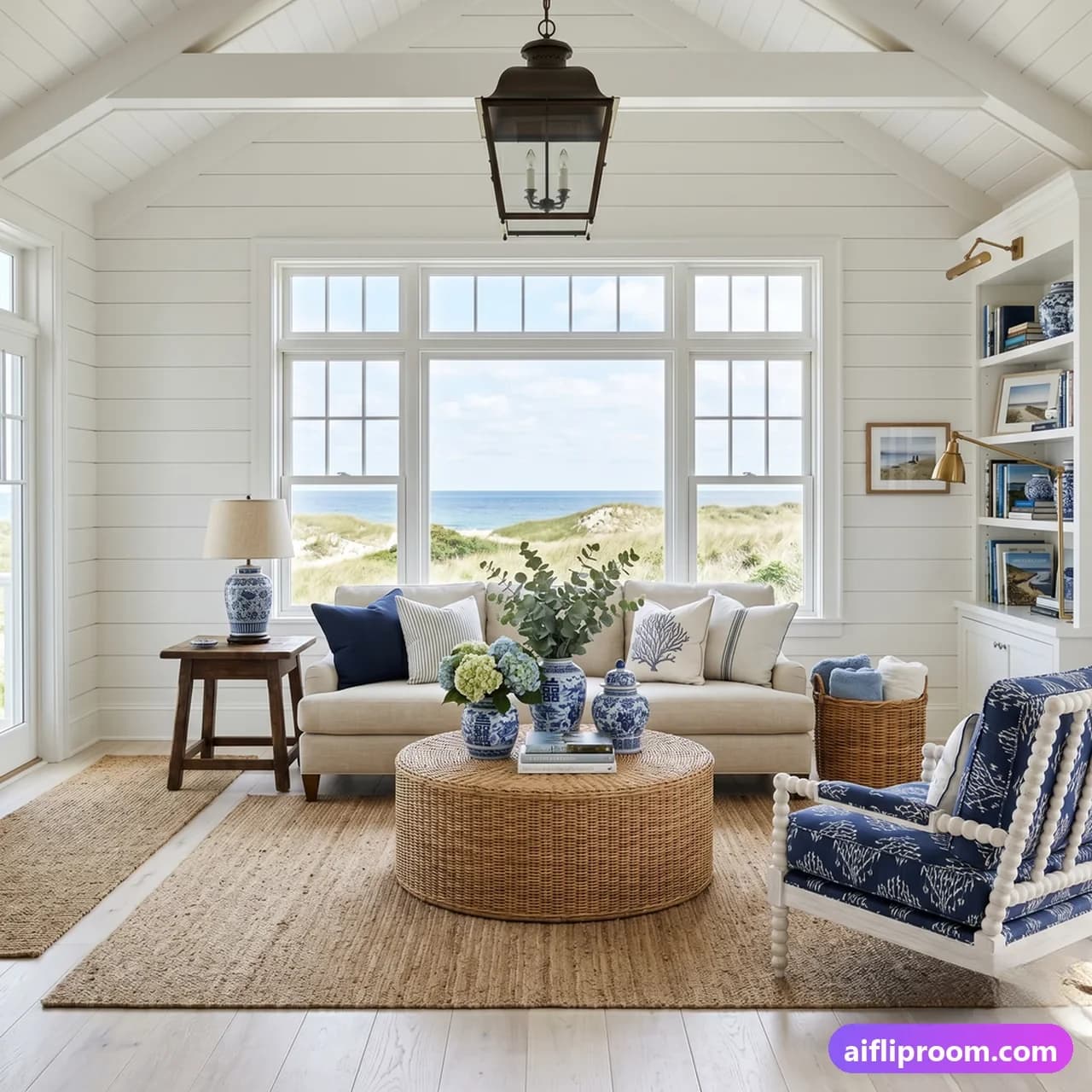
What is Hamptons interior design?
Hamptons style is relaxed coastal luxury, modelled on the upscale beach houses of the US East Coast. It takes the lightness and ease of coastal design and adds a layer of polish and quality, so a room feels both effortless and clearly considered. The palette is crisp and disciplined — navy and white above all, with soft sandy neutrals — and white shiplap walls give the architecture texture. Natural linen upholstery, pale or whitewashed oak floors and woven rattan accents keep things breezy, while blue-and-white ceramics and tailored details signal care. The result is bright, airy and aspirational without being showy. In staging, Hamptons style is a strong choice for coastal and premium suburban listings: it photographs as fresh, calm and high-end, and it lets a buyer picture a relaxed but elevated lifestyle.
Where Hamptons comes from
The Hamptons look takes its name from the beach towns on the eastern end of Long Island, where wealthy New York families have summered since the nineteenth century. The houses are large, shingled and formal in plan, but they are holiday houses, so the interiors developed a particular tension that defines the style: expensive materials and classical proportions, treated casually. Slipcovers over good furniture. Panelled walls painted white rather than stained. It is coastal without being beachy, and traditional without being stuffy, and that combination is why it travels so well to places with no ocean at all. Australia in particular adopted it wholesale, to the point where much of what is sold as Hamptons style today is Australian rather than American.
Key elements of Hamptons
- A crisp navy and white palette
- White shiplap walls
- Natural linen upholstery
- Pale or whitewashed oak floors
- Woven rattan accents and blue-and-white ceramics
- A light, breezy, polished feel
When to use Hamptons
Living rooms and bedrooms. An aspirational yet calm look that suits coastal and premium suburban listings.
Hamptons colours and materials
White and navy do the structural work, softened by sand, oatmeal, pale grey and duck-egg blue. Natural timber appears in floors and in occasional furniture, usually pale to mid-toned. Materials read as considered rather than rustic: linen and cotton in generous weaves, cane and rattan, marble or engineered stone, polished nickel and brushed brass, and plenty of painted panelling. Pattern is restrained and classical — a stripe, a check, a simple trellis. What separates it from broader coastal style is the formality: symmetry, proper joinery and quality upholstery, rather than the sun-bleached informality of a beach cottage.
Hamptons room by room
Living room in Hamptons
A large slipcovered sofa in white or oatmeal, a pair of matching armchairs, and a coffee table in timber or marble — symmetry is doing real work here. Panelled or shiplap walls painted white, a jute or flatweave rug, and cushions in navy and stripe. Cane or rattan in one piece to keep it from feeling like a formal drawing room. Lighting should be a proper fixture rather than an afterthought: an oversized lantern pendant or a chandelier in a simple shape. Coffee-table books, a large vase of hydrangeas, and very little else.
Kitchen in Hamptons
Shaker cabinetry in white or a soft grey-blue, a marble or marble-look worktop, a large island with pendant lights above, and a butler or farmhouse sink. Polished nickel or brushed brass hardware, subway tile or panelling behind the range, and glass-fronted upper cabinets showing white crockery. Bar stools with cane or upholstered seats. Hamptons kitchens are generous and symmetrical, and the island is almost always the centre of the plan.
Bedroom in Hamptons
An upholstered bed in white or a soft neutral with a tall headboard, crisp white bedding with a navy or stripe accent, and matching nightstands and lamps. Panelled walls, plantation shutters or full-length linen curtains, and a bench at the foot of the bed. Keep the palette to white, navy and one soft neutral. This is a style that rewards restraint in the bedroom — the room should look like a very good hotel that happens to be by the sea.
Bathroom in Hamptons
White panelling on the lower wall, marble or marble-effect tile, a double vanity with a stone top, and polished nickel fittings. A large framed mirror or a pair of them, wall sconces either side rather than a single light above, and white towels. A freestanding tub if the room can take one. The formality of the symmetry is what makes this read as Hamptons rather than as generic coastal.
Outdoor space in Hamptons
A covered porch or deck with teak or white-painted furniture, generous cushions in white and navy stripe, and a large outdoor rug. Lanterns, a table big enough to eat at, and planting kept simple and structured — hydrangeas above all, plus boxwood and grasses. The outdoor space in this style is treated as another room rather than as a garden, and it is usually where the house is actually used.
Hamptons mistakes to avoid
- Confusing it with beach cottage style. Hamptons is formal, symmetrical and expensive-feeling. Driftwood, shells and rope belong to a different look and cheapen this one instantly.
- Navy everywhere. It is an accent, not a base. Navy walls, navy sofa and navy rug turns the style heavy and loses the light it depends on.
- Skipping the panelling. Wall detail is a large part of what makes the style recognisable, and flat plasterboard walls leave the room looking merely white.
- Undersized lighting. The rooms this style comes from are large, and a small pendant over a big island is the most common giveaway.
- Cheap slipcovers. The casual-over-good-furniture idea only works if the furniture underneath is good and the covers fit properly.
Hamptons questions, answered
What is the difference between Hamptons and coastal style?
Coastal is informal, sun-bleached and textural — jute, rattan, faded blues, an unfussy attitude. Hamptons is its formal cousin: symmetry, panelled walls, marble, proper joinery, quality upholstery and a tighter navy-and-white palette. Coastal looks relaxed; Hamptons looks relaxed but is quite carefully arranged.
Do I need to live near the sea for Hamptons style?
No, and most homes decorated this way are nowhere near a coast. Because the style leans on architecture and quality rather than on beach references, it works in suburban and even urban homes. What it does need is reasonably generous rooms and decent natural light — it does not compress well into small dark spaces.
What colours define Hamptons interiors?
White as the dominant colour, navy as the primary accent, and sand, oatmeal, pale grey and duck-egg blue in between. Timber appears in floors and occasional furniture. The discipline is keeping the navy to accents so the rooms stay light.
How do I get the look affordably?
Three things carry most of it: paint the walls white and add simple panelling or beading, buy one good white slipcovered sofa rather than several cheaper pieces, and put a properly sized lantern or pendant in the main room. Then keep everything else white, navy and natural. Hydrangeas in a large vase are the cheapest finishing touch in the entire style.
Is Hamptons style good for staging a property?
It is excellent for larger family homes, coastal properties and anything in the upper-middle of the market, where it reads as fresh, expensive and broadly likeable. It works less well in small apartments and modern minimal buildings, where the panelling and symmetry have nothing to attach to.
Guides to read next
Longer reads on getting a room photographed and restaged well.
- See Your Own Room in a New Style Before You Buy AnythingPreview your actual room in a new style before buying furniture or hiring anyone: what a preview settles, what it can't, and five steps to a useful one.
- How to Photograph Rooms for Virtual Staging: 7 RulesDaylight, lamps off, a level phone at chest height, the 1x lens not 0.5x, one room per frame, clear surfaces — seven habits that make AI staging look real.
- What Is Virtual Staging? The Complete Guide: How It Works, Cost, Rules, ExamplesVirtual staging explained in plain language: how AI furnishes a photo of a real room, what it costs, what agents think of it (NAR 2025), who it helps, the rules and how to spot bad staging.
See your room in Hamptons
Upload a photo and our AI restages it in the Hamptons look in 15–60 seconds, depending on how much detail your room has — keeping your walls, windows and layout intact.
Try Hamptons on your room