Tropical Outdoor Design
Palms, bird of paradise, bougainvillea — lush resort paradise.
Stage your outdoor space in Tropical Outdoor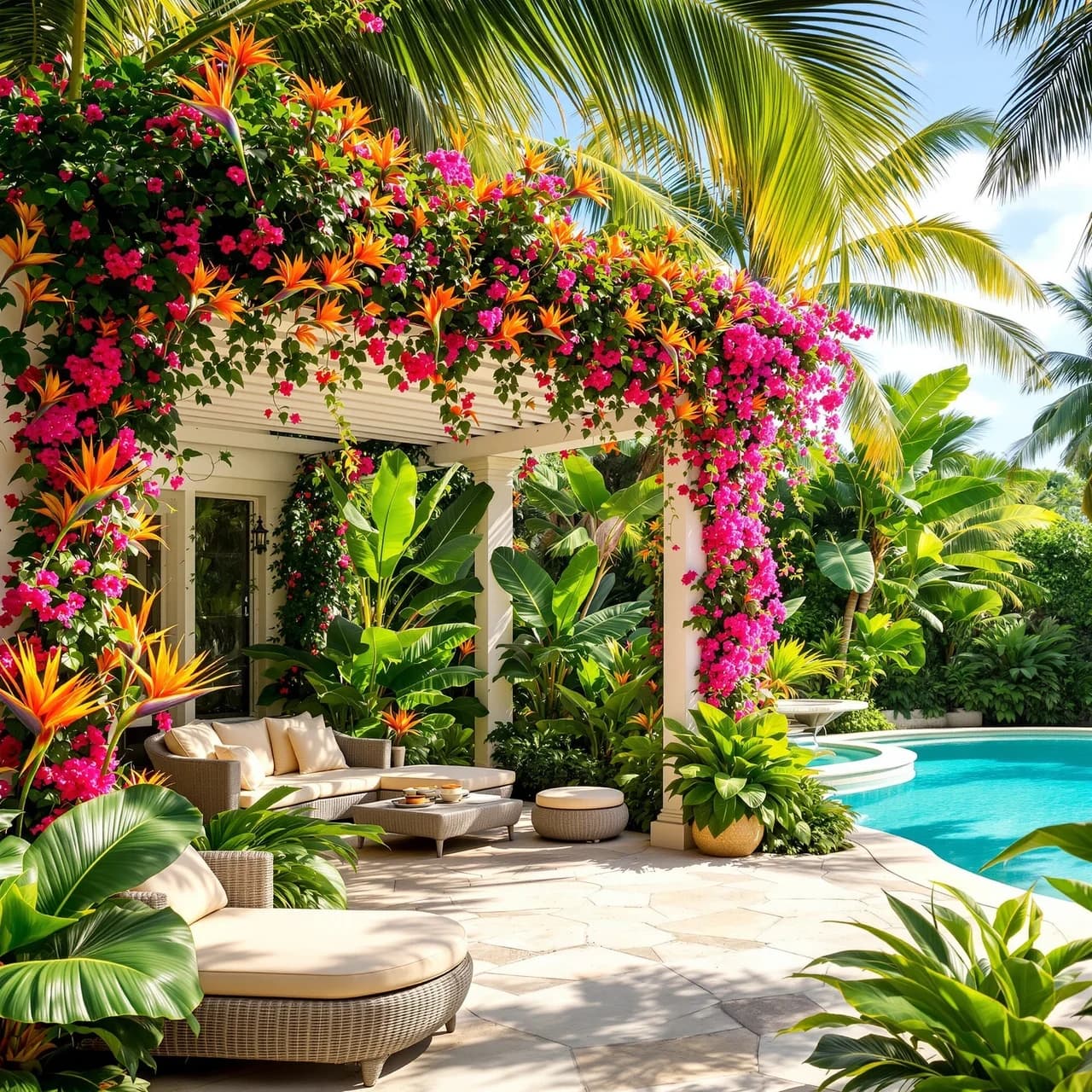
What is Tropical Outdoor design?
Tropical outdoor design turns a backyard, patio or pool surround into a lush, resort-like escape. Mature palms and bold, large-leaf foliage create a green, enveloping backdrop; climbing bougainvillea and flowering plants add bursts of colour; natural flagstone paths and woven rattan furniture keep the mood relaxed and holiday-like. The planting is generous and layered, so the space feels abundant and alive rather than merely tidy. The palette is green and bright, the atmosphere unhurried. The result is an outdoor area that reads as a private paradise. In staging, tropical outdoor design is a strong fit for warm-climate listings: it lets a buyer imagine the backyard as a destination in its own right, not just a strip of lawn.
Where Tropical Outdoor comes from
Tropical gardens are built for the opposite problem to most of the styles on this list: not scarcity but abundance. Heat and rain grow things faster than anyone can control them, so the tradition is not about coaxing plants into performing but about managing density and, above all, making shade. Layers matter — a canopy of palms or broadleaf trees, a middle storey of shrubs, and ground cover beneath — because that is how the vegetation actually arranges itself and because each layer shelters the one below. The resort version added the swimming pool and the loungers, and that is the image most people now have, but the underlying garden is a layered planting scheme with somewhere shaded to sit inside it.
Key elements of Tropical Outdoor
- Mature palms and large-leaf foliage
- Climbing bougainvillea and flowering plants
- Natural flagstone paths
- Woven rattan outdoor furniture
- Dense, layered planting
- A relaxed, resort-like mood
When to use Tropical Outdoor
Backyards, patios and pool areas of warm-climate properties. Presents the outdoor space as a private resort escape.
Tropical Outdoor colours and materials
Green in every register, from lime to near-black, with the flowers doing something the rest of this list avoids: shouting. Hibiscus red, bougainvillea magenta, heliconia orange, frangipani white and yellow, all against foliage rather than against each other. Built surfaces stay quiet — timber decking, pale stone, dark gravel — so the planting carries everything. Materials are teak and hardwood, bamboo, rattan and wicker for covered areas, natural stone, and canvas or thatch for shade. Furniture is usually neutral: white, cream or natural, so it disappears into the greenery instead of competing with it.
Tropical Outdoor area by area
Shaded seating in Tropical Outdoor
Under a canopy of planting, a thatched or timber structure, or a large canvas sail. Teak or all-weather wicker seating with white or cream cushions, a low table, and a rug that copes with damp. The seating should sit inside the planting rather than beside it — being surrounded is the whole sensation the style delivers, and a sofa on an open patio with a palm ten metres away does not produce it.
Pool area in Tropical Outdoor
Where there is one, plant right up to the edge rather than leaving a wide ring of paving — the contrast between water and dense foliage is what makes a tropical pool look like a tropical pool. Loungers on one side, shade on the other, and a dark pool lining if the choice is available, which reads far better against greenery than a pale blue one. Where there is no pool, a plunge pool, an outdoor shower or even a large water bowl carries some of the same idea.
Planting layers in Tropical Outdoor
Build in three storeys. A canopy of palms, banana, tree ferns or broadleaf trees. A middle layer of large-leaved shrubs — philodendron, monstera, ginger, heliconia, bird of paradise. Ground cover beneath to keep soil covered and weeds down. Plant far more densely than instinct suggests; sparse tropical planting looks like a garden centre display, and the density is what produces both the shade and the enclosure.
Path and ground surface in Tropical Outdoor
Stepping stones or timber boards through planting, gravel or bark elsewhere. Paths should curve and should not reveal the whole garden at once, because part of the effect is not being able to see where the space ends. Lawn is possible in this climate but is usually the least interesting use of the ground.
Evening in Tropical Outdoor
Uplights into the canopy so the leaves throw shadow, a few lanterns at ground level, and nothing bright. Tropical gardens are used after dark more than most, and the lighting should treat the planting as the subject. Torches and fire bowls suit the style and should be kept well away from anything that drops dry leaves.
Tropical Outdoor mistakes to avoid
- Planting too sparsely. Density is the style. Widely spaced specimens on bare mulch read as a nursery rather than as a garden.
- Skipping the shade. A tropical garden with nowhere shaded to sit is unusable in the middle of the day, which is when it looks best.
- Loud furniture. The planting is doing the colour. Brightly patterned cushions and coloured furniture fight it — neutral seating lets the garden read.
- Ignoring the growth rate. Everything here grows fast. Plant with a maintenance plan or the garden closes over the path within two seasons.
- Buying tender plants for a cold climate without a plan. Many will not survive a frost. Either accept them as seasonal, choose hardy lookalikes, or provide winter protection deliberately.
Tropical Outdoor questions, answered
What plants create a tropical garden?
In three layers: palms, banana, tree ferns or broadleaf trees for canopy; philodendron, monstera, ginger, heliconia and bird of paradise for the middle; and dense ground cover beneath. Flower colour comes from hibiscus, bougainvillea, frangipani and heliconia. Density matters more than variety.
Can I get a tropical look in a temperate climate?
Yes, using hardy plants with tropical-looking foliage: hardy banana, fatsia, tree fern, bamboo, canna, phormium, gunnera and hardy palms such as trachycarpus. The visual signature is large leaves and dense layering rather than the actual species, so the effect is very achievable — the flowers are the part that does not translate.
How do I make shade in a tropical garden?
Ideally with planting, since a canopy cools the air as well as blocking the sun. Where the garden is young, a thatched or timber structure, a large canvas sail or a pergola with a fast climber over it bridges the gap. Site the seating so it is shaded in the middle of the day rather than in the early morning.
Is a tropical garden high maintenance?
In a genuinely tropical climate, yes — everything grows quickly and needs cutting back. In a temperate climate the maintenance is different rather than lighter: less cutting back, more winter protection for tender species. Choosing hardy foliage plants over tender ones reduces both considerably.
Does tropical outdoor staging help sell a property?
It works well for warm-climate homes, holiday properties and anything with a pool, where it shows the outdoor space as a destination rather than as a leftover. In a temperate suburban garden it can look aspirational rather than plausible, and a coastal or modern treatment usually suits the property better.
Guides to read next
Longer reads on getting a outdoor space photographed and restaged well.
- Outdoor Virtual Staging: Patio, Deck and Backyard IdeasOutdoor virtual staging space by space — patio, deck, balcony, porch, pool deck, backyard: what each may gain, what stays as shot, and landscaping previews.
- How to Photograph Rooms for Virtual Staging: 7 RulesDaylight, lamps off, a level phone at chest height, the 1x lens not 0.5x, one room per frame, clear surfaces — seven habits that make AI staging look real.
- See Your Own Room in a New Style Before You Buy AnythingPreview your actual room in a new style before buying furniture or hiring anyone: what a preview settles, what it can't, and five steps to a useful one.
See your outdoor space in Tropical Outdoor
Upload a photo and our AI restages it in the Tropical Outdoor look in 15–60 seconds, depending on how much detail your outdoor space has — keeping your walls, windows and layout intact.
Outdoor styles are part of the Pro and Agency plans. New accounts get 3 free renders on the interior styles. How outdoor virtual staging works
Try Tropical Outdoor on your outdoor space