Japanese Zen Garden Outdoor Design
Raked gravel, bamboo, koi pond, single maple — meditative serenity.
Stage your outdoor space in Japanese Zen Garden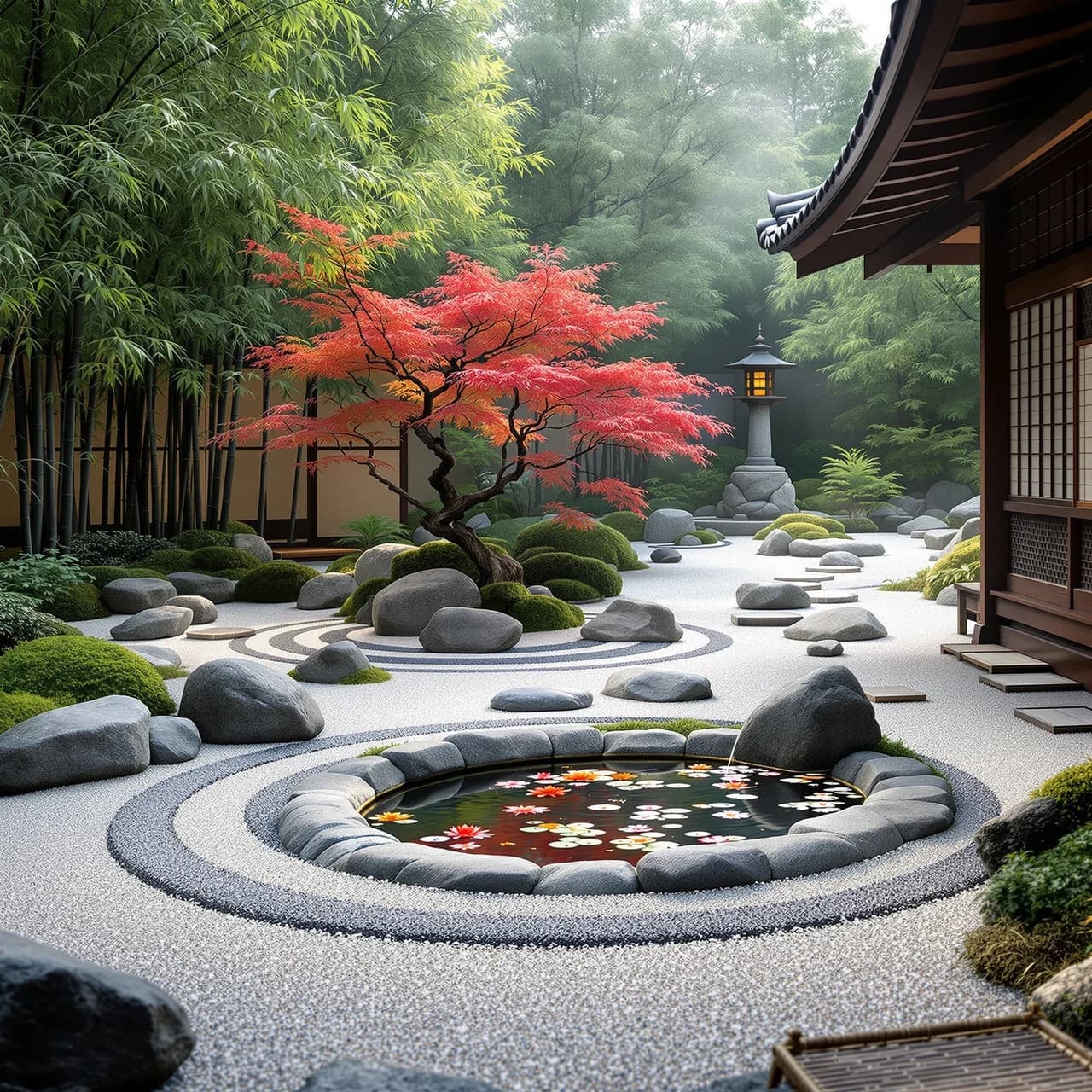
What is Japanese Zen Garden outdoor design?
A Japanese Zen garden is an outdoor space designed for calm and contemplation rather than display. Every element is deliberate and restrained. Raked gravel, combed into flowing patterns, surrounds carefully placed weathered rocks; black bamboo, a single maple and moss-covered stepping stones provide quiet, measured greenery; a stone lantern and a small water feature — a koi pond or a bamboo fountain — complete the scene. There is no excess and no clutter; the beauty is in proportion and stillness. The result is a serene, low-planting outdoor space with a strong, meditative identity. In staging, a Zen garden is a distinctive feature for the right property, appealing to buyers who want a calm, contemplative outdoor retreat instead of a conventional lawn.
Virtual staging in Japanese Zen Garden: before and after
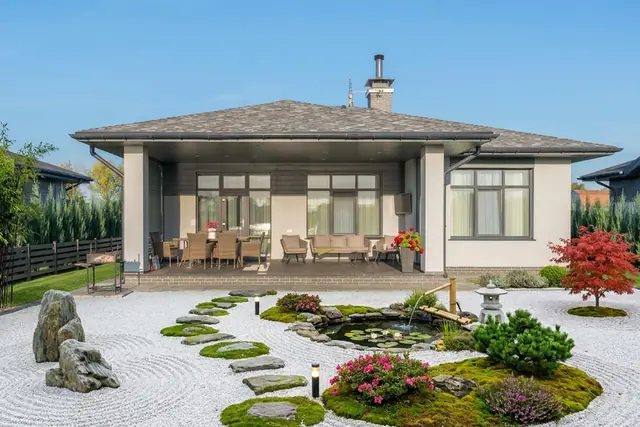
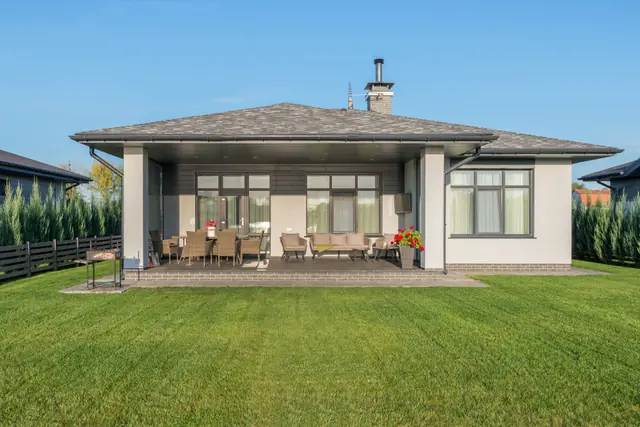
A Zen garden changes the ground itself, so it is the clearest case of a design preview: in the pair below the lawn becomes raked white gravel with moss islands and weathered rocks, a small koi pond with a bamboo fountain, a stone lantern, stepping stones, flowering azaleas and a red Japanese maple in the far right corner. The house, its windows and roof, the covered terrace with its tiles and brick step, the furniture and the barbecue stay as photographed, and nothing is planted in front of the windows or the terrace. It shows a homeowner what the yard could become; a listing photo should keep the lawn and add only furniture.
Using a staged photo in a listing? Our free disclosure wording tool gives the label your MLS asks for.
Where Japanese Zen Garden comes from
The gardens most people mean by Zen are karesansui — dry landscape gardens developed at Japanese Buddhist temples from around the fourteenth century. Gravel or sand stands for water, carefully chosen and placed rocks stand for islands or mountains, and moss, clipped shrubs and a few trees complete a composition intended to be contemplated from a fixed viewpoint rather than walked through. They are abstract landscapes, not flower gardens, and the restraint is doctrinal rather than aesthetic. Alongside them sit other Japanese garden traditions — stroll gardens with ponds and bridges, and tea gardens with stepping stones and a water basin — and the domestic version borrows from all three. The consistent principle is that everything present is deliberate and everything absent is also deliberate.
Key elements of Japanese Zen Garden
- Raked gravel in flowing patterns
- Carefully placed weathered rocks
- Black bamboo and a single maple
- A stone lantern
- A koi pond or bamboo water feature
- Moss-covered stepping stones
When to use Japanese Zen Garden
Gardens and courtyards for buyers who want a calm, contemplative outdoor retreat. A distinctive feature for the right property.
Japanese Zen Garden colours and materials
Grey, green and weathered timber, and almost nothing else. The grey of gravel and stone, the many greens of moss, clipped shrubs, bamboo and maple, and the brown-grey of aged cedar and bamboo fencing. Seasonal colour is permitted but strictly rationed — the red of a maple in autumn, a brief flowering cherry, the white of a camellia. Materials are raked granite gravel, natural uncut stone, moss, bamboo, cedar, and iron or stone lanterns. Nothing is painted, nothing is glossy, and no plant is chosen for the length of time it flowers.
Japanese Zen Garden area by area
Gravel and rock composition in Japanese Zen Garden
The heart of a dry garden. Rake fine granite gravel into straight lines across the open area and concentric rings around each rock group. Rocks are placed in odd-numbered groups — three, five, seven — with one dominant stone and the others subordinate, each set deep enough to look as though it grew there rather than arrived on a truck. Leave far more empty gravel than feels comfortable; the emptiness is the composition, not the background to it.
Planting in Japanese Zen Garden
Green, textural and clipped. Moss where the shade and moisture allow, otherwise a low evergreen ground cover. Clipped azalea or box in soft rounded forms, one Japanese maple for autumn, bamboo as a screen, and ferns in the damp corners. Pines shaped by pruning where the garden is large enough. The whole planting palette for an average garden is four or five species — resisting the urge to add more is most of the discipline.
Water and basin in Japanese Zen Garden
A tsukubai — a low stone water basin with a bamboo spout, traditionally placed so you must crouch to use it — is the single most evocative object in a Japanese garden and needs almost no space. A small still pool, edged with stone and planted at one end, works where there is room. Moving water should be a trickle rather than a feature; the sound matters and the display does not.
Path and stepping stones in Japanese Zen Garden
Irregular flat stones set slightly proud of moss or gravel, spaced to a natural stride, deliberately not in a straight line. The pace of the path is designed: stones set closer together slow you down where there is something to look at. A path should lead somewhere modest — a bench, a basin, a view — rather than circling for its own sake.
Boundary and screen in Japanese Zen Garden
A bamboo or cedar fence, a clipped hedge, or a simple rendered wall. The enclosure matters because the garden is a composed view and needs an edge to be composed against. Where a neighbouring building intrudes, a bamboo screen or a well-placed tree blocking the sightline does more for the garden than anything planted at ground level.
Japanese Zen Garden mistakes to avoid
- Buying ornaments. Mass-produced pagodas, Buddha statues and plastic lanterns are the fastest way to turn a Japanese garden into a garden-centre display. One good stone object, or none.
- Too many species. Four or five is a Japanese garden. Fifteen is a mixed border with gravel in it.
- Rocks sitting on the surface. Stones should be buried to a third or more of their depth so they read as outcrops rather than as objects placed on the ground.
- Even, symmetrical arrangement. Japanese composition is asymmetric and uses odd numbers. Matched pairs and centred layouts read as Western immediately.
- Underestimating the upkeep. Raked gravel needs re-raking, moss needs weeding, and clipped forms need clipping. The look is calm; the maintenance is not automatic.
Japanese Zen Garden questions, answered
What is a Zen garden?
Usually a reference to karesansui, the Japanese dry landscape garden developed at Buddhist temples from around the fourteenth century. Raked gravel represents water, placed rocks represent islands or mountains, and the composition is designed to be viewed and contemplated from a fixed point rather than walked through. It contains no flowers by design.
How do I place the rocks?
In odd-numbered groups, with one clearly dominant stone and the others subordinate in size and position, arranged asymmetrically. Bury each one to at least a third of its depth so it reads as outcrop rather than ornament. Set the largest first and place the rest in relation to it, and view the arrangement from wherever the garden will actually be seen from before committing.
Can I make a Zen garden in a small space?
It is one of the best styles for a small or awkward space, including a courtyard, a side return or even a balcony. A gravel bed, three rocks, one clipped shrub, a bamboo screen and a stone basin will fill a few square metres completely and look intentional. Small Japanese gardens are a long-established form rather than a compromise.
What plants belong in a Japanese garden?
Moss, clipped azalea and box, Japanese maple, bamboo, ferns, and pine where there is space to prune it properly. Iris, camellia and cherry appear for brief seasonal moments. The list is short on purpose — the interest comes from form, texture and the changing of a few things rather than from variety.
Is a Zen garden good for staging a property?
It works unusually well for small, shaded or awkward outdoor spaces, which are exactly the ones that photograph badly when left empty. It reads as calm, deliberate and low-maintenance, and it suits city properties and modern homes. In a large family garden a buyer may want lawn and play space instead.
Guides to read next
Longer reads on getting a outdoor space photographed and restaged well.
- Outdoor Virtual Staging: Patio, Deck and Backyard IdeasOutdoor virtual staging space by space — patio, deck, balcony, porch, pool deck, backyard: what each may gain, what stays as shot, and landscaping previews.
- How to Photograph Rooms for Virtual Staging: 7 RulesDaylight, lamps off, a level phone at chest height, the 1x lens not 0.5x, one room per frame, clear surfaces — seven habits that make AI staging look real.
- See Your Own Room in a New Style Before You Buy AnythingPreview your actual room in a new style before buying furniture or hiring anyone: what a preview settles, what it can't, and five steps to a useful one.
See your outdoor space in Japanese Zen Garden
Upload a photo and our AI restages it in the Japanese Zen Garden look in 15–60 seconds, depending on how much detail your outdoor space has — keeping your walls, windows and layout intact.
Outdoor styles are part of the Pro and Agency plans. New accounts get 3 free renders on the interior styles. How outdoor virtual staging works
Try Japanese Zen Garden on your outdoor space