UK Virtual Staging Rules: Consumer Law, Rightmove, Zoopla and the Property Ombudsman
AI Flip Room · 20 min read

The United Kingdom has no virtual staging rule that we could find, and no MLS to write one. What it has is a consumer law that bans misleading marketing of anything, homes included; codes of practice for agents and landlords, two of which treat a photo as a statement outright: "pictorial" in The Property Ombudsman's, "in pictures" in Wales's; the advertising codes the ASA enforces; and three national portals, Rightmove, Zoopla and OnTheMarket, whose own pages decide what a listing photo may carry. Two of those portals now write about AI images directly. Rightmove's help page on misleading adverts, in its version modified on 22 September 2026, says AI images "should be displayed alongside genuine photographs of the property"; Zoopla's member terms say that a member whose photos are made with AI "will make this clear".
The short answer: virtual staging is allowed in the UK, as long as the photo shows the room furnished rather than changing what the property is, and, in our reading, as long as you say so where a buyer will see it. This article quotes the Digital Markets, Competition and Consumers Act 2024 and the CMA's guidance on it, the codes of The Property Ombudsman and Propertymark, the CAP Code and two ASA rulings, the three portals, and the codes that differ in Scotland and Wales; sets out what to do; explains what a slip costs; and separates what the texts say from what you will read elsewhere. It is written for estate and letting agents, and for private sellers and landlords who stage their own photos. It is not legal advice; where we are interpreting rather than reporting, we say so.
Is virtual staging allowed in the UK?
Yes, as far as every law, code and portal page we read goes: none bans it, and none uses the words virtual staging. The Digital Markets, Competition and Consumers Act 2024, Part 4, Chapter 1, in force since 6 April 2025 under S.I. 2025/272, puts its rule in one line of section 225: "Unfair commercial practices are prohibited." A practice is unfair if it involves a misleading action or a misleading omission and "it is likely to cause the average consumer to take a transactional decision that the consumer would not have taken otherwise". Homes are covered: the Act's definition of goods includes "immoveable property", and the CMA's guidance, CMA207 of 18 November 2025, lists "immovable property, such as the sale or lease of land to consumers" as a product and "whether to agree to a sales presentation or view a property" as a transactional decision. So a photo that gets someone to book a viewing on a false impression is inside the Act even if nobody buys. The words photograph, image and staging appear nowhere in the Chapter.
The Chapter replaced the Consumer Protection from Unfair Trading Regulations 2008, the CPRs most agents learned, for anything done on or after 6 April 2025; section 252 keeps the old Regulations only for the past: "The CPUTR 2008 continue to have effect in relation to any act or omission which takes place before the commencement date." The Property Misdescriptions Act 1991, which ran alongside the CPRs until then, was repealed from 1 October 2013.
First question: who you are, where, and which portal
Three things decide which texts bind you.
- Who you are. The Act binds traders, people acting for the purposes of their business (section 225(3)): every estate and letting agent and, in our reading, a landlord who lets as a business, but usually not a homeowner selling their own home. The codes bind their members: The Property Ombudsman's code is "mandatory for all Property Ombudsman (TPO) Members", and Propertymark's rules bind its members. Every agent who does residential estate agency work has to be in a redress scheme in the first place: "Every person who engages in relevant estate agency work shall be required to be a member of an approved redress scheme" (Estate Agents (Redress Scheme) Order 2008, article 2, made under section 23A of the Estate Agents Act 1979).
- Where. England, Wales, Scotland and Northern Ireland share the Act; the codes for letting agents and landlords differ, and the table further down sets them side by side.
- Which portal. Rightmove, Zoopla and OnTheMarket each have their own page or terms, quoted below, and a listing on all three must satisfy all three. Zoopla says the homes on it "are provided to us by registered estate agents"; OnTheMarket, that its listings come from "third party property advertisers, including estate agents, letting agents and new home developers". So, in our reading, a private seller's staged photos usually reach a portal through an agent, and the agent's duties come with them.
The rules, word for word
Three things in those texts decide how you stage in the UK. First, the only texts that ask for anything specific about AI images are the portals'. Rightmove wants AI images "displayed alongside genuine photographs of the property"; Zoopla wants AI-made photos made clear and may refuse them where the law or the integrity of its site requires. No UK law or code we read prescribes a staging label.
Second, the codes say "pictorial", which settles a question the Act leaves to inference: a photo is a statement about the property. TPO's clauses 7i and 7a and the Rent Smart Wales code's "in pictures" put photos on the same footing as the written particulars. TPO's sales code still names the CPRs as the source of that duty; for anything done since 6 April 2025 the duty sits in the Act.
Third, the line is drawn in terms of the property, not the furniture: Rightmove's "disguise the property's true condition, add features that do not exist", CAP's "exaggerating the quality or size of the product", the Act's "overall presentation which is likely to deceive the average consumer". None of these texts mentions staging, so none grants it an exception; our reading of where furniture falls is below.
What to do on each portal
| Rightmove | Zoopla | OnTheMarket | |
|---|---|---|---|
| What it says about AI images | AI images "can be used on Rightmove, but they must not create a misleading or unrealistic representation of the property" | Where a photo is made with AI "the Member will make this clear", and Zoopla "may decline to upload" such content "as required by Applicable Law or in order to protect the integrity of the Website(s)" | Nothing we found; its website terms say "We do not verify the property details provided to us" |
| Where the disclosure goes | Not prescribed. Ours: the property description, with the genuine photo beside the staged one | Not prescribed beyond "make this clear". Ours: the property description, and a plain label on the photo | Not prescribed. Ours: the property description |
| Words | Not prescribed. Ours: "One or more photos are virtually staged with AI. The furniture shown is not included." | Not prescribed. The same sentence | Not prescribed. The same sentence |
| Text on the photo | Nothing on its public help pages; the terms of its contract with agents we did not find published | No "promotion of the Member" and no "advertisements of any other products or services of the Member or any third parties" | Nothing we found |
| Our stamp | The plain "Virtually Staged." without our name, or off | The plain "Virtually Staged." without our name, or off | The plain "Virtually Staged." without our name, or off |
| Original | Asked for: AI images "should be displayed alongside genuine photographs of the property" | Not required. Keep it | Not required. Keep it |
| What may not change | AI images "should not be used to disguise the property's true condition, add features that do not exist, or otherwise create an unrealistic impression of what is being offered" | Content "will be accurate, transparent, up to date and not misleading" | Nothing of its own; the Act and the codes apply |
| What a slip costs | A report goes to its Data Quality team "for review"; in a 2025 case in the trade press, staged pictures were removed "at the portal's request" | Nothing published; Zoopla "may decline to upload" AI-made content where the law or the site's integrity requires | Nothing published |
Our disclosure wording tool gives this kind of answer for the US and Canadian markets in this series; for the United Kingdom, use the table above.
And in each nation
| England | Wales | Scotland | Northern Ireland | |
|---|---|---|---|---|
| The law | The Act's ban on unfair practices, enforced by local Trading Standards and the CMA | The same | The same; a summary conviction carries "a fine not exceeding the statutory maximum" | The same, enforced by "the Department for the Economy in Northern Ireland" and the CMA |
| Codes that name pictures | TPO sales code 7i and lettings code 7a: "whether oral, pictorial or written" | TPO sales code 7i; Rent Smart Wales 2.6: "whether spoken, in pictures or in writing" | TPO's Scottish sales code 7i: "whether oral, pictorial or written" | TPO sales code 7i, which covers "England, Wales and Northern Ireland" |
| Letting agents | A redress scheme is compulsory under an order that "applies in relation to England only"; TPO lettings code 7a | The Rent Smart Wales code for licensed landlords and agents | A statutory code, paragraph 38: "clear, accurate and not knowingly or negligently misleading" | We have not read the rules |
Text on the photo, and our stamp
No UK law or code we read says anything about words on a photo, and the portals barely do. Zoopla's Photograph Content Criteria say a photo must "not contain any promotion of the Member" and must "not contain any advertisements of any other products or services of the Member or any third parties". In our reading they are aimed at agency branding rather than staging labels, but a stamp with a company's name on it, the agency's or the staging tool's, reads as exactly what they ban. Rightmove's public help pages say nothing on the point, and the terms of its contract with agents we did not find published. Our reading: a small, plain label with no company name is a disclosure, not a promotion. Put the same words in the description as well, where no portal text we read restricts them.
If you stage with our tool: the optional "Virtually Staged · AI Flip Room" stamp sits in the bottom-right corner and carries our name, which on Zoopla is a third party's name on the photo, so in the UK switch to the plain setting or switch it off. For a single render on Pro, Agency or a Room Pack, the generate screen offers three settings: our stamp, which is the default; a plain "Virtually Staged." without our name or colours; and no stamp. The plain setting does not mention AI, so on Zoopla the sentence in the description is what makes the AI use clear. Free renders carry a tiled watermark and our badge; they are for judging, not for a listing. One honest warning about our own output: AI can repaint a wall or swap a light fixture in some styles — check every render against the original before it goes on a portal.
The original photo
Rightmove is the only UK text we read that asks for the real photo next to the edited one: "AI images should be displayed alongside genuine photographs of the property, allowing home hunters to clearly understand its actual appearance and condition." It does not say where in the gallery or how many; our reading is one unstaged original for each staged frame, in the same gallery. Zoopla, OnTheMarket, the Act and the codes do not ask for an original.
Keep it anyway, for every staged frame, on every portal. Under CAP Code rule 3.7, marketers "must hold documentary evidence to prove claims that consumers are likely to regard as objective", and "The ASA may regard claims as misleading in the absence of adequate substantiation"; in our reading, the unstaged original is that evidence. TPO's clause 7j adds a step that is easy to skip: the sales particulars "must be agreed with the seller to confirm that the details are accurate". The clause speaks of the written details; our reading is that the staged photos belong in what the seller signs off.
What may change: the misleading test
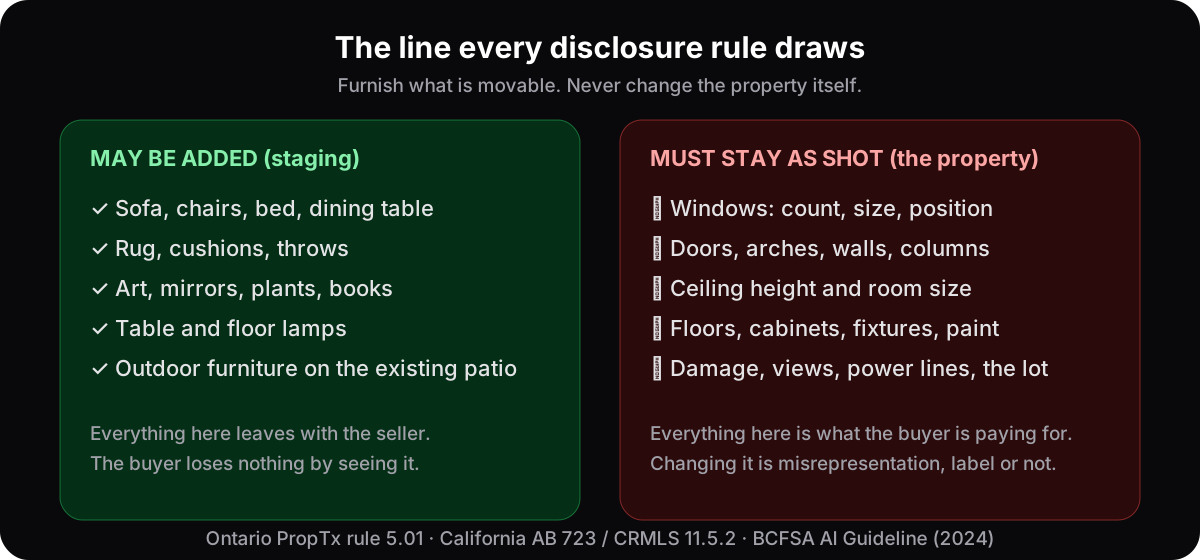
No UK law, code or portal page we read names the furniture. The tests are about the property. Rightmove: AI images "should not be used to disguise the property's true condition, add features that do not exist, or otherwise create an unrealistic impression of what is being offered". The Act: no "false or misleading information" and no "overall presentation which is likely to deceive the average consumer", and "the reference to misleading information includes a reference to information which, although true, is presented in a misleading way." CAP: "Images which give an inaccurate impression about the product which consumers will receive, for example by exaggerating the quality or size of the product, or suggesting that the product comes with extras when it does not, are likely to mislead." The CMA's own property example is about the number of bedrooms: a house advertised "as having 3 bedrooms, when in fact it has 2 bedrooms and a box room too small for a bed" is likely to change "whether to view the house".
The ASA has ruled on finishes. In 2012 it upheld a complaint about a new-build advert whose bathroom image "featured a number of additional upgrades, such as tiled bath panels and chrome finishes", because buyers "would expect the finish as featured to be available at the price advertised" and "it was not clear that the upgrades were only available at an additional cost" (Taylor Wimpey UK Ltd, 14 November 2012, as summarised in CAP's advice on new-build homes). We found no ASA ruling on a virtually staged photo.
Our reading. Furniture, rugs, art, lamps and plants in an empty room: not part of the property, so staging, disclosed. Replacing the seller's furniture with digital pieces: the same, disclosed the same way, with the original kept. New paint, flooring, worktops, light fittings, a repaired ceiling, a greener lawn, a brighter view, a neighbour's building taken out: those are the property's "true condition" and "features", and changing them is what Rightmove and the Act describe, label or not. A double bed squeezed into a box room, or a room made to look larger, is the CMA's bedroom example in picture form.
The trade press has reported what that looks like. In August 2025 The Negotiator wrote about a terrace in Eaglescliffe whose listing carried a note at the foot of the description that it included "virtually staged images (provided by the vendor)". Some pictures were still "removed from the Rightmove listing at the portal's request, including one of the front of the building with an adjoining beauty parlour removed and others with imaginary furniture", although the listing also carried "original interior photographs" of the same rooms. Our reading: a note at the foot of the description does not protect a photo that changes the street, and after a complaint a portal may take down staged photos too, so put the disclosure where it is seen and keep every render true to the room.
What happens if you get it wrong?
None of the texts names a penalty for undisclosed or over-edited staging. What follows is the line each would apply to a misleading photo, and that choice is our reading.
Under the Act, engaging in a misleading action or a misleading omission is a criminal offence (section 237(1) and (2)). The CMA's guidance says these are strict liability offences: "There is no need to prove the intent of the trader." The defence is to prove that the offence was due to a mistake, another person or a cause beyond your control, and "that the defendant took all reasonable precautions and exercised all due diligence to avoid the commission of such an offence" (section 238). The penalty, under section 240: "on summary conviction in England and Wales, to a fine"; "on summary conviction in Scotland or Northern Ireland, to a fine not exceeding the statutory maximum"; "on conviction on indictment, to imprisonment for a term not exceeding two years or to a fine (or both)". Local Trading Standards enforce its prohibitions in Great Britain and "the Department for the Economy in Northern Ireland" there, and "The CMA may also enforce the provisions of this Chapter." (section 231).
What is new since 6 April 2025 is that the CMA can fine without going to court. Where a practice "harms the collective interests of consumers" (section 148), a final infringement notice can impose "a fixed amount not exceeding £300,000 or, if higher, 10% of the total value of the turnover (if any) of the respondent" (section 182(6)), and Schedule 16 lists "Chapters 1, 2 and 3 of Part 4" of the Act among the laws enforced this way. Our reading: the CMA is more likely to use that power against practices with a wide reach than against one agent's photo, though section 148 says the collective interests of consumers "are capable of being harmed by a single act or omission", and the test is the same.
Below the law sit the codes. TPO members agree that "All advertisements must be legal, decent, honest and truthful in accordance with the ASA Codes" (clause 7n) and that "You will be liable if you include anything in the sales particulars which you have reason to doubt is correct" (clause 7m). Propertymark's rule 13.1.1 bars any act that "Involves dishonesty, deceitful behaviour, or misrepresentation". The ASA treats a listing page as an advert: in a 2017 ruling against a property website whose page still showed a house taken off the market two years earlier, it found the ad "breached CAP Code (Edition 12) rules 3.1 (Misleading advertising) and 3.7 (Substantiation)" and said "The ad must not appear again in its current form." In another, against a developer whose TV advert showed homes "located at their Cambridgeshire site rather than of the properties situated at their Little London Park location", it concluded that "the ad was misleading", because one of the homes shown could not be viewed there.
The portals can act without a court. Rightmove asks anyone who believes "AI imagery is being used misleadingly" to send the advert, and says "We will review the information you provide and determine whether the property advert needs further investigation." Zoopla "may decline to upload" AI-made content "as required by Applicable Law or in order to protect the integrity of the Website(s)".
Material information: the withdrawn guidance and what is coming
For years the reference text on what a listing must disclose was National Trading Standards' material information guidance, completed on 30 November 2023: "Parts B and C* of the process to improve material information disclosure in property listings are published today", NTS announced, developed alongside "the UK's major property portals including Rightmove, Zoopla, OnTheMarket and Property Pal". Its announcement lists nothing about photographs, and the guidance itself we could not read: it is no longer on the NTS site, and on 18 October 2026 the links to the sales guidance, the lettings guidance and the quick guide for agents all led to the material information page, which carries one sentence about the government's sales packs. In May 2025 an NTS spokesman told Legal Futures that the regulations behind it "have since been superseded and replaced by the new Digital Markets, Competition and Consumers Act 2024" and that the guidance "has been withdrawn".
The duty did not go with the guidance. The Act still treats leaving out "material information" as misleading, defining it as what "the average consumer needs to take an informed transactional decision", and TPO's clause 7i still says "All material information (*) must be disclosed". More is coming. The government's homebuying announcement of 18 June 2026 proposes that "Sellers and estate agents will have to provide key information upfront in 'sales packs' at the point of listing", with legislation "By the end of Parliament", and promises, for "Later this year", "a Code of Practice to set out minimum standards for property agents and guidance to improve the quality of information in property listings". When that code is published, read what it says about photographs.
What people write versus what the texts say
| What you will read elsewhere | What the UK texts say |
|---|---|
| "The CPRs have taken the place of the old Property Misdescriptions Act" | True when it was written, in 2020: the Property Misdescriptions Act 1991 was repealed from 1 October 2013. For anything done since 6 April 2025 the CPRs have themselves been replaced by Part 4, Chapter 1 of the Digital Markets, Competition and Consumers Act 2024, and "The CPUTR 2008 continue to have effect in relation to any act or omission which takes place before the commencement date." |
| UK rules are "the ones every agent knows as the CPRs" | The same point, from a page updated in September 2026: for a listing published today the test is in sections 226 and 227 of the Act, and the CMA can fine directly, up to £300,000 or 10% of turnover (section 182(6)). |
| Label each staged image with a phrase such as "Virtually Staged — Digital Furniture Added" | No UK text we read prescribes a phrase. Zoopla asks for AI use to be made clear; Rightmove asks for genuine photographs alongside AI images; everything else is the general ban on misleading. |
What should a UK agent actually do?
- Check which portals the listing goes on; a listing on Rightmove, Zoopla and OnTheMarket must satisfy all three.
- Disclose in the description, every time: One or more photos are virtually staged with AI. The furniture shown is not included. On Zoopla that is, in our reading, how you "make this clear" for AI-made photos; everywhere else it is what the misleading-omission test rewards. Put it near the top, not at the foot: the Act counts information given "in such a way that the consumer is unlikely to see it" as left out.
- On the image, only a plain label. A small "Virtually Staged." with no agency or company name; Zoopla bars "any promotion of the Member" on photos.
- Put the genuine photo in the gallery. Rightmove asks for AI images "alongside genuine photographs of the property"; do the same on every portal.
- Stage furniture only. Furniture, rugs, art, lamps, plants. Walls, floors, worktops, light fittings, windows, the view, the garden and the neighbours stay as photographed.
- Keep the room's true size. The CMA's example is a house advertised with "3 bedrooms" that has a box room too small for a bed; a staged bed must fit the real room.
- Get the seller's sign-off on the staged photos with the particulars (our reading of TPO clause 7j), and keep the originals as your evidence (CAP Code rule 3.7).
- Use a current photo. A staged render of a room that has since changed misleads before any furniture is added.
If most of your listings are vacant, our page for listing agents shows how staging fits into that: furnish the room, keep its geometry, keep the original.
Why we wrote this
We make an AI virtual staging tool, and in the UK our branded stamp should come off on every portal, which is a reason to be precise rather than reassuring. Every quotation of a law, code, ruling or portal above can be checked against the Digital Markets, Competition and Consumers Act 2024, Part 4, Chapter 1, its section 148, section 182 and Schedule 16, the commencement regulations and the CMA's guidance CMA207 (PDF); the CAP Code, section 03, CAP's advice on misleading advertising and new-build homes, and the ASA rulings on Houser Ltd and Birch's Group Ltd; Rightmove's help pages on misleading adverts and photos used by another agent, Zoopla's member terms and help page on reporting a listing, and OnTheMarket's website terms; The Property Ombudsman's sales code (PDF), Scottish sales code (PDF) and England lettings code (PDF), and Propertymark's rules (PDF); the Rent Smart Wales code (PDF) and the page that publishes it, Scotland's Letting Agent Code of Practice and the regulations that brought it in; the redress orders of 2008 and 2014; and the government's homebuying announcement with National Trading Standards' announcement of 2023 and material information page. The points about who counts as a trader, where furniture falls under the misleading test, a label on the image, our stamp, the seller's sign-off, which penalty would apply and the reach of the CMA's fines are labelled as our interpretation. For the general principles, see our virtual staging disclosure guide; for another market without an MLS, where the portals write the label rule, Australia; for rules written by provincial regulators rather than portals, Canada.
Questions UK agents ask
Is virtual staging allowed in the UK?+
Yes, as far as the texts go: no UK statute, code or portal page we read bans it, and none uses the words virtual staging. What the law, the codes and the two portals that write about AI ban is a misleading picture. The Digital Markets, Competition and Consumers Act 2024 bans "the provision of false or misleading information" and "an overall presentation which is likely to deceive the average consumer" (section 226), and adds that "an overall presentation may be deceiving even if the information it contains is true." The Property Ombudsman's code wants every statement "whether oral, pictorial or written" to be accurate. Rightmove says AI-generated or enhanced images "can be used on Rightmove, but they must not create a misleading or unrealistic representation of the property". Our reading: furniture in an empty room, labelled as such, misleads no one about the property; a render that changes the room does, label or not.
Do I have to label a virtually staged photo in the UK?+
On Zoopla, yes, if the photo was made with AI: clause 5.1(c) of its member terms says that where a photo is "produced using autonomous technology (fully or partial), machine learning or other analogous technologies the Member will make this clear". On Rightmove, its help page asks for AI images to sit "alongside genuine photographs of the property" and says nothing about wording. No UK law we read prescribes a staging label. What the Act does say is that leaving out "material information" can mislead, and that information given "in such a way that the consumer is unlikely to see it" counts as left out (section 227). Our reading: a buyer who sees a furnished room needs to know the furniture is not there, so say it where they will see it. Our wording: "One or more photos are virtually staged with AI. The furniture shown is not included." in the property description, and a plain "Virtually Staged." on each staged photo where the portal allows it.
Can I put "Virtually staged" on the photo itself?+
None of the UK texts we read bans a plain label on a photo, and none asks for one. Zoopla's terms bar a photo from containing "any promotion of the Member" or "any advertisements of any other products or services of the Member or any third parties", so our reading is: plain words, no agency name and no staging company's name. Rightmove's public help pages say nothing about text on images, and the terms of its contract with agents we did not find published. Our reading for every portal: a small plain "Virtually Staged." is a disclosure, not an advert, while a stamp that names a company is an advert. The sentence in the description is the label no portal text we read restricts.
Do I have to show the original photo next to the staged one?+
Rightmove's help page asks for it for AI images: "AI images should be displayed alongside genuine photographs of the property, allowing home hunters to clearly understand its actual appearance and condition". That is the only UK text we read that asks for the real photo beside the edited one, and it does not say where in the gallery or how many. Zoopla, OnTheMarket, the Act and the codes ask for no original. Keep it for every staged frame anyway: under CAP Code rule 3.7 marketers "must hold documentary evidence to prove claims that consumers are likely to regard as objective", and, in our reading, the unstaged original is the evidence that only the furniture changed.
What does a mistake cost?+
Under the Digital Markets, Competition and Consumers Act 2024, a misleading action or omission is a criminal offence (section 237), and the CMA's guidance says "There is no need to prove the intent of the trader." There is a defence for a trader who "took all reasonable precautions and exercised all due diligence" (section 238). The penalty is "on summary conviction in England and Wales, to a fine", in Scotland or Northern Ireland "a fine not exceeding the statutory maximum", and "on conviction on indictment, to imprisonment for a term not exceeding two years or to a fine (or both)" (section 240). Since 6 April 2025 the CMA can also impose its own penalty, "a fixed amount not exceeding £300,000 or, if higher, 10% of the total value of the turnover" (section 182(6)), for practices that harm "the collective interests of consumers". Outside the courts, the ASA can rule that an ad "must not appear again in its current form", TPO and Propertymark members answer to their schemes, and Rightmove reviews reported adverts and can have pictures removed.
Do the rules apply to private sellers and landlords?+
The Act binds traders, people acting for the purposes of their business (section 225(3)). Our reading: an estate or letting agent always is one, a landlord who lets as a business may well be one, and a homeowner selling their own home usually is not. But the portals take listings from businesses: Zoopla says its homes "are provided to us by registered estate agents", and OnTheMarket that its listings come from "third party property advertisers, including estate agents, letting agents and new home developers". So, in our reading, a private seller's staged photos usually reach a portal through an agent, and the agent's duties apply to them. In Wales a licensed landlord is bound by the Rent Smart Wales code, which names statements made "in pictures". Whoever you are, the portal's rules bind the listing.
Is it different in Scotland, Wales or Northern Ireland?+
The Act is the same everywhere: its unfair trading Chapter is enforced by local Trading Standards in Great Britain and by "the Department for the Economy in Northern Ireland" (section 231). The codes differ. In Scotland, letting agents are bound by a statutory code whose paragraph 38 says "Your advertising and marketing must be clear, accurate and not knowingly or negligently misleading", and TPO's Scottish sales code repeats the "whether oral, pictorial or written" line. In Wales, licensed landlords and letting agents follow the Rent Smart Wales code: statements "whether spoken, in pictures or in writing, must be correct and not misleading". In England, letting agents must belong to a redress scheme under an order that "applies in relation to England only", and TPO's England lettings code has the same "pictorial" line. For Northern Ireland we read the Act and TPO's sales code, which covers "England, Wales and Northern Ireland"; the letting rules there, and the terms of the portal Property Pal, we have not read.
Last checked against Part 4, Chapter 1, sections 148 and 182 and Schedule 16 of the Digital Markets, Competition and Consumers Act 2024 and S.I. 2025/272, the CMA's guidance CMA207 (18 November 2025), the CAP Code section 03 and CAP's advice on misleading advertising (12 March 2026), the ASA rulings on Houser Ltd (19 July 2017) and Birch's Group Ltd (4 January 2017), Rightmove's help pages (22 September 2026 and 18 August 2026), Zoopla's member terms (1 December 2025), OnTheMarket's website terms, The Property Ombudsman's sales codes (effective from 1 June 2019, files of March 2026) and England lettings code (effective from 1 May 2026), Propertymark's rules (10 March 2026), the Rent Smart Wales code (October 2015), Scotland's Letting Agent Code of Practice (in force since 31 January 2018), the redress orders of 2008 and 2014, the government's homebuying announcement (18 June 2026) and National Trading Standards' material information pages, on 18 October 2026. Rules change; verify before relying on this.
See it on your own room
Upload a photo and watch AI restage your space in 15–60 seconds, depending on how much detail it has — free to try, no credit card.
Try AI Flip Room freeGot a question about this?
Something unclear or not covered? Ask here. We read every question and answer the useful ones right in the article. Nothing you write is published.
Related reading
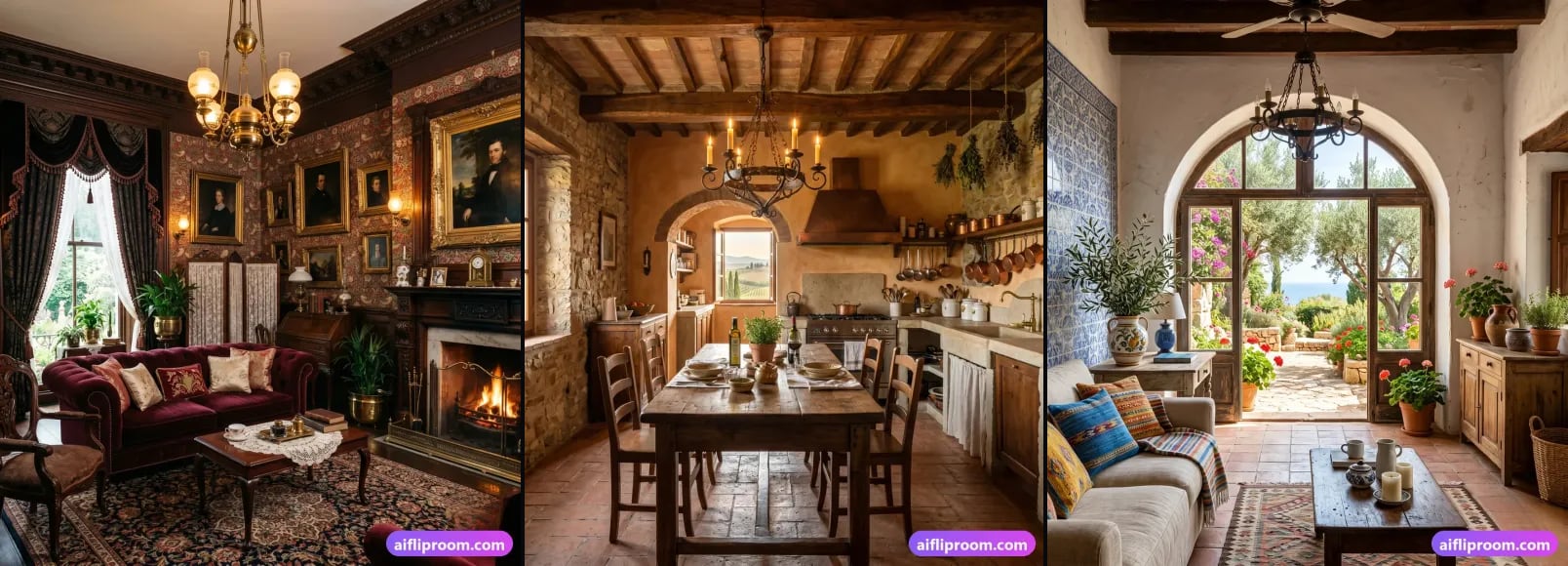
Virtual Staging Disclosure Rules: How to Label Staged Photos
Why disclosure is required, three ways to label a virtually staged photo, what you may change vs never touch, and the rules of sixteen jurisdictions compared.
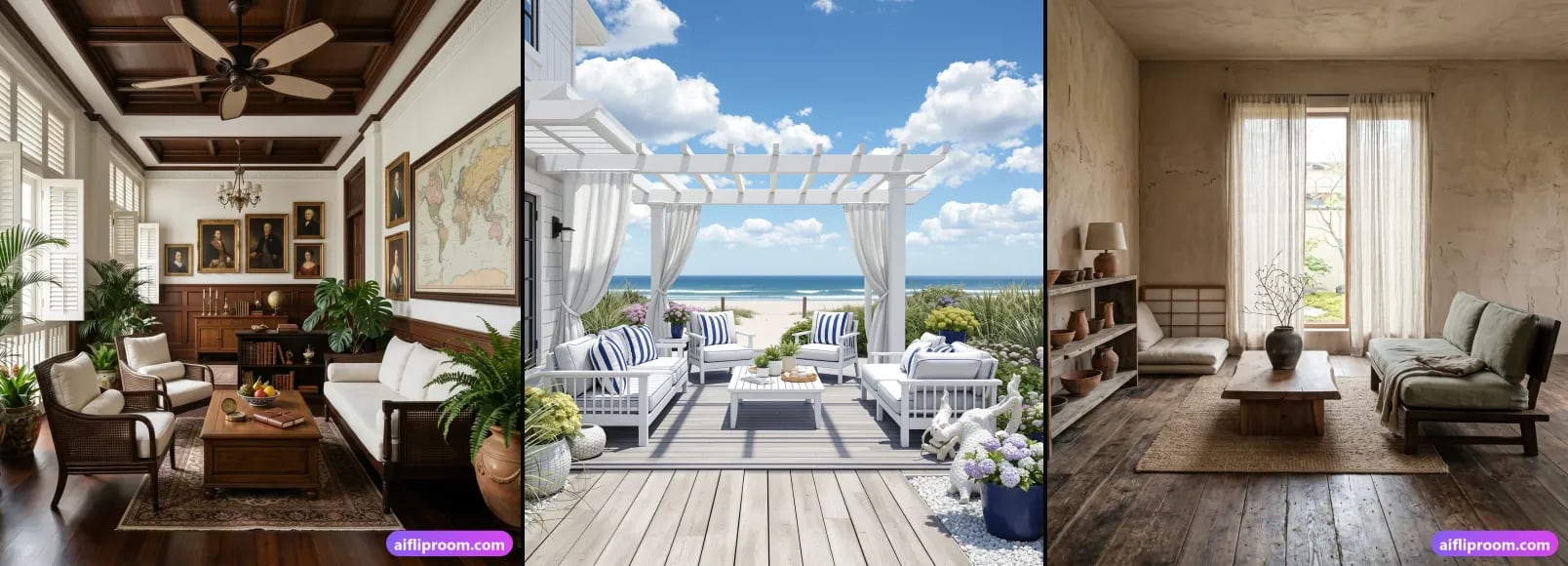
Australia Virtual Staging Rules: Consumer Law, the States, realestate.com.au and Domain
Is virtual staging allowed in Australia? Yes, if it does not mislead: the Consumer Law sets the test, realestate.com.au wants AI edits disclosed, NSW rental ads will have to flag misleading edits.
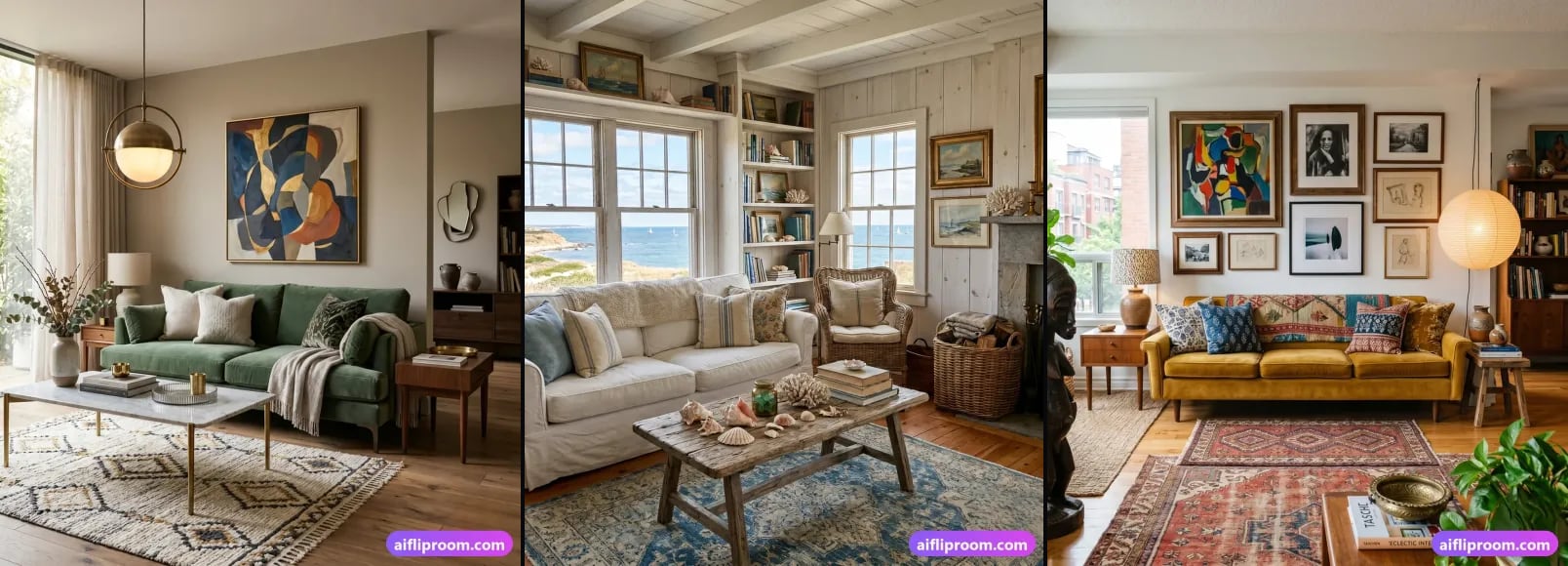
Virtually Staged Listing? 5 Things a Buyer Can Demand
AI staging is legal in Ontario, BC, Quebec, Alberta, California, New York, Florida, Texas, Washington, Arizona, Illinois, Georgia, Colorado, Australia, the UK and Bright MLS, with conditions.