Bohemian Interior Design
Colorful textiles, plants, eclectic furniture, free-spirited mix.
Stage your room in Bohemian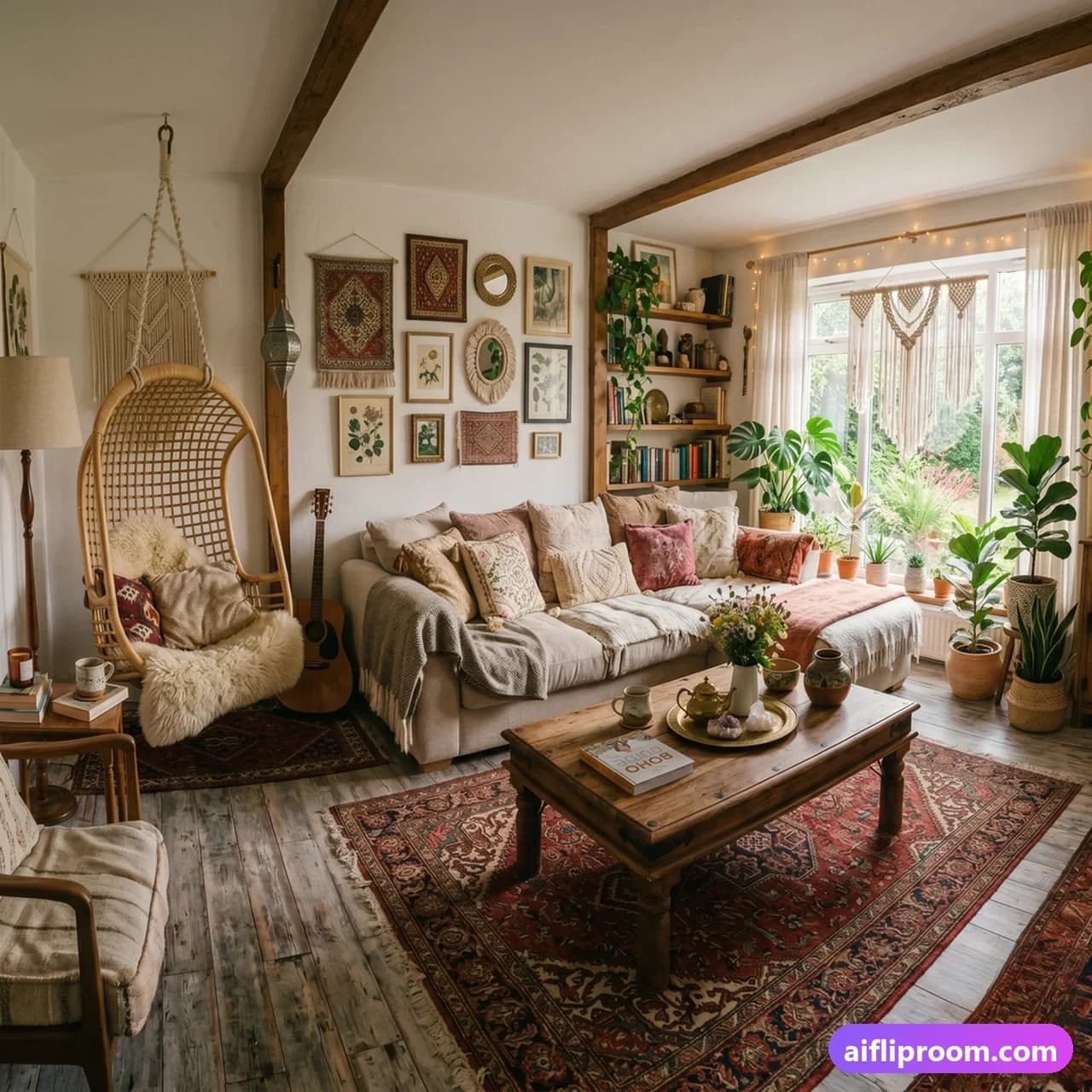
What is Bohemian interior design?
Bohemian — or boho — style is the most personal look on this list. Where many styles aim for cohesion, bohemian celebrates the opposite: a room assembled over time, full of things with stories, layered without apology. Patterned textiles and rugs pile up; houseplants are everywhere; colour is warm and unafraid; rattan, macramé and other natural materials add craft and texture. Globally-inspired and vintage finds sit side by side, and the arrangement feels collected rather than decorated. The trick that keeps it from looking like chaos is a warm, fairly consistent colour temperature running underneath all the variety. The result is relaxed, expressive and full of life. In staging, bohemian is useful for adding warmth and personality to plain or boxy rooms, and it speaks directly to creative and younger buyers who want a home that feels individual.
Where Bohemian comes from
The word predates the interiors by a century. Bohemian described artists and writers in nineteenth-century Paris who lived cheaply and unconventionally, furnishing rooms with whatever they had — inherited rugs, market finds, objects brought back from travels. The look followed the life rather than the other way round, which is why the defining quality is accumulation rather than any particular palette. The 1960s and 1970s revived it with a stronger global influence, and the current version keeps the layering while calming the colour. What has never changed is the underlying logic: nothing matches because nothing was bought together, and the room is a record of a person rather than a scheme.
Key elements of Bohemian
- Layered patterned textiles and rugs
- Abundant houseplants
- A warm, unafraid mix of colours
- Rattan, macramé and natural materials
- Globally-inspired and vintage finds
- A collected, lived-in arrangement
When to use Bohemian
Living rooms and bedrooms aimed at creative, younger buyers. Adds warmth and personality to plain or boxy rooms.
Bohemian colours and materials
Warm and earthy, built from terracotta, rust, ochre, saffron and burnt sienna, with olive, teal and deep plum for depth. The base is usually warm white or a sandy neutral so the layers have somewhere to sit. Materials are the point: rattan, cane, macramé, kilim and Persian rugs, block-printed and embroidered cotton, velvet, leather, unglazed ceramic and plenty of living plants. Metals stay warm and slightly aged — brass, copper, hammered rather than polished. The one thing that reliably breaks the look is anything machine-perfect; boho depends on visible handwork.
Bohemian room by room
Living room in Bohemian
Layer rugs — a large jute or flatweave underneath and a patterned kilim or vintage Persian on top, deliberately overlapping. A low, comfortable sofa piled with cushions in mismatched patterns that share a colour family, a rattan or peacock chair, and a low wooden coffee table. Plants at three heights: something tall in a basket, something trailing from a shelf, something small on the table. Wall decoration can be macramé, textiles, a mix of framed and unframed art, or woven baskets — the wall is treated as another layer rather than as background.
Bedroom in Bohemian
A low bed or a mattress on a simple frame, layered with a block-printed quilt, a throw and cushions in three or four different fabrics. Hang a canopy, a length of textile or a macramé piece behind the bed instead of a headboard. Rattan or wicker nightstands, a floor lamp with a woven shade, string lights or a lantern for low light, and a rug that extends well past the bed. Plants and books stacked on the floor are part of the look rather than untidiness.
Reading corner in Bohemian
Boho does small dedicated spaces better than almost any style. A hanging or papasan chair, a floor cushion or pouf, a stack of books, a small side table, and a plant tall enough to enclose the corner. One lamp with warm light and a soft rug underfoot. The corner should look like somewhere a person actually sits, which means a throw left over the arm rather than folded.
Dining area in Bohemian
A simple wooden table with chairs that do not match — cane, rattan, painted timber, a bench along one side. A woven pendant above, a runner rather than a tablecloth, and ceramics with visible glaze variation. Plants on the table and hanging near the window. This is the room where a bohemian scheme is easiest to build slowly, because mismatched seating is the whole point and can be collected over time.
Outdoor space in Bohemian
The style translates directly outside. A low table, floor cushions and poufs, an outdoor rug, a canopy or hanging fabric for shade, lanterns and string lights. Plants in terracotta pots of different sizes, clustered rather than lined up. The aim is somewhere to sit on the ground comfortably for a long time, which is exactly the aim indoors as well.
Bohemian mistakes to avoid
- Buying a boho set. Layering only reads as authentic when the pieces genuinely differ in age and origin; a matched collection sold as bohemian is the opposite of the idea.
- Layering without a common thread. Mismatched is not the same as random. Give the patterns a shared colour family or a shared warmth and the room holds together.
- Forgetting the plants. They are structural in this style, not decorative. A bohemian room without greenery looks unfinished in a way that is hard to fix with more textiles.
- Cool grey as a base. Boho needs warmth underneath — warm white, sand, clay. Grey makes the whole palette look muddy.
- Confusing layered with cluttered. There should still be clear surfaces and space to move; the layering happens in textiles and on walls, not across every horizontal surface.
Bohemian questions, answered
What is the difference between bohemian and eclectic style?
Eclectic describes any deliberate mix of periods and styles, and it can be formal, minimal or bold. Bohemian is a specific flavour of eclectic: warm, earthy, textile-heavy, plant-filled and relaxed. All bohemian rooms are eclectic; most eclectic rooms are not bohemian.
Is bohemian style still popular?
The maximalist macramé-everywhere version has cooled, but the style has moved rather than disappeared. The current direction is quieter — fewer patterns, a more restrained earthy palette, more natural materials and negative space. It is often blended with minimalism or Scandinavian design, which keeps the texture and drops the visual noise.
How do I do bohemian without it looking cluttered?
Limit the palette to three or four related colours, keep one wall and one large surface clear, and layer in specific places rather than everywhere — the floor, the sofa, one wall. Choose fewer but larger objects. The rooms that read as cluttered are usually the ones with too many small things at the same scale.
What plants suit a bohemian interior?
Large-leaved and trailing species do the most work: monstera, fiddle-leaf fig, rubber plant, pothos, string of pearls, spider plant, and a hanging fern. Plant them in terracotta, ceramic or woven baskets rather than plastic, and group them in odd numbers at different heights.
Is bohemian a good choice for staging a property?
It works for creative, urban and rental properties and for younger buyers, where it reads as warm and characterful. It is a weaker choice for a broad-market family home, because it is personal by nature and buyers respond to staging that lets them imagine their own things in the space. A light bohemian touch over a neutral base is the safer version.
Guides to read next
Longer reads on getting a room photographed and restaged well.
- See Your Own Room in a New Style Before You Buy AnythingPreview your actual room in a new style before buying furniture or hiring anyone: what a preview settles, what it can't, and five steps to a useful one.
- How to Photograph Rooms for Virtual Staging: 7 RulesDaylight, lamps off, a level phone at chest height, the 1x lens not 0.5x, one room per frame, clear surfaces — seven habits that make AI staging look real.
- What Is Virtual Staging? The Complete Guide: How It Works, Cost, Rules, ExamplesVirtual staging explained in plain language: how AI furnishes a photo of a real room, what it costs, what agents think of it (NAR 2025), who it helps, the rules and how to spot bad staging.
See your room in Bohemian
Upload a photo and our AI restages it in the Bohemian look in 15–60 seconds, depending on how much detail your room has — keeping your walls, windows and layout intact.
Try Bohemian on your room