Japandi Bedroom Ideas
How to design a Japandi bedroom — a low bed, washed linen, warm neutrals and the small number of objects the style allows.
Stage your bedroom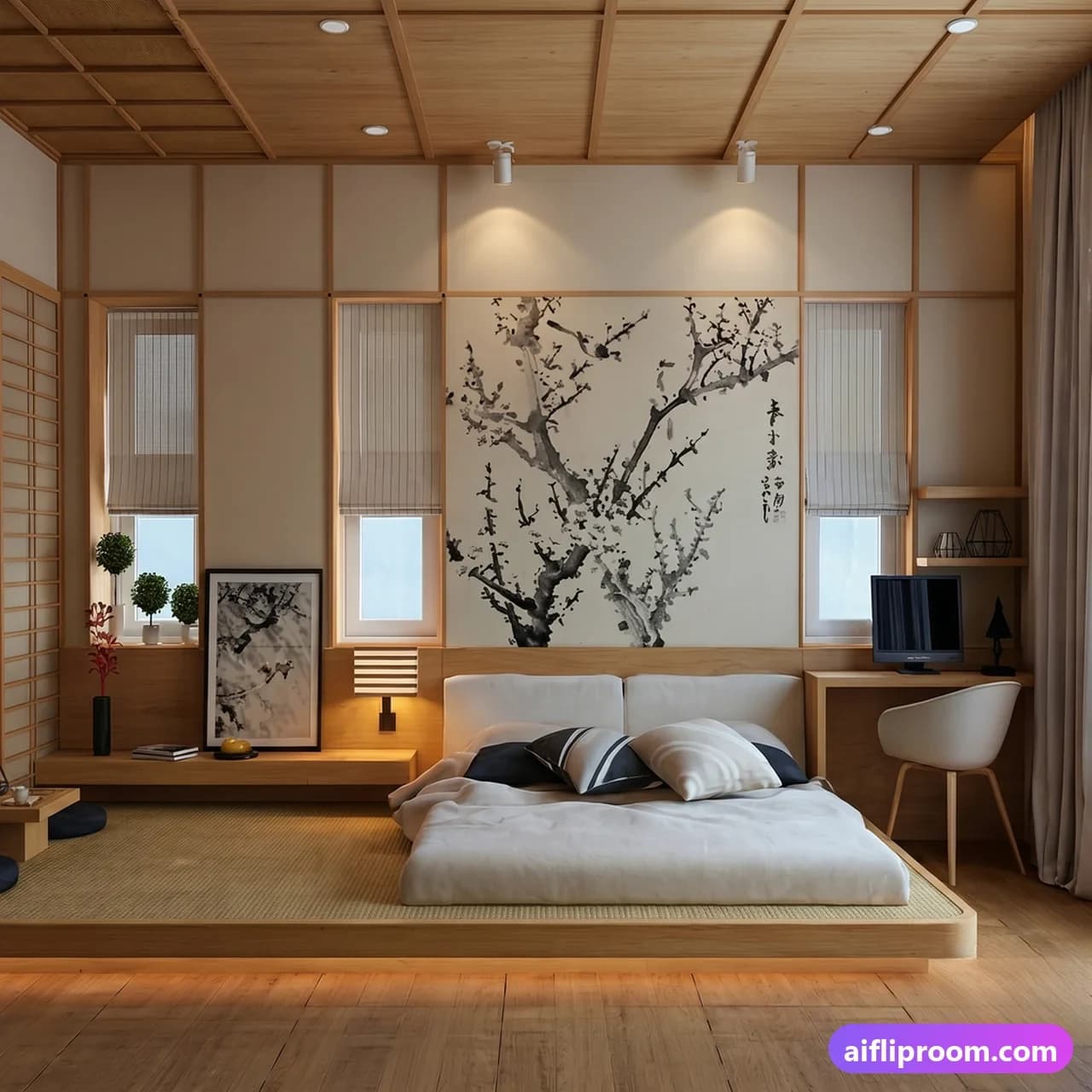
Japandi in a bedroom
The Japandi bedroom is the room where the style is easiest to get right, because what it asks for is what a bedroom wants anyway: a low bed, very few objects, soft light and materials that are pleasant against skin. Almost nothing has to be argued for. If you are trying Japandi for the first time and want to know whether you will actually like living in it, this is the room to start with.
The defining decision is the bed height. A platform bed close to the floor changes the proportions of the whole room — the ceiling reads higher, the walls read larger, and everything else in the room has to come down to meet it. That single choice does more than any amount of styling, and it is also the one people most often skip, which is why so many bedrooms described as Japandi are simply beige.
Layout and furniture
A low platform bed, ideally with a slim or absent headboard, centred on the longest usable wall with space to walk both sides. Nightstands should be small, wooden and low enough that the top sits at or just below mattress height — a tall bedside cabinet next to a low bed is the most visible proportion mistake in the style.
Storage closes and preferably disappears. Built-in wardrobes with flat fronts in a colour close to the wall, or a single low chest. Nothing on top of the chest except one object. If the room is large enough for a chair, one low armchair or a simple bench at the foot of the bed is the correct amount of extra furniture; two chairs and a dressing table is too much.
Leave the wall above the bed empty or hang one piece. Symmetry is not required and slight asymmetry is more in keeping — a single lamp on one side and a wall light on the other reads better in this style than a matched pair does.
Colours, materials and finishes
Washed linen is the material the room is built on. Bedding in white, flax, oat or clay, layered rather than tightly made, with one wool or cotton throw folded across the foot. Skip the pile of decorative cushions entirely — two pillows and perhaps one square is the whole specification.
Wood should be pale on the frame and can be darker in a smaller piece: pale oak or ash for the bed, walnut or blackened timber for a stool or a shelf. Walls in a warm off-white or a soft greige. The dark note in a bedroom is usually a single object — an ink-glazed vase, a black-framed print, a charcoal throw — because the room should be quieter than the living areas.
A rug beside the bed matters more here than in any other room, since it is the first thing you stand on. Wool, in a warm neutral, large enough to catch both feet.
Lighting
Paper or linen shades, warm bulbs, and nothing overhead. Two low sources either side of the bed at reading height, and if the room needs more, one floor lamp in a corner. A dimmer on at least one of them.
At the window, unlined linen or a simple woven blind that filters rather than blocks. If the room needs to be genuinely dark for sleep, run a blackout blind behind a linen curtain rather than choosing a heavy lined curtain — the linen keeps the daytime character of the room, the blind does the work at night. This is the one place where Japandi's preference for light materials has to negotiate with practicality, and layering is how it does it.
What goes wrong in this room
- A tall bed with a tall headboard. The low horizontal is the style. An upholstered headboard reaching most of the way up the wall belongs to a different look.
- Nightstands taller than the mattress. Small and low, or the proportions of the whole room stop working.
- Cushion piles. Two pillows and maybe one more. Decorative stacks are the opposite of the idea.
- A cool grey palette. Japandi neutrals are warm — flax, oat, clay. Cool grey linen reads as contemporary minimalism instead.
- Nothing dark at all. Even in the quietest room, one ink or charcoal object keeps the neutrals from going flat.
Bedroom questions, answered
What kind of bed is Japandi?
A low platform bed in pale timber, with a slim headboard or none, and ideally a visible frame rather than a base that meets the floor. Height is the important part — around 30 to 45 cm to the top of the mattress rather than the 60 cm typical of a divan. Upholstered and tall-headboard beds sit outside the style.
What bedding colours suit a Japandi bedroom?
White, flax, oat, clay or a soft grey-beige, in washed linen or brushed cotton. Keep the whole bed within one warm family rather than contrasting — the interest should come from the weave and the folds rather than from colour. One deeper accent, in a throw or a single cushion, is enough.
Do I need a rug in a Japandi bedroom?
On a hard floor, yes, and it does more than it looks. A wool rug in a warm neutral placed so it catches both feet on rising both softens the room acoustically and supplies the texture a sparse bedroom needs. On carpet it is optional, though a smaller flat-weave still adds the layer.
How do I store clothes without cluttering the room?
Built-in wardrobes with flat handle-less fronts painted close to the wall colour, so they read as wall rather than as furniture. Where built-ins are not possible, one low chest with nothing on top and a single rail concealed behind a linen curtain. The style depends on nothing being out, which makes storage a design decision rather than an afterthought.
Guides to read next
Longer reads on photographing a room and restaging it without changing it.
- Japandi Style Guide: Palette, Materials, Furniture, RoomsWhat Japandi is, the palette and materials that make it read as real, the furniture that works, how it changes room by room, and the mistakes to avoid.
- See Your Own Room in a New Style Before You Buy AnythingPreview your actual room in a new style before buying furniture or hiring anyone: what a preview settles, what it can't, and five steps to a useful one.
- How to Photograph Rooms for Virtual Staging: 7 RulesDaylight, lamps off, a level phone at chest height, the 1x lens not 0.5x, one room per frame, clear surfaces — seven habits that make AI staging look real.
See your bedroom in Japandi
Upload a photo and our AI restages it in 15–60 seconds, depending on how much detail your room has — keeping your walls, windows and layout intact.
Try Japandi free