Japandi Home Office Ideas
How to design a Japandi home office — a quiet desk, closed storage, warm light and cable management treated as a design decision.
Stage your home office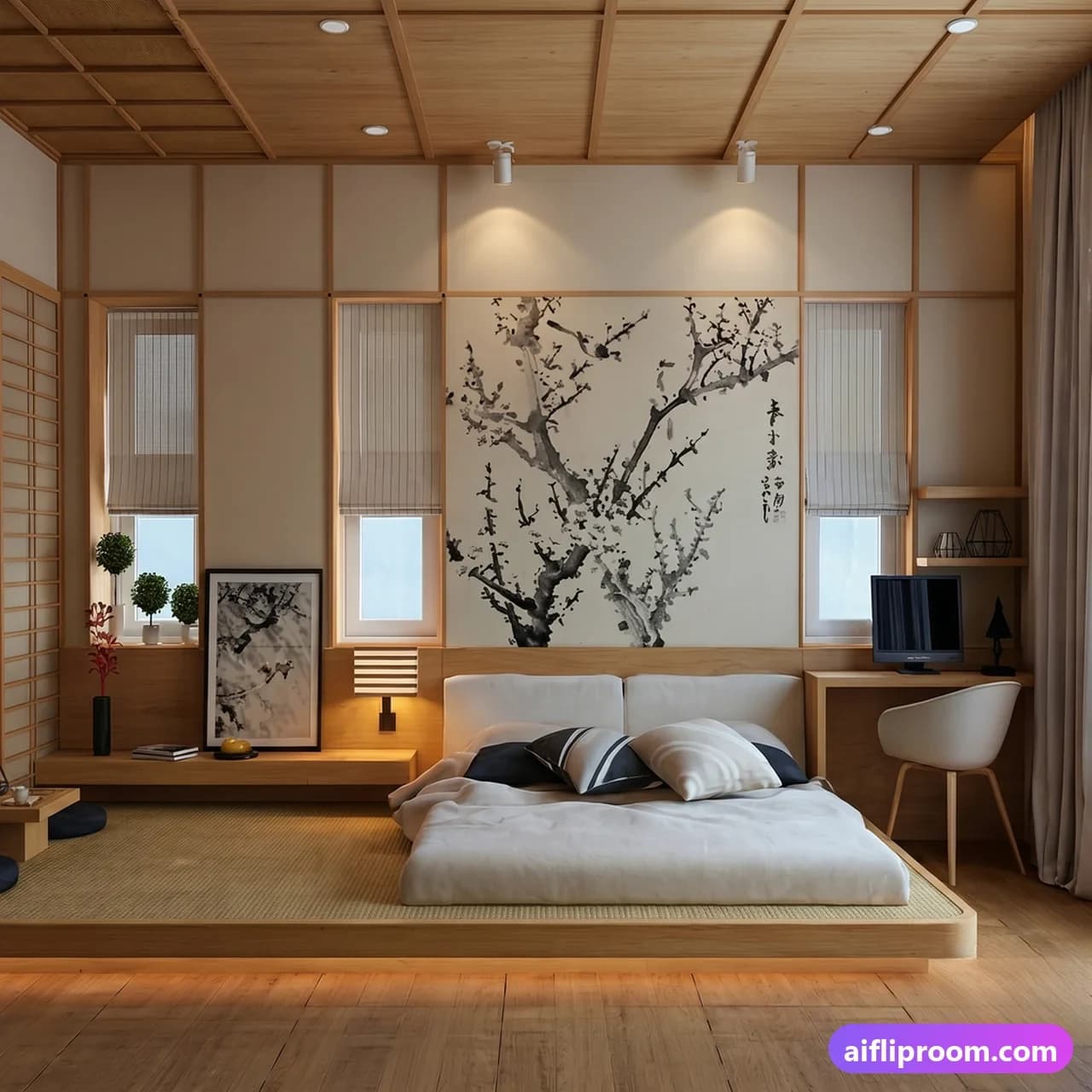
Japandi in a home office
A Japandi home office is deliberately under-furnished, and there is a practical argument behind the aesthetic one: nothing in the room should compete for attention with what you are trying to concentrate on. A desk, a chair, storage that closes, one plant and one object with no function at all is the entire specification. Everything else is a source of low-level visual noise that you stop noticing consciously and keep noticing anyway.
The room also has a second job that most style guides ignore. If you take video calls, the wall behind you is on display several hours a day, which makes it one of the few surfaces in a home with a genuine reason to be considered. A plain warm wall with one framed piece and a plant at the edge of frame is both the Japandi answer and, conveniently, the best-looking background you can have.
Layout and furniture
A solid timber desk with slim legs and a clean top, positioned facing a window or into the room rather than at a blank wall. One comfortable chair, chosen for support rather than for looks, and it is worth saying plainly that a beautiful uncomfortable chair is the wrong choice in a room you sit in for six hours.
Storage along one wall, closed. Low shelving or a cabinet in pale timber, with at most one open shelf holding a small number of things. Nothing stacked on the floor. If the room is shared with another function — a spare bedroom, a corner of a living room — a slatted timber screen separates the working area visually without cutting the light.
Leave the wall behind the desk almost bare, and leave the desk top clear at the end of each day. The room's calm is a daily habit as much as a design.
Colours, materials and finishes
Pale oak or ash on the desk and storage, a warm off-white or soft greige on the walls, and a wool rug underfoot. The rug is not decorative here: a hard-floored room with bare walls has poor acoustics, and calls sound noticeably better in a room with a rug and a curtain in it.
One dark element to anchor the neutrals — a black task lamp, a charcoal chair, an ink-framed print. Textiles in linen and wool. Keep plastic out of sight where you can; the monitor and the keyboard are unavoidable, but a timber monitor stand and a fabric-covered cable channel do a surprising amount.
Lighting
Task light first, and it should be adjustable. A directional lamp on the desk with a warm bulb, positioned to light the work rather than the screen. Then one soft source elsewhere in the room so the screen is not the brightest thing in a dark space, which is what causes eye strain in the evening.
Daylight should come from the side rather than from directly in front or behind the desk — behind you it puts the screen in silhouette and washes out a video call, in front it produces glare. A linen blind that filters rather than blocks lets you tune it through the day.
What goes wrong in this room
- Ignoring cables. In a room this sparse, a tangle under the desk is the loudest thing in it. A tray, a channel and one power block, done once.
- A beautiful uncomfortable chair. Six hours a day makes this a health decision, not a styling one. Choose the support first and the finish second.
- Hard surfaces everywhere. No rug, no curtain and no soft furnishing gives a room an echo that every call picks up.
- Desk facing a blank wall. Face a window or into the room. Working at a wall in a minimal room is unnecessarily bleak.
- Open shelving used as storage. One shelf of chosen objects; everything else behind a door, or the room stops being restful within a month.
Home office questions, answered
What desk suits a Japandi home office?
A solid timber desk in pale oak or ash with slim legs, a clean top and either no drawers or one shallow one. Height around 72 to 75 cm for most people. Avoid glass, high-gloss finishes and heavy pedestal desks; the style wants the floor visible underneath and the surface quiet.
How do I hide cables in a minimal room?
Route everything to a single tray fixed under the desk, use one extension block rather than several, and run the one cable that has to reach the wall inside a fabric sleeve or a channel matched to the wall colour. Wireless peripherals remove two more. It is half an hour of work and it is the difference between a calm desk and a tidy-looking mess.
Can a Japandi office work in a corner of a bedroom or living room?
Yes, and the style handles it better than most because everything is low and quiet. Use a slatted timber screen or a low open shelf to mark the boundary without blocking light, keep the desk in the same timber as the room's other furniture so it reads as belonging, and choose a chair you are happy to look at in the evening.
What should be on the wall behind the desk?
Very little, and that is also the best answer for video calls. A plain warm wall, one framed piece off-centre, and a plant at the edge of the frame. Shelves directly behind you are distracting on camera and tend to collect exactly the clutter the style is trying to remove.
Guides to read next
Longer reads on photographing a room and restaging it without changing it.
- Japandi Style Guide: Palette, Materials, Furniture, RoomsWhat Japandi is, the palette and materials that make it read as real, the furniture that works, how it changes room by room, and the mistakes to avoid.
- See Your Own Room in a New Style Before You Buy AnythingPreview your actual room in a new style before buying furniture or hiring anyone: what a preview settles, what it can't, and five steps to a useful one.
- How to Photograph Rooms for Virtual Staging: 7 RulesDaylight, lamps off, a level phone at chest height, the 1x lens not 0.5x, one room per frame, clear surfaces — seven habits that make AI staging look real.
See your home office in Japandi
Upload a photo and our AI restages it in 15–60 seconds, depending on how much detail your room has — keeping your walls, windows and layout intact.
Try Japandi free