Coastal Outdoor Design
Weathered teak, blue-and-white stripes, dune grasses — breezy coastal patio.
Stage your outdoor space in Coastal Outdoor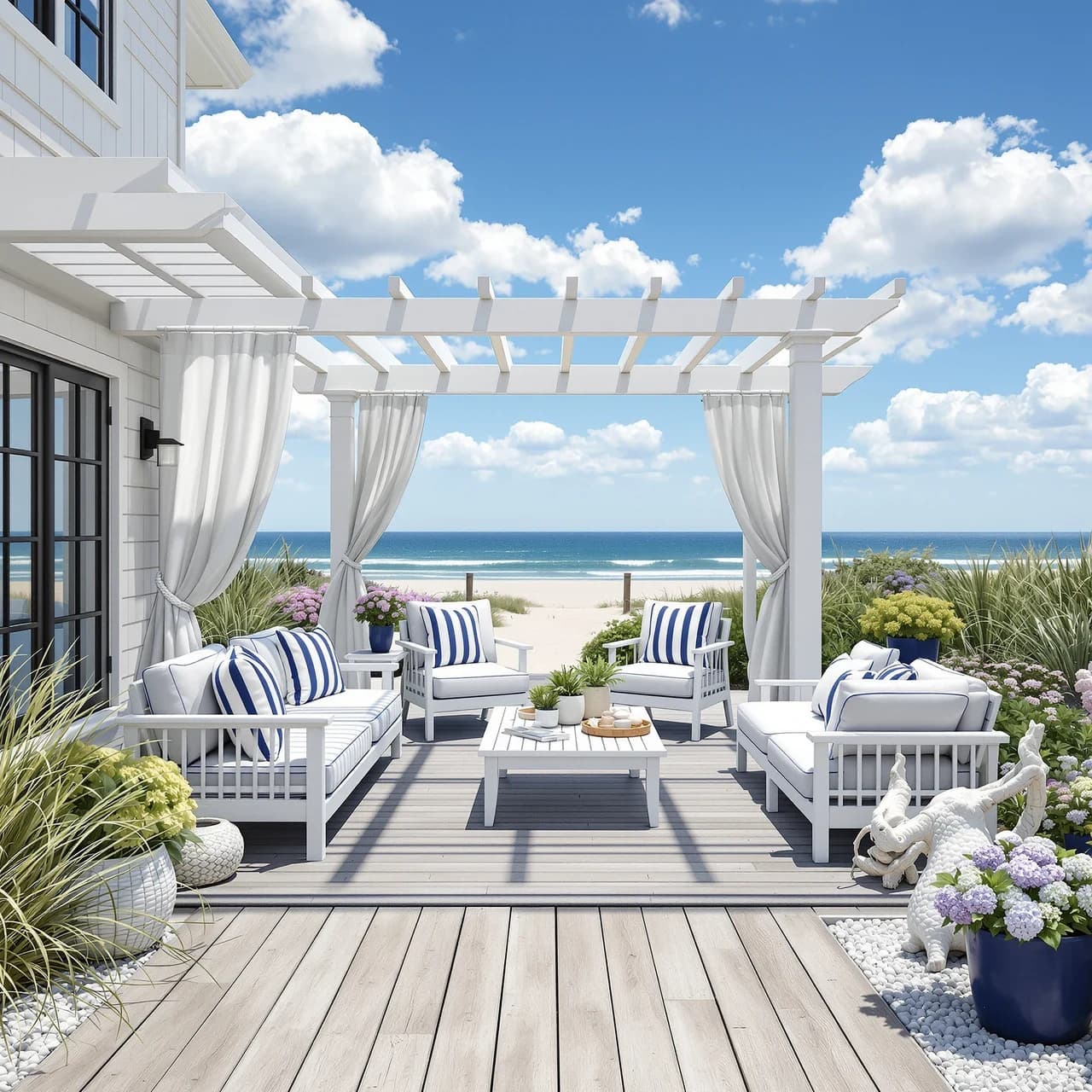
What is Coastal Outdoor design?
Coastal outdoor design gives a backyard, patio or deck the relaxed, breezy feel of a coastal escape. Weathered grey teak decking sets a soft, sun-faded base; white wood furniture with blue-and-white striped cushions keeps it crisp and cheerful; a pergola draped in breezy linen filters the light. Ornamental dune grass, a smooth pebble path and driftwood accents tie the space to the shoreline, and the palette stays light and airy throughout. The mood is unhurried and easy. The result is a breezy outdoor space that feels like a holiday. In staging, coastal outdoor design is a natural fit for coastal properties, and more broadly for any listing you want a buyer to picture as a relaxed, restful escape.
Where Coastal Outdoor comes from
Coastal outdoor spaces were shaped by wind, salt and sand, and every convention comes from one of the three. Timber was left unpainted or allowed to weather because salt destroys a finish quickly. Furniture was teak or wicker because both survive being left out. Planting stayed low and tough because anything tall and soft gets shredded by onshore wind. Decking and gravel replaced lawn because sand and salt kill grass. What is now bought as a look was a list of things that lasted. The practical consequence is that a coastal garden done properly is one of the lowest-maintenance outdoor spaces there is — and one of the easiest to get wrong, because the decorative version ignores every constraint that produced it.
Key elements of Coastal Outdoor
- Weathered grey teak decking
- White wood furniture with blue-and-white striped cushions
- A pergola with breezy linen curtains
- Ornamental dune grass
- A smooth pebble path
- Driftwood and nautical accents
When to use Coastal Outdoor
Decks, patios and backyards of coastal properties. Presents the outdoor space as a breezy, relaxed escape.
Coastal Outdoor colours and materials
Bleached and soft. Weathered silver-grey timber, white and off-white paintwork, sand and pale stone, with the sea blues used sparingly — faded denim, greyed teal, occasionally a deeper navy in a cushion or a shutter. Green arrives as the grey-green of grasses and coastal shrubs rather than as lawn. Materials are teak and other weathering hardwoods, wicker and rattan for covered areas, rope, canvas and outdoor linen, galvanised metal, gravel, shingle and pale stone. Everything matt, everything a little faded.
Coastal Outdoor area by area
Deck or terrace in Coastal Outdoor
Timber decking left to weather to silver-grey, or pale stone where a harder surface is wanted. Teak or all-weather wicker seating with white or oatmeal cushions and one or two in a faded blue. An outdoor rug in a natural weave, a low table, and a market umbrella or sail for shade. Keep the layout open toward whatever view exists, and keep the furniture low if the view is the point.
Dining area in Coastal Outdoor
A teak table with benches or simple chairs, sited where the wind is least — usually against the house or behind a screen. String lights or lanterns for the evening. Coastal dining spaces need shelter more than shade: a windbreak of planting, a slatted screen or a low wall makes the difference between a table that gets used and one that does not.
Planting in Coastal Outdoor
Low, tough and grey-green. Ornamental grasses for movement, plus sea holly, santolina, lavender, rosemary, euphorbia, thrift and coastal daisies. Pine or tamarisk for shelter where there is space. Plant in drifts through gravel or shingle rather than in borders with edges, and skip the lawn — grass on a coastal site is a permanent argument you will lose.
Shelter and screening in Coastal Outdoor
The most useful structure on a coastal plot is a windbreak. A slatted timber screen, a hedge of tamarisk or escallonia, or a low wall in local stone. Slatted rather than solid is deliberate: wind hitting a solid barrier turns turbulent behind it, while a permeable screen slows it. Site the seating in the lee of whatever you build.
Path and ground surface in Coastal Outdoor
Shingle, gravel or reclaimed timber boards, edged loosely or not at all. Stepping stones through gravel where a route is needed. The informality is correct — a crisply edged path with clipped borders belongs to a different kind of garden and looks over-managed by the sea.
Coastal Outdoor mistakes to avoid
- Nautical ornaments. Anchors, ship wheels, rope-wrapped everything and starfish are the fastest way to turn a coastal garden into a souvenir stall.
- Planting a lawn. Salt, sand and wind make it a losing battle. Gravel with drifts of grasses looks better, costs less and survives.
- Solid windbreaks. Wind over a solid fence becomes turbulent on the other side. Slatted screens and permeable hedging shelter far more effectively.
- Painted or varnished timber. It fails quickly in salt air and looks worse doing it. Let hardwood weather to grey; it is both the correct look and the correct maintenance strategy.
- Bright blue. Coastal blues are faded and greyed. A saturated blue reads as a swimming pool rather than as the sea.
Coastal Outdoor questions, answered
What plants survive in a coastal garden?
Salt- and wind-tolerant species with tough or waxy leaves: ornamental grasses, sea holly, santolina, lavender, rosemary, euphorbia, thrift, sea kale, escallonia and tamarisk. Most have grey-green or silver foliage, which is an adaptation to the conditions and is also what gives coastal planting its characteristic colour.
How do I protect an exposed outdoor space from wind?
Use permeable rather than solid barriers. A slatted screen with roughly half open area, or a hedge, slows the wind and calms it. A solid fence deflects wind upward and creates turbulence behind it, which is why sheltered corners often turn out windier than expected. Then site the seating in the lee of the screen rather than in the open.
What furniture lasts by the sea?
Teak and other naturally oily hardwoods, all-weather woven resin, and powder-coated aluminium. Avoid untreated steel, which rusts fast, and painted or varnished timber, which fails in salt air. Cushions should be in genuine outdoor fabric and stored dry when not in use.
Can I do coastal style away from the coast?
Easily, because most of it is palette and material rather than location. Weathered timber, gravel, grasses, teak furniture and faded blue accents read as relaxed and airy anywhere. It is only the literal nautical props that look out of place inland — and those are the part worth dropping regardless.
Does coastal outdoor staging help a listing?
It is very effective for seaside and holiday properties, and for any home with a deck or terrace, because it shows the space furnished and usable rather than as bare boards. It also photographs brightly, which helps a listing more than most decorating choices do.
Guides to read next
Longer reads on getting a outdoor space photographed and restaged well.
- Outdoor Virtual Staging: Patio, Deck and Backyard IdeasOutdoor virtual staging space by space — patio, deck, balcony, porch, pool deck, backyard: what each may gain, what stays as shot, and landscaping previews.
- How to Photograph Rooms for Virtual Staging: 7 RulesDaylight, lamps off, a level phone at chest height, the 1x lens not 0.5x, one room per frame, clear surfaces — seven habits that make AI staging look real.
- See Your Own Room in a New Style Before You Buy AnythingPreview your actual room in a new style before buying furniture or hiring anyone: what a preview settles, what it can't, and five steps to a useful one.
See your outdoor space in Coastal Outdoor
Upload a photo and our AI restages it in the Coastal Outdoor look in 15–60 seconds, depending on how much detail your outdoor space has — keeping your walls, windows and layout intact.
Outdoor styles are part of the Pro and Agency plans. New accounts get 3 free renders on the interior styles. How outdoor virtual staging works
Try Coastal Outdoor on your outdoor space