Desert / Xeriscape Outdoor Design
Saguaros, agave, gravel mulch, weathered boulders — drought-resistant SW.
Stage your outdoor space in Desert / Xeriscape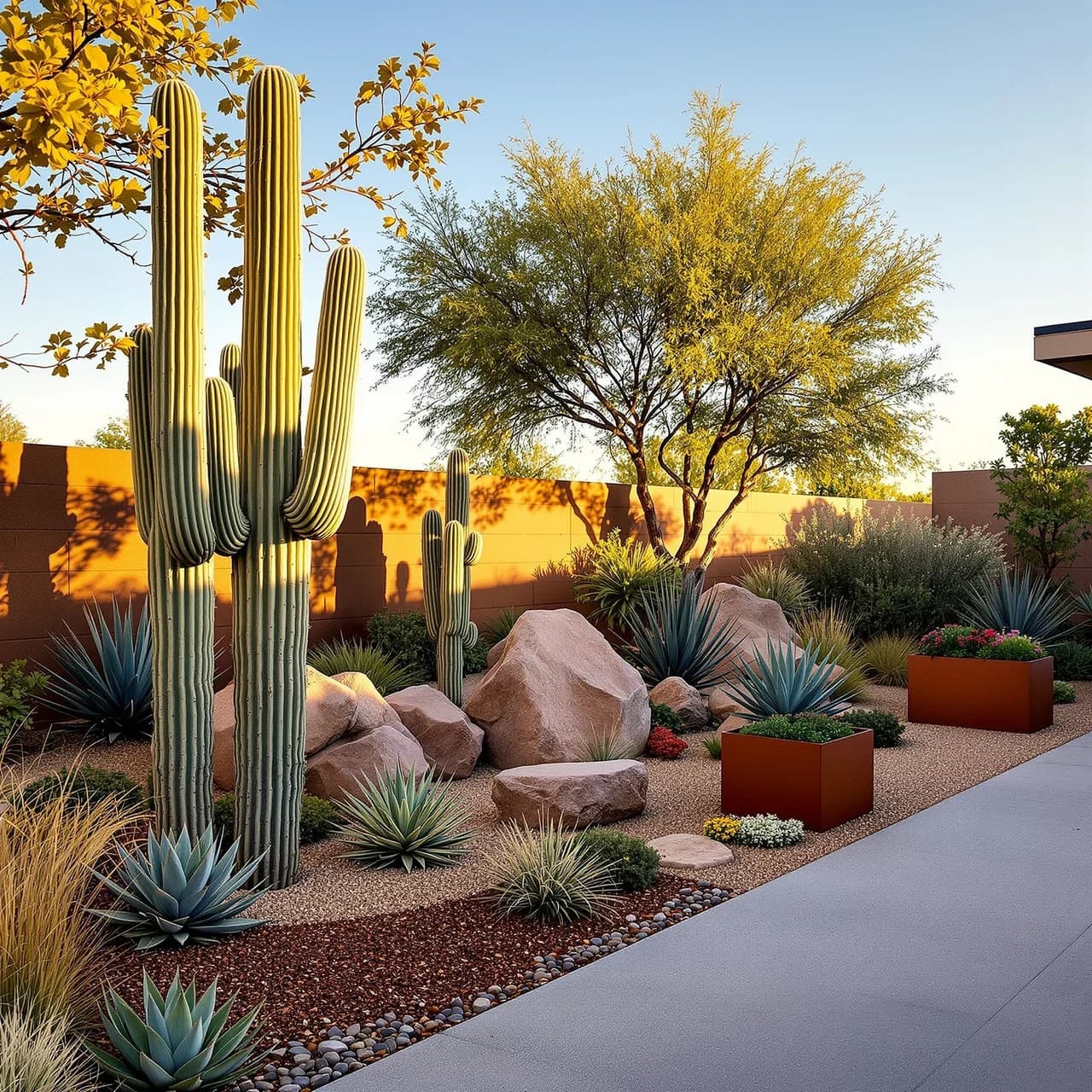
What is Desert / Xeriscape outdoor design?
Desert, or xeriscape, design is a backyard built for a dry climate — striking to look at and almost waterless to run. It treats planting as living sculpture: a saguaro cactus, golden barrel cactus, agave and succulents are arranged for shape and contrast rather than packed in for cover. Decorative gravel in tan and rust tones replaces thirsty lawn; weathered sandstone boulders and corten-steel planters give the space structure and a warm, modern edge. The palette is earthy and sunbaked. The result is a low-water, low-maintenance outdoor space that still looks designed and intentional. In staging, desert xeriscape design suits desert-region properties, and it appeals to buyers who want a backyard that looks good without a sprinkler system or constant upkeep.
Where Desert / Xeriscape comes from
Xeriscape is a coined word — from the Greek for dry — put together in Denver in the early 1980s during a drought, to describe landscaping designed around water conservation rather than around a lawn. The principles were practical and are still the ones used: plan for the site you have, improve the soil, limit turf, choose plants adapted to the climate, water efficiently, mulch, and maintain properly. The desert aesthetic that now goes with it — gravel, boulders, agave, sculptural cacti — is the natural visual outcome of following those rules in an arid region, and it turned out to be strikingly beautiful, which is why it spread far beyond the places that need it. It is worth knowing the word means low-water, not zero-plant: a xeriscape is a planted garden, not a gravel car park.
Key elements of Desert / Xeriscape
- Sculptural saguaro and barrel cacti
- Agave and succulents
- Decorative gravel in tan and rust tones
- Weathered sandstone boulders
- Corten-steel planters
- A warm, earthy, low-water palette
When to use Desert / Xeriscape
Backyards of desert-region properties. Appeals to buyers who want a striking, low-maintenance, low-water outdoor space.
Desert / Xeriscape colours and materials
The desert itself. Sand, buff, terracotta and rust in the ground surface and stone, the blue-greens, grey-greens and silvers of succulent and agave foliage, and the deep green of shrubs. Flower colour is brief and brilliant — the yellows, magentas and oranges of cactus and desert bloom. Built elements are usually warm: adobe or rendered walls, Corten steel, weathered timber, and dark or rust-toned gravel rather than white. The most consequential material decision is the gravel colour, since it covers most of the ground and sets the temperature of the whole scheme.
Desert / Xeriscape area by area
Planting composition in Desert / Xeriscape
Treat the plants as sculpture and space them so each one is legible. A few large architectural specimens — agave, yucca, ocotillo, barrel or saguaro cactus where climate allows — as the structure, then softer masses of desert shrubs and grasses between them, and ground-hugging succulents at the base. Group in odd numbers, vary the heights sharply, and leave real gaps. This is a style where empty ground is part of the composition rather than a job unfinished.
Ground surface and boulders in Desert / Xeriscape
Decomposed granite, gravel or crushed stone across most of the area, in a warm rather than a cold tone. Boulders placed as though they emerged rather than arrived — buried to a third of their depth, grouped in odd numbers, largest first. A dry creek bed of varied stone is both a handsome feature and a genuinely useful way to route the rain that does fall.
Shaded seating in Desert / Xeriscape
Shade is not optional here. A ramada, a pergola with a shade sail or slats, or a mature tree such as palo verde or mesquite. Underneath, simple timber or metal furniture with washable cushions, and a fire pit for the evening, since the temperature drop after dark is the reason desert gardens are used at night. Site the seating to face the best planting composition rather than the fence.
Water — used sparingly in Desert / Xeriscape
A small still basin or a low bowl fountain uses very little water and does a great deal for the sound and for wildlife. Rainwater capture, whether a tank or simply grading the ground so runoff feeds a planted swale, is the more useful gesture and is at the centre of the original xeriscape idea. Large ornamental water features contradict the entire premise.
Lighting in Desert / Xeriscape
Uplight two or three specimen plants and let their shadows do the work — an agave or a cactus lit from below throws one of the most dramatic shadows in any garden. Low warm light along a step or a wall. Avoid lighting everything; the sparseness that looks composed by day becomes emptiness under flat light.
Desert / Xeriscape mistakes to avoid
- Gravel with almost nothing in it. Xeriscape means low water, not no plants. A gravelled yard with three shrubs is a maintenance decision, not a garden, and it also gets hotter than one with planting in it.
- Cold white or grey gravel. It reads as a driveway and reflects glare. Warm buff, gold and rust tones look far better against desert planting.
- Boulders sitting on the surface. Bury them. A rock resting on gravel looks delivered; one set into the ground looks geological.
- Cacti next to paths and seating. Many are genuinely dangerous at close range. Put the spiny species well back and the soft-leaved ones near where people walk.
- Assuming no maintenance. Xeriscape is low water, not low work — gravel needs weeding, succulents need occasional dividing, and established plants still need deep watering in their first years.
Desert / Xeriscape questions, answered
What does xeriscape mean?
Landscaping designed to need little or no supplemental water. The term was coined in Denver in the early 1980s during a drought, and the original principles still hold: plan for the site, improve the soil, limit turf, choose climate-adapted plants, water efficiently, mulch, and maintain properly. It describes an approach rather than a specific desert look.
Does a xeriscape have to look like a desert?
No. The desert palette is what the principles produce in an arid region, but a low-water garden in a temperate climate can be Mediterranean, prairie or gravel-garden in character and still be a xeriscape. What defines it is the water strategy, not the plant list.
What plants suit a desert garden?
Architectural succulents and cacti — agave, yucca, ocotillo, barrel cactus, aloe — plus desert shrubs such as sage, creosote and Texas ranger, ornamental grasses, and small trees like palo verde, mesquite and desert willow. Which of them survive depends heavily on your winter minimum, so check hardiness before buying, especially for cacti.
Is gravel better than mulch?
It depends what you are growing. Gravel suits succulents and desert plants, keeps their crowns dry and lasts indefinitely. Organic mulch feeds the soil and holds moisture better, which suits shrubs and perennials. Many good low-water gardens use both — gravel around the succulents, bark or compost around everything else.
Does desert landscaping help sell a property?
In arid regions, strongly — buyers there understand the water bill and read a xeriscape as an asset rather than as a compromise. It also photographs well because the planting is sculptural. Elsewhere it can look out of place, and a planting style suited to the local climate will serve the listing better.
Guides to read next
Longer reads on getting a outdoor space photographed and restaged well.
- Outdoor Virtual Staging: Patio, Deck and Backyard IdeasOutdoor virtual staging space by space — patio, deck, balcony, porch, pool deck, backyard: what each may gain, what stays as shot, and landscaping previews.
- How to Photograph Rooms for Virtual Staging: 7 RulesDaylight, lamps off, a level phone at chest height, the 1x lens not 0.5x, one room per frame, clear surfaces — seven habits that make AI staging look real.
- See Your Own Room in a New Style Before You Buy AnythingPreview your actual room in a new style before buying furniture or hiring anyone: what a preview settles, what it can't, and five steps to a useful one.
See your outdoor space in Desert / Xeriscape
Upload a photo and our AI restages it in the Desert / Xeriscape look in 15–60 seconds, depending on how much detail your outdoor space has — keeping your walls, windows and layout intact.
Outdoor styles are part of the Pro and Agency plans. New accounts get 3 free renders on the interior styles. How outdoor virtual staging works
Try Desert / Xeriscape on your outdoor space