English Cottage Outdoor Design
Roses, foxgloves, hollyhocks — abundantly blooming country garden.
Stage your outdoor space in English Cottage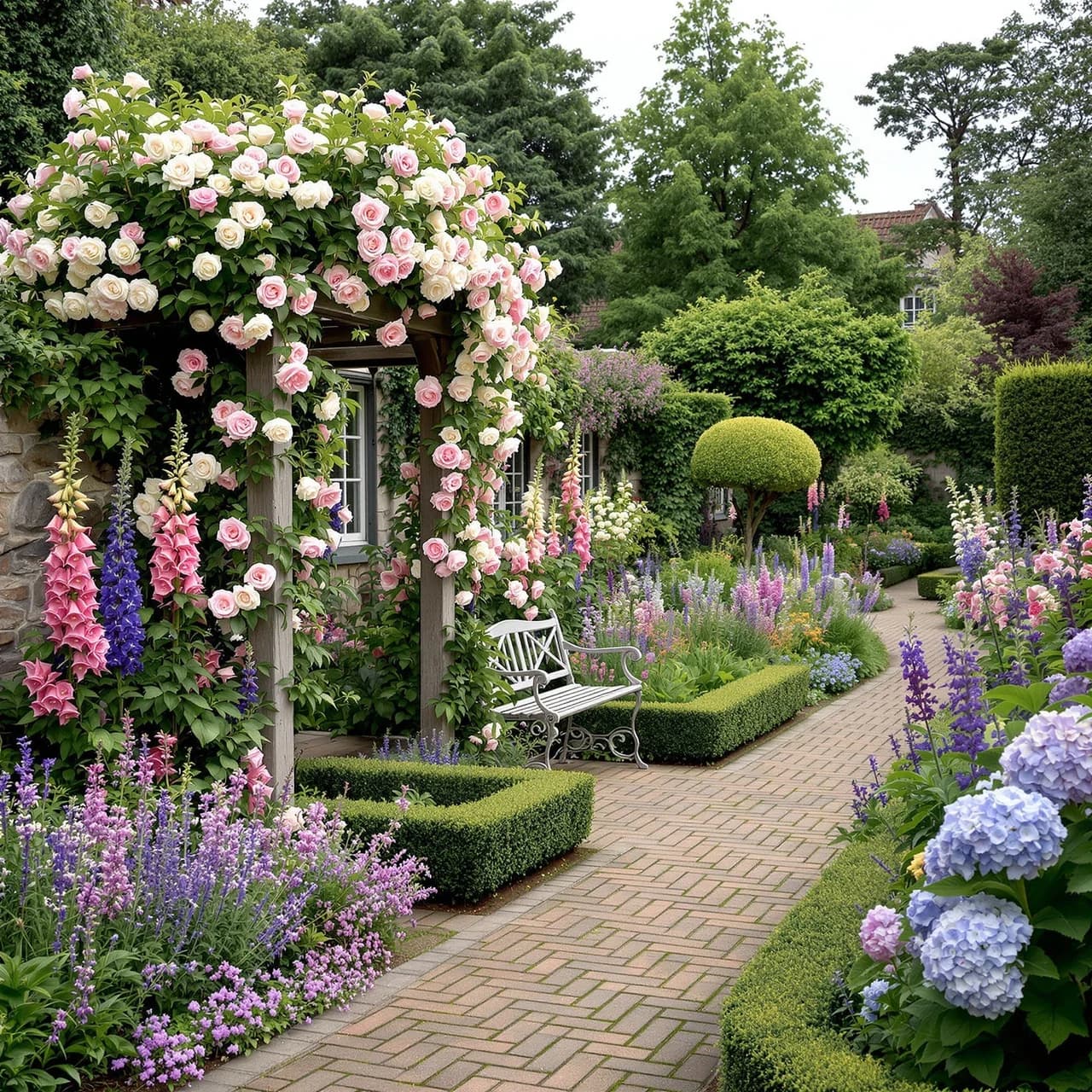
What is English Cottage outdoor design?
An English cottage garden is an outdoor space defined by abundance. Where many garden styles aim for order, this one aims for a romantic, generous fullness — beds that spill over with colour and look gathered rather than planned. Climbing roses cover a weathered wood arbour; towering foxgloves, delphiniums and hollyhocks rise against stone walls; lavender borders and low boxwood hedges give the planting just enough structure to read as designed. A brick herringbone path and an antique garden bench complete it. The result is a lush, layered garden that feels established and full of life. In staging, an English cottage garden is a charming, characterful choice for period and countryside properties, and it gives a buyer the sense of a garden that has been loved for years.
Where English Cottage comes from
The cottage garden began as a working plot. Labourers' cottages had a strip of ground that had to feed the household, so vegetables, fruit, herbs and a few flowers for the house grew together in whatever space there was, with a pig or beehives at the end. There was no design and no lawn — every square foot was needed. The romantic version arrived in the nineteenth century, when writers and garden designers looked at that dense informal planting and decided it was more beautiful than the formal bedding schemes then in fashion. What they kept was the abundance and the apparent disorder; what they quietly dropped was the vegetables. Modern cottage gardens are that idealised version, and the ones that feel most alive are the ones that put a little of the productive planting back.
Key elements of English Cottage
- Climbing roses on a weathered wood arbour
- Towering foxgloves and delphiniums
- Hollyhocks against stone walls
- Lavender borders
- Low boxwood hedges for structure
- A brick herringbone path and antique bench
When to use English Cottage
Gardens of period and countryside properties. Presents an established, romantic, full-of-life outdoor space.
English Cottage colours and materials
Soft, mixed and slightly old-fashioned. Pink, mauve, lavender, soft blue, cream and white dominate, with deeper crimson and purple for weight and a little yellow for lift. Nothing is a single block — the colours are meant to run together. Hard materials stay quiet and traditional: brick, local stone, gravel, weathered timber, painted picket fencing, and terracotta pots. Metal is black or verdigris. The palette rule that keeps it from looking chaotic is to allow yourself many colours but keep them all in the same tonal register, so nothing is fluorescent and nothing is a hard primary.
English Cottage area by area
Borders in English Cottage
Deep, dense and planted so nothing bare shows. Mix heights deliberately — tall spires at the back and through the middle rather than strictly at the rear — and let plants self-seed into gaps and paths. Repeat two or three key plants along the length so the eye has something to follow. The essential trick is density: a cottage border is planted much closer than the labels advise, which is why weeds struggle and why it looks abundant rather than tidy.
Paths in English Cottage
Narrow, informal and made from brick, gravel, stone flags or bark, deliberately allowed to be encroached on. Planting should spill over the edges so the path narrows in places — a crisp mown edge belongs to a different kind of garden. A path should go somewhere: a gate, a bench, a shed, a fruit tree.
Structures and climbers in English Cottage
An arch or arbour with a rose or clematis, a picket or hazel-woven fence, a bench against a warm wall, and a small shed or greenhouse. Climbers are half the effect — roses, honeysuckle, clematis and sweet peas going up walls, over arches and through shrubs. Anything vertical in this garden should have something growing on it.
The productive corner in English Cottage
The part most modern cottage gardens leave out and the part that makes them convincing. A few rows of vegetables among the flowers, a fruit tree, a herb bed by the kitchen door, or a row of runner beans up a wigwam. It does not need to be a separate plot — traditionally it was not — and mixing edible plants through the border is both historically correct and good for pollinators.
Seating in English Cottage
A simple bench or a pair of chairs tucked into the planting rather than set on a terrace. A small table for tea. Cottage gardens are meant to be sat in the middle of, so the seat that gets used most is usually the one surrounded by flowers rather than the one with the best view of them.
English Cottage mistakes to avoid
- Planting too far apart. Density is the entire look. Follow the spacing on the label and you get a bedding scheme with gaps, not a cottage garden.
- Too tidy. Deadheading and cutting back are fine; edging every bed, mowing everything and removing every self-seeder is not. The style depends on a little disorder.
- Modern hard landscaping. Large pale porcelain paving, composite decking and clipped geometric hedging fight the planting. Brick, gravel and stone are correct.
- Only annuals. A garden of bedding plants needs replanting every year and has no structure in winter. Build on perennials, shrubs and roses and use annuals to fill gaps.
- One of everything. The abundance reads as chaos without repetition. Repeat two or three plants through the border and the rest can be as varied as you like.
English Cottage questions, answered
What plants make an English cottage garden?
Roses, foxglove, hollyhock, delphinium, lupin, geranium, catmint, lavender, phlox, peony, aquilegia, sweet pea, cosmos and nigella, with honeysuckle and clematis climbing. The mix should be mostly perennials for structure with annuals filling gaps, and traditionally a few vegetables and herbs among them.
How do I stop a cottage garden looking messy rather than abundant?
Three things separate the two. Repeat two or three plants along the length of the border so the eye reads a rhythm. Keep the hard edges — the path, the fence, the gate — clear and in good order, so the planting looks deliberately loose against something crisp. And keep the colours in one tonal register rather than mixing pastels with hot primaries.
Does a cottage garden need a lot of work?
It needs regular light work rather than occasional heavy work: deadheading, staking tall plants, dividing perennials every few years and editing self-seeders. It also suppresses weeds better than a sparsely planted border, because there is no bare soil for them. It is not a low-maintenance garden, but the maintenance is pleasant and can be done a little at a time.
Can I have a cottage garden in a small space or in pots?
Yes. The style is about density and informality rather than about size, and it originated in very small plots. In containers, use large pots, plant several species together in each, and choose compact varieties of the classics — a wigwam of sweet peas, a rose in a big pot and a group of herbs will read as a cottage garden on a small patio.
Is a cottage garden good for staging a property?
It suits period homes, cottages and rural properties and photographs beautifully in late spring and summer. The caution is seasonal honesty — a cottage garden in February looks like bare soil, so buyers should not be shown a June image as though it were the current state without saying so.
Guides to read next
Longer reads on getting a outdoor space photographed and restaged well.
- Outdoor Virtual Staging: Patio, Deck and Backyard IdeasOutdoor virtual staging space by space — patio, deck, balcony, porch, pool deck, backyard: what each may gain, what stays as shot, and landscaping previews.
- How to Photograph Rooms for Virtual Staging: 7 RulesDaylight, lamps off, a level phone at chest height, the 1x lens not 0.5x, one room per frame, clear surfaces — seven habits that make AI staging look real.
- See Your Own Room in a New Style Before You Buy AnythingPreview your actual room in a new style before buying furniture or hiring anyone: what a preview settles, what it can't, and five steps to a useful one.
See your outdoor space in English Cottage
Upload a photo and our AI restages it in the English Cottage look in 15–60 seconds, depending on how much detail your outdoor space has — keeping your walls, windows and layout intact.
Outdoor styles are part of the Pro and Agency plans. New accounts get 3 free renders on the interior styles. How outdoor virtual staging works
Try English Cottage on your outdoor space