Virtual vs Physical Staging in 2026: Cost, Time, What Agents Say
AI Flip Room · 6 min read
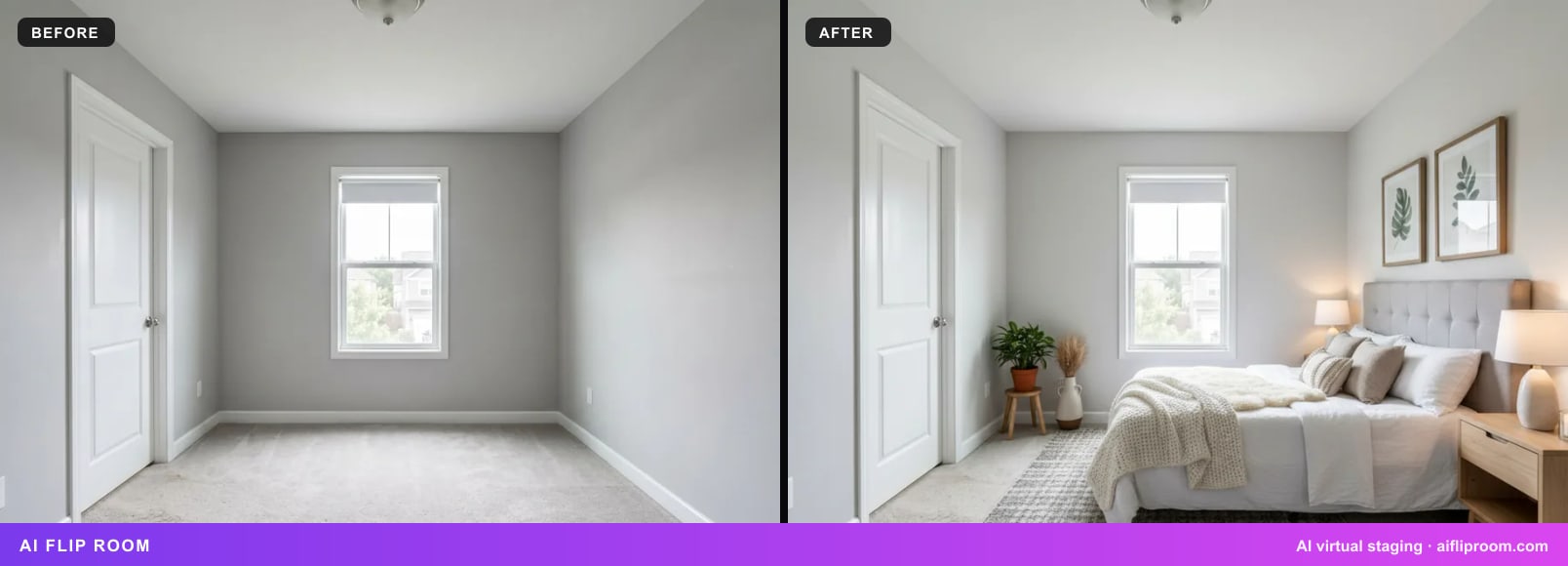
Physical staging puts real furniture in the house for the weeks it is on the market; virtual staging puts furniture only in the photos. Physical costs far more: in the National Association of Realtors' 2025 survey, a staging service had a median cost of $1,500, or $500 when the agent staged the home. Virtual staging is priced per photo — C$14.95 to C$49 in Canada, £14.20 to £60 in the UK and A$22 to A$60 in Australia in the public price lists we read on 25 October 2026 — and AI staging per render, for well under a dollar. Physical staging wins at the showing; virtual staging wins on cost, speed and the number of rooms it can cover. Many listings use both.
We make an AI staging tool, so read the parts about AI knowing that. Every other number here comes from a survey or a public price list and says which. The survey figures are the ones collected, with links and the source's own words, on our home staging statistics page.
What is the difference between virtual and physical staging?
| Physical staging | Virtual staging | |
|---|---|---|
| What changes | Real furniture and decor in the home | Furniture added to the listing photos only |
| Where buyers see it | Photos, video, showings and open houses | Photos; the rooms are empty at the showing |
| Cost | Median $1,500 with a staging service, $500 staged by the agent (NAR, 2025) | Per photo from a service, per render with AI |
| Time to ready | A consultation, a delivery and a set-up | A 48-hour turnaround in one UK price list we read; 15–60 seconds per render with our AI |
| How long it lasts | A hire term: 30 days, four weeks or eight weeks in the price lists we read, then extra | As long as the photos are used |
| Disclosure | Nothing to label: the furniture is really there, though it does not come with the house | A label in most markets, and the untouched original kept |
How much does each one cost?
NAR's 2025 Profile of Home Staging is the most-cited source for physical staging: the median cost was $1,500 with a staging service and $500 when the seller's agent did it. Members of the Real Estate Staging Association report a higher average, $4,934 across 233 US properties in the first half of 2026; that is stagers reporting their own projects, and an average rather than a median, so it is not comparable with NAR's figure.
Outside the US we found no national survey. Staging companies' own price lists give a feel for it: vacant-home packages from C$2,350 plus GST in British Columbia with up to a month of furniture rental, from £2,100 in the UK with an eight-week furniture hire, and A$2,500 to A$5,400 including GST in Melbourne. One Ottawa company charges C$375 a week once its 30-day term runs out, which is the cost that grows while a home sits.
Virtual staging is priced per photo. In the price lists we read, an eight-photo gallery came to C$119.60 to C$392 in Canada, £113.60 to £480 in the UK and A$176 to A$480 in Australia; virtual staging cost in Canada, the UK and Australia has the lists, the sales tax and the method. AI staging is priced per render: at AI Flip Room the first three are free, then $0.45 a render with the one-time Room Pack ($9 for 20 renders) or about $0.18 on Pro ($46 a month for 250 renders). Our virtual staging cost guide has the full arithmetic, and the staging cost calculator weighs it against what each month on the market costs you.
How long does each one take?
Physical staging needs a consultation, a delivery date and a pick-up, and the furniture is hired for a term: 30 days in one Ottawa price list, eight weeks in one UK list, a four-week campaign in one Australian guide. If the home is still for sale when the term ends, the hire runs on. None of the lists we read gives a typical lead time to book a stager, so we do not quote one.
Virtual staging needs only the photos. A service where a person edits them returns them in hours to days; one UK list we read promises 48 hours. An AI render takes 15–60 seconds, depending on how much detail the room has, and a second style for the same room is another render rather than another delivery.
What do buyers' agents say about staging?
Most of what is known comes from agents' opinions, not from sale prices. In NAR's 2025 survey, 83% of buyers' agents said staging made it easier for a buyer to picture the home as their future home. On price they split: 17% of buyers' agents said staging raised the dollar value offered by 1% to 5% compared with similar unstaged homes, and 41% said it had no impact on the dollar value. Among listing agents, 49% said staging reduced the time a home spent on the market.
On virtual staging the signal is weaker: 38% of buyers' agents said virtual staging was less important to their clients. Yet the first viewing happens on a screen: agents said buyers who had an expectation planned to view a median of 20 homes virtually and eight in person. That is viewing online, not virtual staging, but it is where a staged photo does its work. We found no independent study of whether virtually staged listings sell faster or for more; the statistics page explains where the popular "sells faster" numbers really come from.
When does physical staging win?
- When the showing decides the sale. Buyers walk through furnished rooms. 58% of agents in NAR's survey said buyers were disappointed by how homes looked compared with homes on TV shows, and pictures set expectations the same way.
- In high-end homes, where the price carries a four-figure staging bill and buyers expect to see the life the house offers in person.
- In rooms with awkward scale, where real furniture proves that a sofa and a dining table fit.
- For open houses and video tours, where the furniture has to be there.
When does virtual staging win?
- On cost and speed. An eight-photo gallery costs a fraction of a staging package in every price list we read, and it is ready before the listing goes live.
- On coverage. Every room can be staged, including the basement, the den or the narrow bonus room nobody can read when it is empty.
- On choice. The same room can be shown in more than one style for different buyers, from one photo.
- For homes that are hard to furnish, such as a vacant condo with strict move-in bookings or a property far from any stager.
The price of that is a rule you cannot skip: label the photos, keep the originals and change nothing that belongs to the house. Our virtual staging rules hub quotes what each market requires, and how to choose a free virtual staging tool has a 30-second check for a render that moved a window.
Can you combine virtual and physical staging?
Yes, and it is often the sensible middle. Stage the room buyers care about most for real and the rest in the photos: in NAR's 2025 survey, buyers' agents rated the living room the most important room to stage (37%), ahead of the primary bedroom (34%) and the kitchen (23%). Keep one style across both, so the gallery reads as one home, label the virtual photos, and tell buyers before the showing which rooms they saw furnished only in the pictures.
Questions people ask about virtual and physical staging
Is virtual staging cheaper than physical staging?+
Yes, by a wide margin. NAR's 2025 survey put the median cost of a staging service at $1,500, plus a furniture hire term that runs on if the home does not sell. The public per-photo price lists we read ranged from C$14.95 to C$49 in Canada, £14.20 to £60 in the UK and A$22 to A$60 in Australia, and AI staging costs less again: AI Flip Room is $0.45 a render with its one-time Room Pack.
Does virtual staging work as well as physical staging?+
No study we know of compares sale results directly. Agents' opinions favour staging in general — 83% of buyers' agents in NAR's 2025 survey said it helps buyers picture the home as theirs — but 38% of buyers' agents said virtual staging was less important to their clients. Virtual staging works where the first viewing happens, online; physical staging also works at the showing.
Do buyers feel misled by virtually staged photos?+
They can, if the photo changed the property or was not labelled. Label every virtually staged photo, keep the original, change only furniture and decor, and tell buyers before the showing that the rooms are empty. A furnished photo of an empty room is fine; a photo with a window that is not there is not.
Can you use virtual and physical staging in the same listing?+
Yes. A common split is real furniture in the living room, the room buyers' agents rated most important to stage in NAR's 2025 survey, and virtual staging for the bedrooms and secondary rooms. Use one style across both and label the virtual photos.
Written by the AI Flip Room team. How we write and check our guides.
See it on your own room
Upload a photo and watch AI restage your space in 15–60 seconds, depending on how much detail it has — free to try, no credit card.
Try AI Flip Room freeGot a question about this?
Something unclear or not covered? Ask here. We read every question and answer the useful ones right in the article. Nothing you write is published.
Related reading
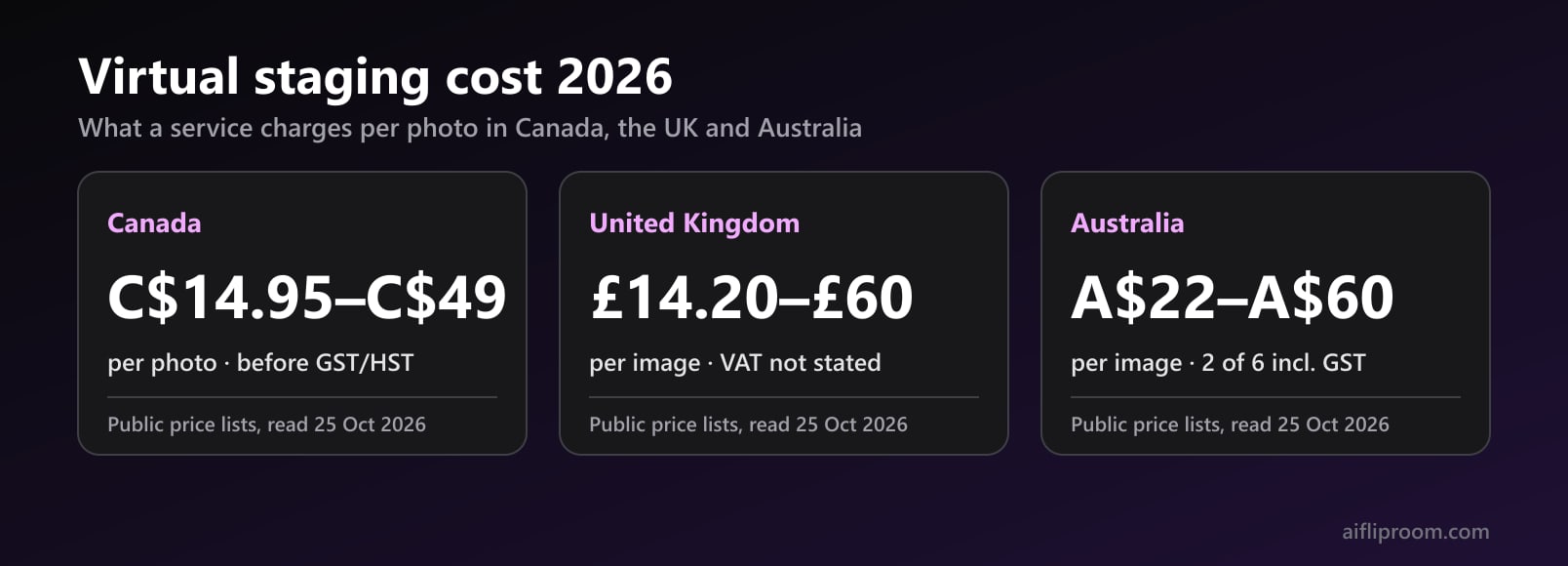
Virtual Staging Cost in Canada, the UK and Australia (2026)
Virtual staging prices in CAD, GBP and AUD from public price lists read on 25 Oct 2026, with sales tax, physical staging packages and one listing worked out.

How to Choose a Free Virtual Staging Tool: 9 Checks
Nine checks to run on any free virtual staging tool before a listing photo goes in: watermark, file size, license, card, credits, geometry, privacy, original, labels.
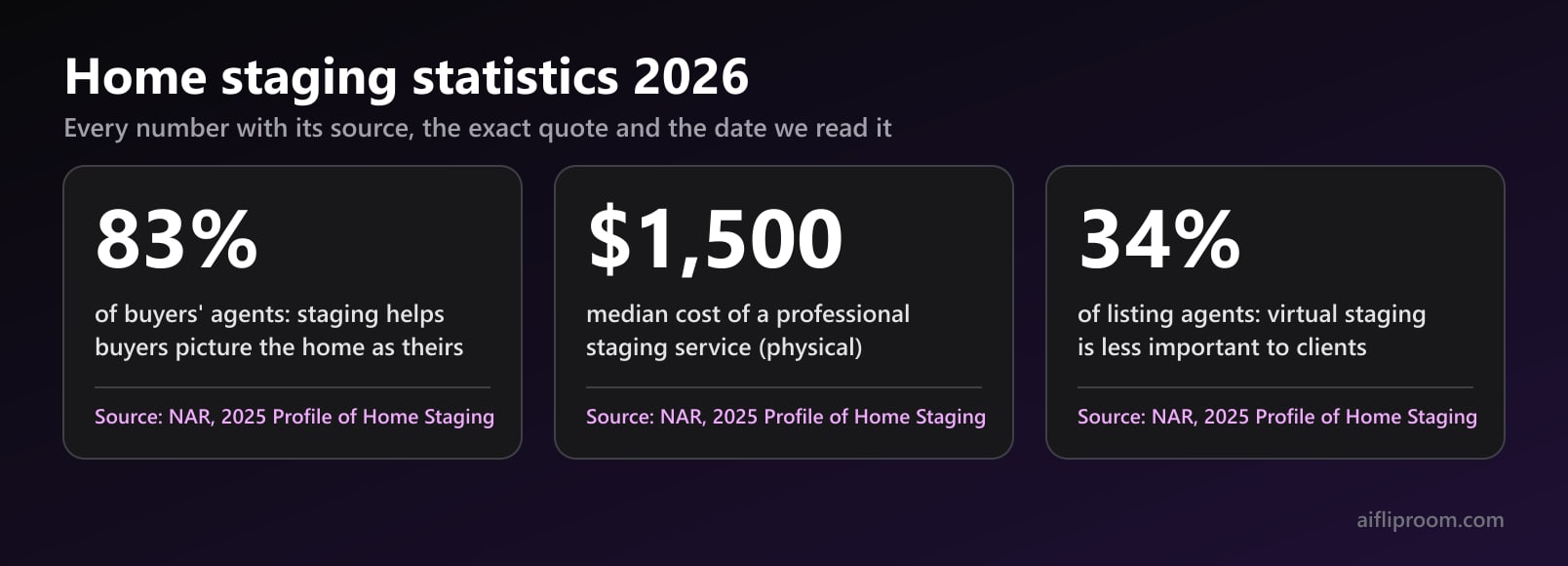
Home Staging and Virtual Staging Statistics 2026, With Sources
26 home staging and virtual staging numbers, each with what it measures, the source's own words, a link, the date we read it and a ready citation.